

Gavriil Korganov, whose name is sometimes Anglicised as Gabriel Korganov, was born on 3 May 1880 in Tiflis in the Russian Empire, what is now Tbilisi, the capital of the Republic of Georgia. Korganov was from a military family and joined the Tiflis Cadet Corps in 1897. Two years later, Korganov enrolled in the Mikhailovskaya Military Artillery Academy in Saint Petersburg and went on to the General Staff Academy. Korganov would become a General in the Imperial Russian Army. Korganov’s only other known association is the Freemasons, which he joined at some point before the First World War.
Even before war broke out, Korganov was down in the Caucasus organising the Armenian volunteers—both Russian-Armenians and Ottoman-Armenians, some of them deserters from the Ottoman Army—who were conducting a rebellion against the Ottoman government. Once the Ottomans were officially at war in November 1914 and Russia invaded the east of Empire, the emboldened Armenian guerrillas expanded their activities yet further and in time became organised into conventional military units that fought as auxiliaries of the Russian Army.
The Bolshevik coup in Russia in November 1917, and the Communists signing the Treaty of Brest-Litovsk with the Germans who brought them to power in March 1918, took Russia out of the Great War and opened space for the formerly-Russian-backed Armenians to proclaim their own Republic in May 1918. Korganov served this Armenian State, but it did not last long. In a joint invasion at the end of 1920, the new Turkish Republic took parts of western Armenia and the Soviet Union conquered the remnant, turning it into a “Socialist Republic”, which gained independence when the Soviet Enpire collapsed in 1991 and is the territory of Armenia as it exists today.
Korganov wrote a memoir of his involvement in these events in 1927, while in exile in France, entitled, La participation des Arméniens à la guerre mondiale sur le front du Caucase (1914-1918) avec 19 schémas. The book was originally published in French and Emanuil Egiaevich Dolbakyan created a Russian translation. A rough English translation is given below. Korganov died in Paris on 8 January 1954 and is buried in the Père Lachaise Cemetery.
The Participation of the Armenians in the World War on the Caucasus Front (1914–1918), with 19 Schematics
[PAGE 5]
PREFACE
The World War once again confirmed the truth that, no matter how humanity evolves and no matter how widely humanistic ideas spread throughout the world, the right of peoples to independent existence can be upheld only through armed struggle.
The Armenian people, having lost their independence several centuries ago but jealously preserving their national identity and culture, could not but take part in the great universal conflagration, especially on the Russo-Turkish theatre of war, which included, among other things, the territory of historical Armenia, precisely on the side of the Entente Powers, toward which they were driven by the course of their own history, their national interests, and their political aspirations.
From the very first days of the war, the Armenians enthusiastically responded to the call to join the ranks of the Entente armies and fulfilled their duty to the end.
Numerous volunteers poured in from all sides to stand beneath the banners of the Entente armies or, where circumstances permitted, to form independent military units.
A revolution broke out in Russia, which led to the collapse of the Russian army and its withdrawal from the Transcaucasian front. And it was precisely upon the shoulders of the Armenians that the heavy task of defending Transcaucasia fell, and Armenia, having
[PAGE 6]
created its national forces, entered the struggle on the side of the Allies as a belligerent State.
Deprived of all assistance, even of communication with their allies, the Armenians courageously and steadfastly endured an unequal struggle, often in situations that seemed hopeless, for seven months and yielded only two months before the conclusion of the general armistice that ended the World War (the Turks entered Baku on 15 September 1918).
This prolonged, stubborn struggle without external assistance, by compelling the Turks, for their part, to divert a portion of their forces there, delayed the loss of Transcaucasia by seven months, which was of great significance for the Asiatic theatre of war.
The war, although it inflicted unprecedented human losses upon the Armenians, led to the creation of the Armenian State, however small the latter may have been, and however uncertain its political organisation.
The vital forces of the Armenian people heroically withstood the historical trial, and the first stage on the path to the rebirth of Armenia was achieved.
In order better to understand the conditions in which the Armenian forces found themselves in the course of the events described in the present book, it is necessary to cast a glance not only at the military operations but also at the political situation as it existed in that epoch.
Not all parts of the present account could be described with equal completeness and documentary precision owing to the absence in many cases of archival materials, partly lost and partly inaccessible due to their being located in the territory of the new States that emerged in Transcaucasia.
For this reason, the present work does not claim to be a gapless account of the events it describes,
[PAGE 7]
but it contains not a single fact that has not been confirmed either by official documents or by eyewitness testimony.
I have written nothing about the actions of Andranik in Karabakh because he himself related them in his memoirs.
Considering my sole aim to be to give a faithful general picture of the importance of Armenia’s participation as a State fighting on the side of the Entente Powers, I have refrained from describing the heroic actions of individual persons, believing that in historical moments which a people experiences, it is only the manifestation of the will, unity, and sacrifices of the whole people that should be studied, and not the exploits of individual representatives.
Moreover, by describing the brilliant exploits of certain specific individuals and passing over in silence the no less glorious deeds of others, of whom I may not have known, I might have been accused of partiality.
However, I consider it my duty to recount how many Russian officers, Russian by nationality, with remarkable selflessness assisted us in our unequal struggle. I cannot fail to mention the names of General Vyshinsky, who held the post of Chief of Staff of the Armenian Corps and before that the post of Chief of Staff of the Caucasian Army; General Deev, commandant of the fortress of Kars; Colonel Morel, former military attaché of the Russian embassy in Tokyo, who, when the Russian troops were withdrawing from the Caucasus, was in Erzindjan at the moment of the fatal crisis; Colonel Zinkevich, former Chief of Staff to Generals Andranik and Silikov; and finally Colonel Efremov with his officers’ detachment, in which officers worthy of respect served as ordinary soldiers. Unfortunately, I am unable in a brief preface
[PAGE 8]
to list all the names deserving the highest gratitude from the Armenians.
I have entitled my book “The Participation of the Armenians in the World War,” but my narrative does not claim to be a historical work fully exhausting this subject, and I would be happy if the materials that served me as the basis for the present work might in some measure prove useful to future historians in studying the historical epoch in which the Armenian people passed through such terrible trials and displayed so much courage and self-sacrifice.
[PAGE 9]
CHAPTER I: FORMATION OF ARMENIAN LEGIONS
The Russian Armenians, subject to compulsory military service since 1886, participated en masse in the Great War, in the ranks of the Russian army.
Throughout the entire duration of the war they provided nearly 13% of their total population.
Fulfilling their duty as loyal subjects, the Armenians, taken as a whole, defined their attitude towards the events that were unfolding and towards the world war that was beginning.
Turkey’s participation in the war, alongside the Central Empires, no longer left any doubt as to the choice of that attitude.
The historical experience of 1877–1914 had clearly demonstrated that all the reforms concerning the Armenian vilayets in Turkey and aimed at safeguarding the physical existence and the culture of the nation had remained dead letters, resulting only in periodic massacres of the Armenian population.
The victory of the Central Empires and consequently of Turkey would have meant the annihilation of the remnants of the Armenian population in Turkey and would even have threatened the existence of the Armenians of Transcaucasia.
This situation imposed upon the Armenians a supreme effort of all their forces. Thus, not content with participating in the war in the ranks of the Russian army,
[PAGE 10]
they requested authorisation to form volunteer legions on the Caucasus front.
According to the plan conceived, these legions were to be composed of elements exempt, for various reasons, from military service; of persons who had not yet reached or had already passed the prescribed age; and of Armenians who had arrived from abroad.
This proposal was received by the High Command of the Caucasian front in a more or less ambiguous manner.
If, on the one hand, there was an advantage in using during the war elements animated by a fierce hatred toward the enemy, thoroughly familiar with the theatre of war, speaking the native languages and dialects, and having ties among the local populations, on the other hand there was the danger of forming national units, in view of the possibility of a development of separatist sentiments.
After numerous negotiations, in the middle of the month of September, the “Armenian National Bureau” in Tiflis received authorisation to form in the Caucasus four Armenian volunteer legions. Their formation was completed toward the end of October 1914, that is to say at the very moment of Turkey’s declaration of war. The strength of these legions reached 2,500 men, with 600 men in reserve.
Their command was entrusted to Armenian national heroes: Andranik, Dro, Amazasp and Keri, all four seasoned partisans in the struggle against the Turks.
The legions were not assembled into higher units, but were attached to various corps and groups of the vast Caucasus front, as they were considered useful especially for reconnaissance service; this explains their almost equal distribution across the entire front.
[PAGE 11]
CHAPTER II: THE FIRST PERIOD OF THE WAR, OCTOBER 1914–JANUARY 1915
Before proceeding to the history of the Legions, it is necessary to indicate, as a whole, the general situation on the Caucasus front.
The order of battle of the Caucasus Army at the beginning of the war against Turkey was as follows:
1st Region of Batum. — 4 battalions under General Liakhov, covering the right flank and maintaining order in the district of Tchorok.
2nd Region of Olti. — General Istomine: 8 battalions, 24 guns, 12 sotnias of Cossacks. Operational direction: Olti–Ide–Erzeroum.
3rd Region of Sarikamiche. — General Berkhman: 24 battalions, 92 guns, 24 sotnias of Cossacks. Operational direction: Sarikamiche–valley of Passène–Erzeroum.
4th Region of Kaglisman. — General Prjevalsky: 6 battalions, 6 sotnias of Cossacks maintaining liaison between the Sarikamiche group and the Erivan detachment.
5th Region of Erivan. — General Abatsieff: 14 battalions, 32 guns; 24 sotnias of Cossacks intended to penetrate into the valley of Alachkert and to cover the line of communications Erivan–Dilijan–Tiflis.
6th Region of Makou. — General Nikolaïeff: 1 battalion, 12 sotnias, 4 guns. Operational direction: Makou–Bayazid–Van.
[PAGE 12]
[PAGE 13]
7th Region of Azerbaijan. — General Tchernozouboff: 7 battalions, 24 guns and 24 sotnias of Cossacks, to maintain order in Persian Azerbaijan and cover the left flank of the army.
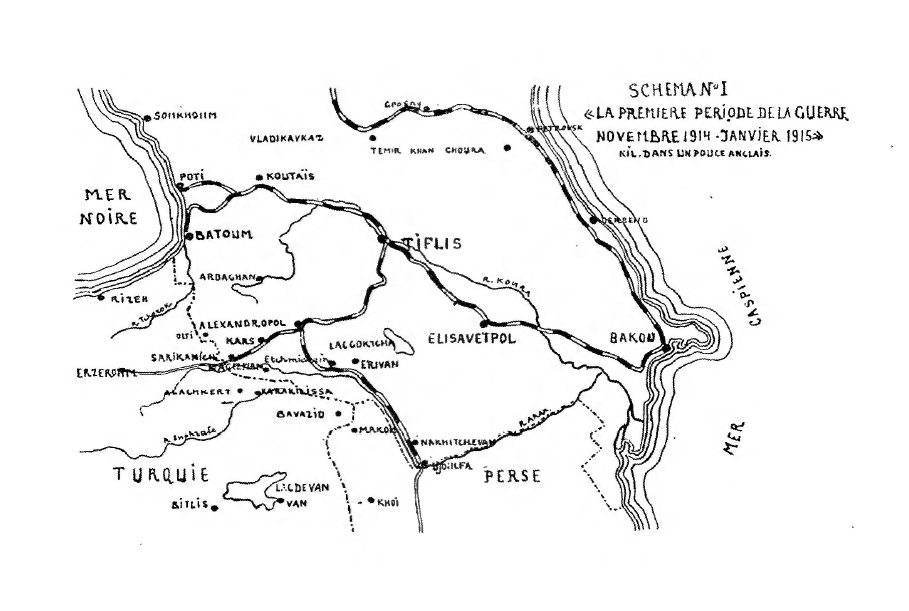
On the very day of the declaration of war, the troops of the Sarikamiche, Kaglisman, and Erivan groups crossed the frontier and drove back the Turkish advance guards, which were completing their concentration based on Erzeroum.
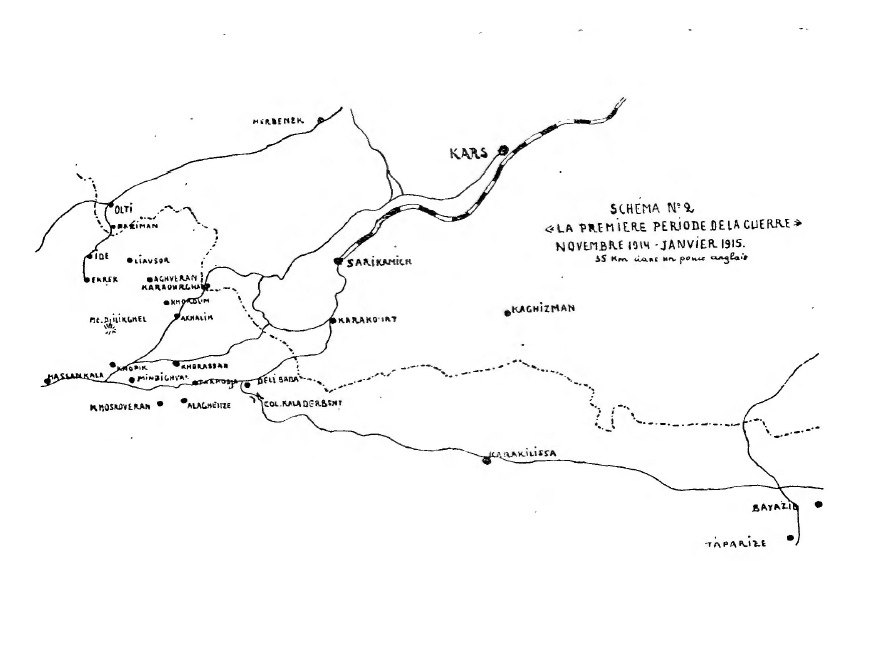
On 8 November the Russian troops, after sharp fighting in their favour, occupied the entire valley of Passène and part of the valley of Alachkert. The line of the front ran from Ide, by Mount Djilik-Gheul, Khopik, Minidighvan, Déli-Baba, to Karakilissa of Alachkert.
The Turks, having completed their concentration on 10 November, launched a counter-attack in the operational direction Erzeroum–Sarikamiche. After several days of fighting, which lasted until 19 November, the Sarikamiche group of General Berkhman entrenched itself on the line Khoroum–Akhalik–Khorassan–Tarkhodja.
During the first engagements in this direction, the legions did not take part in the operations, but from 19 November the 4th Legion was incorporated into the 2nd Turkestan Corps, which had arrived at Sarikamiche and Karaourghan to reinforce the right flank of the Sarikamiche group.
From Karaourghan the legion was directed toward Aghvéran and then toward Ide, towards which the column of General Istomine, coming from Olti, was advancing at the same time.
On 29 November the legion seized, after sharp fighting, the village of Liavsor and continued its advance toward Ekrek, situated 10 kilometres south of Ide, while maintaining liaison between the right flank of the 2nd Turkestan Corps and the group of General Istomine, which, meanwhile, had occupied Ide.
[PAGE 14]
From the beginning of the month of December the enemy had displayed feverish activity, and on the 22nd of the same month he attacked the Sarikamiche group and the Olti detachment.
While conducting a frontal attack against the Sarikamiche group and thus holding it in its positions, the enemy simultaneously launched his offensive against the Olti detachment, with the evident intention of reaching the Kars–Sarikamiche line and by this manoeuvre cutting off the main body of the Caucasus Army from its base.
On 22 December the 4th Legion, pressed by the Turks, received the order to withdraw toward Ide, but as this town had already been evacuated by the Russian troops, it had to force its way with the bayonet through enemy detachments, which had already occupied part of this mountainous region.
Having reached Nariman, the legion was obliged to divide into two columns and suffered serious losses before being able to reach Sarikamiche and Merdének.
After the reinforcement of the Sarikamiche group by the 2nd Turkestan Corps, the Kaglisman detachment of General Prjevalsky received the order to advance toward Déli-Baba, the troops of General Abatsieff having already occupied Karakilissa of Alachkert.
After the occupation of Déli-Baba, the 3rd Legion, which formed part of General Prjevalsky’s troops, formed with other units a special detachment, whose task was to guard the Kara-Derbent pass in order to ensure liaison with the valley of Alachkert.
On 19 November the legion had its first encounter with the enemy near the village of Aaghueze; it then successively drove back the Kurdish hordes and, after sharp fighting, occupied the villages of Pirsahan, Kapanak and Khosrovéran, thus making itself master of the massif that covered the southern pass.
[PAGE 15]
[PAGE 16]
On 24 November the legion, being judged too far advanced, was recalled to Alagheuze, where it remained until 31 December to guard the extreme left wing of the Sarikamiche group, taking part in local encounters with the enemy and in reconnaissance missions.
To characterise the conduct of the legions before the enemy during this period, it is interesting to cite, as an example, the official certificate issued by the commander of the 2nd Brigade of Plastouns, General Gouligà, to the 3rd Legion which was under his orders:
This certificate is issued to the Commander of the 3rd Armenian Legion, Amazasp Servantian. Under his command, this legion took part, from 5 to 28 December 1914, in all the engagements fought by the troops entrusted to me, and it particularly distinguished itself during the reconnaissance missions carried out on 15 December at Sangmane, Mirkhasané and Kapanak. On the night of 19 December the Armenian troops offered stubborn resistance to the Turkish attack on the village of Alagheuze, inflicting 30 killed and 40 wounded. On 23 December, during our march on Kapanak, Amazasp’s legion rendered very particular services. I certify that in general the soldiers of the Armenian legion fought with bravery in all the combats, even the wounded who were still able to fight taking part in the attacks.
In witness whereof we affix the official seal and sign:
19 February 1915.
(Signed) GOULIGA,
Brigadier General, commander of the 2nd Brigade of the Kuban.
BOUKRITOFF,
Colonel, Chief of Staff.CHILNIKOFF,
Lieutenant, Aide-de-Camp.
Thus, in the principal direction of Erzeroum (Sarikamiche group), the 3rd and 4th legions took part in all the operations of this group on both
[PAGE 17]
flanks and took part in the Battle of Sarikamiche from 22 December 1914 to 16 January 1915, which ended with the rout of the Turkish army and the capture of the Turkish 9th Corps.
The 2nd Legion, advance guard of the Bayazid detachment (General Nikolaïeff), marching on Van, fought a hard two-day battle (12–13 November) on the Tapariz Pass, losing its commander Dro, who was seriously wounded.
Subsequently attached to the detachment of General Abatsieff, operating in the valley of Alachkert, it took part in seven battles fought during the period of 1914 and served as cover for the exodus of the Armenian population toward the Russian frontier.
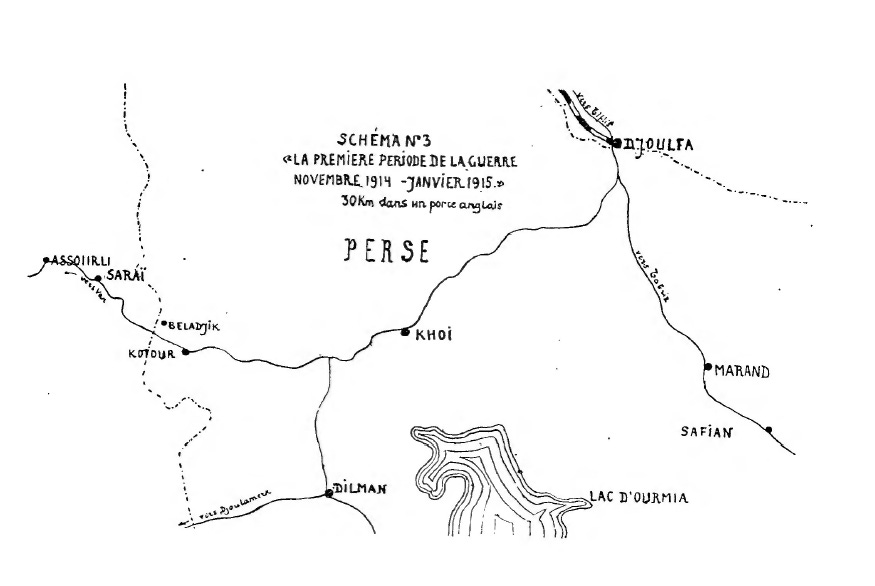
Finally, the 1st Legion, assigned to the Azerbaijan group of General Tchernozouboff, took part in the occupation of the region of Kotour (18–30 November). On 1 and 9 December it participated in the capture of Saraï and Assourli, having thereafter to sustain until 15 December fighting against the Kurds who were defending the direction of Van.
On 15 December the legion was recalled in order to be opposed to considerable enemy forces, which had succeeded in penetrating behind its positions in the region of Kotour.
The legion then took part, on 18 December, in the battle fought near the village of Béladjik by the 4th Caucasus Cossack Division against the Kurds and the Turkish gendarmerie, who were threatening the line of communication of that Division with Khoï.
As a consequence of the course of the Sarikamiche operations and the appearance of considerable Turkish forces in the direction of Tabriz, the legion, together with other units, received the order to withdraw via Khoï toward Djoulfa, where it arrived on 15 January, covering the exodus of the Armenian population of the Dilman region.
[PAGE 18]
[PAGE 19]
On 24 January the legion advanced toward Safian to reinforce the troops retreating from Tabriz, pressed by a Turkish division. It arrived there on 28 January, at the very moment when the battle of Safian was ending in a complete defeat of the Turks, who withdrew in haste toward the southern shore of Lake Ourmia.
The calm that had been established on the Caucasus front toward the end of December 1914 and the beginning of 1915 made it possible to withdraw the legions from the front and grant them a well-deserved rest in the Government of Erivan and the District of Kars, where they could moreover complete their training.
The 1st Legion was stationed at Marand, in Persian Azerbaijan.
What was the work of the legionaries in this first period of the war?
Here is the assessment of the Commander of the 1st Caucasus Corps:
To the Commander of the 3rd Armenian Legion, Amazasp Servantian.
By order of the Army Commander, the 3rd Armenian Legion ceases to form part of the forces entrusted to me and receives a new destination. From the beginning of hostilities with Turkey, the 3rd Legion was incorporated into the Sarikamiche detachment, then placed in the detachment of Colonel Koulébalkine. The legion particularly distinguished itself in the combats of 22 November, 23 December and 5 January. On 19 December it sustained, at Alagheuze, the first shock of the Turks, the prelude to the operations of Sarikamiche, which were to end in a brilliant victory; during the fierce combat at Alagheuze the Armenians lost 30 men killed and 40 wounded, but they offered stubborn resistance to the enemy until the arrival of reinforcements, in whose company they inflicted a cruel defeat upon the enemy. I regret that I must part from the valiant commander of the legion and his brave soldiers. However, it gives me pleasure, in the name of the army, to thank them for their devotion, the
[PAGE 20]
excellent and useful services rendered in the troops of Sarikamiche. I wish them, in the new task assigned to them, happiness, brilliant successes and new feats of arms.
During three months the 3rd Armenian Legion fulfilled with honour the heavy and responsible task of covering the left flank of the Sarikamiche detachment, of carrying out reconnaissance service in the gorges and the harsh mountains of Palantéken, fighting bravely, side by side with the brigades of Generals Gouligà and Prjevalsky, and finally in the troops of General Baratof.
With God, sustained by confidence in ourselves and in our sacred cause, forward to victory!
KALTINE, Brigadier General,
Commander of the 1st Caucasus Army Corps.
Telegram
To His Holiness the Catholicos of All the Armenians
Djoulfa, 22 November
In the combat of 22 November the legion of Armenian volunteers of Andranik showed much bravery and self-sacrifice. I am happy to inform His Holiness, whose benevolence and prayers I invoke for our future successes.
TCHERNOZOUBOFF
If this first period of the war on the Caucasus front revealed certain shortcomings concerning the organisation of the legions, it nevertheless made it possible at the same time to appreciate their fighting qualities, their capacity for resistance, and their will to win despite all the losses suffered.
During this period the Armenian legions lost 156 legionaries killed and 743 wounded, out of a strength of 2,482 men, or 36 per cent, without their morale being shaken, proof of the excellent warrior spirit that animated them.
The High Command of the Front appreciated at its true value the fine conduct of the Armenian legions and
[PAGE 21]
authorised the formation of two new legions: the 5th, under Vartan, and the 6th, under Avcharian.
Each legion numbering 1,000 men, the total strength of the Armenian legions represented a force of 6,000 combatants. Completed and reinforced during their short rest, they were again sent to the army front, four of them (the 2nd, 3rd, 4th and 5th) entering the Van detachment.
Such a grouping of four legions in the same detachment is explained first of all by the task imposed upon it. It was at Van that the Armenian population had risen against the Turks and was defending itself heroically; but, surrounded on all sides by enemies better organised and armed, it urgently requested to be rescued. Furthermore, by the composition of these legions, which were drawn from this region, they knew perfectly the terrain on which military operations were to unfold. The 1st Legion remained, as before, attached to the Azerbaijan detachment of General Tchernozouboff, while the 6th, newly formed, was incorporated into the detachment of General Baratof (Sarikamiche group).
At the end of the winter of 1915, the Turks deployed ever-increasing activity on the front of the Persian Azerbaijan detachment.
The 1st Legion was at that moment resting at Marand. Having received on 2 March the urgent order to march on Khoï, it formed part of General Nazarbekoff’s group1 at the battle fought on 4 March near the mountain of Douz-Dagh. It remained until 28 April in the region of Khoï and took part in no further combat, calm having been established along the whole front.
Toward the middle of April, the offensive launched on the side of Ourmia by a division of Khalil Bey in the
[PAGE 22]
direction of Dilman threatened the left wing of the Caucasus front, which, if successful, would have opened to the Turks direct access to the road to Djoulfa and would ultimately have led to the loss of the Tiflis–Baku railway and of all the lines of communication of the Caucasus front.
On 28 April the legion, urgently summoned to Dilman, arrived on the 30th and took part in the battle of 1 May, holding the key positions together with a battalion of the 8th Rifle Regiment.
In this battle the legion lost 3 officers and 16 legionaries killed and wounded.
Having encountered energetic and unexpected resistance, driven back in disorder and having suffered heavy losses, Khalil Bey withdrew in haste in the direction of Djoulamerk to save the remnants of his division, vigorously pursued by the troops of General Nazarbekoff, with the 1st Armenian Legion at their head as advance guard.
[PAGE 23]
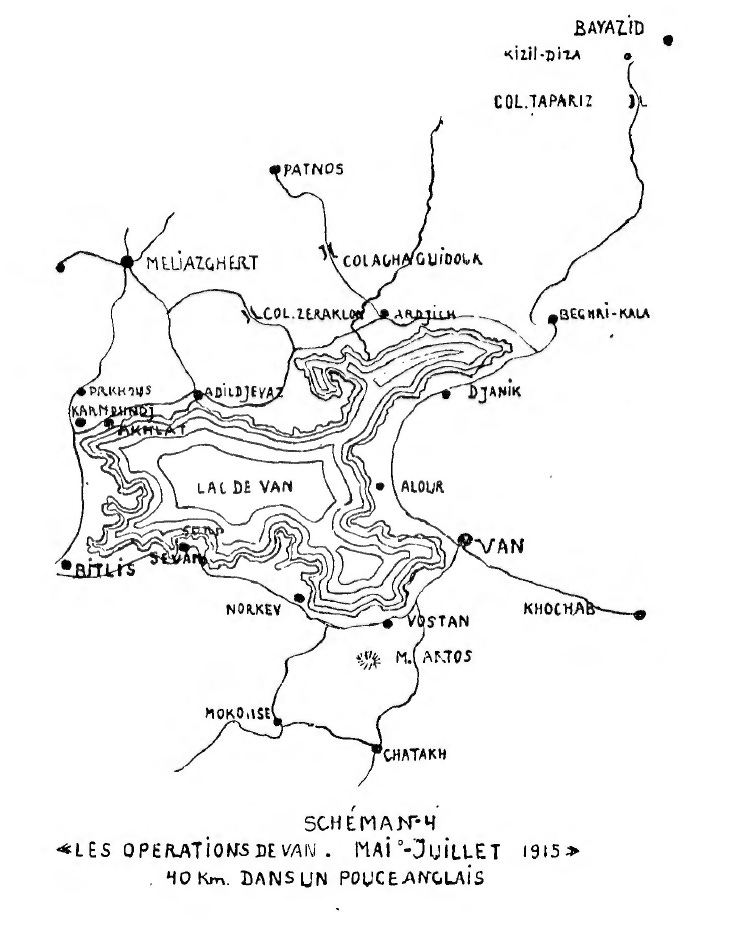
CHAPTER III: THE OPERATIONS OF VAN, MAY–JULY 1915
As we have said above, the 2nd, 3rd, 4th and 5th legions had been directed toward Van in the spring of 1915, and we have indicated the reasons for such a concentration of these four legions in a single group and for the choice of a determined direction of advance.
The legions formed an independent detachment, called the Ararat detachment, commanded by Vartan. Shortly before its return to the field, the 5th Legion was dissolved, its cadres serving to complete and reinforce the 2nd, 3rd and 4th legions.
Departing from Erivan on 28 April, the Ararat detachment crossed on 4 May the Tchinghil Pass (on the former Russo-Turkish frontier) and on the same day reached the approaches to Kizil-Diza, situated at the foot of Mount Tapariz, on the road from the Bayazid valley to Van.
On 11 May this detachment, forming the advance guard of General Nikolaïeff’s detachment, captured Beghri-Kala.
On 14 May the detachment again went over to the offensive; the following day it took the village of Djanik and on 18 May entered the village of Alour, where the population of Van, freed from a long siege, gave a reception
[PAGE 24]
an enthusiastic reception to the detachment. The Turkish troops withdrew in haste along the southern shore of Lake Van, in the direction of Vostan.
On the occasion of the capture of Van, the Commander of the 4th Army Corps sent a telegram of congratulations to the Catholicos of All the Armenians, conceived in these terms:
Etchmiadzin, to His Holiness the Catholicos of All the Armenians. — 25 May 1915.
I thank you with all my heart for the fervent prayers that you addressed to the Most High in the cathedral of Etchmiadzin on this memorable day when Van was delivered from the historical enemy of Christianity and of the Armenian people of the secular yoke, thanks to the valiant and victorious troops and the courageous Armenian legions of the IV Army Corps entrusted to me. 5302.
GENERAL OGANOVSKI.
After the occupation of Van it was indispensable to clear the region south of Lake Van of Turks and Kurdish bands in order to be able to establish ourselves there firmly. With this aim the 2nd Legion received on 21 May the order to occupy Chatakh, and then Mokouse.
On 23 May, after a short combat, the legion seized Chatakh, freeing from the yoke of their oppressors the Armenian population of that region, which had risen against the Turks.
After leaving there a small garrison as a precautionary measure, the legion continued its advance toward Mokouse, which it occupied on 31 May. During the night of 4–5 June the Turks attempted a counter-attack with the aim of retaking the abandoned lines that covered the direction of Sghert, but were repulsed with the aid of the local Armenian population.
On 29 May the 4th Legion received the order to occupy Vostan. After an engagement which lasted six hours, it
[PAGE 25]
[PAGE 26]
seized the town, driving the Turks beyond the Vostan Pass and capturing from them three guns. It was then reinforced by the 3rd Legion, which arrived from Van, and together they broke all resistance on the part of the Turks. On 7 June, after a fierce combat, Sévan was occupied, and on the 12th the two legions entered Sorp.
However, the Turks, having received new reinforcements, passed to the offensive the following day, which obliged the legions at Sorp to withdraw first to Sévan and then to the line Norkev–Mokouse.
Thus, on 13 June, the line of the Russian front south of Lake Van passed through Norkev, Mokouse, and Chatakh. It is to be noted that this entire line was occupied exclusively by the Armenian legions and by Armenian volunteer formations from the region.
During the lull that followed these events and lasted until 27 June on this front, the 2nd Legion, as well as the 1st, which had come from Persian Azerbaijan, were united with the 3rd and 4th in the region of Norkev, the former leaving small garrisons at Mokouse and at Chatakh.
Taking advantage of this period of temporary respite, a company of the 2nd Legion, under the command of Mesrope, carried out a bold raid in the region of Sparkeret, west of Mokouse, and liberated 4,000 Armenians captured by the Kurds.
On 28 June all the legions were incorporated into the group of General Troukhine (1 battalion of frontier guards, 4 Armenian legions, 1 squadron of frontier guards, 12 sotnias of Cossacks, 6 field guns, 6 mountain guns).
These troops were to advance along the southern shore of the lake, in order to cover from the direction of Bitlis the left wing of the IV Corps of the Caucasus Army.
[PAGE 27]
This corps was operating on the front of Meliazghert–Akhlat, with the objective of occupying the line Khnis-Kala-Mouche.
The army command considered this operation very important: the occupation of the Khnis–Mouche line was to serve as a base for future operations, which would result in the capture of Erzeroum.
After the concentration of all General Troukhine’s forces in the region of Norkev, they captured Sévan after a two-day battle (29–30 June).
During their advance they encountered stubborn resistance from the Turks, reinforced near Sorp by an infantry brigade.
Khalil Bey had decided in turn to launch a counter-attack against the Russian 4th Corps, but, in order to protect his right flank threatened by the advance of General Troukhine, he left at Sorp the 44th, 106th, and 107th Turkish regiments.
But in the battle fought on 12 July, all the Turkish positions were taken, and two-thirds of their artillery fell into the hands of the victors. On 14 July the troops of General Troukhine reached the Meliazghert–Bitlis road, at the south-western extremity of the lake.
Congratulating the troops on their brilliant success, General Troukhine, in his order of the day of 15 July, noted their bravery and endurance, crowned by victory:
The legions of Andranik and of Dro attacked the enemy positions on the left flank with impetuosity, while the legion of Amazasp, under exceptionally difficult conditions and without being able to be supported by artillery, climbed mountains covered with snow. The legions, despite their fatigue, vigorously pursued the enemy whom they had dislodged.
Simultaneously with these combats on the southern shore of Lake Van, the operations of the 4th Corps began on
[PAGE 28]
on the Kope-Karmoundj line, crowned with success. General Troukhine’s group received the order to stand ready to continue its advance.
But already by 17 July the situation had changed.
On 15 July, on the front of the 4th Corps, the Turks, having received significant reinforcements, launched a counter-attack.
The Russian corps was forced to assume the defensive, while General Troukhine’s group received the order on 17 July to withdraw to positions south-west of Sorp.
These positions were attacked by the Turks on 19 July with the intention of breaking the resistance of General Troukhine’s Van group in order to secure the region of Bitlis and close it to an invasion by Russian troops.
These attacks were victoriously repulsed by the troops on 19 and 20 July and resulted in a complete defeat of the Turks.
On 21 July General Troukhine’s group reoccupied the south-western region of the lake and established contact with the left flank of the 4th Army Corps.
At the battle of 19 July, charging with his cavalry, the valiant Khétcho, of the Ararat detachment, was killed.
On the occasion of this victory, in his order of the day of 21 July, General Troukhine expressed himself in the following terms:
After a two-day battle, on 19 and 20 July, the troops of the group entrusted to me have driven the enemy from the positions which he occupied.
The victory is due principally to the accurate fire of our infantry, composed for three-quarters of Armenian legions.
The enemy has been definitively repulsed thanks to the precision of the artillery fire. History will appreciate your victory, valour
[PAGE 29]
brave troops. For my part, I congratulate the officers as well as the simple soldiers on the victory won over the enemy, and I thank you for your efforts.
GENERAL OF DIVISION TROUKHINE
But the turning movement of the Turks against the 4th Army Corps near Meliazghert and the breakthrough of the Russian front at Prkhousse completely changed the situation. The Turkish offensive along the entire front of the 4th Corps forced it—and at the same time General Troukhine’s group—into a general retreat.
The occupation of Meliazghert by the Turks opened to them the shortest route toward the valley of Alachkert, separating the units of the 4th Corps and threatening Transcaucasia. The Army Command was compelled to give the order to evacuate the region of Van and to concentrate the elements of the 4th Corps, which withdrew along the northern shore of the lake, into the valley of Alachkert, via Beghri-Kala and the Tapariz Pass.
The 1st and 2nd Legions, after effecting their junction with the left-flank column of the 4th Corps, withdrew along the northern shore of the lake, while the 3rd and 4th, remaining incorporated in General Troukhine’s group, retreated along the southern shore of the lake, serving as cover for the Armenian population, which was obliged to evacuate the vast region of Van.
The retreat of General Troukhine’s detachment began on 24 July at 2 p.m., without being disturbed by the Turks; only the Kurds showed activity on the Mokouse–Chatakh front and attacked Mokouse, held by a company of the 2nd Legion, during the night of 23–24 July. But this attack failed, the legionaries having lost 1 killed and 26 wounded.
On the morning of 26 July General Troukhine’s detachment arrived at Sévan and continued its retreat toward Van, having received the order to defend that city and its entire region.
[PAGE 30]
The 1st and 2nd Legions marched in the rear guard of the left-flank column of the 4th Army Corps; to them fell the heavy task of defending the defile of Beghri, through which the numerous Armenian population of Mokhouse-Chatakh and of the entire region of Van had to pass.
General Troukhine’s group, finding itself isolated from the rest of the Caucasus Army, evacuated Van on 4 August with the intention of withdrawing northward, but had to change direction toward the south-east and Persia, the route of Beghri-Kala having been cut off.
The retreat of the Russian army along the entire front in July 1915 left the 1st and 2nd Armenian legions at Igdir, and the 3rd and 4th at Dilman.
[PAGE 31]
CHAPTER IV: THE REORGANISATION OF THE LEGIONS
The news of the retreat of the Russian troops from the vilayet of Van fell like a thunderbolt upon the unfortunate Armenian population and indirectly affected the morale of the legions.
Legionaries were leaving the ranks to go in search of relatives in the immense tide of Armenians who were flowing back toward the Russian frontier and toward the unknown.
The Armenian National Bureau took measures to put an end to the desertion and decided, whatever the cost, to complete the legions and to continue the struggle against Turkey.
This decision was facilitated by the presence of two new legions (the 6th and 7th), formed at Erivan during the summer and ready to proceed to the front.
Following discussions with the General Staff of the Caucasus Army, it was decided that: first, the 3rd and 4th legions would remain at Dilman and would be immediately completed by 750 legionaries drawn from the 6th and 7th legions, and, second, the 1st and 2nd legions would be completed as soon as possible and sent again from Igdir to the front.
To characterise this heroic resolution to continue the unequal struggle against the Turks, we quote here the appeal of Andranik, commander of the 1st legion, to the Armenian population:
[PAGE 32]
I summon you to come immediately to Erivan to enlist in the legion, whose reorganisation must be completed by 13 September at the latest.
My friends, for ten consecutive months we have suffered in the mountains and the defiles, enduring all privations, crossing enormous distances, often suffering from hunger and lacking footwear. But we must not despair. The moment has arrived to give proof of courage and strength. The aim which we cherish and pursue must lead us toward our homeland, which demands to be liberated and avenged.
The reorganisation of the legions lasted more than three months—August, September, and October. By an order of the day of the 4th Caucasus Army Corps, all the Armenian legions “formed and in the process of formation” were placed under the orders of the Commander of the 1st Territorial Brigade (Order of the Day of the Commander of the 6th Army Corps, 16 August 1915, No. 61), the latter being invested with the powers of a Divisional Commander.
This order of the day was in complete accord with the intentions of the Armenian National Bureau, which wished to unite all the legions into a compact unit and give them a single direction.
But contrary to the aforementioned order, at the moment of the resumption of hostilities, these legions were once again dispersed, partly on the front of the 4th Corps, partly on that of the Azerbaijan-Van group.
[PAGE 33]
CHAPTER V: THE REOCCUPATION OF THE REGION OF VAN
The resistance of the 4th Army Corps, which, after retreating toward the Russian frontier, had faced the enemy on the positions of the southern slopes of the Aghri-Dagh range, then in turn passed to the offensive, while the troops of General Baratof of the Sarikamiche group operated on the left flank of the Turks, resulted first in the complete halting of the Turkish attack and then in their precipitate retreat, which soon turned into a rout.
The 6th Legion formed part of General Baratof’s troops; its commander, Lieutenant Avcharoff, met a hero’s death in these combats.
The spoils of the victors consisted of 5,000 prisoners and a considerable quantity of artillery, munitions, transport, etc.
The plan of the Turkish command, conceived with the aim of breaking through the front of the 4th Corps, which occupied the left wing of the Caucasus Army, in order then to invade the province of Erivan and separate the two theatres of war—the Turco-Caucasian and the Persian—failed, while the Russian troops, pursuing their advantage, re-established at the end of the month of August their front in the vilayet of Van.
On the southern shore of Lake Van, in order to cover the city of Van, a detachment was sent forward with orders to occupy the positions west of the village of Vostan, which defended the approaches in the direction of Bitlis-Van.
[PAGE 34]
On 20 September, half-companies of the 3rd and 4th Legions were incorporated into this detachment. These legions were at Dilman, where, as we have seen above, they had been placed during the retreat of the Russian troops from the vilayet of Van in the month of July.
The small units of Armenian legionaries took part on 10 October in the defence of the Vostan Pass, on the night of 13 October in the defence of the positions in front of Van against the Turks coming from the southern shore of the lake, and on 14 October they were among the troops that once again seized the positions of Vostan.
Calm was gradually restored in this region and major hostilities ceased until the beginning of January 1916.
During this period of lull, the Van group occupied with a small advance guard the villages of Vostan and Khan, situated south of the Artos massif and blocking the road toward Chatakh.
Khochab, a large Kurdish village west of Van, was kept under surveillance by the cavalry.
The legions arrived at Van in the following order:
On 22 October, the 7th Legion of Prince Arghoutian;
on the 25th, the 3rd Legion of Amazasp from Dilman;
and on the 27th, the 1st Legion, temporarily commanded by Sembat.
A half-company of the 4th Legion was sent on 23 October to Dilman to rejoin its legion.
On 20 November, the 1st Legion was sent from Van to Ardjich, and to it fell the difficult task of occupying almost the entire northern and western shoreline of Lake Van.
The 3rd Legion remained at Van until mid-March 1916; the 7th received, toward the beginning of December, the order to proceed in the direction of Ourmia.
As we have just stated, the 1st Legion left Van on 20 November and was incorporated into the Ardjich group.
[PAGE 35]
The Ardjich group, composed of three sotnias of Cossacks, the Armenian legion, half a battalion of infantry, and two field guns, received the task of dispersing the Kurds in the region of Zélian-Déré, north of Ardjich, inhabited by a warlike Kurdish population.
Threatening the Ardjich group from the north, the Kurds, commanded by Turkish officers, at the same time posed a danger to the troops of the 4th Corps at Patnos, where the 2nd Legion was also located. By pushing in between Patnos and Ardjich, the Kurds were obstructing communications between the Azerbaijan group, Van, and the 4th Army Corps via the Ardjich–Patnos route.
Sent on 25 November from Ardjich on reconnaissance, the legion cleared the Kurds from the sector nearest to Ardjich and observed their concentration in the Zilian-Déré-Sou defile.
The situation thus clarified, the commander of the Van group ordered the Ardjich group to launch an attack against the Kurds, which was carried out on 13 December, the 1st Armenian Legion forming part of the detachment together with two sotnias of Cossacks and two guns.
Supported by the artillery, the legion captured the Kurdish positions commanding the Zilian-Déré-Sou defile, completely cleared the Patnos–Ardjich road of local partisans, and, as punishment in accordance with an order received from the Corps commander, destroyed fifteen Kurdish villages north of Ardjich.
In this action the legion lost four killed and eight wounded; among the latter was the deputy commander of the sotnia, Archak.
Toward the second half of December, communication with Patnos was again threatened by Kurdish incursions, and, by order of the army commander, expeditions composed of units drawn from the 4th Corps were directed toward Patnos as well as toward Ardjich.
[PAGE 36]
From the Ardjich side advanced a column composed of the 1st Legion, half a battalion of infantry, two sotnias of Cossacks, and four guns; from the Patnos side, the 2nd Armenian Legion, half a battalion of infantry, one sotnia of Cossacks, and two guns.
On 11 January these two columns moved forward, cleared the entire region of Kurds, and, as punishment, destroyed seven of their villages.
They effected their junction on 13 January at noon at the Agha-Giadouk Pass and re-established communications between Patnos and Ardjich after dispersing Kurdish bands sometimes numbering as many as 1,000 men.
The losses of the 1st Legion during this two-month period in the Ardjich sector amounted to five killed and seventeen wounded.
[PAGE 37]
CHAPTER VI: THE OPERATIONS OF BITLIS, FEBRUARY–APRIL 1916
The beginning of the year 1916 was marked by major events on the Caucasus front, which opened with the capture of Erzeroum, of Bitlis, of Trebizond on the Turkish theatre, and of Kermanchah on the Persian theatre.
The opportunity for a decisive operation, aimed at Erzeroum, Mouche, and Bitlis, became evident after the occupation by Russian troops of Keupri-Keui and Khnis-Kala.
The capture of Erzeroum and the occupation of the valley of Mouche gave the Russians the possibility of continuing their offensive in the directions of Sivas, Kharpout, and Diarbekir, cutting the Turks off from their base of operations against Transcaucasia.
The Commander of the 4th Corps, having received the order from the Army Commander to take Mouche and Bitlis, advanced in that direction the column of General Abatsieff (6½ battalions, 10 guns, and 3 sotnias of Cossacks).
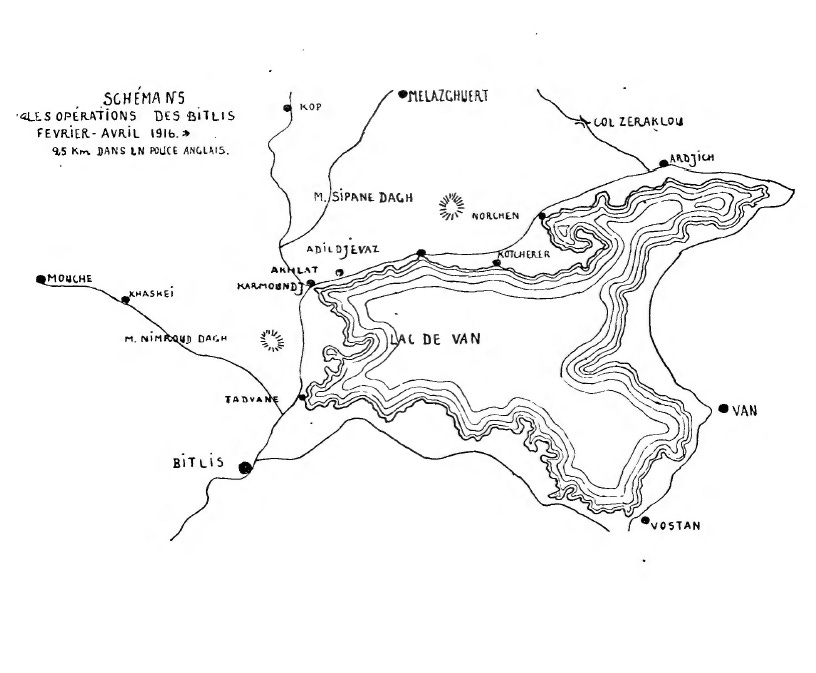
At the end of January 1916, this column occupied the region of Mount Nimroud (western shore of Lake Van), from where it launched its attack on Bitlis.
To support the operations of General Abatsieff’s column, the commander of the Van group, General Koulébiakine, received the order to advance two columns: one along the northern shore of the lake in order to
[PAGE 38]
clear the terrain behind the forces of General Abatsieff of Kurdish bands. This column was then to join him by advancing through Akhlat and Karmoundj, while the other would arrive by the southern shore of the lake.
The 1st Legion formed part of the column that skirted the lake to the north, having as cavalry three sotnias of Cossacks and two field guns.
On 2 February the column departed from Ardjich and routed the Kurdish bands it encountered 10 kilometres west of that town, pursuing them in a north-easterly direction as far as the Zéraklou Pass and the village of Norchen, which it occupied on the evening of the same day.
The column remained there for eight days, and it was only on 11 February that it received the order to advance in the direction of Adeldjivaz.
The Kurds, for their part, were determined to oppose the Russian offensive and occupied positions between the southern slopes of Mount Sipane and the lake; but by an energetic attack of the legion’s cavalry and a sotnia of Cossacks under Andranik, the left wing of the Kurds was routed and driven back toward Adeldjivaz. At the same time the infantry of the legion captured, on the right flank of the adversary, the village of Kotcherer, which it took after a fierce combat.
This defeat so shook the morale of the Kurds that thereafter they were unable to offer serious resistance to the Russian advance, and on 12 February the legion occupied Adeldjivaz and then Akhlat.
On 19 February the column was incorporated into the Bitlis group of General Abatsieff and received the order to occupy the village of Tadvane, situated on the south-western shore of the lake. This operation was completed on 20 February.
One of the columns, which included the 2nd Legion in its strength, occupied Mouche on 15 February.
Thus, toward the end of February, the group of General Abatsieff occupied the front passing through Mouche-
[PAGE 39]
[PAGE 40]
Khaskeuï–Tadvane. At that point it was joined by the column advancing along the southern shore of the lake.
In order to secure the position from which the attack on the Turkish entrenchments of Bitlis was to be launched, General Abatsieff ordered the 1st Armenian Legion, supported by a battalion of infantry and two guns, to occupy the Bitlis defile.
Despite the superiority of the Turkish forces, which occupied the positions at the entrance of the defile with eight battalions, on 21 February the legion attempted to force its way toward the Mouche–Bitlis road, but without success.
The general attack began on 28 February, the troops being grouped in three columns, the 1st Legion forming part of the central column and the 2nd of the right-flank column.
The enemy withdrew from its advanced positions to occupy the heights on the southern bank of the Bitlis-Sou river, which barred access to Bitlis.
The central column engaged in combat early in the morning of 29 February, advancing through deep snow on steep slopes, but despite its desperate efforts it did not succeed in seizing the enemy sector assigned to it.
The fighting ceased at nightfall, the legion having lost 15 killed and 55 wounded.
On the night of 2–3 March the decision was taken to seize the enemy positions by a night attack. The legion continued, as before, to form part of the central column.
It approached silently, without firing a shot, toward the sector that had been assigned to it, then rushed upon the enemy, who, taken by surprise, fled in disorder, abandoning two mountain guns.
The line of Turkish fortifications was broken and the central column, closely pursuing the enemy in rout, penetrated on its heels into the town.
[PAGE 41]
After the occupation of Bitlis, the 1st Legion was charged with guarding the Mouche–Bitlis road against Kurdish incursions.
Having departed from Bitlis on 7 March, the legion successfully carried out this task, repelling numerous Kurdish attacks.
On 25 March it was urgently summoned back to Bitlis, as a Turkish attack was expected from the direction of Sghert.
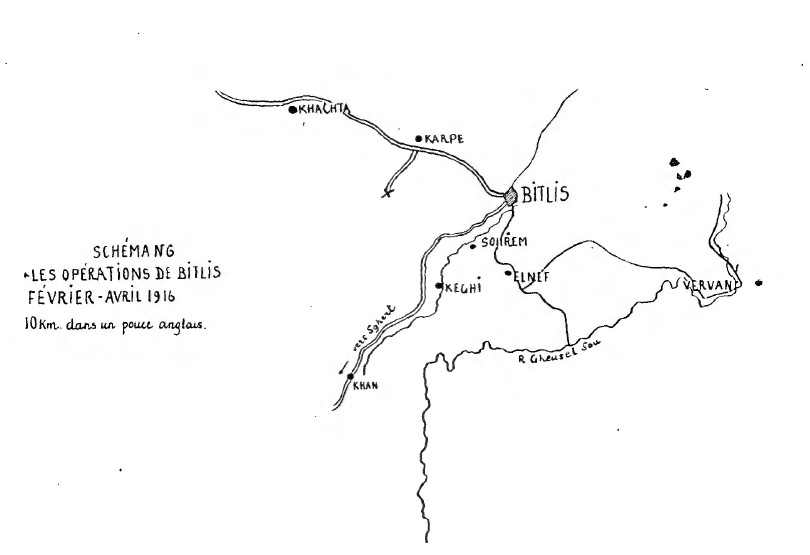
Arriving at Bitlis on 29 March, it took part in numerous combats in the region of the village of Karpe, situated 10 kilometres west of that town.
At the same time, 20 kilometres west of Bitlis, Kurdish bands assembled, interrupting by their periodic incursions all communications along the Mouche–Bitlis road.
According to information supplied by our agents, the Turkish 5th Corps was concentrating at Diarbekir, and a division was preparing to march on Bitlis and Mouche via Sghert. To defend the approaches to Bitlis in that direction, a special detachment established its advance guard (one battalion) on positions near the village of Elnef, about 6 kilometres south of Bitlis.
A battalion was sent into the mountainous region west of Bitlis, which the Kurds had invaded, to cover the town from the west; it took up position near the village of Khachta, 20 kilometres from the town.
The 1st Legion received the order to leave Bitlis on 6 April with the mission of clearing the Kurds from the region north and south of the Karpe–Khachta road.
At the moment of the legion’s arrival on the spot, the Turkish offensive to the south from the direction of Keghi (15 kilometres south of Bitlis on the Sghert–Bitlis road) appeared imminent.
On the morning of 7 April the Turks launched their offensive, a column advancing from the direction of Keghi, with
[PAGE 42]
[PAGE 43]
the intention of turning both flanks of the legion at its position at Karpe.
In view of the danger of being cut off from the rest of the troops, the battalion stationed near Khachta received the order to withdraw to Bitlis.
Throughout the day of 8 April one of the legion’s companies heroically defended the pass south of Karpe; but finally, threatened with being enveloped on both flanks, it rejoined the legion at its positions at Karpe.
By a stubborn defence and by skilfully withdrawing from position to position along the main defensive lines, the legion halted for two days the advance of the Turks, who were attempting to outflank Bitlis from the west.
Having failed in their attacks and seeing their rear threatened by a column sent from Mouche to the assistance of the Bitlis group, the enemy withdrew toward Keghi during the night of 9–10 April, and the legion reoccupied the positions near the village of Karpe and restored its connection with the Mouche group.
At the beginning of April the Bitlis group consisted of 14 battalions, including within this force two Armenian legions2 (the 1st and 3rd), three sotnias of Cossacks, and ten guns.
This group had received the order to defend at all costs the outlet of the valley of Mouche from the south on the Karpe–Vervan front and, after driving the enemy from its positions, to seize the heights that defended the entrance to the Bitlis defile from the direction of Khan.
[PAGE 44]
But the 1st Legion, which was exhausted and had suffered cruel losses, almost all its officers having been put out of action, had to be kept in the general reserve.
The 3rd Legion formed part of the left-flank column, composed of four battalions (including the legion) and four guns, the whole commanded by Colonel Obraszoff.
This column was tasked with occupying positions in the sector between the Bitlis–Vervan and Bitlis–Khan lines, which it was to organise for a prolonged defence.
The Turks, for their part, opposed this column with three battalions occupying the snow-covered ridge south of Elnef.
Colonel Obraszoff’s column received the order to attack these positions at dawn on 25 April and to carry them.
The legion, positioned on the left wing, was to begin the attack against the enemy’s right flank at 4 a.m., outflanking it from the direction of the Gheusel defile.
But this operation failed, and despite repeated attacks launched by the column against the Turkish trenches during the days of 25 and 26 April, the enemy held all its positions.
Nevertheless, the legion achieved a partial success in its sector, which earned it an honourable mention in the order of the day of the column commander, Colonel Obraszoff, dated 28 April 1916, from which we quote the following passage:
During the attack on the snow-covered ridge near the village of Elnef on 25 and 26 April, the 3rd Armenian Legion attacked with remarkable dash. The officers in particular behaved heroically, but unfortunately almost all were put out of action. On 25 April the legion seized, one after the other, all the trench lines, from which the Turks were driven by fire or by the bayonet.
[PAGE 45]
The impetuosity of the attack was such that the Turks did not have time to evacuate their bivouacs, which fell into the hands of the Armenian legionaries.
[PAGE 46]
CHAPTER VII: THE KHISAN EXPEDITION
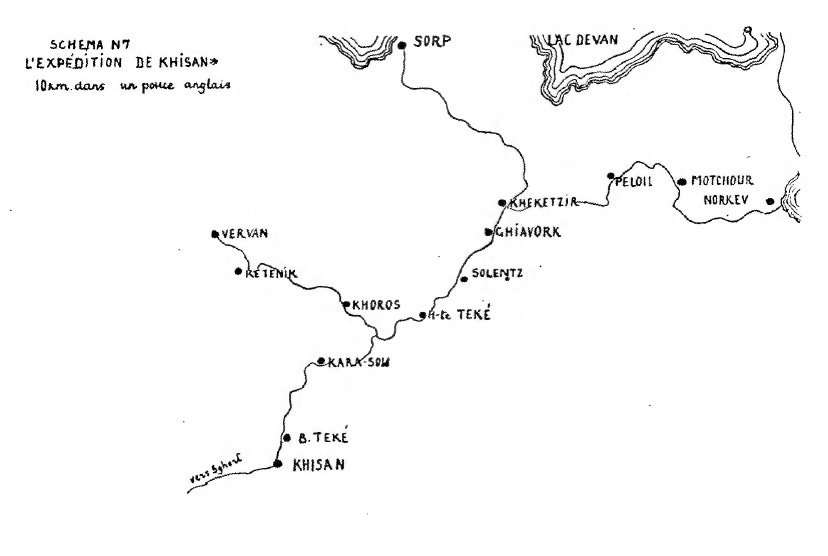
The expedition to Khisan, undertaken by the 3rd Legion of Amazasp, which lasted from 12 March to 12 April 1916, constitutes a separate episode in the struggle for possession of Bitlis.
The objective of this expedition had been defined by a telegram which the Commander of the Van group, General Koulébiakine, received on 11 March from the Commander of the Caucasus Army, General Yudenitch, conceived in the following terms:
Send immediately the 3rd Legion, which is to occupy Khisan and carry out reconnaissances in the direction of Sghert.
According to the information received, a Turkish offensive from the direction of Sghert was to be expected, with the aim of retaking Bitlis.
A sotnia of Cossacks also formed part of this detachment, but being entirely absorbed in guarding the lines of communication, the T.S.F. station, and the transport escort, it was unable to take any active part in the operations that followed.
On 11 March the detachment marched from Van to Vostan, reached Norkev the following day, and on 13 March the villages of Motchour and Palou, from where it proceeded toward Khisan.
The first encounter with the Kurds took place on 15 March near the village of Ghiavork, the legion losing
[PAGE 47]
[PAGE 48]
11 wounded, but forcing the Kurds to withdraw. It spent the night in the village of Solentz.
The road was dreadful, indeed, it scarcely existed; nothing but loose stones, steep slopes covered with snow, precipices, and sharp ridges, with scarcely the trace of a path. In climbing the slopes, men and horses sank into heaps of snow.
At dawn on 16 March, the Kurds, having received reinforcements, attacked the village of Solentz, occupied by the legion, in order to prevent it from reaching the entrance to the Khisan defile; but after a ten-hour combat they were forced not only to withdraw but also to evacuate the village of Haut-Téké.
Reconnaissances carried out between 17 and 19 March revealed a concentration of Kurdish forces, estimated at 2,000 fighters, throughout the region of Khisan.
On 21 March the legion, continuing its advance, occupied, after a four-hour combat, the village of Khoros (west of the village of Haut-Téké) and established, by means of a patrol at the village of Kétének, contact with the left flank of the Bitlis group.
On 23 March the legion seized the village of Kara-Sou and continued its advance toward Khisan.
At 6.30 in the evening the legion vigorously attacked the Kurds who occupied the village of Bas-Téké, which it carried despite the stubborn resistance of the enemy, and at nightfall it occupied Khisan, where it freed 500 Armenian civilian prisoners and captured considerable booty in munitions, equipment, and provisions.
The legion had operated in a very unfavourable season and under exceptionally arduous conditions, owing to the rugged nature of the theatre of war—a mountainous country without roads and inhabited by a hostile population. But, by the occupation of Khisan, it had accomplished the first part of the task entrusted to it
[PAGE 49]
had been assigned to it by the Commander of the Caucasus Army, after having covered, almost without transport and while fighting continuously, 120 kilometres in 11 days.
On 25 and 26 March mounted patrols were sent in the direction of Sghert, but the Kurds offered such vigorous resistance that they were unable to penetrate the area; they were consequently reinforced by units of the legion.
The reconnaissance yielded appreciable results, making it possible to establish that the Turks were covering themselves in the direction of Khisan with considerable Kurdish forces, in order to secure their advance on Bitlis and the left flank of the Bitlis group.
This latest manoeuvre resulted, on 28 March, in the withdrawal of the left flank of the Bitlis group from Vervan toward Bitlis, following which the legion, being in too advanced a position, received the order at nightfall to withdraw to Kara-Sou and then toward the junction of the Khoros–Vervan–Kara-Sou roads.
On 29 March this latter point was occupied by the legion, which then pushed reconnaissances toward Khisan and established contact with the left flank of the Bitlis group, which reoccupied Vervan.
The reconnaissances of 31 March, 1 and 2 April made it possible to establish the concentration of significant enemy forces at Khisan, Turkish askers and gendarmes being among the Kurds.
The situation on the front of the Bitlis group became worrying, the Turks, having received reinforcements, passing once again to the offensive.
In these circumstances the legion received the order to withdraw to Khéketzir, where it assembled on 8 April. It continued to conduct reconnaissances in the direction of Kara-Sou–Khisan and was charged with maintaining liaison with Vervan, and was to oppose to the utmost any Turkish attempt to
[PAGE 50]
break through the line east of Vervan (left flank of the Bitlis group) in the direction of the shore of Lake Van.
The situation of the Bitlis group, having to withstand the offensive of superior Turkish forces, was becoming increasingly precarious, and on 9 April the legion received the order to march on Vervan to reinforce its left flank.
Such were the reasons why the legion had entered the strength of the Bitlis group and had taken part in its combats during the month of April 1916, described in the preceding chapter.
In sum, taking into account the insufficiency of its forces, the legion had resolved the problem set before it in the Khisan expedition with the maximum results that could be expected under conditions of exceptional difficulty.
[PAGE 51]
CHAPTER VIII: THE ORGANISATION OF THE ARMENIAN LEGIONS DURING THE PERIOD OCTOBER 1914–APRIL 1916
We have just retraced the course of the operations of the legions during the period from October 1914 to April 1916, having only lightly touched upon their internal organisation. But, in order to form a proper idea of the work of the legions and of the manner in which they fulfilled their duty, voluntarily assumed, it is indispensable to take account of their organisation, for upon the latter depended to a great extent their degree of combat effectiveness.
In authorising the formation of Armenian volunteer legions, the High Command of the Caucasus Front had not strictly determined their strength, organisation, or system of supply.
They were rather imagined as groups of partisans, isolated and supplied in the manner of guerrillas, without organic ties to the regular troops, roaming along the entire front, passing from one group to another, thus making it impossible for the higher command to enter into direct contact with them—something which would have enabled it to assign to them only those tasks that they were capable of accomplishing or for which they were particularly suited.
The armament of the legionaries was very varied; some of them had none at all. Above all, there were difficulties in the supply of cartridges, which
[PAGE 52]
made itself felt in a troubling manner during many engagements. The absence or shortage of technical means of communication, engineering tools, supply parks, field kitchens, mess tins, tents, etc., complicated the situation. Footwear and winter equipment were constantly lacking.
The commanders of the legions and their lieutenants did not hold officers’ rank. The consequence was that when the legions entered Russian units, they found themselves in a position of inferiority, which often gave rise to painful misunderstandings.
The lack of doctors and of medical and administrative personnel was often keenly felt during operations.
Instead of being supplied and equipped by the intendance and other competent military institutions, the legions often had to turn, in order to meet their needs, to the Armenian National Council at Tiflis.
Despite all these difficulties that had to be overcome from the very beginning of the formation of the legions—despite all kinds of obstacles, the inexperience of the commanders, the open or secret ill will of certain governing circles—they were formed and took part in the operations of the regular Russian army, often with important and independent tasks, such as, for example, the operation of the three Armenian legions on the southern shore of Lake Van from 21 May 1915 to 27 June 1915, of which we have spoken.
Did these legions give all that could be asked of them as combat units? Were they useful on the Caucasus front?
The answer is to be found in this historical survey and in the orders of the day of the High Command of the Caucasus Army.
The Armenian National Council at Tiflis repeatedly drew the attention of the Russian authorities to the
[PAGE 53]
deficiencies in the organisation of the legions, fully aware that this state of affairs was bound to have a harmful effect on the morale of the legionaries, on their discipline, and on their military effectiveness.
For these reasons, the Armenian National Council had repeatedly approached the High Command of the front, requesting the reorganisation of the legions into regular battalions, notwithstanding the likelihood that such a measure would provoke the disbanding of part of the legionaries and the withdrawal of several of their commanders.
[PAGE 54]
CHAPTER IX: THE ARMENIAN LEGIONS REORGANISED INTO ARMENIAN RIFLE BATTALIONS
The organisational shortcomings of the legions and the abnormal conditions in which the legionaries lived made it necessary to reorganise them into regular units, incorporating elements of regular troops and providing them with experienced commanders and officers, while at the same time supplying them with everything required by Russian regulations.
Toward the end of 1915, the Armenian National Council made a new approach in this direction to the High Command of the Caucasus Front.
This time the proposal was received favourably, and already at the beginning of March 1916 the “Stavka” (Headquarters of the Tsar, Commander-in-Chief) ordered the reorganisation of the Armenian volunteer legions into six Armenian rifle battalions, assimilating their strength to that of the Cossack foot units (Plastuns) composed of four companies.
At the time of the publication of this order, the legions were scattered along the entire front: the 1st, 2nd, 3rd, and 6th in Turkey; the 4th, 5th, and 7th in Persian Azerbaijan.
As the situation at the front permitted, the legions were withdrawn and brought to the rear of the battle line.
[PAGE 55]
The 1st Legion, in view of its small strength, was dissolved and served to complete the others, which were formed as follows:
The 2nd Legion into the 1st Armenian Rifle Battalion
The 3rd Legion into the 2nd Armenian Rifle Battalion
The 4th Legion into the 5th Armenian Rifle Battalion
The 5th Legion into the 4th Armenian Rifle Battalion
The 6th Legion into the 3rd Armenian Rifle Battalion
The 7th Legion into the 6th Armenian Rifle Battalion
In order to bring these Armenian battalions up to normal strength, all Armenian officers and soldiers from the units of the Caucasus front who wished to serve in this national formation were transferred into them, with the addition of elements drawn from march battalions.
The question of supply had not been resolved satisfactorily along the entire Caucasus front, and this circumstance naturally also affected the morale of the Armenian battalions.
Likewise, equipment was entirely insufficient and did not allow all the combatants to be properly clothed, while footwear was completely lacking. They were obliged to make do by repairing as best they could what was available and making use of it.
Harness was also incomplete and defective, while armament consisted of rifles of the most varied systems, especially Turkish Mausers captured from the enemy, but generally in poor condition and without bayonets.
There was not a single machine gun and no transport; the promised horses and wagons had not been supplied. It was necessary to adapt heavy wagons taken from the Turks to the terrain and to requisition or purchase horses locally.
Engineering equipment was entirely lacking, as was communications equipment.
[PAGE 56]
While appreciating the services rendered by the legions, the High Command of the Caucasus, for reasons of internal policy, feared to group these battalions into larger national units that might have encouraged separatist tendencies; and, as before, the new battalions were dispersed across the vast Caucasus front, passing from one group to another and continually changing higher command.
In the account that follows, we shall confine ourselves to describing the operations of the Armenian battalions for which we possess indisputable documentation.
After the collapse of the Russian front in the Caucasus, the archives of the staffs were partly lost or fell into the hands of the Bolsheviks or the new Soviet republics of the Caucasus. The possibility of making use of these historical documents was thus lost for a long time, if not forever.
[PAGE 57]
CHAPTER X: OPERATIONS OF THE FIRST ARMENIAN RIFLE BATTALION ON THE TURKISH FRONT
The reorganisation of this battalion had not yet been completed when, at the beginning of June 1916, it was attached to the 39th Infantry Division, which at that time occupied positions near the village of Yeni-Keui, 40 kilometres east of the town of Mamakhatoon.
By mid-June the situation on the Caucasus front was as follows:
Having completed their concentration in the region of Gümüşhane–Ardos (80–100 kilometres south-west of the town of Trebizond), the Turks launched an offensive against the 5th Army Corps, which was operating in the direction of the coast, and forced it to withdraw 25–30 kilometres to the east. The enemy’s intention was to outflank from the south the fortified region of Trebizond and reach the sea, thereby cutting off the town of Trebizond and the Russian troops defending it from their lines of communication.
By this manoeuvre the Turkish command hoped to draw Russian reserves to the threatened sector and then easily deliver a decisive blow on the main axis of
[PAGE 58]
Ognut-Khnis-Kala-Keupri-Keui, thereby reaching the rear of Erzerum.
The Turkish advance units intended for this purpose were detected at the end of June in the region of Keghi-Cholik-Ognut.
If successfully carried out, this plan to break through the centre of the Russian Caucasus Army would have resulted in the retreat of both flanks of the army to their initial positions at the beginning of the war and the evacuation of the captured Turkish territory, transferring the struggle to the borders of Transcaucasia.
To counter this plan, the command of the Caucasus Army decided to forestall the enemy by launching a general offensive of its own, aimed at delivering a decisive blow in the directions of Bayburt and Erzerum. This offensive was scheduled for the night of 8 July 1916.
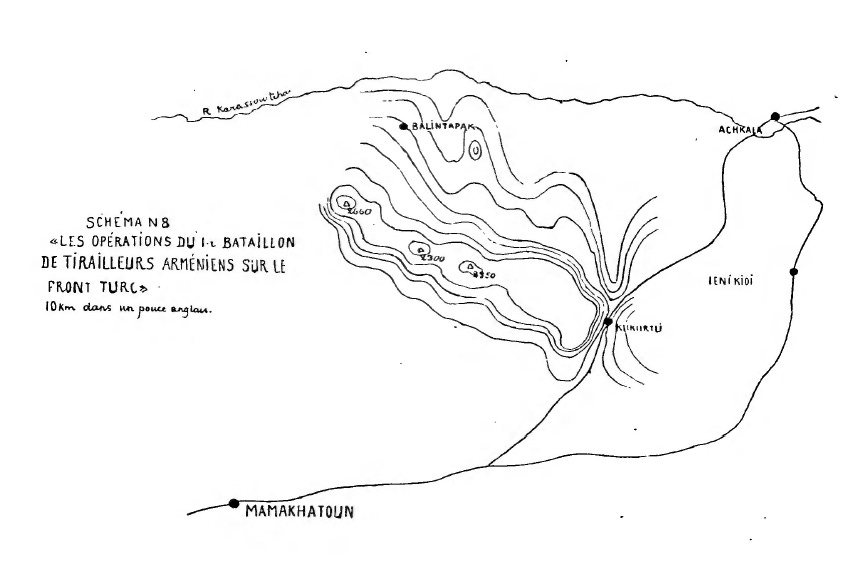
The 1st Armenian Rifle Battalion, which formed part of the 39th Infantry Division, relieved the 4th Don Plastun Battalion on 5 July in positions near the village of Kyukyurtli and was incorporated into the detachment of the division’s right sector (4 battalions, 14 guns).
This sector extended from the Karasuchai River to the village of Kyukyurtli; the 1st Armenian Battalion occupied positions from the Kyukyurtli Pass to the village of the same name. To the south of the battalion were the positions of other units of the division.
Thus, on the very eve of the offensive, the Armenian battalion replaced a Don Plastun battalion that had had sufficient time to familiarise itself with its position and study the approaches to the Turkish trenches, whereas the Armenian riflemen and their commanders were not only unfamiliar with the terrain on which they were to operate but were not even informed of the overall situation.
[PAGE 59]
We shall see later how these circumstances partly became the cause of the increased losses suffered by the battalion in the fighting of 8, 9, and 10 July, in which it received its baptism of fire.
On 7 July the divisional commander issued an order to the troops of the sector, including the Armenian battalion, to attack at dawn the following day, with the task of seizing the Turkish position that stretched along the mountain ridge from the village of Balin-Tepe—height 2350 metres—to its southern spur. The Armenian battalion was ordered to capture this spur. It was decided to approach the enemy’s position by 2 a.m., making use of the darkness during the two hours that remained before dawn at that time of year, and to launch the assault when it became sufficiently light.
Advancing in the dark across highly broken terrain presented great difficulties, and not all units reached in time the line from which the attack was to begin. When at dawn the 1st Armenian Battalion, in accordance with the general plan, rushed to storm the Turkish positions, it was met not only by deadly infantry and machine-gun fire from the front but also by flanking fire from the left, because the troops advancing to the south of the battalion, who were to cover it on that side, had not yet reached their assigned positions. After a fierce battle and heavy losses, the battalion was forced to withdraw to its initial positions, which in turn led to the retreat of the entire sector to its original lines.
At dawn on 9 July the attack was renewed, and this time the battalion successfully seized the southern spur of height 2350 but was not supported by the other units advancing farther south. As the enemy outflanked its left wing and attacked from the front with superior forces, the battalion was again
[PAGE 60]
[PAGE 61]
forced to abandon the captured positions, which, as on the previous day, entailed the withdrawal of the entire sector’s troops.
On the night of 9 and 10 July the attack was ordered to be resumed. This time it was successful. The battalion quickly captured the spur and, advancing along the crest, joined the troops that had taken height 2350, and then, by combined effort, heights 2300 and 2660.
The Turkish losses were considerable; nevertheless, they retreated in fairly good order under cover of their cavalry. On our side the Armenian battalion suffered heavily, losing 55 per cent of its personnel killed and wounded during these attacks. But in this, its first battle, it displayed great bravery, excellent discipline, and steadfastness characteristic of troops with high morale. It was precisely thanks to these qualities that the battalion was able to accomplish the difficult task assigned to it, despite the terrible losses it sustained—losses that even seasoned veteran troops could hardly have endured with greater heroism.
The Turks were vigorously pursued. The battalion formed part of the advance guard of the 39th Infantry Division, and on 24 July it entered the town of Erzincan. At the same time, in operations on this axis, Russian troops, after fierce fighting, captured Bayburt on 15 July and Kelkit on 27 July.
Finally, on 5 August the Turks were driven from the Chardakhli Pass, through which runs the Erzincan–Sivas road (60 kilometres west of Erzincan).
But here the offensive of the Caucasus Army came to a halt because of troop exhaustion and the impossibility of organising transport.
The battalion remained in positions near the village of Chardakhli throughout the autumn and until the end of the winter of 1917, continuing to form part of the 39th Infantry Division.
[PAGE 62]
By the beginning of March 1917 the battalion was stationed on the left flank of the Erzincan position, where it remained until early August 1917, when it was withdrawn from the front for reorganisation into a two-battalion regiment.
[PAGE 63]
CHAPTER XI: OPERATIONS OF THE ARMENIAN RIFLE BATTALIONS ON THE PERSIAN THEATRE OF WAR
With the onset of the summer of 1916, the region of Persian Azerbaijan began to assume ever-increasing importance.
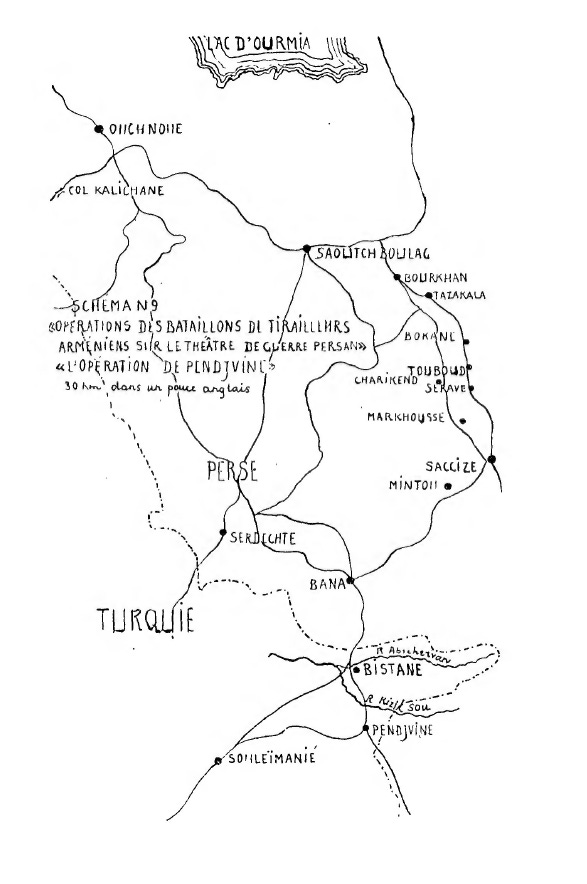
A concentration of Turkish troops was noted at Revanduz and Sulaymaniyah (Mosul vilayet); their advance guard had already crossed the Persian frontier and occupied Serdesht, Bana, and Sakkez.
If the Turkish operations in the direction of Revanduz and in the direction of Sulaymaniyah–Bana–Sakkez were successful, they would become masters of the whole of Persian Kurdistan. Reinforced by the local population, always ready to fight against the Russians, the Turks could then develop their operations toward Tabriz, once again threatening the left flank of the Caucasus front and its rear.
To prevent such a possibility, units of the 7th Caucasus Corps, which were already occupying Persian Azerbaijan and consisted mainly of Cossack cavalry reinforced by two Armenian rifle battalions, one border-guard regiment, and one territorial battalion, were placed on the first line. These forces were organised into three columns:
[PAGE 64]
[PAGE 65]
The right column, in the direction of the Kalishan Pass, 20 kilometres south-west of the town of Ushnu—12 Cossack sotnias;
The central column, in the direction of the Sheikhan–Gerus–Revanduz Pass—12 Cossack sotnias;
The left column, in the direction of Sakkez–Bana—24 Cossack sotnias and 2 battalions.
The 4th Armenian Rifle Battalion, which was being formed at Marand, received on 14 June the order to proceed immediately to Soukh-Boulagh, where it arrived on 24 June.
On 3 July the battalion occupied a position 20 kilometres south-east of Soukh-Boulagh in order to cover that point from the direction of the village of Burkhan, toward which the Turks were advancing from Sakkez.
The battalion remained in this position until 6 August, performing security duties.
We said above that one column had been detached from the 7th Caucasus Corps with orders to advance toward Sakkez–Bana, but it did not reach its destination and was forced to retreat to Bokan under the pressure of superior Turkish forces.
The corps commander then decided to reinforce this column with a detachment of three battalions (two of which were Armenian: the 4th and 6th), 10 Cossack sotnias, and 6 guns, and to throw it into a counterattack against the advancing enemy, who had already occupied Bokan.
This detachment was to outflank the Turkish left and strike the enemy in the rear. On the night of 8 August it occupied the line Tazakale–Sharikend, but the Turks, having been warned in time of this turning movement, withdrew on the evening of 8 August in the direction of Sakkez and then took up positions 10 kilometres north of that town, at the same time covering the road to Bana.
[PAGE 66]
According to reconnaissance data, the Turkish forces consisted of 6 infantry battalions with artillery.
Having decided to attack the enemy, the detachment commander on the evening of 11 August divided his troops into two parts: one consisted of the forces that had arrived from Soukh-Boulagh and were positioned near the village of Markhus; the other was the column operating in the direction of Sakkez–Bana near the village of Serav.
The enemy positions were to be attacked at dawn on 12 August.
The 4th and 6th Armenian battalions were in the centre of the battle formation and were to advance along the Serav–Sakkez road.
The formidable Turkish positions, fortified with trenches solidly constructed in several lines, stretched in a long convex arc along high mountain ridges, blocking the approaches to Sakkez.
At 6 a.m. on 12 August the Armenian riflemen launched a bayonet attack under murderous infantry and machine-gun fire and captured the first line of enemy trenches. After a short pause, despite heavy losses, they attacked again and by 3 p.m. had taken the entire mountain ridge.
By evening the Turks had been driven from all their positions and, finding both their flanks threatened with envelopment by Russian cavalry, hastily retreated toward Sakkez, covering their withdrawal with separate detachments capable of stubborn resistance in the mountainous terrain.
Properly appreciating this feat, the group commander, General Koulebiakine, sent the following telegram to the commander of the 4th Armenian
[PAGE 67]
Rifle Battalion, Lieutenant-Colonel Osepian:
I congratulate the battalion on its first baptism of fire and its first victory. Thank you for your valiant conduct.
I personally visited today the impregnable position that you stormed and was able on the spot to appreciate the bravery of the Armenian riflemen who captured it. 553.
KOULEBIAKINE.
The following telegram was received from the corps commander, Divisional General Tchernozoubov:
To Lieutenant-Colonel Osepian. — I am happy that your brave men conducted themselves brilliantly under your command. May God protect you. 1065.
TCHERNOZOUBOV
The Turkish retreat toward Sakkez freed the left flank of the corps and enabled its commander to assist the central column, which was being pressed by the enemy, by detaching from the left column 3 battalions and 22 Cossack sotnias. The left column was reduced to 2 battalions, one of them Armenian, and 2 cavalry regiments.
With forces of precisely this strength, the column on 18 August occupied the line Sakkez–Markhus with the task of holding back the Turks from the direction of Bana and observing the roads leading south-east.
On 21 August the Turks went over to the offensive from the direction of Bana and by evening of the same day occupied the heights near the village of Mintu.
The enemy concentrated his forces near the village of Tubud, and the situation remained unchanged until 29 August.
On 30 August the commander of the left column decided to resume the offensive.
[PAGE 68]
In this mountainous terrain the infantry—2 battalions, one of them Armenian—alone were able to manoeuvre without particular difficulty. The column gallantly fulfilled its task and forced the enemy to abandon his positions and retreat. Armenian losses amounted to 37 riflemen killed and wounded.
After this battle the commander of the Armenian battalion received the following telegram from the column commander:
I congratulate the brave riflemen and their commander on the success. I especially thank the 4th company. 123.
GENERAL NAZAROV.
Taking part in the general pursuit of the enemy, who was retreating in complete disorder, the column occupied the village of Mintu on the evening of 2 September, but there the detachment was halted by order of the corps commander.
Having decided to capture the town of Bana, the corps commander, in order to ensure the success of the attack by the left column, sent from Soukh-Boulagh a group of troops into the rear of the Turkish positions near Bana.
The general offensive began on 5 September; the 4th Armenian Rifle Battalion was in the first line.
The skilful manoeuvre of the battalion, together with the diversion in the enemy’s rear, compelled the Turks to abandon their positions and leave the town of Bana.
After the Russian troops occupied the town, the Armenian riflemen received orders to move south of it in support of a Cossack brigade sent on a raid toward Penjwen.
After this brigade returned from its raid, the battalion was first stationed in the town of Bana, but subsequently, owing to the impossibility of subsisting in a completely
[PAGE 69]
devastated area and the total absence of resources, the entire left column was withdrawn to the region of Bokan, while its advance guard, the 4th Armenian Battalion, was sent to Sakkez, where it arrived on 12 September.
As we see, from 1 June to 1 September 1916 the 4th Armenian Rifle Battalion was constantly on the march, engaged in endless battles and skirmishes. The riflemen were in a pitiable condition, almost barefoot, in rags, and moreover insufficiently fed.
The battalion’s losses were very considerable, though not so much from killed and wounded—5 officers and 87 riflemen—as from epidemic diseases, chiefly cholera, which claimed many victims.
Thus, for two and a half months the battalion remained continuously in the advance guard. In this mountainous region the cold was setting in, and men without winter clothing somehow sheltered in tents to avoid falling ill from the autumn weather.
Only on 29 November was the battalion relieved and able to rest in the region of Bokan, where it remained until 7 March 1917.
On that day it took part in a demonstrative movement toward Bana in order to disrupt the Turkish offensive against the 1st Cavalry Corps near the town of Senneh.
On 17 March the battalion entered the town of Bana, where it remained until 22 June 1917.
[PAGE 70]
CHAPTER XII: THE PENJWEN OPERATION
On 22 June 1917 an order was received from the commander of the 7th Caucasus Corps to attack the Turkish positions at Bistan, which barred the road to Penjwen. The operation was to culminate in the capture of that town.
Its capture would secure the direction Sulaymaniyah–Senneh, establish contact with the right flank of the 1st Caucasus Cavalry Corps operating in the region of Kermanshah, and paralyse Turkish manoeuvres between the two Russian corps operating on the Persian front.
In view of the importance of this operation, the left column was reinforced by a large group of cavalry held in reserve, so that its final strength amounted to 2 infantry battalions (the 4th and 6th Armenian) and 36 Cossack sotnias.
The enemy occupied positions along a mountain ridge near the village of Bistan, between the Abishirvan River and its tributary, the Kizil-Su.
To attack him it was necessary to advance across the completely open valley of the Abishirvan River and ford it.
It was therefore decided to begin the attack at 1 a.m. on the night of 23–24 June. As soon as they approached the Abishirvan River, the battalions deployed into battle formation for a night assault and began to ford the river.
[PAGE 71]
Despite the intense fire that the Turks promptly opened, the Armenian riflemen crossed the river and stormed the mountain ridge, from which the enemy was forced to retreat in disorder.
But the 6th Armenian Battalion, advancing against the Turkish right flank, did not have time to consolidate its captured positions and was compelled to withdraw before a strong enemy counterattack. Its retreat entailed that of the 4th Battalion; in the end everything returned to the original positions.
After this setback, the corps commander decided to renew the attack, but only after the column had been reinforced with field artillery.
The troops were ordered to remain in readiness in close proximity to the enemy, who occupied commanding ground.
At dawn on 28 June the artillery began the preparation for the assault on the enemy trenches, and at 7 a.m. the order to attack was given. The 4th and 6th Armenian battalions, deployed in battle formation, descended into the valley of the Abishirvan River and advanced without firing a shot under Turkish artillery and infantry fire.
Before them lay an open zone which had to be crossed at any cost and as rapidly as possible. The riflemen crossed it and reached the mountain, at the foot of which, in a dead ground area, they were able to take a short rest. But scarcely had they recovered their breath when they rushed the Turkish trenches, which they captured, driving the Turks out with the bayonet as they retreated in great disorder.
In this attack the 4th Battalion lost 2 officers and 36 riflemen killed and wounded but captured one gun from the enemy.
On 28 and 29 June the troops were able to enjoy a rest well earned.
[PAGE 72]
Unfortunately, however, the detachment commander failed to appreciate fully the importance of the heights on the left flank of the Bistan position on the left bank of the Kizil-Su River.
On the evening of 29 June they were reoccupied by the Turks, and in order to advance toward Penjwen it was again necessary to seize these heights.
The execution of this difficult task was entrusted to the 4th Armenian Battalion, and on 30 June at 5 a.m. it began the attack. Despite stubborn enemy resistance, by 10 a.m. the battalion had captured these heights, losing 57 killed and wounded in the attack. The detachment left several units on these positions as a precaution and then proceeded to occupy Penjwen.
But once again the importance of the heights on the southern bank of the Kizil-Su, which dominated Penjwen, was underestimated, and the Turks, who had already retreated toward Sulaymaniyah, regained the advantage by seizing these heights on 3 July.
This enemy success forced the detachment to abandon Penjwen and withdraw to the Bistan positions, from which it later moved to the region of the town of Bana.
There the Armenian battalion succeeded on 16 August in halting the Turkish pursuit, losing 9 officers and 80 riflemen killed and wounded in this rearguard action.
By the end of August the Armenian battalions were withdrawn to be reorganised into rifle regiments, with two battalions in each.
The losses suffered by the 4th and 6th Armenian Battalions between 22 June and 6 August were very considerable.
The 4th Battalion lost 12 officers and 183 riflemen. As for the 6th Battalion, the corresponding data have been lost. It would not be an exaggeration to state that the Armenian riflemen bore
[PAGE 73]
the heaviest burden during these operations and battles conducted by the left column, since the activity of the cavalry, which formed part of this column, was substantially restricted by the mountainous nature of the theatre of war in this region. The fact that the Armenian battalions always proved equal to the tasks assigned to them is evidence of their discipline, their deep sense of duty, and their high fighting spirit.
[PAGE 74]
CHAPTER XIII: REORGANISATION OF THE ARMENIAN RIFLE BATTALIONS INTO COMPOSITE ARMENIAN RIFLE REGIMENTS
The Russian Revolution, in its initial and very brief phase, aroused in both the people and the army a desire and energy to continue the struggle.
However, as events unfolded, the army, subjected to propaganda, became increasingly demoralised and soon refused to carry out the orders of its command. It became evident, even to the least informed, that the Russian army was losing its combat effectiveness and that in the near future it would leave the front and turn its weapons inward. Already after the July Bolshevik demonstrations in Petrograd, rumours spread that the army would remain at the front only until October.
The victories of the Russian troops on the Caucasus front had made it possible to occupy the greater part of Turkish Armenia; but with the army’s withdrawal from the front, the fate not only of that territory but of the whole of Transcaucasia was placed in jeopardy.
[PAGE 75]
The results of all the conquests, sanctified by the heroism and courage of the troops and by the blood of countless victims, might be nullified.
In anticipation of the front being stripped of Russian troops, it was necessary to prepare to defend the Armenian regions by their own forces and to undertake a more effective organisation of those forces.
The grave question of Armenians fighting the Turks one on one was imposed by the logical course of events. The task now was to mobilise all the forces at their disposal by creating new Armenian units from Armenian soldiers serving in the Russian army and by consolidating the previously separate Armenian battalions into regiments.
Armenian political circles in Petrograd and the Armenian National Council in Tiflis undertook the necessary démarches before the Russian authorities, which were still functioning in some measure, for the reorganisation of the Armenian armed forces.
The Armenian National Council requested the reorganisation of the independent Armenian battalions into two-battalion regiments, which in turn were to be grouped into brigades. At the same time, it insisted on the necessity of forming new units of all branches of service, while refraining from raising the question of forming a separate Armenian army corps.
The démarches of the Armenian political circles in Petrograd and of the Armenian National Council were favourably received both by the Ministry of War and by the High Command of the Caucasus front.
The Minister of War placed the following resolution on the petition of the Armenian National Council:
I consider it necessary to proceed immediately with the reorganisation of the Armenian rifle battalions into regiments and their unification into divisions.
[PAGE 76]
This reorganisation of the battalions into regiments was carried out in accordance with the orders of the Commander-in-Chief of the Caucasus front of 2 July 1917, No. 480, and of 11 July of the same year, No. 540.
These two orders formed the basis of the organisation of the future Armenian Corps. But events developed so rapidly that already in October 1917 it became clear that, in order to save the Caucasus front, it was necessary without delay to begin replacing the Russian troops with national troops. And although as late as September the High Command of the Caucasus front had considered the formation of an Armenian Corps premature, the course of events soon placed this question on the agenda.
[PAGE 77]
CHAPTER XIV: THE RUSSIAN TROOPS LEAVE THE CAUCASUS FRONT. FORMATION OF THE ARMENIAN CORPS
As the front disintegrated, the number of Russian units still retaining some degree of combat effectiveness diminished—a circumstance which finally convinced the High Command of the Caucasus Front of the urgent necessity of creating national troops.
Against the background of general collapse, the Armenian regiments already in the ranks preserved their military value—a fact which could not but influence the decision to form an Armenian Corps.
After the reorganisation of the Armenian battalions into regiments, this authorisation was again sought in October 1917. According to the adopted plan, the six regiments already in service (two battalions each) were to be expanded into eight regiments (three battalions each), organised into two divisions of four regiments apiece, with cavalry (one brigade), fifteen artillery batteries, engineer troops, and technical units.
All Armenian soldiers from all Russian fronts and from march battalions were to be called up to reinforce the existing units and complete the new formations envisaged by the general plan.
[PAGE 78]
These démarches before the Russian authorities coincided with the withdrawal of Russian troops from the front, and this time they were received favourably.
On 13 December 1917 the Commander-in-Chief of the Caucasus Front issued Order No. 136, on the basis of which the Armenian Army Corps was finally to be formed.3
[PAGE 79]
To understand more clearly the events that we shall describe next, it is necessary to take into account the conditions and circumstances under which the formation of these armed forces was to be carried out.
The repercussions of the Bolshevik coup d’état initially affected the fighting spirit of the Caucasus troops less than on other fronts, owing to the distance of this theatre of war from the two capitals.
Undoubtedly, on the Caucasus front all the symptoms of the impending collapse were also manifest, partial abandonment of positions, failure to execute orders, sabotage, and plundering of property, but on a less catastrophic scale than in Russia.
On the other hand, this very remoteness of Transcaucasia from the centres of disintegration, and its particular situation, were soon to lead to the abandonment of the entire front by the troops.
Transcaucasia did not regard the Bolshevik authority as the legitimate all-Russian government.
To administer the region, and despite the Bolsheviks’ accession to power, Transcaucasia formed in early November 1917 a local authority called the “Transcaucasian Commissariat,” composed of representatives of all parties and nationalities of Transcaucasia.
The formation of this new government was interpreted by the front, infected with Bolshevik propaganda, as an act of separation from Russia.
The demoralisation of the Russian troops was further aggravated by the news that the enemy had proposed the conclusion of an armistice.
The Transcaucasian Commissariat, taking into account the condition of the army and in full agreement with the Commander-in-Chief of the Caucasus Front, immediately accepted this proposal and concluded an armistice with the Turks on 18 December 1917.
[PAGE 80]
This was enough to provide the mass of disorganised and exhausted Russian soldiers—who had in mind only one idea, to return home as soon as possible—with a pretext to abandon the front.
In order to defend the front and continue the struggle, only one means remained: to form and send to the front without delay national troops interested in defending their own country—Turkish Armenia and Transcaucasia.
Simultaneously with the expansion and formation of the Armenian troops mentioned above, measures were taken to create at the front itself units composed of Armenian soldiers of the Russian Caucasus Army, which at that moment was in the full course of withdrawal. These units were to be reinforced by recruiting from the local Armenian population and subsequently formed into a third division of the Armenian Corps.
The following official documents give us a general idea of the situation on the Caucasus front at the moment of the signing of the armistice and show, on the other hand, the sharp change that occurred in the thinking of the Russian Caucasus command, which now hoped to continue the struggle with the help of Armenian troops alone—troops whose formation it had regarded for years with such hostility.
We reproduce the following telegram from the Commander of the Caucasus Army to the Commander-in-Chief of the Front, dated 25 December 1917, No. 2320:
Despite the precisely fixed dates for the withdrawal of the units of the 1st Corps, the latter is leaving its positions on its own initiative, and this departure soon threatens to strip the front.
Under these conditions, any delay in sending the Armenian regiments to the front and, as a possible
[PAGE 81]
consequence, the occupation of Erzincan, if not by the Turks, then at least by the Kurds, will probably compel me to abandon the entire region. We shall irretrievably lose Turkish Armenia.
The Quartermaster General of the Headquarters of the Caucasus Army reported on 6 January (No. 56170)4:
The 6th Corps has abandoned its positions and has entirely retreated in the direction of Sarikamish. At present the last regiment is in the process of withdrawal, and by 13 January there will be no soldiers south of Shaitan-Dagh, and from that side the front will be completely open.
The 1st Corps has likewise for the most part begun to withdraw, and I fear that the last units of the corps will leave Erzincan before the appointed date.
Meanwhile, the withdrawal of our troops from this point and its occupation by the Kurds will inevitably entail a violation of the armistice by the Turks and their offensive along the entire front. There is no doubt that the occupation of the Erzincan region by the Turks will be followed by our complete abandonment of the Western Front.
The 2nd Turkestan and 5th Caucasus Corps have also raised the question of leaving the front. The withdrawal of our troops from the Western Front will inevitably entail, given the present state of the Caucasus Army, the complete abandonment of the Turkish territory occupied by us.
In other words, the abandonment of the Erzincan region is equivalent to the abandonment of all Turkish Armenia—that is, the loss of everything we have gained during three years of victorious war against the Turks.
This allows me once again to request that you urgently dispatch the Armenian regiments, even if only two, which would enable us to stabilise our situation.
[PAGE 82]
The Commander of the 4th Corps telegraphed on 13 January (No. 3461):
Transports, supply services, soldiers, and corps institutions are departing in disorder. Disorderly flight increases every day. The Armenian regiments are exhausted by guarding institutions and supply routes. Without the dispatch of fresh troops from the rear, I cannot answer for the consequences.
The Chief of Staff of the Caucasus Army telegraphed (No. 33265) to the Chief of Staff of the Front:
Russian soldiers are terrorising the local inhabitants (Armenians) and forcing them to retreat with them.
The picture of disorderly flight was the same in all corps. This noisy crowd pouring back had to be replaced by Armenian units still in the process of formation, upon whom fell the heavy task of defending solely by their own forces not only the immense front stretching from Bayburt to Persian Azerbaijan, but also such fortresses as Erzerum, Kars, and others.5
On 16 January 1918 the Quartermaster General of the Caucasus Front wrote to General Nazarbekov, commander of the Armenian Corps (No. 23):
The situation at the front is difficult, and the abandonment of fortified regions creates an especially critical situation, compelling me to issue the following order to fortress commanders:
“The Commander-in-Chief of the Caucasus Army orders you, in view of the departure of Russian soldiers and officers from the front, to entrust the defence of the fortified regions to the national troops.”
Meanwhile, the task of the Armenian Corps was not limited to occupying the front and fortresses: for
[PAGE 83]
the most part it came down to guarding all communications and, especially, the railways.
On 21 January the Directorate of the Kars–Merdinek Railway telegraphed:
Russian soldiers of the railway brigade servicing the Kars–Merdinek line are abandoning property worth millions of roubles and halting traffic. We request the formation of an Armenian railway battalion and the transfer to it of the property of this brigade and of the Kars–Merdinek line.
In his telegram of 25 January (No. 88), the commander of the Erzerum Group indicated that urgent measures were necessary for the transfer of the Erzerum railway into Armenian hands, beginning on 13 February:
If this question of vital importance is not satisfactorily resolved by 13 February, the Armenian troops occupying Armenia will be compelled to abandon it, and it will become impossible to continue the struggle.
In such a brief outline it is impossible to cite all the official documents describing the situation at the front.
The Armenian Corps, still in the process of formation, was entrusted not only with the heavy task of holding the front, maintaining communications, supply stages, and fortresses, but also of taking over and safeguarding the enormous quantities of property abandoned by the Russian troops.
The situation in the rear of the active army was no better. We have no intention in this account of discussing the orientation adopted by each of the numerous peoples of the Caucasus toward
[PAGE 84]
the Turks and the Entente,6 but we cannot pass over in silence certain events behind the fighting Armenian Corps that made its unequal struggle against the Turks even more difficult.
Organised bands, led by Turkish agents and emissaries, began by destroying all the main lines in the rear of the army.
First the Baku–Tiflis railway was closed to traffic; then the turn came for the Baku–Grozny line.
Closer to the front, the line Erivan–Julfa, of vital importance, was paralysed, and raids were carried out against the Tiflis–Alexandropol line.
At the same time, pogroms of Armenian villages by Kurds began, initially in the Erivan province; but soon the movement expanded, assuming a systematic character in the districts with mixed Armenian–Tatar populations in the Tiflis, Elisavetpol, and Baku provinces.
Numerous Armenian communities sought exemption from military service for their male population so as not to leave their villages without protection.
These pogroms of the peaceful Armenian population became increasingly frequent and were evidently methodically organised.
The organisers of these raids pursued the aim of compelling the male population capable of bearing arms to remain at home, thereby paralysing
[PAGE 85]
the active Armenian Corps and demoralising its soldiers, who could not but be troubled at the thought that while they were fighting at the front their homes were left without protection and doomed to pillage and destruction.
The authorities in the rear did not possess sufficient means to combat anarchy, as a result of which Turkish emissaries were able to act with complete freedom. On the other hand, it was impossible to demand that the Armenian Corps detach units from the front to restore order in the rear.
This situation compelled the Armenian National Council to demand from the High Command of the Front7 the creation of special units to maintain order in the rear, guard communications, and protect the Armenian population. These units began to be formed, in accordance with the orders of the Commander-in-Chief of the Caucasus Front of 23 and 26 January and 5 February 1918, in Shulaver (Borchalin district, Tiflis province), in Shushi (Nagorno-Karabakh, Elisavetpol province), in Akhalkalak (Tiflis province), in Nakhichevan (Erivan province), in Elisavetpol, in Baku, in Akhaltsikh (Tiflis province), in Tiflis, and in Varushan (Nukha district, Elisavetpol province).
Such were the conditions under which the Armenian Corps was formed, and such was the situation in which it found itself at the moment when it alone had to sustain an unequal struggle against Turkish forces far superior in number, better armed, and much better organised.
We now turn to an examination of the situation on the Caucasus front after the Russian troops had left it.
[PAGE 86]
CHAPTER XV: THE SITUATION OF THE ARMY ON THE FRONT AFTER THE WITHDRAWAL OF THE RUSSIAN TROOPS
At the beginning of 1918 the Russian army completely abandoned its positions on the Caucasus front. Its last echelons were already passing through Erzerum, Erivan, and Julfa, or concentrating at Trebizond in order to return to Russia either overland by rail or by sea.
The Russian Caucasus front no longer existed, and from that moment until the end of May 1918—that is, for six months—the small Armenian army alone had to withstand a desperate struggle against the Turkish army, defending an extensive front 400 kilometres in length, from Kelkit to Erzincan and from Khnis to Van.
Of course, this new front, given the weakness of the forces at its disposal, could not form a continuous line; circumstances compelled the Armenian army to divide into independent detachments without possible communication between them, in order to defend the principal probable directions of Turkish advance.
The disposition of these detachments was as follows:
Kelkit: units composed of Armenian volunteers from the Bayburt region.
Erzincan: the Erzincan Infantry Regiment of three battalions, formed from Armenian soldiers who had refused to follow the withdrawing Russian troops.
[PAGE 87]
Erzerum: the Erzerum Infantry Regiment, formed from local inhabitants; the 1st Armenian Rifle Regiment; and one battalion of the 4th Rifle Regiment, which had arrived from Erivan.
Khnis-Kala: the 2nd Armenian Rifle Regiment, the Khnis Regiment, and the Karaklis Regiment; the latter two organised from the local Armenian population.
This group was to cover the sector between Khnis and Lake Van.
Van: the 5th Armenian Rifle Regiment and two Van regiments, recruited from Armenians of that region.
Erivan: the 3rd and 6th Armenian Rifle Regiments (whose transformation into three-battalion regiments was nearing completion) and one battalion of the 4th Rifle Regiment.
Kars: the regiment of this fortress (still in the process of formation).
Alexandropol: the 7th and 8th Armenian Rifle Regiments and units of the fortress defence zone—in the process of formation.
At the same time, in the rear of the front, cavalry, artillery, technical, auxiliary units, and staffs were being formed.
In accordance with the decisions of the commander of the Russian army, who was still in Erzerum and directing operations, the troops of the Georgian Corps were to occupy the line Gumushkhane-Trebizond, north of the front of the Armenian Corps.
For their part, the Turks, well aware of the disintegration of the Russian
[PAGE 88]
army, temporarily suspended all hostile actions that might have slowed its progressive agony.
Meanwhile, it was more than probable that the Turks, informed of the withdrawal of the Russian army and of its replacement by national troops, would seize the first pretext to break the armistice and resume hostilities.
[PAGE 89]
CHAPTER XVI: THE DEFENCE OF THE ERZINCAN REGION
On 30 December 1917 the Erzincan region was defended solely by Armenian regular and irregular units, which had no choice but to rely on their own forces.
At that moment the Erzincan Group consisted of only one infantry regiment (the Erzincan Regiment), one cavalry squadron of volunteers, one field artillery battery, and one mountain artillery platoon. In total, there were no more than 1,800 bayonets, 120 sabres, 4 field guns, 2 mountain guns, and 6 machine guns. Command was entrusted to Colonel Morel, former Chief of Staff of the 7th Caucasus Rifle Division, which had joined in the general withdrawal of the Russian troops.
This group, reinforced by local Armenian partisan detachments, was tasked with defending the Erzincan region along the former front of the 1st Corps of the Caucasus Army, which had abandoned its positions to return to Russia after the signing of the armistice.
This front extended 70 kilometres in a straight line from Erzincan to Fam. Army Headquarters assumed that the group would face only Kurdish forces, since, owing to climatic conditions and the nature of the terrain, an attack
[PAGE 90]
by the Turkish army was considered unlikely, as the passes were blocked by deep snow. It was necessary at all costs to gain time in order to allow the Armenians to complete the formation of the units of the national corps. In the event of an offensive by superior Ottoman forces, it was decided to retreat to Erzerum.
The main forces of the group were concentrated at Erzerum, with a line of supply stages established as far as Mamahatun.
Small volunteer detachments occupied Kardjil, Mamahatun, and Sur-Piran. The latter blocked the exit from the Chelik gorge toward the Erzincan valley.
Fam was occupied by a battalion which covered Mamahatun from the south.
Communication between this group and Army Headquarters (in Erzerum) left much to be desired. The telegraph no longer functioned, Russian personnel had departed, and the Kurds had cut the telephone lines.
Mounted courier communication along the supply line to Mamahatun was maintained only until 23 January because of constant Kurdish raids on the route, and the small Erzincan Group, burdened with the defence of the forward front line, had absolutely no possibility of sending expeditions to the rear to secure its communications.
Thus, by the end of January 1918, the Erzincan Group found itself in complete isolation, 150 kilometres from the fortress of Erzerum.
The Armenian forces scrupulously observed all the terms of the armistice, but troubling signs gave reason to fear that the Turks would violate it.
Already in letters addressed on 22 January 1918 to the Commander of the Caucasus Army, General Odishelidze, and to the Commander of the Front,
[PAGE 91]
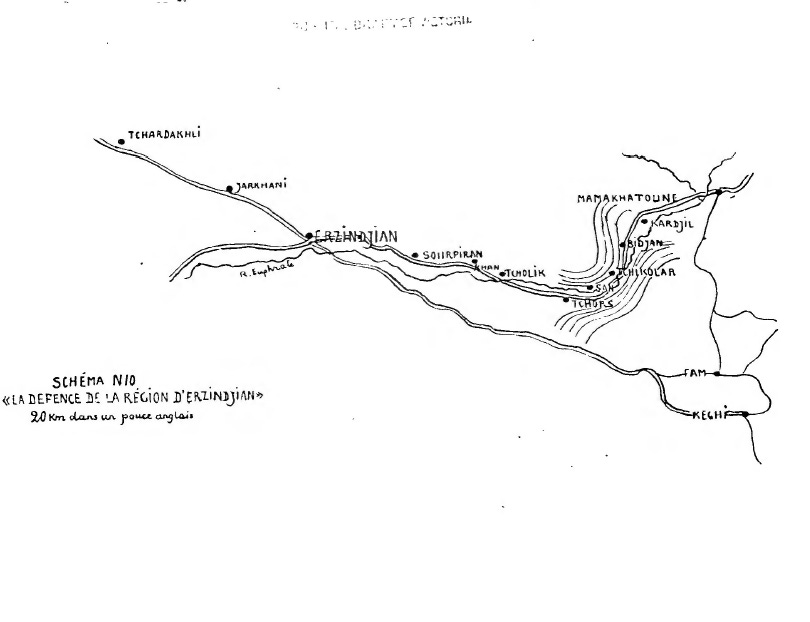
[PAGE 92]
General Przhevalsky, the Commander-in-Chief of the Turkish army, Vehib Pasha, complained of so-called atrocities committed by Armenians against the Muslim population of the Erzincan region and expressed doubts that the Armenian units, which had “replaced the Russian troops who had left the front,” were capable of restoring order in the region.
Vehib Pasha’s letters of 1 and 11 February to General Odishelidze left no doubt as to the Turkish desire to find a pretext for invading the Erzincan region.
It would have sufficed to send some expedition against the Kurdish bands that were harassing the communications of the Erzincan Group for the Turks to interpret this as an act of violence against the Muslim population and a violation of the armistice.
Reports from agents left no further doubt regarding the Turkish intention to invade the territory of Turkish Armenia abandoned by the Russian troops.
Alongside the increasingly evident aggressive intentions of the Turks, Kurdish partisan warfare intensified throughout the rear of the group.
For example, on 27 and 28 January two successive attacks were organised against Sur-Piran, which was held by a detachment of 60 Armenian fighters.
With the help of urgently dispatched reinforcements—an infantry company, a cavalry squadron, and two guns from the Erzincan Group—these attacks were repelled, and the Kurds left 65 of their men dead on the field.
But this was only the beginning of attacks against this important
[PAGE 93]
strategic point, and soon (2 February) the commander of the group was compelled to detach from his reserve two more infantry companies and a cavalry squadron to protect his lines of communication.
These troops engaged Kurdish bands near the village of Khan, 25 kilometres east of Erzincan, and, given the numerical superiority of the attackers, the group commander sent two additional companies as reinforcements.
However, on 3 February all these units were suddenly recalled to Erzincan, without being given time to disarm the Kurds or restore communications with the city, because reliable information indicated that a general Turkish offensive was imminent, one that would rely upon an uprising of the population against the weak local garrison.
The position of this group, separated from Erzerum by a distance of 150 kilometres, weakened by the dispatch of numerous detachments, threatened in its rear, unable to ensure supplies, and lacking communication with the commander-in-chief, was becoming increasingly critical.
One thing was beyond doubt: the necessity of prolonged resistance against the advancing Turkish forces; the question was merely to gain the time needed to complete the formation of the various units and the mobilisation of the Armenian Corps.
On 10 February, around midday, a Turkish company suddenly appeared at the Chardakhli post on the road leading to Sivas.
The commander of the post stopped it and asked for an explanation as to how it had appeared during the armistice in the neutral zone.
The Turkish officer apologised, stating that his company had lost its way in the fog during manoeuvres.
[PAGE 94]
The Chardakhli post was immediately reinforced. But on 12 February it was attacked and forced to withdraw to the village of Yarkhani.
On the same day, General Przhevalsky, Commander-in-Chief of the Caucasus Front, and General Odishelidze, Commander of the Caucasus Army, received a telegram (No. 1020) from Vehib Pasha, in which he again insisted on alleged atrocities committed by Armenians, which obliged him to move his troops in order to protect the Muslim population. “I can assure you that the Erzincan agreement (temporary) remains fully in force; the only provision of the treaty that has lost its validity as a result of the departure of the Russian troops is the demarcation line.”
This declaration was followed by the advance of Turkish units of the 36th Division, developing their offensive from the direction of Kemah.
The group commander could oppose them with only 1,000 bayonets, 120 sabres, and 6 guns; the rest had been assigned to guard the lines of communication.
This disparity of forces dictated the necessity of withdrawing in good time to Erzerum, avoiding serious engagements if possible.
On 13 February, at dawn, the advanced detachments of the Turkish troops advanced simultaneously along the Sivas and Kemah roads.
After reaching a line 10 kilometres west of Erzincan, the Turkish units attempted to encircle the city at once in order to reach the rear of the group.
Enemy cavalry moved along the Kemah road, bypassing the city from the south, while infantry columns advanced to the north.
[PAGE 95]
The group commander had no means of resisting this manoeuvre. To avoid encirclement, at 10 a.m. he ordered the supply trains and Armenian refugees to leave the city.
The first day’s march to the Khan stage was organised in two columns along two parallel roads: the refugees, under the protection of two infantry companies, a cavalry squadron, and two guns, took the northern road; the main forces of the garrison (six infantry companies with four guns and the supply train) took the southern road.
By 14:00 the group had left Erzincan, leaving two companies as a rearguard on the western outskirts of the city; these in turn withdrew at 15:00.
Enemy cavalry, particularly the Kurds, rushed in pursuit of the retreating columns but were repulsed everywhere.
Around 19:00 the main forces of the group concentrated at Khan. After allowing the refugees to move ahead, they resumed their march following a two-hour rest and reached the Chelik stage at 04:00 on 14 February, having covered more than 40 kilometres in a single day.
This night march, along a road covered with deep snow, was extremely arduous and made even more painful by the need to repel attacks by Kurdish cavalry. Wagons overturned on steep slopes into the Euphrates or became stuck in the snow. Men froze. The retreat cost the lives of more than 100 refugees who perished along the way.
After several hours of rest, the march resumed, but this time under the threat of Turkish cavalry advancing with alarming speed.
[PAGE 96]
On 14 February at 13:00 the group, now forming a single column, moved toward Chors. The marching order reflected the situation. In the vanguard was an infantry company. Then came the artillery with a covering company; half a kilometre behind followed the supply train and refugees, protected by three companies and a squadron, with half a company on each side guarding the flanks. The rearguard consisted of four companies.
After about sixteen hours of continuous marching, complicated by Kurdish attacks, the vanguard was eight kilometres from Chors. Here the terrain formed a small deep valley about one kilometre long, whose two exits were nothing more than narrow passes between steep cliffs descending sheer into the Euphrates.
This valley had often been the scene of bloody massacres, and when in February 1916 the Turks were forced to abandon the fortress of Erzerum, they were treacherously robbed and killed there in the hundreds by the same Dersim Kurds who were now their allies.
As soon as the vanguard company entered the defile, it came under fire from an unseen enemy entrenched on the surrounding heights. The vanguard, reinforced by an infantry company and two guns, was ordered to clear the way for the main body of the column, halted at the entrance to the defile. It was necessary to hurry to dislodge the enemy blocking the path, since Turkish cavalry from the direction of Khan had already begun harassing the rearguard. The group commander, once again reinforcing the vanguard with an infantry company and Murad’s volunteer cavalry (the well-known Armenian partisan), placed himself at the head
[PAGE 97]
of these forces and launched them in an assault on the heights blocking the exit from the defile.
This sudden attack threw the Kurds into confusion, and by about 17:00 half the passage was cleared, and by 20:00 the troops entered Chors. Their losses amounted to about 25 killed and 80 wounded; among the refugees, 40 wounded were counted.
The halt of one day at Chors gave some rest to the troops and the refugees, who had suffered so greatly, and the Chors company, which had been guarding the line of communications, rejoined the group.
The road between Chors and Bidjan runs through a narrow defile 15 kilometres long, very favourable for ambushes. In order to pass through it before dawn, the group left Chors at midnight on 16 February. To secure themselves against Kurdish attacks, two companies were to occupy two ravines in the defile near the villages of San and Chikolar, while one and a half companies were ordered to guard the first bridge over the Euphrates, five kilometres from Chors, and a half-company the second bridge over the same river, seven kilometres from Bidjan.
Thus, the group left Chors at midnight on 16 February. At the beginning of the retreat the enemy did not harass it, but at 2:30 a.m. news was received that the second bridge over the Euphrates, probably set on fire by the Kurds at sunset, was burning and that part of it had already collapsed.
At 3 a.m. the main body of the group, together with the refugees, reached the bridge, which had ceased burning.
At that point the river flows between high and steep banks. At night, under enemy pressure, it was impossible to cross it with the wagons. It was therefore necessary to abandon them and to carry the wounded and sick by hand.
[PAGE 98]
Finally, between 8 and 10 a.m., the troops reached Bidjan, having crossed the Euphrates by ford and repelled several Kurdish attacks.
The losses of that day (16 February) amounted to 28 killed and 61 wounded. But the number of frostbite cases was considerably higher, reaching 40% among the troops and 50% among the refugees.
After first attending to the sick and wounded, the retreat was continued, leaving in Bidjan a rearguard of three infantry companies with five guns. By 3 p.m. the group entered Kardjil. Continuing the march on 17 February, the group and the refugees arrived at Mamahatun by 1 p.m. and posted guards at the Euphrates crossings.
At Kardjil and Mamahatun 2,000 new refugees joined the troops. It was necessary first to arrange for their evacuation to the rear, since they impeded troop movements, slowed operations, and reduced the already small force to the role of escort for thousands of elderly people, women, and children.
On 18 February the refugees were evacuated, and on 19 February the group moved from Mamahatun to Yeni-köy, leaving a rearguard at Mamahatun.
It was no longer possible to count on serious resistance from this small group, exhausted by privations and fatigue. On the other hand, it was impossible to draw reinforcements from the Erzerum garrison, which could scarcely manage with its own strength, and the units in the rear were far from fully formed.
Under these conditions the group received orders to withdraw to Erzerum and, relying on the fortress, to hold back the Turkish advance.
On 24 February it entered Erzerum. To defend the fortress from the direction of Mamahatun
[PAGE 99]
and Bayburt, an understrength battalion (400 bayonets), reinforced by Sepuh’s Armenian partisans who had retreated from Kelkit and Bayburt at the same time as the Erzincan Group, occupied the village of Korchma. Another battalion of the same strength occupied the village of Taki-deresi, 12 kilometres south-west of Erzerum.
There the Erzincan Group was dissolved and reorganised into the Erzincan Regiment. It was later incorporated into the 1st Brigade of Andranik’s division, at the same time as the Erzerum Regiment, composed of local Armenians. We have spoken of this division in the chapter “Formation of the Armenian Army Corps.”
***
Such was the odyssey of the Erzincan Group, which fulfilled the task assigned to it to the extent permitted by its own strength and the general situation.
Not strong enough to guard the entire front left open after the withdrawal of the 1st Russian Caucasus Corps, it nevertheless held Erzincan and all the stages on the roads to Mamahatun, Fam, and Kardjil until the last.
Abandoned 150 kilometres from Erzerum, cut off from its base, with small forces scattered over a vast area, in the harsh conditions of a severe winter campaign and relentlessly pursued by the enemy, it succeeded in barring the road to Erzerum, giving the rear time to organise and form new units, to evacuate the region, and to cover the retreat of thousands of refugees.
[PAGE 100]
CHAPTER XVII: THE DEFENCE OF THE ERZERUM REGION
The group of Erzerum units, formed by the merger of the Erzincan Group with the Erzerum garrison, constituted the 1st Armenian Infantry Brigade:
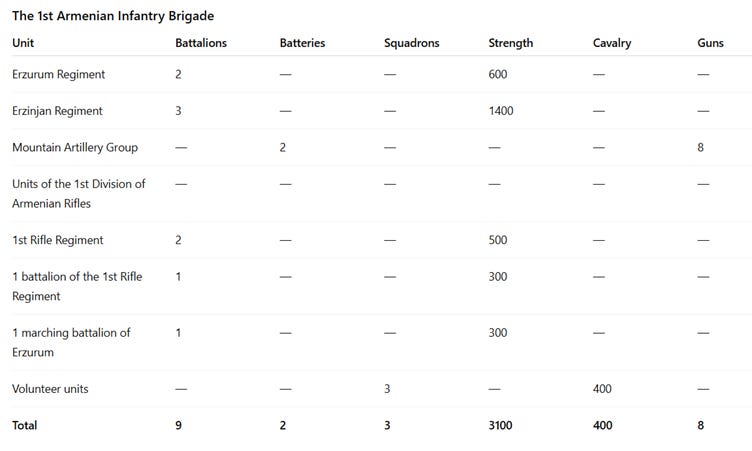
This small force was tasked with halting the advance of superior enemy forces into Transcaucasia and defending the Erzerum region.
At first, the Turks operated from the direction of Erzincan with only two infantry regiments, two cavalry squadrons, and two mountain batteries, all belonging to the 36th Division. However, depending on circumstances, they could easily be
[PAGE 101]
reinforced by other units of the Turkish army operating on the Caucasus Front, which now had complete freedom of manoeuvre after the withdrawal of the Russian forces.
On 23 February mounted patrols of the 36th Turkish Division appeared near Yeni-köy and Ashkala, while forward detachments of the same division were observed at Mamahatun and in the Kup-dag defile. As it advanced, the division was reinforced by the Kurdish population, which supplied up to 3,500 armed horsemen.
***
Before proceeding to a description of the actual military operations, it is necessary to consider the situation as a whole, as it appeared at that time on the theatre of war in general and in this region in particular.
The regular Turkish troops were effectively supported not only by the Kurds but by the entire Muslim population. In the region of the Erzerum fortress alone there were up to 20,000 Muslims, of whom about 7,000 were armed. In Erzerum itself there openly existed a “National Muslim Society,” created immediately after the Russian Revolution and the collapse of the front.
This society was the central body of all the Muslims of the region and maintained close secret contact with the Turkish staff, which directed the preparation of an uprising.
The Armenian commandant was well aware of the dangerous activities of this organisation, but, lacking sufficient forces, considered it impossible to resort to energetic measures and feared further aggravating the critical situation created by the withdrawal of the Russian army.
[PAGE 102]
The fortified region of Erzerum, equipped by Russian engineers with a view to prolonged resistance, no longer in any way corresponded to the forces that were to defend it. The necessity of guarding at least the important tactical points led to the dispersal and weakening of the troops, not to mention that the group had to assign up to 300 men daily to guard various administrative institutions of the fortress.
The artillery of Erzerum numbered approximately 400 field and fortress guns of calibres from 7.7 to 15 cm, but there were only 40 officers and 400 soldiers available to serve them. Moreover, during the period of the revolution the entire arsenal had suffered greatly and had become almost unusable.
Of these 400 guns, only 16 field pieces were serviceable and capable of opening fire; the rest, together with heaps of shells, were buried under deep snow, as no one had taken care to clear them.
All the engineering works of the fortress were in the same condition.
As for food supplies, the region had already been exhausted by the Russian army. It was necessary to draw upon the stores of the fortress itself, but the depots had been partially looted by Russian soldiers who had passed through Erzerum over the course of two months, and it was also necessary to feed the many refugees who had entered Erzerum following the army.
For the horses there remained only hay, and that in limited quantities, with no hope of obtaining more from the rear; these poor animals could no longer be used for work.
The morale of the troops was put to the test by rumours of peace negotiations with Turkey, for while the Turks resumed
[PAGE 103]
their offensive in order to seize Erzerum and reconquer all of Turkish Armenia, they were at the same time taking the initiative in opening peace negotiations.
On 23 February, the very day of the opening of the Seim, the Transcaucasian Commissariat received a radiogram from General Ferik Vehib Pasha, commander of the Turkish army on the Caucasus Front, informing, on behalf of the Turkish Government, that its plenipotentiary representatives were ready to depart from Constantinople for Tiflis in order to determine preliminary conditions that might serve as a basis for concluding peace and recognising the Transcaucasian Government.
To understand this proposal of the Turkish Government, one must recall that as early as 14 January General Odishelidze, commander of the Caucasus Army, had received a letter signed by Vehib Pasha, dated 9 January No. 430, in which the Turkish general wrote:
General Enver Pasha would like to know what possibilities exist for the resumption of relations with the Independent Caucasian Government and on what basis the Independent Caucasian Government might renew peaceful relations between the two countries.
For this purpose His Excellency, with benevolent intent, proposes that I send to the capital of the Caucasian Government a commission of representatives, considering this mission useful from the point of view of establishing in the near future a just peace desired by both sides.
The Transcaucasian Commissariat was able to respond to this proposal only two weeks later.
On 17 January the Congress of the Regional Centre of Soviets of Workers’, Soldiers’ and Peasants’ Deputies decided from the outset that Transcaucasia, as part of the Russian Republic, could begin peace negotiations only after receiving authorisation from
[PAGE 104]
the Constituent Assembly, which was to convene in Moscow. But since the Constituent Assembly was soon dispersed by the Bolsheviks, the Transcaucasian Commissariat, in agreement with the Presidium of the Regional Centre and representatives of the national councils, decided at a meeting on 28 January to invite to a conference in Tiflis on 13 February representatives of Ukraine and the South-Eastern Union, which had not recognised the Bolshevik government, to discuss the Turkish proposals.
It was in this sense that the Transcaucasian Government sent its reply on 28 January to General Ferik Vehib Mehmed, indicating that:
The Transcaucasian Government must coordinate its steps directed toward ending the war with the opinions and views of other independent governments of the Russian Republic, which are equally interested, like the Transcaucasian Government, in concluding peace.
The letter further stated that, in view of these circumstances, a final reply to the proposals of the Turkish Government would be given within three weeks.
Meanwhile, this proposed conference in Tiflis with the independent governments of the neighbouring territories of the Russian Republic did not take place.
The Government of the South-Eastern Union found the proposed date too near because of interrupted communications, and the reply of the Ukrainian Government was never received.
Thus, the Transcaucasian Commissariat decided to conduct independent negotiations and telegraphed on 19 February 1918 to General Ferik Vehib Pasha that it was ready to begin negotiations, but that the basic directives
[PAGE 105]
and conditions of peace had to be worked out by the Transcaucasian Seim—the sole representative body of all Transcaucasia—which was to convene in Tiflis on 23 February.
To this telegram General Ferik Vehib Pasha replied on 23 February, stating that the Turkish delegates were ready to depart from Constantinople for Tiflis to begin peace negotiations.
As we see, Transcaucasia had not separated from Russia, but, unwilling to recognise Bolshevik authority, had merely formed a provisional government and wished to act in accordance with the interests and viewpoints of the South-Eastern Union and Ukraine. The Turks, for their part, and with them the Central Powers, sought to take advantage of this situation to push Transcaucasia toward proclaiming its independence.
The letter of General Vehib Pasha of 16 January, addressed to General Odishelidze, commander of the Caucasus Army, and received by the Government in Tiflis on 14 February 1918, is very characteristic in this respect.
In that letter Vehib Pasha, vested with the necessary authority, proposed that the Transcaucasian Government send plenipotentiary representatives to Brest-Litovsk, where the delegates of the Central Powers would do everything possible to have the Transcaucasian Government recognised as independent.
As is known, this policy, imposed by the Central Powers, prevailed. Transcaucasia, which did not recognise Soviet authority—ready to cede to Turkey a large part of its territory and disregarding the interests of that country and its peoples—vainly hoped to continue the struggle with the support of
[PAGE 106]
Southern Russia. These circumstances compelled Transcaucasia to accept the Turkish proposal and begin independent preliminary peace negotiations in the hope of preserving the integrity of its territory by that means.
At its session of 1 March 1918 the Seim unanimously adopted the principles of the peace negotiations:
In essence they were as follows:
The Transcaucasian Seim, under the present conditions, fully assumes the authority to conclude peace with Turkey.
The Transcaucasian Seim enters into negotiations with the aim of concluding a final peace with Turkey.
The restoration of the state frontier between Russia and Turkey as it existed at the time of the declaration of war in 1914 should serve as the basis of the peace treaty.
The delegation must defend the right of self-determination for Eastern Anatolia, in particular ensuring recognition of the autonomy of Turkish Armenia under Turkish sovereignty.
The composition of the delegation was determined the following day. It included five Muslims, four Georgians, and two Armenians.
Considering the presence of Turkish delegates in Tiflis undesirable in view of ongoing military operations at the front, the Transcaucasian Commissariat expressed in a telegram of 25 February, addressed to the commander of the Turkish army on the Caucasus Front, the wish to convene the meeting in Trebizond or in any other place of his choosing.
However, the departure of the delegation to Trebizond was postponed after news was received of the signing on 3 March of the peace treaty at Brest-Litovsk, under which Batumi, Kars, and Ardahan were transferred to Turkey.
[PAGE 107]
Deprived of any information regarding the subsequent policy of the Ottoman Government, the delegation was compelled to wait in Tiflis for a reply to its telegrams sent simultaneously to Trebizond and to the Turkish General Staff to clarify this point.
Only on 7 March was the delegation informed that the Turkish delegates were expected that same day in Trebizond, and it immediately departed for that city, arriving the following day.
But the Turkish delegates deliberately delayed their arrival; they came only on 12 March, and the conference began on 14 March.
***
Above we have already indicated that, in order to cover Erzerum from the direction of Bayburt and Mamahatun, an advance guard composed of an understrength battalion with two mountain guns and 200 cavalrymen was stationed near the village of Korchma at the junction of the Erzerum–Bayburt and Erzerum–Mamahatun roads.
This advance guard placed patrols in Ashkala and in the gorge of Yeni-Köy, which, under enemy pressure, withdrew on 25 February back to Korchma.
On the morning of 27 February, an enemy advance guard consisting of 400 bayonets, two mountain guns, and 300 men of Kurdish cavalry attacked the Armenian advance guard, but after a three-hour battle was driven back.
On 28 February, the Armenian advance guard, under pressure from superior enemy forces and facing the threat of being encircled from the direction of Yeni-Köy, was compelled to withdraw to Aladja. On 2 March it continued its retreat toward Ilidja, into the fortress area.
[PAGE 108]
In order to reinforce the Ilidja detachment, the fortress commandant, General Andranik,8 sent forward part of the 1st Armenian Rifle Regiment (500 bayonets), while the regiment itself, in order to cover its right flank, occupied the village of Araz and then the line Archik–Isavank.
Bands of armed Muslims, who had been concentrated to the north-west of Erzerum with the intention of joining the Turks, were driven back and dispersed; but before they had been completely eliminated in the south-western sector of the fortified area, the Turks began concentrating their forces opposite the front of the detachments at Ilidja and Taki-deresi and then attacked them.
The small Erzerum garrison faced the Turkish 36th Infantry Division, soon reinforced by Turkish troops arriving from the direction of Bayburt and Erzincan.
On 8 March, around noon, the enemy began an offensive from the direction of Arinkara against the right flank of the Ilidja detachment near the village of Archik, but was repulsed and withdrew to its former positions.
The concentration of Turkish troops at Aladja
[PAGE 109]
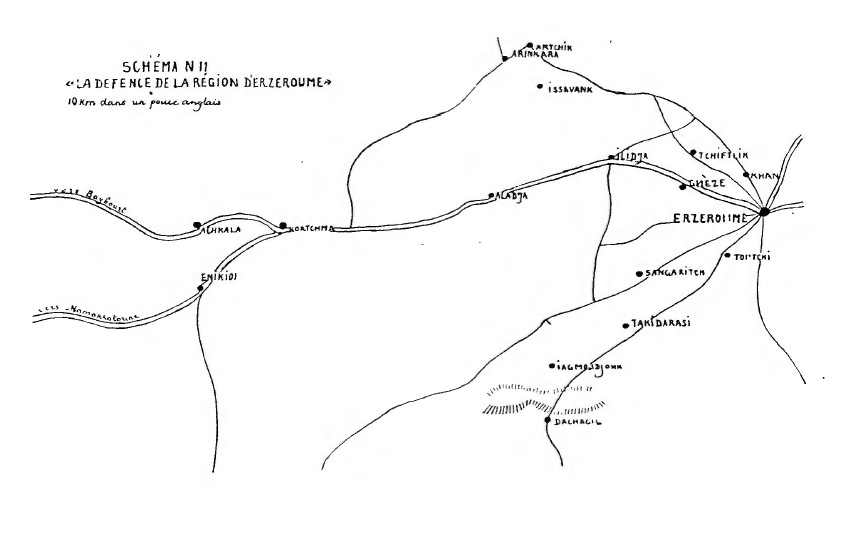
[PAGE 110]
continued on 9 and 10 March, and on 11 March at dawn they again went over to the offensive against the positions of the Ilidja detachment.
By 9 a.m., the enemy’s numerical superiority had already become evident. Observing Turkish manoeuvres with the clear intention of enveloping his flanks, the detachment commander decided around midday to withdraw to the village of Gez, in immediate proximity to the belt of fortress fortifications, and occupied the village of Khan.
Reinforced by a battalion sent to assist by the fortress commandant, the detachment launched a counter-attack in order to retake the heights of the village of Gez, but it failed.
On that day, the Ilidja detachment lost 130 men killed and wounded.
At the same time, fighting began in Taki-deresi. An enemy column numbering 2,000 men (including Kurdish cavalry) advanced from the direction of Kegi toward Taki-deresi–Erzerum.
By 25 February the enemy had concentrated at Dashakhli and appeared to be adhering to a passive tactic; however, it sent a hundred Kurds through the Shaitan-dag gorge toward the village of Yagmujuk to observe the Taki-deresi detachment.
This detachment numbered only 250 bayonets, 4 machine guns, and 50 cavalrymen. Communication with the Ilidja detachment was maintained by patrols in the village of Sangarich, but from 6 March this communication was cut off. The patrols were attacked by enemy forces numbering about 300 men and, after a two-hour battle, withdrew to Taki-deresi for fear of being encircled.
While these events were taking place on 9, 10, and 11 March on the front of the Ilidja detachment, the enemy group
[PAGE 111]
concentrated in the area of the villages of Dashakhli and Yagmujuk began its offensive on 9 March from the direction of Yagmujuk against Taki-deresi.
This attack, initially repulsed, was renewed at dawn on 11 March. The commander of the detachment at Taki-deresi held firmly to his position, but, learning of the withdrawal of the Ilidja detachment, also decided to withdraw to the belt of Erzerum’s fortress fortifications. This was timely, because during his stubborn resistance he had weakened his flanks, and it became necessary to cut a path with bayonets through the Turkish ranks.
This brilliant success was achieved thanks to the courage of the personnel and the energy of the commander, Colonel Torgom,9 who was concussed and under whom two horses were killed. Only by evening did the detachment reach the fortress fortifications, having lost during these three days of fighting 93 men killed and wounded out of a total strength of 350 combatants, and 40 horses.
On 11 March, towards evening, scouts reported the concentration of enemy forces numbering approximately one division on the western front of Erzerum and the occupation of the area of the villages of Ilidja–Gez. The Kurds, numbering 1,500 men, were positioned on the flanks of the regular Turkish troops near the villages of Chiftlik–Tuchi. In the fortress of Erzerum itself there were about 4,000 armed Muslims, who were acting in concert with the Turks.
Against all these forces, the defenders of Erzerum numbered in their ranks only 3,000 men.
Under these circumstances it was impossible to count on serious resistance; the extent of the fortress fortifications was in absolute disproportion to the available strength of the garrison, while at the same time
[PAGE 112]
the artillery and engineer units were deprived of ammunition. The troops were left without communications, and the city was flooded with refugees pouring in from all sides.
At about 8 p.m. on 11 March, General Andranik, the fortress commandant, convened an extraordinary council of war, which decided to evacuate Erzerum and retreat.
At about 5 a.m. on 12 March, the baggage train and refugees were sent toward Hasan-kala. At 7 o’clock the troops set out, covered by a rearguard which took up positions near the Kharberd and Trebizond gates on the western side of the fortress fortifications.
At about 9 a.m., the Turks attacked almost simultaneously the Kharberd and Trebizond gates. After a short but violent struggle, the weak rearguards, seeing the threat of encirclement and having behind them the armed and hostile population of the city, were forced to withdraw, cutting their way with bayonets through the enemy lines.
Murad’s brave cavalrymen were the last to leave the city in accordance with the order received, after repelling several attacks by the urban population, which attempted to seize the fortress gates.
Before abandoning Erzerum, the troops, as far as possible, destroyed artillery installations and engineer matériel that could still be of use, as well as commissariat depots.
The pursuit by regular Turkish troops did not go beyond the fortress fortifications; the enemy contented itself with their capture and the restoration of order, for the city was already in the hands of looters.
[PAGE 113]
Thus, the Erzerum group was able, without particular difficulty, to proceed via Hasan-kala to the 1914 frontier.
In the Battle of Erzerum on 12 March, the group lost 130 officers and soldiers killed, 95 wounded, and 60 taken prisoner.
120 Armenian peasants who were unable to leave the city in time were torn to pieces by the mob.
After the loss of Erzerum, the struggle for Turkish Armenia ended, and the war crossed the frontiers of Transcaucasia.
[PAGE 114]
CHAPTER XVIII: SARIKAMISH
15 March: General Nazarbekov, commander of the Armenian National Corps, was appointed commander of the entire front line stretching from Olti to Khanat and Maku. The Olti–Batumi line to the north of the Armenian Corps was to be defended by the Georgians. Command of these two corps was united in the person of the commander-in-chief of the front, General Lebedinsky, with headquarters in Tiflis, who in turn was subordinate to the Transcaucasian Commissariat, formed, as we have said above, on 18 November 1917.
On 14 March 1918, the Erzerum group, covering the departure of refugees from that district, withdrew to the old Russo-Turkish frontier, supported by detachments left in Karaurgan and Medjingert, by scouts in Bardus and Karakurt, and joined the main forces at Sarikamish.
After the evacuation of Erzerum, the position of the detachment left at Hnys-kala, consisting of the 2nd Armenian Rifle Regiment and the 2nd Brigade (the Hnys and Karaklisa regiments, formed from Armenians of that district), became critical.
This detachment was to form a barrier against the Turkish advance between Hnys and Lake Van, but in view of the above-mentioned events its commander was ordered on 12 March to abandon the position and withdraw.
[PAGE 115]
The 2nd Armenian Rifle Regiment withdrew accordingly as far as Kepri-köy, where it effected its junction with the retreating Erzerum group, while the 2nd Brigade was directed via Kop–Melazgert to Karaklisa of Alashkert.
The Armenian Corps, which alone was to replace the entire former Russian Caucasian Army, occupied the following positions:
DISTRICT OF SARIKAMISH – KARAURGAN – MEDJINGERT
A Special Officers’ Detachment (composed entirely of Russian officers);
1st Armenian Brigade (Erzincan and Erzerum Infantry Regiments);
1st and 2nd Armenian Rifle Regiments, 1st Battalion of the 4th Regiment;
3rd and 7th Regiments transferred to Sarikamish from Kars and Alexandropol, 1st Cavalry Regiment from Tiflis;
This group, composed for the most part of units of the 1st Armenian Rifle Division and the 1st Brigade with its artillery, and commanded by General Areshev,10 numbered 13 (understrength) battalions, 30 field and mountain guns, and 4 cavalry squadrons.
DISTRICT OF THE ALASHKERT VALLEY
2nd Brigade (Hnys and Karaklisa Regiments) with its artillery.
In total: 4 battalions and 8 guns, arrived from Hnys.
DISTRICT OF VAN
5th Armenian Rifle Regiment and 3rd Brigade (1st and 2nd Van Regiments) with its artillery.
In total: 6 battalions and 8 guns.
[PAGE 116]
Behind these troops, which were in immediate contact with the enemy, the corps commander placed on a second line the following mobile and manoeuvrable forces:
The Erivan group, commanded by the commander of the 2nd Armenian Rifle Division, composed of one battalion of the 4th Armenian Rifle Regiment, the 6th Armenian Rifle Regiment, the 2nd Cavalry Regiment, and the Artillery Brigade of the 2nd Division. In total: 3 battalions, 4 cavalry squadrons, and 20 guns.
At Alexandropol: the 8th Armenian Rifle Regiment, fortress units, one mountain horse battery, and one howitzer battery.
In Tiflis the formation of the following units was nearing completion: the Makin Regiment, which was to guard the Erivan–Julfa road line, and the Zeitun Cavalry Regiment.
The Kars garrison consisted mainly of technical units servicing the fortress, its own garrison regiment (3 battalions), and the Kars Cavalry Regiment.
When the war crossed the frontiers of Transcaucasia, the command could still count on the possibility of using the Lori, Kazakh, and Akhalkalaki regiments, which were stationed in the Lori steppe, in Kazakh and Akhalkalaki, but it could not touch the formations stationed in Shushi, Nakhichevan, Elisavetpol, Akhaltsikhe, and in the Nukha district, which were intended to guard the rear of the troops and to protect the local Armenian population.
Armenian troops consisting of soldiers and officers transferred from the European front and concentrated in Baku found themselves cut off from Armenia as a result of the cessation of all railway communication. Subsequently they would play an important role in the operation to defend Baku.
[PAGE 117]
The groups and detachments included technical units and troops specially assigned to guard lines of communication.
In total, to resist the Turks, the maximum at the disposal of the Armenian command was 36 understrength battalions, amounting to 15,000 bayonets, on a front 250 kilometres in length.
Intelligence reported the presence on the Turkish side of at least five divisions: three divisions—namely the 5th, 11th, and 36th—in the first line on the main Erzerum–Sarikamish–Kars axis, one division in the Alashkert valley, and one division in the Lake Van district.
Approximately in mid-March, on the front of the advance guards of the Sarikamish group, at Bardus, Karaurgan, Medjingert, and Karakurt, it was established that Turkish reconnaissance detachments were becoming increasingly active. At the same time, in the rear of the group, especially in the Selim district, bands of armed Tatars and Kurds raided the Kars–Sarikamish railway line and harassed the Armenian population.
On 23 March, the advance guard of the Karaurgan detachment, composed of volunteers, was attacked by two Turkish battalions with two guns and a cavalry squadron.
Facing these superior forces, the detachment withdrew to Khan-dere, where it was reinforced by an officers’ unit sent in haste from Sarikamish.
After occupying the Sirbasan heights, the Turks halted, and for an entire week quiet prevailed on the front, broken from time to time by clashes between reconnaissance units.
But on 30 March the Turks renewed their offensive against the units covering Karakurt, and on 2 April against Bardus, capturing the villages of Chermek
[PAGE 118]
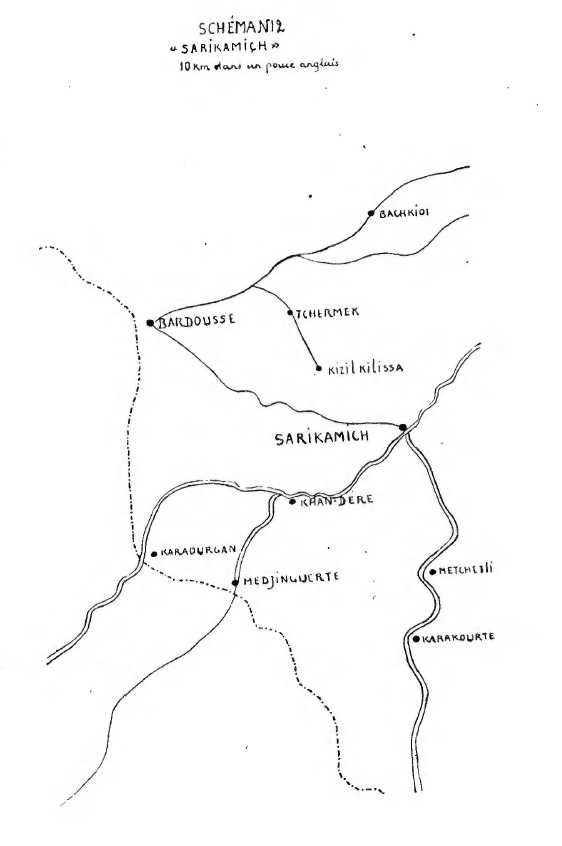
[PAGE 119]
and Kizil-kilisa. On 3 and 4 April they continued their advance toward Khan-dere from the direction of Karaurgan and Medjingert.
The total strength of all these Turkish advance guards was not less than six battalions.
At the same time, Tatars and Kurds continued their raids in the Novo-Selim district.
On 4 April the defensive line of the Sarikamish group ran along the ridge of heights east of the villages of Chermek and Kizil-kilisa, along the Sirbasan heights, across the Esnos pass and Mount Vank, ending at the village of Mechetli. The main forces of these troops were located at Sarikamish. Turkish success in the direction of Varishan from Bardus threatened the rear of the Sarikamish group.
On 4 April the Turkish offensive begun in that direction was repulsed, but despite this success the position of the group, threatened with attack from the rear and flank, was becoming critical; all the more so because bands of armed Kurds and Muslims had seized the village of Bash-köy in the Novo-Selim district.
The Sarikamish group, despite its insufficient strength, was thus tasked with halting the Turkish advance along a 50-kilometre front and, in addition, securing the line of communication, which was incessantly harassed by Muslim bands.
Despite the precarious position in which the Sarikamish group found itself, the corps commander, General Nazarbekov, decided to hold out to the last in order to give time for the local population of the district and, in particular, the Kars fortress, whose imminent encirclement could easily be foreseen, to withdraw.
On 5 April the Turks attacked the centre of the Sarikamish group, threatening chiefly its right flank in the direction of Varishan.
[PAGE 120]
After a fierce battle, this village, defended by the 1st Brigade under Colonel Morel, fell into Turkish hands. The loss of this important point hastened General Areshev’s order for the group to retreat, which was carried out on the night of 5–6 April in the direction of Novo-Selim, after the destruction of all depots and the railway station.
The Sarikamish group risked being cut off from Kars if, after taking Varishan, the Turks advanced along the line of the Kars–Sarikamish railway.
To prevent this danger, Colonel Morel, with the remnants of his brigade (the Erzincan and Erzerum regiments), launched a counter-attack against the Turks, which was crowned with success: the village of Varishan was retaken and the enemy put to flight to the west.
During this time the main forces of the Sarikamish group were retreating with fighting in the direction of Novo-Selim.
On 7 April the commander of the Sarikamish group decided to choose a more advantageous defensive position, abandoning Novo-Selim, which lay on the plain.
The whole group entrenched itself on the line of the villages of Yengidzhak–Bazargan–Kikach–Olukhli; the 2nd Brigade, arriving from the Alashkert valley, was to cover the left flank from the direction of Kagyzvan.
We indicated above that on 12 March the army commander had given the Hnys detachment the order to begin its retreat. Accordingly, the 2nd Armenian Rifle Regiment was withdrawn to Kepri-köy, and the 2nd Brigade (the Hnys and Karaklisa regiments) moved via Melazgert to Karakilisa of Alashkert.
The course of operations on the main Erzerum-Sarikamish-Kars axis compelled
[PAGE 121]
the recall of the 2nd Brigade from the Alashkert valley to Kars, while the 5th Armenian Regiment and the 3rd Brigade (the 1st and 2nd Van regiments) were sent to the Lake Van district and thus found themselves in complete isolation at Bayazet.
These latter troops were maintained in this position until the middle of April, as cover for the southern frontier of the Government of Erivan, and were subsequently concentrated at Igdir, without, however, leaving those frontier passes unguarded.
Thus, at the beginning of April the Armenian Corps, forced to defend the entire front, held the following positions:
The Sarikamish group: 17 battalions on the Yengidzhak-Kikach-Olukhli-Berna front;
The Erivan group: 9 battalions, to defend the line marked by the Araks river;
The garrisons of the fortresses of Kars and Alexandropol, as well as other local units; the latter were intended for auxiliary services and the maintenance of order;
Reserve: 4 battalions at Alexandropol (the 8th Rifle Regiment and the Makin battalion, which arrived on 10 April from Tiflis).
[122]
CHAPTER XIX: THE STRUGGLE FOR KARS
On 14 April the enemy forces, consisting of three divisions, occupied with their advance detachments, in the direction of Kars, the line of the following villages: Kara-kala–Kamyshli–Kara-khamza–Yalagu-secham. Kurdish bands operated in the area of Merdenek, Jelaus, Grenaderskoe, and even seized Ardahan. Thus, in the end, the enemy held not only the approaches to the city, but also the roads leading to the Akhalkalaki and Alexandropol highways—that is, in the rear of the Armenian troops operating at Kars.
The forward units, 15 battalions (the former Sarikamish group), occupied the line Yengidzhak–Bazargan–Kechik–Novo-Selim–Akpungar–Tekhnis.
The 2nd Brigade occupied the village of Pasli in the direction of Kagyzvan.
To protect the Kars–Alexandropol railway line, the village of Prokhladnaya and the Mazra station were reliably fortified.
Owing to the shortage of forces, defensive measures were limited to reconnaissance in the direction of Jelaus and Merdenek.
In the same period the garrison of the Kars fortress was reinforced by the 3rd Armenian Rifle Regiment with its 7 infantry battalions, 8 fortress artillery companies, and 1 engineer
[PAGE 123]
company. The strength of the seven battalions did not exceed 3,000 bayonets. With these weak forces it was necessary to occupy a circular defence along a 25-kilometre line of forts.
The eight artillery companies had in their ranks only 60 officers and 1,700 soldiers, 60% of whom were infantrymen trained hastily under a very abbreviated programme. That was all that was available to service 100 field guns and 12 guns of 15-centimetre calibre, placed without cover in the forts and fortifications. The fortress also had a further 700 bronze field guns of an old model and about 100 fortress guns of the 1877 pattern, but the idea of using them had to be abandoned for lack of specialists.
To maintain order in the city, four mounted squadrons were hastily formed from the local population.
The situation was better with the engineer units, and in this respect the defence of the fortress was in a satisfactory condition. The medical services, food supply, and commissariat functioned without particular difficulty.
Such, in broad outline, was the situation on the front of the Armenian Corps troops defending the approaches to Kars, and the condition of the fortress at the moment of the Turkish invasion of this district.
Nothing important occurred on the front of the troops defending the approaches to Kars until the night of 18–19 April. Only the reconnaissance detachments of both sides showed some activity, and thanks to their vigilance it soon became possible to establish that the Turks operating in the direction of Kars had no fewer than three divisions.
At dawn on 19 April the Turkish offensive intensified against the Corps units defending, as we have
[PAGE 124]
noted above, the line Yengidzhak–Bazargan–Kechik–Novo-Selim–Akpungar–Tekhnis–Agadeve.
To hold all these positions, with a total length of 30 kilometres, the detachment commander had only 15 understrength battalions.
The enemy offensive developed in two directions: against the left flank of the group near the village of Agadeve, in order to seize the Akdevelar heights, and against its centre in the direction Novo-Selim–Dolband.
During these operations the Turks succeeded in capturing the Kazik-kaya heights in the direction of Agadeve and in reaching the centre of the Novo-Selim–Dolband line. Thus the left flank was threatened, and if the Turkish advance in that direction had not been stopped, the detachment risked being cut off from Kars and at the same time losing its communications with Alexandropol.
To meet this threat the group commander decided to reinforce it and sent one infantry battalion to it, while the Special Officers’ Detachment was attached to the Agadeve garrison, and the cavalry regiment was to operate against the enemy’s right flank to the east of Mount Akdevelar.
Thus reinforced, the left flank drove the enemy from Mount Kazik-kaya with a brilliant attack and restored the situation. In the centre of the position the enemy was likewise first halted and then thrown back to the Olukhli-Yalguzcham line by a bold counter-attack.
But the Turks, by manoeuvres threatening the encirclement of the left flank and the centre of the group, forced the defenders to exhaust their reserves, while at the same time concentrating more than one infantry regiment against the position of the Erzerum Regiment of the 1st Brigade at Bazargan-Kechik.
[PAGE 125]
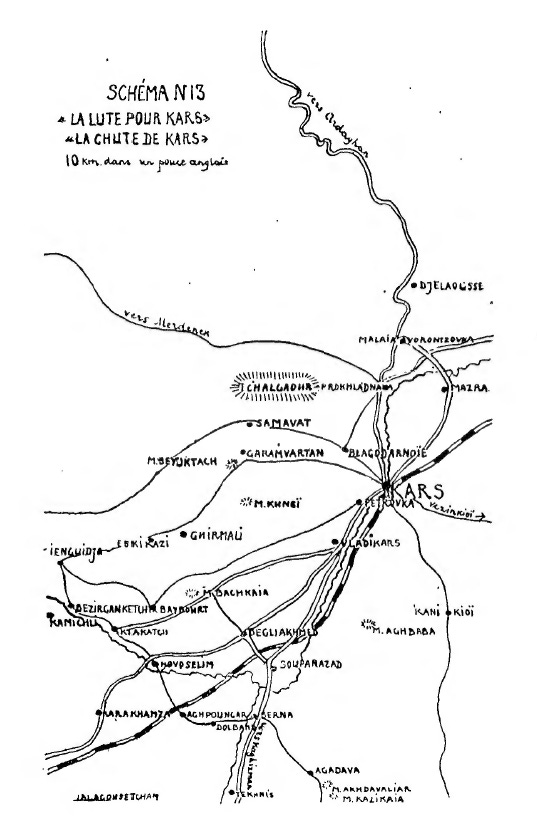
[PAGE 126]
The resistance of the Erzerum Regiment was finally broken; the line Yengidzhan–Bazargan–Kechik–Kikach was abandoned, and the troops withdrew to the line Jarmali–Besh-kaya.
Although the Turkish advance had been halted by 18:00, the group commander (the sick General Areshev was replaced by General Ter-Akopov11), after abandoning the right sector, which exposed the right flank of the centre at Novo-Selim, and having no reserves to restore the situation on the right, was compelled to order the entire centre to withdraw to the line Begli–Ahmed–Supanazad.
In this battle the detachment lost 3 officers and 99 soldiers killed, 11 officers and 153 soldiers wounded, and 70 soldiers missing.
This loss of 325 men (apparently an author’s error; adding the figures gives 336 men. — Translator’s note) and, especially, 14 officers, was very keenly felt by the detachment, which had in its ranks only 15 battalions and 6,000 bayonets and could not count on the arrival of trained reinforcements.
The enemy’s numerical superiority, advancing on a very wide front, forced the Armenian group to defend a line out of proportion to its strength. The lack of reserves and the hasty, insufficient training of new local formations did not allow manoeuvre and in effect condemned the group to a passive tactic and a successive withdrawal in the direction of Kars.
But even if the overall situation remained critical, the latest battles showed that the troops, despite their small numbers, rear-area disorganisation, and the anxiety caused by the country’s political situation, were still capable of fighting. Consequently,
[PAGE 127]
we were entitled to hope to prolong the struggle until the Allies’ final victory.
Such was the impression carried away by the commander-in-chief of the front, General Lebedinsky, during the battle of 19 April in the Novo-Selim sector, in the presence of the commander of the Armenian Corps, General Nazarbekov, accompanied by the chief quartermaster General Kvinitadze, General Korganov,12 deputy chief of staff of the front, and Colonel Chardigny, head of the French military mission in the Caucasus.
Returning from the front on the evening of the same day (19 April), General Lebedinsky visited in Alexandropol the Armenian National Council under the chairmanship of Mr Aharonyan and set out his views on continuing the struggle. His opinion strengthened the resolve of the overwhelming majority of Council members not to lay down their arms.
At dawn on 22 April the enemy offensive resumed along the entire front line. The most stubborn fighting was on the left sector between the village of Supanazad and Mount Akdevelar, while other Turkish forces at about 6 a.m. advanced from the direction of Eski-kazi and Bayburt toward Mount Besh-kaya.
At about 8 a.m. on the left sector the Turks seized the Akdevelar height and at about 10 o’clock Mount Besh-kaya.
The loss of these two tactical keys compelled the group commander to order a retreat and a successive withdrawal of the troops under enemy pressure in order to occupy a new defensive line running from the village of Garam-Vartan along the heights of Beюк-tepe, Kunsi, Ak-baba to the village of Khani-köy.
[PAGE 128]
To the north of Kars the Kurds seized the Russian villages of Malaya Vorontsovka, Prokhladnaya, and Romanovo, and their bands were seen beyond Bashkардиклар.
Toward evening reconnaissance reported that Turkish columns were moving on Blagodarnoye in order to outflank Kars from the north.
The group commander ordered a battalion of the 7th Regiment with two guns and one cavalry squadron, which were covering the withdrawal of the troops in the centre of the position, to occupy the village of Samavat immediately. But this detachment was able to set out for its destination only at 22:00 on 22 April and occupied the indicated sector on 23 April at about 10:00.
Before proceeding to a description of the operations that led to the evacuation of the Kars fortress on 25 April, it is necessary to set out in broad outline the political situation that had developed by this period.
[PAGE 129]
CHAPTER XX: THE TREBIZOND CONFERENCE AND THE DECLARATION OF TRANSCAUCASIAN INDEPENDENCE
As noted above, the Transcaucasian delegates appointed to conduct peace negotiations with Turkey arrived in Trebizond on 8 March, where, according to information received, the Turkish delegates were already expected to have arrived the previous day. In fact, they did not arrive until 12 March, and this delay—conceived in Constantinople and desired—had its reason. These few days gained allowed the Government of the Sublime Porte to rely on an accomplished fact: in accordance with the Treaty of Brest-Litovsk, the districts of Batum, Ardahan, and Kars were no longer part of Transcaucasia, and the planned conference at Trebizond could not discuss this point.
On 10 March, General Ferik Vehib Pasha, commander of the Turkish forces, telegraphed General Lebedinsky, commander-in-chief of the Caucasian Front, obliging him to evacuate Batum, Kars, and Ardahan as soon as possible.
On the same day he telegraphed General Odishilidze, army commander, stating that he was compelled to continue his advance to liberate districts inhabited by Muslims, whom, he said,
[PAGE 130]
the Armenians had begun to massacre after his (General Odishilidze’s) withdrawal from Erzerum.
On 12 March a meeting took place between the heads of the delegations, and a note was delivered by the Transcaucasian delegation requesting explanations regarding Vehib Pasha’s demand for the evacuation of Batum, Kars, and Ardahan, which could easily be interpreted as a refusal to continue negotiations.
The head of the Turkish delegation replied orally that the arrival in Trebizond of the Ottoman delegation itself demonstrated the desire of the Sublime Porte to begin peace negotiations with Transcaucasia. As for General Vehib Pasha’s demand for the evacuation of the said districts, he knew nothing about it and could say nothing.
The conference opened on 14 March.
At this first official session, the Ottoman delegation asked the Transcaucasian delegation to provide brief information on the nature, form, and political and administrative organisation of the Transcaucasian republic.
The Transcaucasian delegation replied that after the Bolshevik coup a new independent government had just been established, now responsible to the Sejm; that Transcaucasia in fact formed a state already engaged in international relations and which had protested against the Brest-Litovsk Treaty concluded without its knowledge. It had not yet been able to notify the great powers of its independence.
Evidently not satisfied with this explanation, the Ottoman delegation sent a new note in which, recognising that treaties concluded between two states are not binding upon a third, it emphasised that in order to benefit from this axiom of
[PAGE 131]
international law, Transcaucasia must constitute itself in accordance with international law and seek recognition from all other states. Moreover, the Ottoman delegation declared that recognition cannot have retroactive effect, and that the Transcaucasian government, which in its telegram of 28 January had stated “that it must coordinate its actions with those of the other autonomous governments of Russia” and had refrained from sending representatives to the Brest-Litovsk Conference, was thereby to be regarded not as an independent state but as a member of the Russian Federative Republic. The Ottoman delegation accordingly considered that it could not accept the Transcaucasian delegation’s statement regarding the illegality of the Brest-Litovsk Treaty insofar as it concerned the Caucasus.
The Transcaucasian delegation replied that the very presence of two delegations at the Trebizond Conference was in itself proof that both sides were disregarding the Brest-Litovsk Treaty.
The Turkish delegation objected that the negotiations undertaken had as their sole purpose the preparation of a basis for future economic and commercial relations and the clarification of practical and technical details not determined by the Brest-Litovsk Treaty, so as not to prejudice the significance of that treaty.
The Transcaucasian delegation maintained its position and on 22 March asked the Turkish delegation to accept the principles adopted by the Sejm on 1 March, repeating its statement that even before the date of ratification of the Brest-Litovsk peace treaty the independent Transcaucasian state had already fulfilled all the formalities required by international law.
[PAGE 132]
The Ottoman delegation protested against the clause concerning “recognition for the peoples of Anatolia of the right to determine their own fate,” regarding this as interference in its internal affairs, and declared that final and official recognition of the Transcaucasian republic could take place only through the inclusion of a special article in the treaty to be concluded, stating that negotiations could begin only after Transcaucasia renounced all claims to Batum, Kars, and Ardahan.
On the same day, 22 March, part of the delegation departed for Tiflis to report to the Sejm, which granted very broad powers to the head of the delegation.
At the last session of the conference, on 5 April, the Transcaucasian delegation, vested with special powers, agreed to the transfer to Turkey of the entire Olti district, the south-western part of the Kars district, the southern part of the Ardahan district, and the western part of the Kagyzvan district.
On 6 April at 7 o’clock an ultimatum arrived from the Ottoman government demanding a response within 48 hours with final proposals.
The ultimatum was due to expire on 10 April at 21:00, but the delegation had received no reply from its government; a new 48-hour deadline was granted, but no answer followed. The head of the delegation, on the basis of full unanimity among its members, replied that the Transcaucasian delegation accepted the Brest-Litovsk Treaty.
The Transcaucasian delegation regarded this consent as a necessity dictated by circumstances, although it was in contradiction with the declared decision of the Sejm.
[PAGE 133]
Let us see what was taking place during this time in Tiflis.
As we have seen, on 6 April the Turkish government demanded a final answer within 48 hours concerning recognition of the Brest-Litovsk Treaty.
The head of the Transcaucasian delegation telegraphed this ultimatum to Tiflis only the following day, adding that in his view the maximum acceptable concessions could concern only the transfer of the Kars district with clarification of its northern and eastern borders, and in the Batum district the entire Artvin region without Artvin itself, but that even under these conditions it would be almost impossible to retain Batum. He added that if by 8 April he remained without directives from the Government and the Sejm, he would consider these proposals accepted.
Although the Government shared the patriotic sentiments of the Presidium of the Sejm and the political parties, it accepted the proposal of the head of the delegation, and the latter on 8 April telegraphed requesting the necessary powers to sign recognition of the Brest-Litovsk Treaty in its entirety if the last proposed concessions were not accepted by the Turks.
This telegram was received by the Government only at 15:00 on 10 April; as a result, the reply could not arrive in time, and the head of the delegation considered himself obliged to declare, on his own initiative, his recognition of the Brest-Litovsk Treaty.
These diplomatic negotiations in Trebizond in no way interrupted military operations.
On 12 April the Turkish commander, relying on the statement of the Transcaucasian delegation of 10 April accepting the Brest-Litovsk Treaty
[PAGE 134]
in full, presented the commandant of the Batum fortress with an ultimatum to hand over the forts by 16:00 on 13 April.
After careful examination of the situation at a session of the Sejm on 13 April, the Government, considering that recognition of the Brest-Litovsk Treaty betrayed the interests of the peoples of Transcaucasia and that its acceptance by the Bolsheviks condemned Russia to the role of a German colony, declared that so long as it retained the confidence of the Sejm it would unite all its forces to resist the demands of the Ottoman government.
All parties of the Transcaucasian Sejm, with the exception of the “Musavat” party, supported the Government and rejected the very idea of possible recognition of the Brest-Litovsk Treaty.
The “Musavat” party, through its representative, declared that the Muslim population of Transcaucasia could not agree to play an active role against Turkey, being bound to it by religious ties; moreover, the representative strongly doubted the possibility of achieving unity among all the peoples of Transcaucasia in the event of renewed hostilities.
Such a declaration by one of the representatives of the Muslims of Transcaucasia (with a population of more than three million) unmistakably revealed the orientation of the Muslim masses, which in advance doomed any attempt to continue the struggle against Turkey to failure.
Despite this, the Sejm adhered to the Government’s decision, and on 14 April the Chairman of the Government sent a telegram to Trebizond ordering the Transcaucasian delegation to return immediately to Tiflis.
Thus the peace negotiations with Turkey were broken off, and the war was continued.
[PAGE 135]
The country was placed under martial law, and a three-man commission vested with extraordinary powers to continue the struggle was established under the Government, but this resolve did not last long.
On 14 April the Turks captured Batum, defended by the Georgians.
The Trebizond delegation returned to Tiflis and entered into direct relations with the Government and the Sejm.
As we have already seen, the formation of the Transcaucasian Commissariat had been prompted by refusal to recognise Bolshevik authority. This separation from Russia, in the minds of its initiators, was to be only temporary, pending a future change in the political regime in Russia. But the hope that Bolshevik power would prove short-lived was not realised. Gradually the idea of Transcaucasian independence began to attract the masses, political parties, organisations, clubs, and others, and was especially strengthened after the shameful Brest-Litovsk Treaty concluded by Bolshevik Russia.
The insistence of the Turkish government and the Central Powers in pressing Transcaucasia to declare its independence created illusions and strengthened the opinion of the supporters of independence that this was the only way out of a hopeless situation.
On 22 April the Transcaucasian Sejm convened in extraordinary session.
The majority of speakers representing the main parties of the Sejm declared their commitment to independence. Only the party of the Russian Socialist-Revolutionaries and the representative of the Russian population in Transcaucasia resolutely opposed this act.
In the end, the decision was taken to proclaim the Transcaucasian Federative Democratic Republic.
[PAGE 136]
On the same day the Government headed by Gegechkori resigned, and the Chairman of the Sejm, after consultations with the parties, proposed to Chkhenkeli, head of the Trebizond delegation, to form a cabinet.
At the same time, the Sejm, having heard the report of the peace delegation, instructed the Government (which at that moment had not yet been formed) to continue peace negotiations and to do everything possible to conclude them as soon as possible.
Thus the Sejm, which on 13 April had supported the Government in its determination to continue the struggle to the death, suddenly changed its position nine days later.
[PAGE 137]
CHAPTER XXI: THE FALL OF KARS
By the morning of 23 April, the units of the Armenian Corps operating in the Kars direction had completed their concentration on the front running from the village of Samavat, the village of Garam-Vartan, the height of Beyuk-tepe, the height of Kunsi, the height of Ak-baba, to the village of Khani-köy, in immediate proximity to the line of the Kars fortress fortifications.
The troops came into contact with the enemy, and soon battle was raging along the entire front when, at 13:30, the commander of the Armenian Corps, General Nazarbekov, received three telegrams of the following content:
No. 1
To the Commander of the Armenian Corps, General Nazarbekov,
To the Commander of the Georgian Corps, General Gabaev
I order you to transmit by all wireless telegraph stations at your disposal to the nearest Turkish stations the following radiogram concerning the independence of Transcaucasia:
“Petrograd, Berlin, London, Constantinople, Paris, Vienna, Rome, Washington, Tokyo, Sofia, Madrid, Kiev, Stockholm, Tehran, Christiania (Oslo – Translator’s note), Copenhagen.”
To the Minister of Foreign Affairs:
“The Transcaucasian Sejm at its session of 22 April resolved to proclaim the independence of the Transcaucasian Federative Democratic Republic. Within the framework of this decision I have the honour to request Your Excellency to inform your Government.”
Chkhenkeli, Minister of Foreign Affairs.
23 April 1918. No. 1503.
[PAGE 138]
No. 2
I inform you that the Transcaucasian Sejm at its session of 22 April declared the complete independence of Transcaucasia. A new government has been formed under the leadership of Chkhenkeli, to which has been entrusted the continuation of peace negotiations with the Turks. The Government orders you to come immediately to an agreement with the Turkish military authorities opposing you on the cessation of hostilities along the entire front by 17:00 today. Telegraph directly to me regarding execution of this order to cease hostilities and send a copy to the commander-in-chief. Immediately after this telegram I am sending you a telegram addressed to Vehib Pasha, which General Nazarbekov is to transmit by radio, and General Gabaev directly by wire from Batum to Trebizond.
23 April 1918. No. 9
Acting Minister of War, General Odishilidze
No. 3
To the Commander of the Armenian Corps, General Nazarbekov,
To the Commander of the Georgian Corps, General Gabaev.
Transmit immediately to Vehib Pasha the following telegram from me:
To the Commander-in-Chief of the Turkish Army on the Caucasian Front, Ferik Vehib Mehmed Pasha.
I have the honour to inform Your Excellency that, in accordance with the telegram of Prime Minister Chkhenkeli of 23 April 1918, sent from Poti and Batum and which you have probably already received, I have had the pleasure of transmitting to the troops operating in Transcaucasia the order of the new Transcaucasian Government to cease hostilities, beginning at 17:00 on 23 April along the entire Caucasian Front, in agreement with the Turkish military command. I hope that Your Excellency, in the interest of the inevitable peace negotiations and in the name of the future friendship of our peoples, will on your side likewise order the cessation of hostilities.
23 April. Tiflis.
Accept the assurances of my highest and sincere respect.
Acting Minister of War, General Odishilidze.
At the same time, General Odishilidze
[PAGE 139]
sent the following telephone message to the commander-in-chief of the entire front, General Lebedinsky:
I am immediately sending to the troops occupying the front the order of the Transcaucasian Government to cease hostilities against the Turks along the entire Transcaucasian Front in agreement with the Turkish military command. I request you urgently to telegraph the troops under your command so that this order be executed immediately.
23 April 1918. 11:05. No. 8.
Acting Minister of War, GENERAL ODISHILIDZE
Apart from their considerable historical interest from a military point of view, these telegrams reflect, as in a mirror, the chaotic condition in which the country found itself at that moment.
We have already seen that at the session of 22 April Mr A. Chkhenkeli was entrusted with forming a government tasked with pursuing peace negotiations. In fact, the Government was formed only on 26 April, when it was presented to the Sejm and received a vote of confidence.
It follows that the above-mentioned telegrams of 23 April, although written in the name of the Government, were in reality merely acts of private individuals, for the simple reason that on that date the Government headed by Mr A. Chkhenkeli did not yet exist.13
[PAGE 140]
Instead of entrusting peace negotiations to the commander-in-chief, who was not even consulted, the order to cease hostilities by 17:00 on 23 April was sent down the chain of command to the corps commanders, without even obtaining assurances from the enemy that it agreed to cease hostilities at that hour.
In his telegram to Vehib Pasha, General Odishilidze merely expressed the hope that, in the interest of successful peace negotiations and in the name of the future friendship of the peoples, the latter would likewise order a cessation of hostilities.
Unfortunately, any hope of such a decision was soon to dissipate on the Armenian front. While the order to cease hostilities reached all levels of the army—thereby damaging troop morale—the Turks continued their advance.
We have already seen that in his telegram of 23 April to Vehib Pasha, General Odishilidze assumed that the Turkish commander must already have received the telegram
[PAGE 141]
from Chkhenkeli sent from Poti and Batum.
What was the meaning of the telegram sent by Chkhenkeli to the Turkish commander-in-chief on 23 April, which the latter was to receive before his own troops received the order to cease hostilities, a matter of which neither the commander-in-chief [of the Caucasian Front] nor the commander of the Armenian Corps knew anything?
In this telegram Chkhenkeli, after stating that the Transcaucasian Government had recognised the Brest-Litovsk Treaty and was ready to send its delegates to resume the interrupted negotiations, wrote:
I shall today issue instructions regarding the dispatch of parlementaires to the Kars line concerning the evacuation of this fortress, and no later than tomorrow they will be before the positions of the Ottoman forces. At the same time, I request you to appoint sufficient time limits for the evacuation. In view of the above, I ask Your Excellency to give immediate orders to cease hostilities along the entire front, which on my side will be given at 5 o’clock on 23 April.
Military annals have probably never recorded so unusual, not to say more, an affair.
What are we to think of the head of a government that did not yet exist, issuing an order to the commander of the troops to cease full-scale hostilities and conclude an armistice without specifying the meaning or objectives of this armistice, and at the same time informing the enemy commander that he agreed to evacuate the most important fortress of the front without any conditions?
It is true that the Transcaucasian Sejm had recognised the Brest-Litovsk Treaty and instructed the forming government to begin peace negotiations, and that
[PAGE 142]
the position of the Armenian Corps and the Kars fortress was precarious; but in any case the war continued, and if, in view of circumstances, a decision had been taken to surrender Kars, compensation should have been demanded from the Turkish side, which otherwise would have had no alternative but to take it by force, with all the risks such an operation entailed.
Of course, given the inequality of forces and the fighting spirit of its defenders, it is evident that the Kars fortress could not have been held for long, but it could not have been taken without serious losses, and this circumstance might undoubtedly have prompted the Turks to concessions in order to obtain the evacuation of Kars and the withdrawal of the army without battle to the frontiers stipulated by the Brest-Litovsk Treaty.14
[PAGE 143]
Having received the order from his government at 13:30, General Nazarbekov notified General Silikov,15 commander of the 2nd Armenian Division and commandant of the Kars fortress, instructing them to cease hostilities (on 23 April at 17:00) and to determine a demarcation line in the direction of Kars, to be established jointly with the commander of the 1st Armenian Rifle Division, who, as we have seen above, was directing the withdrawal to the line of the forts.
The commandant of the fortress received this order at 14:00. After ordering the garrison to cease all active operations after 17:00 and dispatching parlementaires—one to the Chalgour mountain chain, another to the village of Prokhladnaya—he returned to the village of Petrovka, where the headquarters of the 1st Armenian Rifle Division was located, in order to determine the demarcation line.
[PAGE 144]
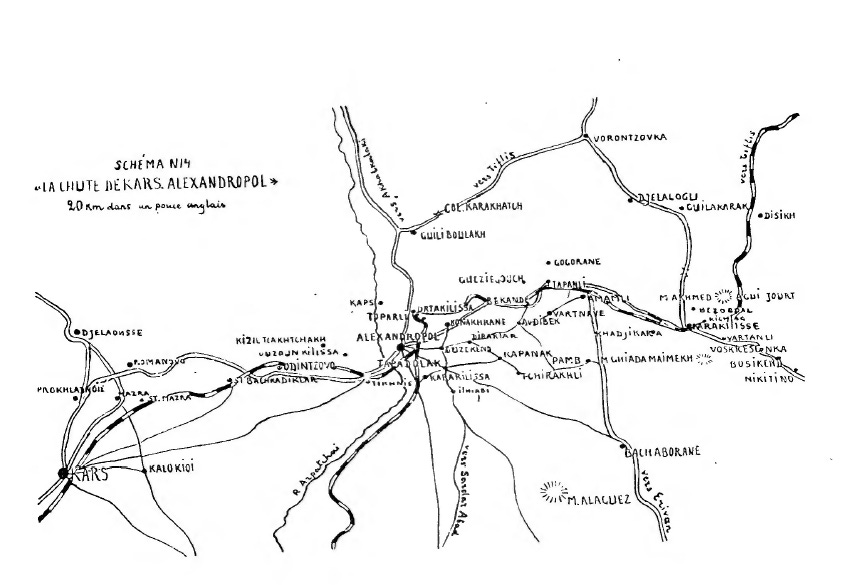
[PAGE 145]
It was decided to propose to the Turks the condition that they not cross the line running from the north-west of the fortress along the Chalgour mountain chain, to the west along Garam-Vartan, and to the south along the heights of Ak-baba.
At about 17:00 the commander of the 1st Separate Armenian Brigade, Colonel Morel (former military attaché of the Russian embassy in Tokyo), was sent along the Sarikamish road as parlementaire. Carrying a letter from the commander of the 1st Armenian Division addressed to the commander of the Turkish forces in the Kars direction, he was to inform him of the order of the Transcaucasian Government to its troops to cease hostilities by 17:00 on 23 April, on condition that the Turkish commander do likewise on his side. Attached to the letter were copies of General Odishilidze’s telegrams of 23 April to General Nazarbekov and to Vehib Pasha concerning the cessation of hostilities.
The chief of staff of the Turkish division declared that he had received no instructions regarding an agreement to cease hostilities, and in the absence of the divisional commander he would immediately telegraph to Sarikamish the contents of the letter brought by Colonel Morel.
At about 22:00 the chief of staff of the Turkish division conveyed the reply of the commander of the Turkish troops operating in the Kars direction, addressed to the commander of the 1st Armenian Rifle Division. It stated that no instructions had been received from the commander-in-chief of the Turkish army regarding the cessation of hostilities, but that he had sent an inquiry to the commander of the Turkish forces on the Caucasian Front, Vehib Pasha, and until a reply was received, the order previously given by Vehib Pasha remained in force, according to which the Turkish troops were to continue
[PAGE 146]
their advance on 24 April. It would be desirable, before the beginning of this advance, for the Armenian troops to withdraw to the forts, in order to avoid a clash with Turkish troops—entirely useless in view of the forthcoming cessation of hostilities.
At about 8 a.m. on 24 April, the headquarters of the Armenian Rifle Division in the village of Petrovka received a new letter from the commander of the Turkish forces in the Kars area:
The proposal of the Caucasian Government has been accepted by the Turkish Government. On our side an authorised representative has already been appointed and will come to you. You (the letter was addressed to the commander of the Armenian division) must withdraw to Kars and stop at a distance of two versts in front of the forts. Your troops must not fire as our troops approach; otherwise we shall resort to force. Today our troops will occupy the positions indicated above. During your withdrawal and our movement, any opening of fire is forbidden. We await your authorised representative in order to begin negotiations.
Begli-Ahmed station, 24 April. 1334–1918.
The letter was written in Turkish and was not signed.
It is possible that the translation of this letter, wholly unclear from a military point of view, was incorrect; otherwise it would have been impossible to explain the Turkish commander’s demand that the Armenian troops occupy a line two versts in front of the forts, which in turn were to be occupied by the Turkish troops.
In any case, there was no time for explanations, because the Turks went over to the offensive, delivering their main blow against the right flank of the troops operating in the Kars area and positioned 8 kilometres west and south-west of the village of Mazra.
If successful, offensive action in this direction would have allowed the Turks to reach
[PAGE 147]
the Kars–Alexandropol railway line behind the troops fighting at Kars and thus cut them off from Alexandropol.
For this reason, at 8 a.m. on 24 April the commander of the 1st Armenian Division ordered the left flank to withdraw to a position by the village of Vezin-köy. By noon on 24 April the position occupied by the Armenian troops formed an arc, bulging towards the enemy, stretching from Mazra to Kars and further in the direction of Vezin-köy.
As soon as the Turks came within range of the fortress artillery, all batteries, except those on the north-eastern front, opened fire, which halted the Turkish advance.
At the same time, the chief of staff of the Armenian Corps, General Vyshinsky, sent to Tiflis to the acting Minister of War, General Odishilidze, the text of the above document from the Turkish command, handed at 8 a.m. to the commander of the 1st Armenian Rifle Division, as well as the substance of Colonel Morel’s negotiations with the Turks.
In reply, the chief of staff received the following order:
The Chairman of the Transcaucasian Government and I, having acquainted ourselves with the telegraphic negotiations of Generals Odishilidze and Vyshinsky at 11:00 on 25 April, decided to accept the Turks’ conditions and cease hostilities in accordance with those conditions. Thus the Government instructs you to give immediately the corresponding instructions to General Nazarbekov.
Minister of War Georgadze, 24 April 1918.
By this decision the Turks were given the opportunity to encircle the fortress without any prior conditions, thereby dooming the garrison to final defeat.
[PAGE 148]
At 11 a.m. Colonel Morel was again sent out from the fortress to continue negotiations with the Turks, interrupted on the evening of the previous day, as we already know, owing to the absence of instructions from Vehib Pasha.
Between Petrovka and Vladikars, Colonel Morel met the commander of the Turkish troops operating in the direction of Kars, Colonel Kyazim Bey. The latter stated that, according to instructions received from higher command, the Turkish troops operating against Kars had been ordered to halt at a distance of 2 kilometres from the fortress forts. As for the question of a demarcation line, it could be resolved only after the time limits and other conditions for the evacuation of Kars and the Kars district by the troops of the Transcaucasian Government had been established; that government, recognising the Brest-Litovsk Treaty, must by that very fact take measures for the immediate evacuation of the entire Kars territory, which by the treaty belonged to Turkey. Developing this thesis further, Kyazim Bey declared that the establishment of a special demarcation line directly in the fortress area was unnecessary, since, according to the agreement between the Turkish and Transcaucasian governments, this line had been fixed for the Armenian troops along the line of the fortress forts and for the Turkish troops at a distance of 2 kilometres from those forts.
During these negotiations the fighting continued and took on a stubborn character, especially near the village of Mazra. The Turks tried to reach the railway and thus complete the encirclement of the fortress. But the Turkish attack was everywhere checked, chiefly by the intense fire of the fortress artillery.
Colonel Morel returned from his second visit to the Turks by 18:00, without any protocol
[PAGE 149]
of his negotiations, being able to provide only an oral report.
Having by this time received the government’s order to allow the Turks to approach the line of the forts to within a distance of two versts, the commandant of the fortress again dispatched Colonel Morel with the mission of obtaining the Turks’ consent to leave open the north-eastern front of the fortress, the highway, and the railway to Alexandropol.
Colonel Morel set out for negotiations with the Turks for the third time at 20:00 on 24 April, at the very same time as Minister-President Chkhenkeli was sending Vehib Pasha telegram No. 12255 on 24 April at 2:55 with the following content:
All your conditions have been accepted by the Transcaucasian Government. All orders to cease hostilities have been given and parlementaires have been sent out. In the Kars area, the commander of the Turkish troops did not formulate the conditions of the armistice clearly enough, indicating that the Transcaucasian troops must withdraw to a line two versts in front of the forts. For this reason, when the Turkish troops began to move toward this line, the commandant of the fortress understood this manoeuvre as a violation of the agreement, after which fire was opened. Measures have now been taken to put an end to any incidents. Moreover, the command of the Turkish troops at Kars has stated that it is blockading Kars from the north-east, which, beyond any doubt, creates difficulties for the agreed evacuation of Kars, which has already begun.
Taking all this into account, I urgently request you to order your subordinates not to create difficulties and unnecessary complications which, in the present circumstances, may lead to needless bloodshed. In my view, a month is necessary for the evacuation of Kars, and I ask you to convey your agreement without delay.
TCHENKELI
In these circumstances the negotiations of the Armenian command with the Turks had little
[PAGE 150]
chance of success. Tiflis at once agreed to the Turks’ demands without consulting the commander-in-chief, who was thus deprived of any freedom of action.
A new meeting of Colonel Morel with Turkish parlementaires took place at Begli-Ahmed.
The Turkish parlementaire, on behalf of Vehib Pasha, set out the following principal demands:
First, surrender of the forts on the left bank of the Kars-chay by noon Constantinople time on 25 April, and the others by the evening of the same day; second, evacuation of the Kars fortress by the troops of the Transcaucasian Government during 25 April; and third, withdrawal of these troops beyond the Arpachay river within three days after leaving the fortress.
Colonel Morel insisted on an extension of these deadlines: given the dispersal of the troops, it would be extremely difficult to organise the withdrawal in time; moreover, it was necessary to organise the evacuation of 20,000 refugees who were leaving Kars.
The Turkish parlementaire, not possessing sufficient authority to decide these questions, agreed to request instructions from Vehib Pasha, adding that if there was no reply by the morning of 25 April, and if the fortress command did not fulfil all the conditions presented to it, the Turkish troops would continue their advance, according to the instructions they had received.
By 2 a.m., at the moment when Colonel Morel returned from his mission, the commandant of Kars received the following telegram from the commander of the Armenian Corps:
I am sending you a telegram just received from the commander-in-chief: “In view of the possibility of the complete encirclement of
[PAGE 151]
Kars and the absolute impossibility of clarifying the conditions to be accepted regarding the evacuation, which the Government has categorically decided upon, I order you to give full freedom to the commandant of the fortress to withdraw the troops toward Alexandropol: they will halt on an intermediate position and entrench there. 12.256, 25 April, 23:55. LEBEDINSKY.”
Thus, I leave to your discretion the decision on the question of the necessity and timing of the evacuation of Kars by its garrison.
25 April, 1:30, No. 829.
NAZARBEKOV
Taking this telegram into account, as well as the general situation, the commander decided to agree to Kyazim Bey’s conditions, but once again sent Colonel Morel to the Turks in an attempt to obtain a postponement for the surrender of the forts on the left bank of the Kars-chay until the evening of 25 April and for the others until the evening of 26 April.
At 5 a.m. Colonel Morel set out for the Turks for the fourth time.
The commander of the Armenian Corps approved the fortress commandant’s decision to surrender the forts; at the same time he ordered that all active units of the Kars garrison, after the evacuation of the fortress, be placed under the commander of the 1st Armenian Rifle Division, who in turn was to hold at all costs the Mazra–Vezin-köy position. The fortress commandant also received orders to remain in Kars to supervise the removal of matériel.
The Transcaucasian Government was so convinced that the Turks would agree to the removal of matériel that the corps commander was made to believe it and to issue the corresponding orders, although it was more than naïve to suppose that the victors would allow the dispatch of the fortress matériel and thus facilitate the continuation of the war by the Transcaucasian Government. Moreover,
[PAGE 152]
even assuming the Turks were so reckless as to agree to this, the removal of fortress matériel was practically impossible owing to the complete absence of labour and transport after the Turkish occupation of Kars.
At 9 a.m. the fortress commandant received the reply that the Turks did not agree to extend the deadline for surrendering the forts. However, all dispositions had already been made, and the evacuation of the forts was completed by 16:00 on 25 April.
The troops left Kars, but the fortress commandant, together with his staff and the fortress administration, remained there.
At 21:00 on 25 April, the first Turkish military unit, a rifle battalion of the 11th Infantry Division, entered Kars.
Kars had fallen. After the fall of Kars, the struggle for possession of the Kars region was in fact concluded.
During the evacuation, the corps commander received the following telegram:
I inform you that the Kars region must be evacuated by our troops up to the frontier along the Arpachay river and that the forts located on the right bank of the Arpachay must be destroyed. The Government has begun negotiations with Turkey in order to obtain for us agreement to grant a postponement of one month for the removal of all matériel from the Kars fortress, and one week for the withdrawal of the troops beyond the limits of the Kars region.
President of the Transcaucasian Government CHKHENKELI.
Acting Minister of War ODISHILIDZE.
Having set no preliminary armistice conditions and having in advance agreed to all the conditions the enemy might propose, the Transcaucasian Government
[PAGE 153]
continued to cherish illusions and to entertain vain hopes that the victor would agree to release all the military matériel of the fortress it had captured under the merciless law of war.
***
Despite the sincere desire to fulfil all the conditions set by the Turks, the retreating Armenian troops were unable to stop military operations.
We have already seen that on 24 April the position occupied by the Armenian troops formed an arc, with its convex side facing the enemy, from Mazra through Kars to Vezin-köy.
Throughout the day, until nightfall, the fighting continued.
Some units of the Begli-Ahmed detachment could not be assembled for coordinated action until 3 a.m. on 25 April, while others were assembled at dawn.
The morale of the troops deteriorated seriously; the possibility of a Turkish incursion into their home districts occupied everyone’s mind. The weakest began to desert. The withdrawal to the line of the villages of Mazra–Kala-köy proceeded slowly.
Despite constant enemy pressure, it was necessary to hold on to this line in order to make possible the retreat of the wagon trains with refugees who left Kars at 4 a.m. on 25 April.
The 1st Cavalry Regiment and part of the 4th Infantry Regiment were to protect the wagon trains from possible Kurdish attacks, as the Kurds were operating in the rear of the detachment.
Indeed, the column was attacked by Turks who managed to break through to the highway near the village of Prokhladnoye, but the situation was restored by a counter-attack by units of the 4th Infantry Regiment.
[PAGE 154]
By the evening of 25 April the Turks had captured the village of Mazra and the heights to the north-east of it, while the Kurds had entered the village of Romanovo. As a result, the right flank of the Begli-Ahmed detachment was forced to fall back toward Mazra station, so that the detachment’s defensive line ran from that point to the village of Kala-köy. This line was occupied, starting from the right flank, by: the Special Battalion of Russian officers, the 7th and 8th regiments of the Armenian infantry division, the remnants of the Erzerum and Erzincan regiments, and then units of the 1st Armenian infantry division and the 2nd Armenian cavalry regiment near the village of Kala-köy.
According to the orders of the corps commander, units of the Kars garrison were to join the Begli-Ahmed detachment as the fortress was evacuated; but this order was carried out with delays caused by the disorganisation of the communications service.
On the morning of 26 April the Turks began an attack near the village of Mazra, turning the detachment’s right flank and seriously threatening its communications with Alexandropol. This danger compelled General Ter-Akopov to retreat, despite the fact that the Turkish attack was repulsed, and to concentrate his troops in Bashkadiklar on the evening of the 26th.
During 27 April the detachment continued its retreat toward Alexandropol and occupied the area of the villages of Kizil-chakchakh, Uzun-kilisa, and Tekhnis, covering its flanks with cavalry.
On 28 April, guided by the armistice conditions, the detachment crossed the Arpachay river, having first destroyed the old fort on the right bank.
[PAGE 155]
The Begli-Ahmed detachment was disbanded, and the troops took up the following positions: the 1st infantry division with its artillery, under the command of General Areshev, at the villages of Toparli, Konak-kran, Duz-kend, Tepe-Dolak, Karakilisa, east of Alexandropol; the 7th and 8th infantry regiments, together with the remnants of the Erzerum and Erzincan regiments and the cavalry brigade, remained in Alexandropol.
The Arpachay river to the south of Alexandropol was guarded by the 2nd Separate Brigade (the Hnys and Karaklisa regiments).
***
We saw above that General Deev, the fortress commandant, and several officers of his staff remained in Kars in order to hand over the fortress to the Turks and ensure the protection of the population. They were also to carry out, if the enemy agreed, the removal of matériel.
On 26 April at 13:00 the commander-in-chief of the Turkish troops operating against the fortress, Colonel Kyazim Bey, arrived in Kars; on the same day he met with General Deev.
It was agreed that all officers and soldiers still in Kars, regardless of nationality, would be free either to remain there or to depart for Alexandropol. But on the evening of 27 April Kyazim Bey suddenly violated this agreement, informing General Deev that military personnel of all ranks were to concentrate in places designated by the Turkish authorities, Armenians separately from the others. He explained this order as a measure of reprisal against the Armenians, whose troops were accused of atrocities against the peaceful Muslim population during their retreat.
[PAGE 156]
However, following the energetic protest of General Deeff against such a violation of one of the stipulations of the act of surrender, a column composed of 190 officers, 500 soldiers (including 150 armed), and 450 inhabitants of Kars (Armenians and Greeks) was able to leave the city for Alexandropol on 30 April under the escort of a company of the 11th Division. It arrived at Odintzovo on 1 May, on the 2nd, under the escort of a battalion of the 5th Division, at Tiflis, and reached Alexandropol on 3 May.
By order of General Nazarbekoff, all the personnel of the artillery, engineers, and telegraph service of the fortress of Kars were retained at Alexandropol to reinforce the garrison of the place. General Deeff, with his staff, departed for Tiflis.
[PAGE 157]
CHAPTER XXII: ALEXANDROPOL
On 3 May 1918 the delegates of the Transcaucasian Republic and the Turkish delegates met in Batum to discuss the terms of peace. The Transcaucasian delegation consisted of M. N. Kachaznuni from Armenia and M. Rasul-zade from Azerbaijan as members, under the chairmanship of M. A. Chkhenkeli, representing Georgia.
The Turkish delegation was at first represented by Djemal Pasha, Minister of the Navy, but he was soon replaced by the Minister of Justice, Halil Bey. The German headquarters had also sent its delegate, the Bavarian General von Lossow.
The negotiations dragged on. The subject and scope of this book do not allow for a detailed discussion of the conference. It is nevertheless necessary to note that from the very outset the Turks insisted on the right to use the Alexandropol-Julfa railway line for transporting troops to Tabriz, later extending these claims to all Caucasian railways for the entire duration of the war. This right was of the utmost importance to the Turkish General Staff, which at that time was planning an offensive against Mosul against the British. This was also stated in the most categorical terms by Ferik Vehib Pasha, commander-in-chief of the Turkish forces operating on the Transcaucasian front.
[PAGE 158]
The military experts, Divisional General Odishilidze and Brigadier General Korganov, who did not consider themselves authorised to agree to such conditions, referred the matter to their delegation, which in turn requested precise instructions from its government.
During the night of 14–15 May the Turkish delegation, without warning, presented an ultimatum demanding the immediate evacuation of Alexandropol and the withdrawal of Armenian troops 25 kilometres east of the city.
This ultimatum was presented at 4 a.m. on 15 May, three hours before its expiry. In fact, the Turkish offensive had already begun before that time, so that the delegation had no opportunity to acquaint itself with the document.
M. A. Chkhenkeli vigorously protested against such conduct during the conference debates, to which Halil Bey replied that the ultimatum had been properly sent in good time, on the evening of 14 May, but that unfortunately his secretary did not know the address of the head of the Transcaucasian delegation, which caused the regrettable delay in delivery.
The commandant of the Alexandropol fortress, for his part, received at 2 a.m. on 15 May from the commander of the Turkish forces a warning written in Turkish, the translation of which was completed only around 6:30 a.m.
The Turks demanded the evacuation of Alexandropol by 6 a.m. and the withdrawal of Armenian troops 20 kilometres east of the city, but without awaiting a reply they suddenly attacked the Armenian troops, at the same time encircling them from the direction of the village of Kaps, north of Alexandropol.
General Nazarbekov, whose headquarters had been moved on 13 May to the station of Karakilisa, was still in Alexandropol. After brief resistance,
[PAGE 159]
the fortress was taken, and the Armenian troops, taken by surprise, continued their retreat to the line of the villages of Orta-kilisa, Duz-kend, and Tepe-Dolak. But the Turks, developing their advantage, captured the villages of Duz-kend, Tepe-Dolak, and Ilkhiali, forcing the Armenian troops to retreat still further to the line of the villages of Toparli–Diraklar–Kapanak.
The loss of Alexandropol gave the Turks the opportunity to act against the Erivan group. Therefore General Nazarbekov issued the following orders: the 1st Armenian Rifle Division with the 7th and 8th regiments of the 2nd Armenian Division was to retreat to the line of the villages of Gök–Leguch–Bekand–Avdibek–Pamb. The cavalry brigade was to remain in the rearguard near the village of Chirakhli. The 1st and 2nd Separate Brigades were ordered to link up with the Erivan group via Sardarapat. Later the 2nd regiment of the cavalry brigade was sent in the same direction. General Andranik, who with his volunteers had occupied Guli-bulakh since 1 May, was to act against the Turkish left flank while at the same time covering Akhalkalaki and Vorontsovka. Simultaneously, General Nazarbekov ordered the Akhalkalaki, Lori, and Kazakh territorial regiments to be brought to readiness. The first two were placed at the disposal of General Andranik, while the third was incorporated into the 1st Division.
With this disposition, the Armenian Corps was condemned to passive defence along the entire front. The task now was to defend what remained of Armenia, into which refugees were pouring from all sides in the face of the Turkish invasion.
General Andranik, occupying the Vorontsovka area, covered the right flank of the Armenian Corps. By its deployment the main forces of the Corps protected the
[PAGE 160]
junction of the roads to Erivan, Karakilisa, and Dilijan. Finally, the Erivan group, defending the capital and the southern districts of Armenia, was reinforced, as we have seen, by the 1st and 2nd Separate Brigades.
The decision taken by General Nazarbekov, calculated to restrain a numerically superior enemy and based on the fighting spirit of his troops, corresponded to the general situation.
General Andranik was compelled to refrain from offensive operations against the enemy’s left flank, which had concentrated its entire 5th Division against him. After fierce fighting at the Karagach pass on the Alexandropol-Tiflis road, Andranik on 19 May was forced to retreat to Djelal-Oglu, and the Turks broke into the Lori steppe.
At the same time the enemy began to concentrate against the 1st Armenian Division. At about 10 a.m. on 21 May the Turks attacked the Gök-Leguch-Avdibek line. The 1st Armenian Division, together with the 7th and 8th regiments, retreated to the Gogoраh-Tapanli-Vartpav line, but on 22 May continued its retreat to Karakilisa, being unable to halt the Turkish advance.
This retreat allowed the enemy to occupy Amamli station, thus opening the road to Erivan.
General Silikov, commander of the 2nd Armenian Division stationed in the Erivan area, sent a detachment under Dro to Bash-Aparan to cover the capital from the north.
General Nazarbekov decided to hold Karakilisa to the last. The objective was, at all costs, to stop the advance of the invaders and save what remained of Armenia with its population and refugees, who were threatened with complete destruction.
In these tragic circumstances the fighting spirit of the troops, severely shaken after the fall of Alexandropol
[PAGE 161]
and the endless retreats, revived in view of the evident common danger, and from all sides numerous deserters began to gather again to return to the ranks.
Taking advantage of this moral upsurge, General Nazarbekov went over to the offensive on 24 May, and this time the impetus of the Armenian units was so irresistible that after fierce fighting the enemy could not withstand the attack and retreated in haste toward Amamli.
Despite this success, General Nazarbekov’s position remained very dangerous, as his right flank was threatened by the 5th Turkish Division occupying the gorges of the Bezobdal range.
General Andranik, responsible for covering this flank, did not have sufficient forces. After two days of fighting against the 5th Turkish Division he was forced to retreat from Djelal-Oglu to Dsegh (40 kilometres north-east of Karakilisa). General Nazarbekov, meanwhile continuing his offensive, sought to envelop the enemy’s right flank.
The advance developed favourably, and by the evening of 26 May Armenian troops had captured the villages of Bezobdal and Hadji-kaly on both flanks and driven the enemy from Mount Gida-Maimakh.
Unfortunately these successes could not be sustained. Taking advantage of their numerical superiority, the Turks launched a powerful counter-attack on 27 May and after fierce fighting recaptured Mount Gida-Maimakh. At the same time two Turkish columns, one numbering 3,000 men with six guns, advanced from the village of Gyulagarak toward Bezobdal on Nazarbekov’s right flank, while another, about 1,500 bayonets strong, advanced from Amamli.
[PAGE 162]
By the evening of 27 May the Turks had taken Bezobdal, from which General Nazarbekov was forced to withdraw his right flank to the heights of Mount Akhmet-Aga-Urt and his centre to the village of Kyshlak.
The Armenian troops could not long hold this position. On 28 May the Turks outflanked the Armenian left, captured the village of Vartanli in the rear of the Karakilisa position, and General Nazarbekov’s troops were again compelled to retreat fighting toward Shagali station. There, thanks to the steep mountain slopes, they managed on 28 May to concentrate on the Bozikend–Nikitino line east of Voskresenskaya, once again barring the enemy’s path from Karakilisa to Erivan.
Andranik’s detachment arrived at Dilijan on 30 May, and the corps headquarters was established in the village of Bas-Akhti.
Until the signing of the armistice between Turkey and Armenia the troops remained on these positions. But Andranik, finding the peace terms shameful, left Dilijan with his detachment on 6 June, heading toward Novo-Bayazet and Nakhichevan.
[PAGE 163]
CHAPTER XXIII: OPERATIONS IN THE ERIVAN AREA
As we have already indicated, certain Armenian units continued to occupy various points in Turkey after the defenders of Erzerum retreated toward the former Russo-Turkish frontier.
In the Alashkert valley there was the 2nd Separate Brigade (the Hnys and Karaklisa regiments) with 8 artillery guns; the 5th Armenian Rifle Regiment (2 battalions) and the 3rd Separate Brigade (the 1st and 2nd Van regiments) with 8 artillery guns were stationed at Van.
The Erivan area, where a battalion of the 4th Armenian Rifle Regiment, the 6th Regiment (3 battalions), and 20 artillery guns were concentrated, served as the base for these two detachments.
By order of General Nazarbekov, the 2nd Separate Brigade left Karakilisa of Alashkert when it became clear that the Turks would deliver their main blow from the direction of Sarikamish–Kars.
From 16 April onward, this brigade took part in all the battles fought near Kars, chiefly opposing the Turkish advance from Kagyzvan.
As for the Van garrison, which had been completely isolated and cut off from communications since the end of March, it received orders to join the Erivan group and arrived on 12 April at Igdir via Bayazet.
[PAGE 164]
Thus, by mid-April the Erivan group consisted of one battalion of the 4th Regiment, the 5th and 6th Regiments, the 3rd Separate Brigade (the 1st and 2nd Van regiments), and 28 artillery guns.
This group was subordinate to the commander of the 2nd Armenian Rifle Division, General Silikov, with the task of overseeing the gorges of the Agri-dag mountain chain and defending the line of the Araks river in order to cover the southern districts of Armenia. At the same time it was necessary to guard the railway from Alagöz station to Nakhichevan.
In reality, owing to the insufficiency of forces, this latter task could only be partially accomplished, as the railway could be covered only as far as the “Wolf’s Gate” near Arazdayan station.
At the end of March most signs indicated that the Turks would soon resume military operations. Tatar bands devastating the country became bolder; reports of their actions came from all sides. They attacked the villages of Yelenovka, Markara, Igdir, Kulpi, as well as the town of Novo-Bayazet, and destroyed telegraph lines and railway tracks.
Unfortunately, the military command was unable to maintain order and ensure security against these bands in the rear of the troops.
Indeed, on 15 April, by categorical order of the Tiflis government, the commander-in-chief of the Caucasian Front was compelled to forbid General Nazarbekov from resorting to the necessary military measures
[PAGE 165]
to counter the acts of violence committed by Muslim bands against the peaceful Armenian population. According to this order, only attacks on troops were to be punished by the military authorities.
These directives dealt a serious blow to the morale of the troops, who were recruited precisely from the populations of the districts now left at the mercy of marauding bands. Everyone thought only of returning home as quickly as possible to defend his own hearth, at a moment when a government without prestige and an administration without authority were incapable of guaranteeing their safety.
It was under the pressing insistence of some of its members that the Government had given this order, deluding itself with the hope that this measure would put an end to clashes between Armenian troops and the rebellious Muslim population and thus bring about a quicker pacification.
In reality, this order only facilitated the actions of the Turkish troops, in no way contributing to the pacification of the country. On the contrary, now that it had become possible to terrorise and plunder the Armenian population with impunity, the audacity of the Tatar bands increased day by day, and they soon even dared to attack regular troops. Thus an armoured train sent from Erivan to support forward units was successfully attacked on 18 and 19 April by the local Muslim population near the stations of Shakhtakhty and Nakhichevan.
The government order of 23 April announcing the cessation of hostilities dealt a further blow to the morale of the troops. A rumour spread among the soldiers that the government was systematically betraying them and that under such conditions any struggle against the enemy was futile. The command therefore had to make superhuman efforts to
[PAGE 166]
prevent the demoralised and distrustful soldiers from abandoning the ranks.
In violation of the concluded armistice, the Turks unexpectedly attacked on 27 April the 3rd Separate Brigade (the 1st and 2nd Van regiments), which occupied the Kudzhakh and Chingil passes on the Agri-dag range.
The 2nd Van Regiment, which defended the Kudzhakh pass, was forced to retreat to the villages of Orgof and Argadji, but the following day it counter-attacked and retook the pass. Meanwhile the Turks continuously received reinforcements, and the Armenian brigade ultimately had to yield and retreat to the Khalfala–Sultanabad line, losing several dozen men killed and 80 wounded. Among the dead was the commander of the 2nd Van Regiment, the brave Colonel Charukchev.16
Nevertheless, after energetic protests by the Transcaucasian government, Ferik Vehib Pasha on 1 May ordered his troops, which had penetrated into the Erivan district, to withdraw to the former Russo-Turkish frontier.
After the Turkish withdrawal, the detachment stationed near Igdir, by order of General Silikov, occupied Orgof with its advance guard.
By mid-May the disposition of Armenian forces in the Erivan district was as follows: the main forces were concentrated at Sardarapat station, with their advance guards at Kulpi and Igdir. One detachment was sent to Araks station to establish contact with the Alexandropol group.
Simultaneously with the capture of Alexandropol, the Turks on 15 May began military operations in the southern part of the Erivan district.
[PAGE 167]
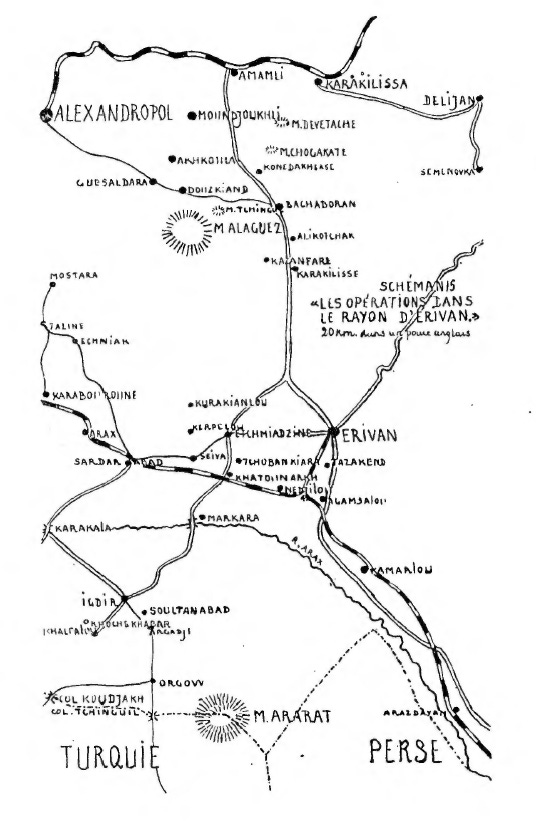
[PAGE 168]
On the night of 18 to 19 May, the Turks attacked the Arax detachment but were driven back toward the station of Karabouroun.
At the same time, they crossed the Agrı-Dagh range and occupied the villages of Khalfalou and Khochkhbar near the town of Igdir. On the same day, the Koulpi detachment withdrew toward the bridge of Karakala on the Arax.
The situation had become such that General Silikoff was obliged not only to defend the southern regions of Armenia but at the same time to protect the capital from the north. Indeed, after the occupation by the Turks of the station of Amamly and the retreat of the Alexandropol group toward Karakilissa, the road from Amamly to Erivan remained open to the enemy. To avert this danger, General Silikoff directed, under the command of Dro, toward Bash-Abaran a detachment drawn from the main body of the troops.
From all sides Armenia was now encircled by the enemy. From the south, west, and north the Turks were advancing, while the east was threatened by the Tatars of Azerbaijan, who had taken the side of their co-religionists.
Reinforced by the Kurds and the Tatars, the Turks launched an offensive on 20 May in the direction of Igdir. The detachment occupying that town withdrew toward the bridge of Markara on the Arax and took up position north of that river; the cavalry remained south of the village to observe the movements of the enemy.
At the same time as the operation against Igdir, a Turkish brigade advanced along the railway line against the Sardarabad detachment and attacked it on 17 May. Under pressure from the Turks, the Armenian units withdrew to the line of the villages of Karakanlou–Kerpalou–Armenian Zeiva, thus protecting Etchmiadzin (Vagarchapat).
[PAGE 169]
On 23 May General Silikov, having reinforced the Sardarapat detachment with his last reserves, launched a counter-attack and succeeded on 24 May in breaking the enemy’s resistance, which gave way on all sectors. But although Armenian troops occupied Karaburun and Alagöz stations and the villages of Talin and Mastara on 29 May, General Silikov could not develop his advance toward Alexandropol and threaten the rear of the Turkish forces.
Indeed, already on 23 May the 3rd Turkish Division, arriving from Amamli station, appeared in the Bash-Aparan area. General Silikov now risked being cut off from Erivan if the Bash-Aparan detachment failed to halt the movement of this division. Consequently, he was obliged to stop his advance on Alexandropol and reinforce Dro’s detachment with a part of his own troops.
On 24 May, Dro approached the village of Ali-Kochak and, continuing his advance, attacked on 25 May the advance guards of the 3rd Turkish Division north of the village of Bash-Aparan. During this clash the 2nd Cavalry Regiment near the village of Kondakhsız launched a swift attack on the enemy, who lost 30 soldiers and one officer.
On 26 May Dro, under threat of the enemy outflanking both his wings, withdrew to the line of the villages of Karakilisa–Kazanfar; but, having received the reinforcements mentioned above, he went over to the offensive on 29 May and after a fierce battle threw the enemy back to the village of Duz-kend, west of Bash-Aparan.
Despite these successes, the position of the Erivan group still remained difficult. Moreover, General Silikov was forced to send the 3rd Separate Brigade (the 1st and 2nd Van regiments) to Semyonovka in order to reinforce the Alexandropol group, which was holding Dilijan.
General Nazarbekov, for his part, was determined
[PAGE 170]
to hold the pass near the village of Semyonovka in case, under enemy pressure, it became necessary to evacuate Dilijan.
On 4 June Armenia signed a peace treaty with Turkey. Pending ratification of the treaty, a temporary armistice was concluded in accordance with a proposal made by the Turkish command.
Under the terms of this armistice, the Sardarapat detachment was to occupy the line of the village of Echnyak–Karaburun station, while Dro held the village of Bash-Aparan, the northern slopes of Mount Chengil, and the Shogakat–Deve-tash heights.
The Turks concentrated opposite Dro’s detachment their forces in the area of the villages of Duz-kend, Gözal-dere, Akhkula, and Mundzhukhli.
But the Turks decided to seize the Sardarapat–Julfa railway in order to transport their troops, and again violated the armistice conditions.
At 9 a.m. on 7 July the Sardarapat detachment was unexpectedly attacked, and its forward units had to fall back. Taking into account the Turks’ great superiority, General Silikov decided to concentrate all available troops in the Echmiadzin area, abandoning the Araks line.
On 8 July at 9 a.m. the enemy attacked the line of the villages of Kerpalu–Zeyva (Tatar), but was repulsed by the 5th Armenian Regiment, joined by numerous partisans.
Leaving three battalions opposite this line, the enemy began moving east, thereby outflanking the left flank of General Silikov’s forces.
On the evening of 8 July the Turks, with two battalions, seized the village of Khatunark, 10 kilometres south of Echmiadzin.
[PAGE 171]
Continuing their advance, on 9 July they successively occupied with the forces of the 11th Division the villages of Chobankyara, Nedzhilu, Tazakend, and Agamsalu.
By these actions Erivan was cut off from the railway line and separated from eastern Armenia.
These positions were maintained by both sides until the general armistice of 11 November 1918, when the Turks began to withdraw from Armenia.
***
Having reached the end of this objective account, and before proceeding to the narrative of the defence of Baku and its district—which forms a separate chapter in the role of the Armenians in the Great War—it is fair to emphasise the importance of the struggle of the Armenian Corps in the period from 24 to 26 May, when its troops gained the upper hand over the enemy through partial tactical advantages: at Karakilisa under Nazarbekov’s command, at Sardarapat under General Silikov, and at Bash-Aparan under Dro’s leadership.
The result of these tactical advantages was the halting of the Turkish offensive and the enemy’s loss of time.
But the political consequences of these successes, it may be said without exaggeration, were extraordinarily important for the fate of the Armenian people.
In the period described here—that is, in the summer of 1918—the principal objectives of the Turkish army’s operations on the Caucasian Front, in accordance with the plans of the Turkish command and the directives of the German headquarters, were the British right flank at Mosul and the Baku region.
[PAGE 172]
Since Armenia lay on the routes of operations toward Persian Azerbaijan and the Baku region, it was absolutely necessary to become master of this country and destroy its resisting force—the Armenian Corps. The Turks had already lost five months by the battles at Karakilisa, Bash-Aparan, and Sardarapat, months of great value, counting from the withdrawal of the Russian troops from the front (January 1918).
These battles showed the Turks that the resisting power of the Armenian Corps had not been crushed, and that it would require still more time and effort to compel it to lay down its arms.
The Turkish command faced a dilemma: either to continue prolonged military operations against the Armenian forces, postponing indefinitely the solution of the main task (Persian Azerbaijan and Baku), which contradicted the principle of economy of force in the theatre of operations; or to pursue the main objective while covering itself with a weak screen against the Armenian Corps, which in that case would stand on the flank of the Turkish communication routes to Julfa and Baku, in the position most dangerous for the Turkish army. A way out of this dilemma was found. Only a few days after the battles mentioned, Turkey suddenly and without any prior notice recognised Armenia’s independence and on 4 June signed a peace treaty with it. In this way the Turks freed their hands on this theatre of war, while retaining at the same time the possibility, simply by not ratifying this treaty, of turning their weapons once again against Armenia at a favourable moment. The defeat of the Central Powers upset this plan.
Isolated as it was from the outside world, it was only to its own forces, only to the fighters of
[PAGE 173]
Karakilissa, of Bash-Abaran, and of Sardarabad that Armenia owes its salvation.
In order to assess fairly the significance of the feat accomplished, it is necessary to compare the forces engaged on both sides.
By the end of May 1918 the Armenian Corps numbered 30 battalions, whereas the Turks at that moment had in the first line alone 5 divisions (the 3rd, 5th, 9th, 11th, and 36th), or 50 battalions, which could, if necessary, be reinforced by troops echeloned between Sarikamish and Alexandropol. Thus, in the first line alone, the Turks had almost a twofold superiority in the number of battalions; but in reality, taking into account the actual strength of the units on both sides, the Turks had a threefold superiority. In fact, Armenian battalions averaged not even 400 bayonets, whereas among the Turks this figure reached at least 700. These 30 Armenian battalions, whose total strength did not exceed 12,000 men, had to fight against fifty Turkish battalions with a total strength of 35,000 men.
An impartial historian of the future will no doubt do justice to the actions of the Armenian Corps and decide whether Armenia had reason to throw itself without hesitation into the struggle with all its military forces, or whether, on the contrary, after the collapse of the Russian front it should have allowed the Turks to occupy the country without resistance.
But what fate would have awaited Armenia and its population if the Turks, with their method of resolving the Armenian question, had established their rule in the country for seven months?
[PAGE 174]
CHAPTER XXIV: THE STRUGGLE FOR THE CITY AND DISTRICT OF BAKU
We have already indicated that Transcaucasia, having refused to recognise Soviet authority, formed at the end of November 1917 an autonomous administrative body called the Transcaucasian Commissariat, which included representatives of all parties and all nationalities of the territory. The authority of this body was exercised very unevenly in different regions of Transcaucasia, and in particular in the city and district of Baku its authority was nil.
Several tens of thousands of workers in the Baku district, employed in oil production and related industries, allowed themselves to be carried away by Bolshevik doctrine. The Executive Committee of Workers’ and Soldiers’ Deputies, which before the Bolshevik revolution had recognised the Provisional Government in Petrograd, refused to submit to the Transcaucasian authority in Baku and subsequently prevented the Baku district from entering the Transcaucasian Republic.
At the beginning of January 1918, bands of Azerbaijani Tatars, incited by Turkish emissaries, interrupted the Baku–Tiflis railway line, thus cutting Baku off from the rest of Transcaucasia.
[PAGE 175]
The struggle for possession of this great centre did not take long to begin.
The Bolsheviks, having consolidated their power in Petrograd and Moscow, set about spreading their influence in the provinces. Baku, with its oil district and developed industry, was of vital importance for Russia, isolated from the outside world and its markets.
On the other hand, the Muslims, who constituted the overwhelming majority of the population of the district, asserted their right to power on national grounds, which had assumed great importance during the revolution.
Turkish emissaries urged the Muslims toward energetic measures. In view of the collapse of the Russian Caucasian Front, the Central Powers were making plans to seize Baku with Turkish assistance. Apart from the possibility of securing oil products, absolutely indispensable for the continuation of the war, possession of this region opened routes across the Caspian Sea to Persia, the Transcaspian region, and Turkestan, from where it would be possible to stir up revolt in Afghanistan and thus threaten British possessions in India.
In order to defend Armenian interests in Baku, an Armenian National Council was organised, relying on the few Armenian military units in the district.
At the moment when the Baku–Tiflis railway connection was cut, the following forces were in Baku: the 2nd Armenian Marching Regiment (700 men), an irregular partisan battalion formed by Amazasp (800 men), a Dashnak detachment (50 men), 2 guns without breech mechanisms, and 5 machine guns. In addition to these organised elements, several thousand Armenian soldiers sent from the Western Front to reinforce the Armenian Corps were present in Baku.
[PAGE 176]
Besides these units, there was in Baku an “International Regiment,” wholly devoted to the Bolshevik cause.
The city lived in expectation of horror.
The Armenian population had every reason to fear Muslim hostility, which, given the national antagonism, was bound to lead to massacres of the civilian population. To prevent this, Armenian units were posted in the city along the boundaries separating the Armenian quarter from the Tatar quarter, as well as at several points in the suburbs, namely in Armenikend, in Kishli, in the White City, and elsewhere.
The political situation was so complex that the slightest incident could provoke an explosion of barely restrained passions.
This incident, insignificant in itself yet signalling the bloody events that followed, occurred on 17 March 1918.
A small group of cavalrymen of the Caucasian Division, formed from local inhabitants and returned to the Caucasus from the Western Front, arrived in Baku under Lieutenant Asadullaev to bury with honours one of their volunteers, the son of the millionaire Tagiev. After completing the ceremony, they boarded a vessel to depart for Lenkoran across the Caspian Sea, but were attacked by the Bolsheviks, who sought to disarm them. The leaders of the Baku Bolsheviks, Shaumyan (appointed by Lenin as Commissar for Transcaucasia) and Japaridze, appealed to the Armenian National Council for assistance, but the latter refused to participate in an action that could have disastrous consequences for the civilian population. Thus, the cavalrymen were disarmed by the Bolsheviks alone.
On the morning of 18 March, the Musavatists (the Muslim Federalist party) presented the Bolsheviks with an
[PAGE 177]
ultimatum, expiring at 6 p.m., demanding the return of the weapons to the cavalrymen representing the local Caucasian population, threatening to resort to force in case of refusal.
Informed of this event and fully aware that a clash between Muslims and Bolsheviks would inevitably involve the Armenians, the Armenian National Council decided to bar the Musavatists from entering the Armenian quarter if their threats continued.
At about 6:30 p.m. on 18 March, a crowd of armed Muslims rushed, firing rifles, at the Armenian quarter of the city. The attack was repelled, but disorderly clashes continued throughout the night of 18–19 March, all day on the 19th, and partly on the 20th and 21st. During the street fighting, when national hatred on both sides reached its height, the peaceful urban population also suffered. Meanwhile measures were taken to protect it, and about 14,000 Muslims found refuge in the Mailov Brothers’ Theatre and other public buildings in the Armenian quarter.
Armenian units lost 6 officers and 60 soldiers killed and wounded.
***
To organise a more effective defence of the Armenian population and the Baku district, the Armenian National Council decided to form a competent military body under its authority. Its choice fell upon General A. Bagratuni (an Armenian), former commander of the Petrograd Military District, who had just arrived in Baku. He was entrusted with supreme direction of all military affairs.
For their part, after
[PAGE 178]
the failure of their attack, the Musavatist leaders returned to Elisabethpol to organise the struggle for the capture of Baku.
At the end of March, Muslims began an offensive against Baku from the directions of Dagestan and Elisabethpol.
From Dagestan a group under the command of former Russian army general Talishinsky advanced. On 27 March this group appeared before the railway station of Khurdalan but was dispersed by a small detachment (700 men) under Colonel Kazarov (an Armenian). This detachment advanced and occupied Gudermes station on the Vladikavkaz railway.
On 1 April military operations began from the direction of Elisabethpol.
A detachment under Prince Magalov, a former colonel of the Russian army, consisting of a regular Tatar cavalry regiment (returned from the Western Front) reinforced by armed bands, approached Adjikabul station on the Transcaucasian railway.
To repel this threat to Baku there were only Amazasp’s volunteers (500 men) with two machine guns and one gun, supported by an armoured train. Disembarking from the latter at Duvan station, the volunteers advanced and captured the enemy position at Adjikabul after an eight-hour battle. The Tatars retreated toward Elisabethpol. A new attack to seize Adjikabul, launched several days later, was likewise repelled, and the Armenian volunteers occupied a defensive position at Adjikabul to cover Baku from that direction.
In these engagements the volunteers lost 7 killed and 22 wounded, but captured several dozen locomotives and about one hundred railway wagons.
[PAGE 179]
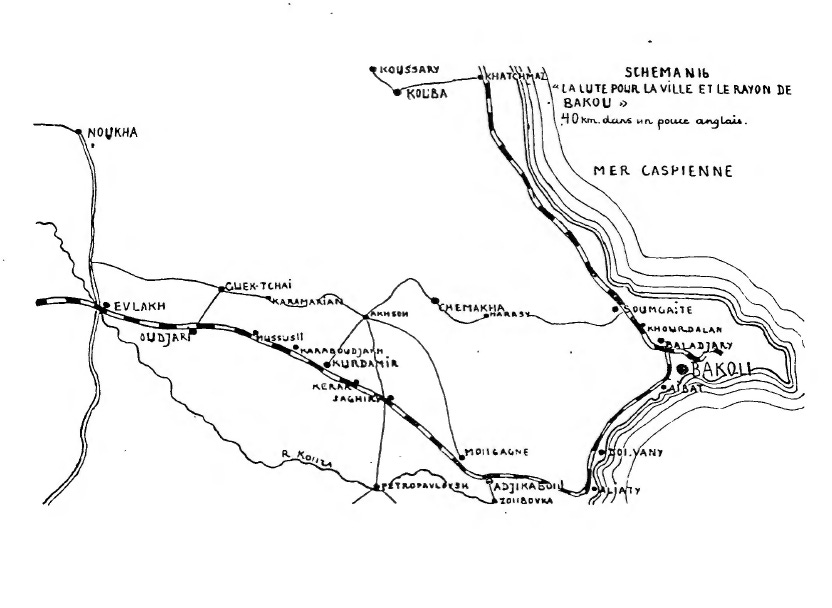
[PAGE 180]
These actions in the directions of Khachmaz and Adjikabul, located 100 and 160 kilometres from Baku respectively, eliminated all immediate dangers to the city. This circumstance significantly enhanced the prestige of the Baku Bolshevik Executive Committee. The Caspian flotilla went over to its side.
The military units were entirely dependent on the Executive Committee in matters of finance, food supply, and equipment. The Bolsheviks also demanded the resignation of the Armenian National Council as a political body and the dissolution of the Armenian military units, in order to incorporate them into the Bolshevik forces that it had been decided to form.
Despite the complete divergence of views between the Armenian leadership and the Bolsheviks regarding internal policy, the former saw in the latter allies for the defence of Baku and its district; all the more so since in Baku the Bolsheviks were very moderate in attempting to apply their doctrines.
On this subject Mr P. G. La Chesnais wrote in his book The Peoples of Transcaucasia During the War and Before the Peace, p. 80:
The Soviet regime was established on the basis of a strange but fateful compromise, because they did not want the domination of the moderate Russians, with whom the Armenians would have entered into alliance, and they could not accept the domination of the Tatars, which would have meant the incorporation of Baku into the Transcaucasian Republic then being formed. Shaumyan, an Armenian Bolshevik, thus became chairman of the Soviet. But it is difficult to imagine an institution more opposed in essence to Bolshevik policy, whose principle was to admit no compromise in the formation of organs of power. The Baku Soviet was Bolshevik only in name, because it in reality represented all the principal political tendencies. The Bolshevik current
[PAGE 181]
obviously enjoyed greater support, but it could not establish absolute authority.
The Armenians did not pursue territorial acquisitions, but confined themselves to the defence of the Baku district, because after its capture by the Turco-Tatars the peaceful Armenian population would have been doomed to inevitable destruction. At the same time, the defence of Baku, by attracting to this point a portion of the enemy forces, eased the general military position of Armenia, exhausted by unequal struggle with the enemies surrounding it. Only the Bolsheviks, who possessed the Caspian flotilla based at Astrakhan, could supply the Armenians with the arms, equipment, and provisions necessary for the units being formed and for the continuation of the struggle.
For these reasons, on 26 April 1918 the Armenian National Council accepted the ultimatum of the Committee for the Defence of the Revolution, headed by Shaumyan.
The formation of military units began. It was carried out under the red banner, but in reality these formations were Armenian, since 95 per cent of their effective strength were of that nationality. The last Russian echelons had passed through Baku in February, returning to Russia.
At first it was decided to form four separate brigades, each of four battalions, but events soon compelled additional recruitment, and the number of battalions was increased to 29.
The artillery consisted of 54 three-inch guns of various types, including breech-loading, mountain, and howitzers, grouped into 9 batteries: 6 field, 2 howitzer, and 1 mountain. The number of machine guns was insufficient. As for cavalry,
[PAGE 182]
only 2 squadrons could be formed instead of the planned regiment, and for technical troops the formation of a sapper battalion and an armoured car detachment was begun.
It was decided to combine the brigades into divisions by August, but events did not permit this reorganisation to be completed.
These hastily created units did not possess the qualities of regular troops. Their formation was based, at best, on revolutionary enthusiasm. Armenian soldiers returning from the Western Front had already been influenced by revolutionary propaganda, which made the maintenance of discipline impossible. In the absence of a sufficient number of professional officers, their places had in most cases to be filled by men lacking any technical training.
Weapons, equipment, and uniforms were even more varied.
It was necessary to make do with what could be found locally or what the Bolsheviks brought from Astrakhan.
The effective strength of a battalion averaged no more than 400 bayonets, and the number of active troops never exceeded 10–12 thousand combatants.
Such were the forces hastily engaged in the struggle against three Turkish divisions, later reinforced by other regular and irregular troops.
Colonel Kazarov (an Armenian) was appointed commander of the troops of the Baku district.
We have already noted that to cover the Baku district from the direction of Dagestan, a detachment had occupied Gudermes station.
On 8 May unexpected news arrived that the local Armenian garrison of the town of Kuba had been
[PAGE 183]
taken by surprise and destroyed. At the same time reports were received of enemy forces concentrating near Khachmaz station.
It was decided immediately to send a detachment to Khachmaz to relieve the Gudermes group, which might be cut off after the loss of Kuba.
The detachment consisted of one and a half infantry battalions, 2 squadrons, and 2 guns.
The first engagement with the enemy took place on 9 May three kilometres west of Khachmaz station. The enemy retreated toward Kuba, and the town was captured after eight hours of fighting. Among the dead two Turkish officers were identified by their uniforms.
On 13 May crowds of Dagestanis again attacked from the direction of the village of Kusary but were repulsed and retreated in disorder, vigorously pursued by the victors, who captured the village of Kusary and seized one gun and two machine guns.
After the dispersal of these bands, the villages of the district submitted, and until the end of events neither the city nor the Baku district was troubled again from the Dagestan side.
Having accomplished its mission, the detachment was recalled to Baku.
***
At the beginning of June the three Transcaucasian republics were compelled to conclude peace with Turkey. Under the terms of the peace treaty the Turks received the right of free passage for their troops throughout the entire territory of Transcaucasia for as long as the war between the Central Powers and the Entente continued.
We have seen that on 1 June the Turks occupied with two divisions the districts of Djelal-Oglu and
[PAGE 184]
Karakilisa, grouping the remainder of their forces around Alexandropol, Kars, and south of Erivan.
After the signing of the peace treaty, the Turks were able immediately to move their divisions from Karakilisa and Djelal-Oglu along the highway to Dilijan and to Akstafa station, and to transport them by rail to Elisabethpol.
At Elisabethpol was the headquarters of the “Islamic Army,” recently formed under the command of Nuri Pasha, brother of Enver Pasha.
In addition to these divisions, which if necessary could be reinforced by rifle units of the 9th Army stationed at Kars, troops of the Azerbaijan Republic were to be incorporated into this army.
The objective of this army was the occupation of the Baku district, with subsequent advance along the western shore of the Caspian Sea to Petrovsk.
This operation was to be facilitated by the fact that the army was to manoeuvre in a country with an exclusively Muslim population, which saw in the Turks its liberators.
The Revolutionary Committee for the Defence of Baku therefore had to deal not only with irregular bands of Azerbaijani Tatars, but also with disciplined units of the Turkish army.
It was necessary to extend the defensive zone of Baku in order to obtain greater freedom of manoeuvre, with the aim of achieving partial successes in the struggle against the advance detachments of the “Islamic Army,” which was still in the process of concentration.
In accordance with this plan it was decided immediately to go over to the offensive against the leading Turkish columns advancing toward Adjikabul and, after repelling their advance, to occupy the line village of Aksu-Kürdamir
[PAGE 185]
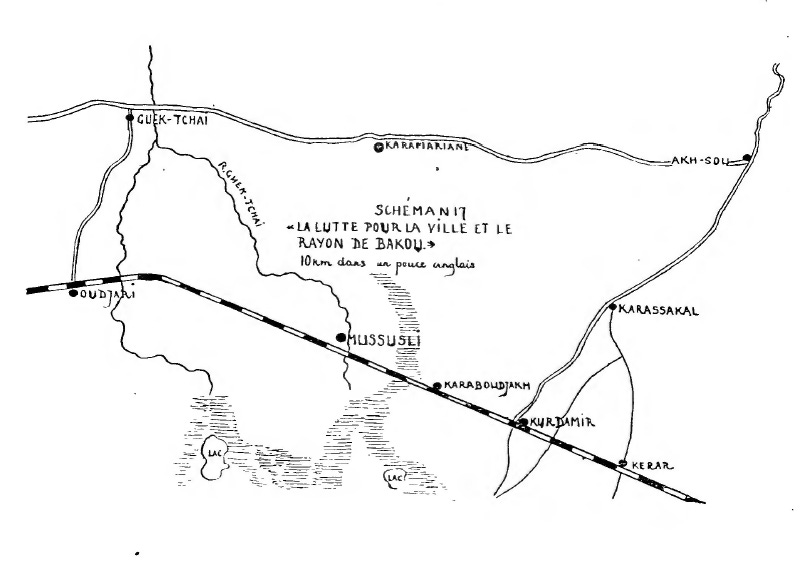
[PAGE 186]
station-village of Petropavlovsk. The occupation of Aksu and Kürdamir station covered Shemakha, from which the road led to Baku, turning the right flank of this centre’s district, while the forces at Petropavlovsk covered the left flank of the Adjikabul position.
After occupying this line, the defence of the district was pushed back to 160 kilometres from the city of Baku.
On 5 June the transport of troop trains to Adjikabul began. After weak resistance, the Turkish advance guards withdrew to Kürdamir.
The attack on Kürdamir was to be carried out by 9 battalions advancing along the railway line.
Another (right) column, consisting of 4 battalions with 2 guns, was to disembark at the Nefteprovodnaya station and move on Aksu, thus threatening the enemy’s rear and easing the task of the central column.
Finally, a third (left) column, consisting of 4 battalions and supported by a river flotilla, was to clear the banks of the Kura and the terrain between it and the railway.
The enemy did not offer serious resistance and on 12 June retreated west to Karabudzhak.
The columns then received new directives: on 13 June the right column was to advance from Kürdamir toward Aksu and, after taking that village, move west, take Gökchay, and from there strike into the enemy’s rear at Mususli, while the central column at the same time was to attack frontally.
The left column was to seize the villages of Petropavlovsk and Salyany.
To the north of the right column, Amirov’s partisans (an Armenian) were to operate, advancing along
[PAGE 187]
the spurs of the southern slope of the Caucasus range in order to attack Gökchay from the north.
The whole operation in practice was reduced to the advance of the right column, since the central column had to wait for the right column’s progress toward Gökchay.
For this reason we shall begin our account with a description of the actions of the right column.
Beginning its advance on the Aksu–Karamaryan–Gökchay axis on 13 June, the column met resistance from the enemy’s forward elements, and only on 16 June did its advance guard—consisting of one battalion and a sotnia—manage to seize the village of Karamaryan. The enemy withdrew toward Gökchay, leaving behind 2 machine guns, which fell into the hands of the victors. The latter lost 4 killed and 12 wounded.
It was established that the column was facing the enemy’s advance guards, and that the enemy, superior in numbers, was concentrating in the Gökchay area.
At 7 a.m. on 17 June the enemy went over to the offensive, but after a fierce battle that lasted the entire day, the right column not only managed to hold all its positions, but even advanced about 2 kilometres west of Karamaryan, capturing two 75-mm guns, 3 machine guns, ammunition, and rifles. Enemy losses were very heavy; the column’s losses amounted to 12 killed and 46 wounded.
However, the column could not develop its success, since the enemy was constantly receiving reinforcements. It therefore remained on the positions it had won until 26 June.
We have already said that the central column
[PAGE 188]
remained at Kürdamir, awaiting the prospects of the right column in the direction of Gökchay.
Thus, on 26 June, the troops defending the Baku district occupied the Karamarian-Kurdamir-Zoubovka line.
The left column encountered superior forces of Azerbaijani Tatars led by Turkish officers, and was unable to advance beyond the village of Zubovka and seize the villages of Petropavlovsk and Salyany as envisaged in the plan of operations.
Subsequent events showed that it would have been better to be satisfied with the results obtained, halt on the line reached, and fortify it for stubborn resistance. But the army commander, having received on 25 June information that one Turkish division was moving from Elisabethpol toward Gökchay and another toward Yevlakh, and that the headquarters of the “Islamic Army” was to be transferred to Ujari station, decided to repeat the manoeuvre that had hitherto succeeded—namely, to attack the enemy forces at Mususli station and at Gökchay before the Turks had time to concentrate them.
An operation of such scale, with troops whose real strength we have characterised above, was very risky, all the more so since the enemy had forced them into inactivity for ten days.
The columns received orders to attack the enemy. The right was to seize Gökchay, while the central column was to take Mususli station.
On 27 June the right column attacked the enemy occupying the heights east of Gökchay. Despite the enemy’s numerical superiority, the attack succeeded, and as a result of the fighting on 27 and 28 June the Turks withdrew 6 kilometres from their original positions. Armenian losses exceeded 260 killed and wounded.
[PAGE 189]
On 29 June the enemy launched a counter-offensive.
The column held firm on 29 and 30 June and 1 July, repulsing on 30 June eleven successive attacks, but by the evening of 1 July, seeing both flanks threatened with encirclement, it withdrew fighting to Karamaryan, and, unable to hold there, retreated on 2 July to positions near the village of Aksu, where it established itself. Aksu had to be held at any cost in order to cover the evacuation of the local Armenian population.
The column’s fighting capacity fell sharply as a result of losses which, after 10 June, exceeded 7 officers and 265 soldiers killed and 16 officers and 534 soldiers wounded—a total of 822 men—and of cholera, which broke out owing to the lack of potable water, inadequate food, and the heat.
The column had about 1,000 sick in its ranks, and its strength, which at the start of operations exceeded 4,400 men, fell to 2,400.
Under these conditions the column was no longer capable of resisting the Turkish advance, since the Turks had already managed to concentrate an entire division against it.
At Aksu the column was reinforced by Amirov’s partisans, who were waging guerrilla warfare in the mountains.
After holding its positions against repeated Turkish attacks and covering the evacuation of the Armenian population, the column, seeing its left flank enveloped and the enemy threatening to break through the Aksu–Kürdamir line, began on 4 July to withdraw toward Shemakha, where it arrived on 6 July.
During this time the central column also began its offensive on 27 June with an attack against the enemy established at Mususli station, intending to outflank its right wing.
[PAGE 190]
This attack failed, since it was undertaken by only part of the column instead of committing all forces from the outset, and also because of the marshy and impassable terrain on the enemy’s right flank. A new attack, combined with a movement to envelop the enemy’s left flank, also failed. For their part, the Turks did not exploit their success, and the central column managed to hold Kürdamir station without being disturbed. But the right column’s retreat from Aksu exposed the central column’s right flank, and to meet this danger it sent several units in that direction on 4 July, which seized the village of Karasakal.
Thus, as of 6 July the Baku forces held the following line: the town of Shemakha–the village of Karasakal–Kürdamir station.
On that day, at Aliat station on the Transcaucasian railway, Colonel Bicherakhov arrived from Persia with his detachment, and was immediately appointed by the Baku Revolutionary Committee as commander-in-chief of the entire district.
***
Before continuing our account of subsequent events, it is necessary to say a few words about the origin of Bicherakhov’s detachment and the personality of its leader.
The Russian expeditionary corps in Persia, like other troops of the Caucasian Front, fell under the corrosive influence of the revolution. Entire units began leaving the front to return to Russia.
Colonel Bicherakhov (a Terek Cossack), serving in the 1st Caucasian Cossack Division, made a heroic attempt to unite around himself the sound
[PAGE 191]
elements still remaining in the corps in order to continue the struggle. A portion of the Cossacks, untouched by propaganda, responded to his call and gathered around him. Soon he had 1,200–1,500 supporters.
Recognising the insufficiency of his forces for independent action, and consciously identifying with Allied interests, Bicherakhov offered his services to the British command in Persia.
By the time the Russian expeditionary corps withdrew from Persia, the British had firmly established themselves in Mesopotamia and replaced the Russian troops that had left Kermanshah.
After the collapse of the Caucasian Front, the British faced the prospect of seeing all northern Persia fall under Turkish control, and for this reason they hastened to accept Bicherakhov’s proposal. With his loyal soldiers he had already occupied the city of Qazvin. The British also undertook the full maintenance of the Cossack partisans.
The British command, fully aware of the importance of keeping northern Persia in its hands, ordered a call throughout its units for “volunteers, officers and non-commissioned officers for an extraordinary and dangerous mission in the East.”
General Dunsterville, who received the task of occupying northern Persia, landed at Basra in January. Establishing contact with Colonel Bicherakhov’s detachment at Qazvin, he decided to move on Enzeli, with the Cossacks in the vanguard, since they knew the terrain and were accustomed to the tricks of the local population, trained by Turkish emissaries.
After forcing the Menjil gorge, the Cossacks easily cleared the remaining stretch of road of the
[PAGE 192]
enemy, and on 17 February Dunsterville’s brigade, though small in number, reached Enzeli, a port on the Caspian Sea.17
Dunsterville’s detachment, after occupying Enzeli and several points for its line of communications with Qazvin, confined itself to maintaining order in the region and watching events. It remained in this position until August 1918.
After the British occupation of Enzeli, Bicherakhov had nothing more to do in Persia, since everything seemed calm on that side, while the Turks had begun their offensive against Baku. Consequently, Bicherakhov decided to go to the aid of that city.
He managed without much difficulty to obtain a gunboat for his purposes, after which the entire Caspian flotilla—intimidated moreover by the threat that fire would be opened against it in case of refusal—joined him.
At the same time he refused to send his men to Baku on small packet boats and ensured that a sufficient number of small vessels were assembled at Enzeli in order to transport his entire detachment in one trip.
To shield his detachment from the harmful influence of Bolshevik propaganda, he bypassed Baku and landed at Aliat station.
The Baku Soviet was forced to put a good face on a bad situation. But, wary of Bicherakhov’s intentions, it in turn summoned from Astrakhan the regiment of Commissar Petrov.
Thus, in the defence of Baku, alongside the Armenians and the Bolshevik detachment of Commissar Petrov, there took part Bicherakhov’s Cossack detachment, which had fought those same Bolsheviks with such energy in Persia. Circumstances
[PAGE 193]
proved stronger than doctrines, and yesterday’s enemies joined hands with the single aim of defending Baku against all attempts to seize it by the Turks and the Central Powers.
***
Immediately after being appointed commander of the Baku defence forces, Colonel Bicherakhov returned at once to the front. His first aim was to halt the Turkish advance in order, at the earliest opportunity, to pass to a counter-offensive.
Taking advantage of the fact that Kürdamir station was still in the hands of the central column, on 8 July he ordered it to hold its ground there, while the right column was to defend Shemakha. The Cossacks, meanwhile, were to seize Karasakal and Aksu and strike into the rear of the Turkish column operating in the direction of Shemakha.
However, reinforcements continued to arrive for the Turks, and the Cossack attack against the enemy group in the Karasakal–Aksu area failed. The enemy in turn went over to the offensive from Karasakal toward Kürdamir, outflanking the right wing and threatening the rear of the central column.
Under threat of encirclement, the central column, together with Bicherakhov’s Cossacks, withdrew on 10 July from Kürdamir to Kerrar.
On 13 July the Turks heavily shelled the position at Kerrar, and on 14 July began their attack. Throughout that day and on 15 July they managed to approach the position to no closer than 800–1,000 paces, but the column was severely shaken. All reserves were committed to battle, and the men were exhausted by three days of continuous fighting and the terrible heat.
[PAGE 194]
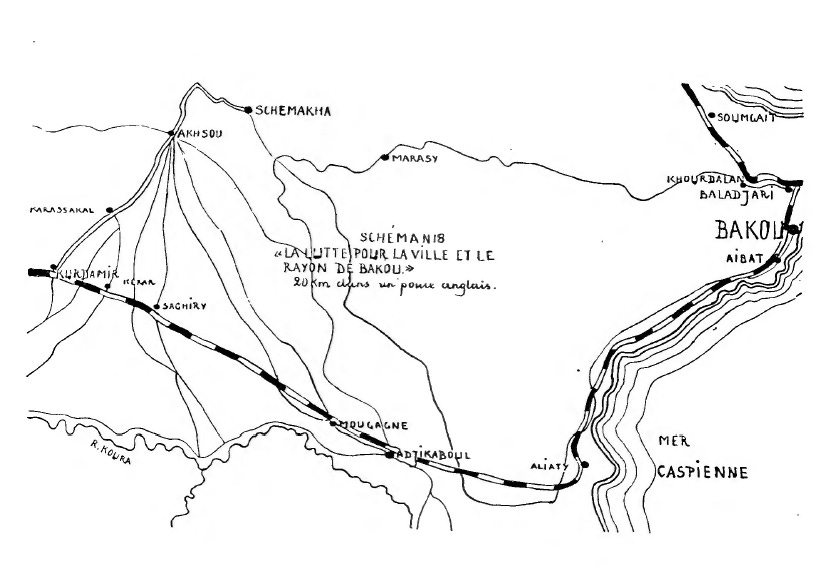
[PAGE 195]
On the evening of 16 July, an outflanking movement by the enemy was detected on the right flank of the position. There was nothing to oppose it, since all the troops were pinned down by the enemy’s energetic assault, and not a single man could be withdrawn from the line of battle.
During the night of 16-17 July, the column, together with Bicherakhov’s Cossacks, withdrew from Kerrar to a new position about 10 kilometres east of that village. The enemy did not pursue.
We have seen that the right column had been ordered to hold Shemakha. It did so successfully until 20 July, but on that day the enemy, having received reinforcements, went over to the offensive, enveloping the column’s left flank. The Turks’ superiority in artillery and cavalry, which carried out a deep outflanking manoeuvre, forced the column to abandon its position and withdraw fighting.
On 21 July, covered by a rearguard, it retreated to the village of Marasi, where it received orders from Colonel Bicherakhov to continue its withdrawal to Khurdalan station. The column withdrew slowly, holding back the enemy with continuous rearguard actions, and reached Khurdalan on 30 July, from where on 31 July it moved to Balajari station.
The entire distance from the village of Marasi to Balajari station—85 kilometres—was covered in 10 days, advancing on average no more than 8 kilometres per day, under constant enemy pressure.
We left the central column between the stations of Kerrar and Sagiri. The enemy did not disturb it, and Colonel Bicherakhov, having ordered the right column to withdraw to Balajari, directed on 20 July that the central column be transported by rail to Adjikabul station,
[PAGE 196]
leaving a rearguard of 2 battalions with cavalry at Mugan station.
After the right column occupied Balajari station, the central column withdrew on 30 July to Aibat station, where it joined the left column, recalled from the village of Zubovka.
Thus, on 31 July the Baku forces held the Balajari–Aibat station line, 5–7 kilometres from Baku.
This marked the beginning of close encirclement.
The troops were regrouped. The units of the right column, in view of their heavy losses—of 4,000 bayonets only 1,800 remained—were withdrawn into Baku for replenishment. Balajari was to be occupied by Bicherakhov’s Cossacks, but they advanced forward to Sumgait in order to operate in the enemy’s rear. As a result, the units of the right column had to return once again to the front.
The position, divided into three sectors, began at Mount Beyuk-dag, following the line of Mount Mud Volcano–Balajari station–the Slaughterhouse–Mount Patamdar, and ending at the Caspian Sea.
The leading circles of the Executive Committee regarded the situation in Baku as hopeless, and at a meeting on 31 July the Committee decided to resign its authority and surrender the city in order to avoid useless bloodshed.
However, representatives of the Armenian national party “Dashnaktsutyun” protested against this decision and succeeded in winning over to their side the Socialist-Revolutionaries, Socialists, and the sailors of the Caspian flotilla. With their support they formed a new government under the name of
[PAGE 197]
the “Baku Dictatorship,” resolved to continue the struggle at any cost and to call for assistance from the British detachment under General Dunsterville, which, as we have seen, had been concentrated in Enzeli since February.
The driving force of the resistance to the end were the Armenians, who could rely only on their own strength.
British assistance was highly uncertain, and after the dissolution of the Executive Committee headed by Shaumyan, Petrov’s detachment, numbering 3,000 men, abandoned its positions and was disarmed.
General A. Bagratuni was elected Commissar for Military and Naval Affairs. In fact, ever since the time of the Executive Committee, and despite his wounds, he had been directing the defence of the city of Baku.
***
On 2 August the Turks began an attack on the left sector from the direction of the Wolf’s Gate. The attack was halted by frontal resistance and by an outflanking thrust from Balajari, but the Turks nevertheless managed to hold their ground and entrench themselves within 500 paces of the city’s defensive belt.
On the evening of the following day, after a preliminary though not very prolonged bombardment, the Turks renewed their attack against the same sector, but achieved no greater success than on the previous day.
On 4 August the enemy, taking advantage of its superiority in artillery, opened intense fire throughout the day against the entire Baku defensive front, and at 3 a.m. on 5 August launched a general assault. Catastrophe seemed inevitable, and the entire Armenian population capable of bearing arms was sent into the trenches. In the end the Turks were repulsed along
[PAGE 198]
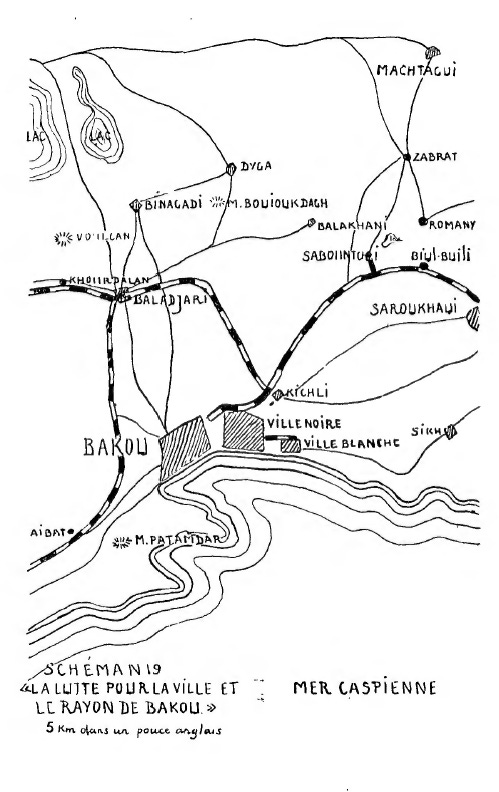
[PAGE 199]
the whole front, and by 8 a.m. the Armenians themselves counterattacked. The enemy could not hold out and by noon fled, leaving 16 machine guns and large numbers of dead and wounded on the field.
But Armenian losses were also serious. On the right sector alone they amounted to 14 officers and 415 soldiers killed and wounded.
The numerical insufficiency of the troops, as well as their exhaustion, made it impossible to pursue the Turks immediately—especially since Colonel Bicherakhov’s Cossacks, who were at Sumgait, ceased fighting and, with 20 guns and 40 machine guns, moved off toward Petrovsk.
Thus Armenian forces alone, numbering only 8,000 men (Petrov’s detachment having been disarmed and Bicherakhov’s Cossacks having withdrawn to Petrovsk), achieved a tactical success against three regular Turkish divisions under the command of Mursal Pasha. After this, a relative lull set in.
On 5 August General Dokuchaev (a Russian) was appointed commander of the troops. Urgent steps were taken to organise and equip the forces and to strengthen the positions.
Confidence in the possibility of salvation increased, all the more so because news was received of the arrival of the British, who were to land a detachment of 4,000 men and subsequently expand it into an expeditionary corps of 20,000.
***
The first British echelon arrived in Baku on 5 August, the very day the Armenians achieved such a notable success against the Turks. This echelon consisted of
[PAGE 200]
several dozen staff personnel of General Dunsterville’s divisional headquarters and clerk-sergeants. It took no fewer than 12 days to transport this small brigade, which did not exceed 3,000 men, from Enzeli to Baku. The last echelon arrived on 17 August.
It should be noted that, on paper, the brigade was to consist of 3,000 men, but in reality its combat strength did not exceed 1,800; the remainder were auxiliary personnel, mostly Indians, serving in transport and rear services.
Although the British arrived as allies and pursued the same objectives as the Armenians—the defence of the Baku district and the blocking of Turkish access to the Caspian Sea and the roads leading into northern Persia—it proved impossible to establish unified command over all the troops concentrated in Baku.
General Dunsterville was completely independent, and with General Bagratuni’s consent his brigade occupied a separate sector at Mud Volcano on the right flank of the defensive line.
No military specialist is required to understand how abnormal such a situation is, when troops pursuing the same objective do not obey a single commander.
It is not without interest to quote here General Dunsterville’s opinion of those who were the driving force behind the city’s defence: “On 19 August I continued my inspection of the front and late in the evening saw members of the Armenian National Council, among whom were several very worthy men. I also paid a visit to the Minister of War,
[PAGE 201]
General Bagratuni (an Armenian), who was still ill, suffering from the effects of the amputation of his left leg, and he made a very favourable impression on me.” (p. 232).
But the overall situation was assessed by the British commander as unpromising. On the same day, 19 August, he noted: “The situation in Baku is undoubtedly very bad, and it seems that the most we can hope for is purely passive defence with probable ultimate defeat. If a thousand or two of our men arrived, all problems would be solved because of the possibility of counterattacks. Without them our position is hopeless.”
Thus one of the senior commanders of Baku’s defence, even before committing his troops to battle, regarded the situation as desperate.
This conviction of inevitable final defeat on the part of one of the leaders of the defence could not but affect the outcome of the intense struggle that was about to begin.
The absence of official data, as well as the scope of the present study, prevent us from examining why all of General Dunsterville’s requests, in which he insistently urged the urgent dispatch of reinforcements, were ignored. It nevertheless appears that only after the fall of Baku did the headquarters in Baghdad and the Indian Army realise that not Mosul alone, but above all the Caucasus, was the gateway to India.
General Dunsterville was recalled and replaced by General Thomson, commander of the 14th Division, reorganised into the “Army of North Persia,” which later occupied Transcaucasia.
***
After the assault of 5 August, a relative calm
[PAGE 202]
settled on the Baku defensive front. The Turks awaited new reinforcements, while the Armenians, determined to fight to the last, took advantage of this to undertake by mid-August a series of limited offensive operations in order to straighten and strengthen the defensive line.
This line ran from Mount Beyuk-dag through Mud Volcano–Balajari–the Slaughterhouse–Mount Patamdar–to the seashore. The territory north of Beyuk-dag to the sea was not defended due to the insufficiency of available forces, and small enemy groups were able to infiltrate east of the city, onto the Absheron Peninsula, in order to arm and organise the local Tatar population. The village of Mashtagi was occupied by the Turks.
In view of its tactical importance for the security of the defensive line, it was decided to drive the Turks out by force, but two attempts, made with insufficient means, failed, and the result achieved was limited to the occupation of the village of Diga to protect Baku from the north.
On the morning of 29 August the Turks, with considerable forces, attacked Mud Volcano, which was held by the British. Despite their heroic defence, the enemy’s superiority and heavy losses compelled the British to evacuate part of their position.
On 1 September the Turks went over to the offensive against the right sector, occupying the line of the villages of Diga–the Binagadi Oilfields–Mount Beyuk-dag.
The attacks could not be repelled, and the defensive line of the right sector was moved back to the line: the village of Balajari–the village of Balakhany–the village of Sabunchi–the village of Bulbuli–the village of Surakhany–the village of Zikh, with the occupation of the villages of Zabrat and Romany as outposts.
The result of the Turkish operations of 1 September was the complete encirclement of Baku.
[PAGE 203]
Communication with the outside world was maintained only across the Caspian Sea. In vain did the Baku Dictatorship place its hopes on the arrival of British reinforcements. The last of Dunsterville’s echelons had landed on 17 August. The general himself had from the outset doubted the possibility of defending Baku, and the unsuccessful outcome of the battles of 29 August and 1 September must have finally confirmed him in that view. According to some reports, in early September General Dunsterville, considering further defence useless, wished to withdraw his troops and proposed that the Dictatorship enter into negotiations with the enemy; but General Bagratuni energetically opposed such a decision, and in the end it was resolved to continue the struggle.
By 10 a.m. on 13 September information was received that opposite the right sector, on the line between the villages of Zikh and Surakhany, there were significant groups of Tatars, on foot and mounted, reinforced by Turks—about 3,000 men in all.
The battle began at about 11 a.m. and continued until midnight; all enemy attacks were repulsed.
However, these attacks were merely demonstrative, and during the night of 13–14 September the Turks launched a vigorous simultaneous offensive against the left sector of the defensive line and along the entire Mount Patamdar–Wolf’s Gate front. The enemy continually committed fresh forces and on the morning of 14 September occupied the Wolf’s Gate.
The central sector was also attacked, and the crushing superiority of the enemy along the entire front became evident. The defenders, having exhausted all their reserves and lacking any possibility of manoeuvre,
[PAGE 204]
were compelled to conduct a passive defence, deprived of all means of counterattack.
By 5 p.m. the British, without informing anyone, abandoned their positions and returned to the city to embark on their transport flotilla. This became the signal for a general retreat, and the defensive line had to be moved back to the city limits. In these conditions the Dictatorship decided to abandon the defence of Baku.
Late in the evening of 14 September the troops began assembling on the quays for embarkation onto transport vessels.
Along the entire line of the city perimeter 4 battalions remained, against which the Turks confined themselves to heavy artillery fire without launching an attack.
By dawn on the 15th up to 8,000 defenders of Baku and civilians had been embarked; at 5 a.m. General Dokuchaev’s staff boarded ship; last, at 6 a.m., when looting had already begun, General Bagratuni and the energetic chairman of the Dashnaktsutyun party, Mr Rostom Zorian, went aboard.
Baku had fallen. The victors gave the city over to plunder by the mob. Turkish troops entered the city only at 5 p.m. on 16 September and somewhat restored order.
During the two days, 15 and 16 September, according to various sources, between 15,000 and 30,000 Armenians were massacred.
***
After having shown the role of the Armenians in the defence of the city and district of Baku, the burden of which fell almost exclusively upon their shoulders, it remains for us to draw attention to the reflection of this stubborn struggle on the course of the World War.
[PAGE 205]
Because of it, the Central Powers were for a long time deprived of the products of the Baku oil industry, the need for which was felt in the most alarming manner, and access to the Caspian Sea was barred to the Turks, thus hindering their operational plans in northern Persia and beyond the Caspian.
We must not forget that Baku is the principal port of the Caspian Sea, from which the Turks could easily establish contact with the Muslim population inhabiting its shores, whose sympathies were not in doubt. If one accepts the idea of a Pan-Turkic empire, then the Caspian Sea, occupying a central position within it, would have served as the link between the territories that would have formed part of it.
The operations of the Turks and the Transcaucasian Tatars were paralysed for a considerable period by the defence of Baku, and the Turks lacked the time to link Transcaucasia with the Transcaspian regions and to carry out the German plan of raising the Muslim peoples of Central Asia, in order to threaten British domination in India.
As confirmation of the important role which the prolonged defence of Baku played in connection with the general strategic situation on the Eastern theatre of war, we shall cite several passages from the well-known book by Erich Ludendorff (First Quartermaster-General of the German Army), Memoirs of the War (1914–1918), Paris, Payot.
In the chapter “The Basis for Continuing the War” (Vol. I, p. 379), General Ludendorff writes:
Apart from coal, iron and steel, fuel for submarines, motor cars and aircraft, as well as lubricating oils, was of the greatest importance for the conduct of the war in general. From this point of view we were limited to Austria-Hungary and Romania. Since Austria could not produce sufficient oil and all efforts undertaken to increase its production remained without result, Romanian
[PAGE 206]
oil was of exceptional importance to us. But even with deliveries of oil from Romania, the fuel question always remained very serious and caused us the greatest difficulties, both for the conduct of the war and for the life of the country. The resources of the Caucasus opened up favourable prospects for us in 1918.
The impossibility of satisfying the growing needs for petroleum products did not cease to trouble the German dictator throughout the war, together with his growing dissatisfaction with the Turks, who, in his opinion, should have taken Baku much earlier.
In the work cited above (Vol. II, p. 256), Ludendorff wrote: “The Turks were constantly around Tabriz and near Baku.”
He returns to this question (Vol. II, p. 276): “The Turks were before Baku. They had also established themselves in northern Persia, though without advancing very far there.”
In the end, in view of Turkish failures, the German commander-in-chief decided to reinforce them with German troops, in order to become master of the oil-bearing territory of Baku as quickly as possible and at any cost.
Here is what Ludendorff writes in his memoirs (Vol. II, pp. 278–279):
We could count only on the oil of Baku, if we were to take it ourselves. I remember only too well the great shortage of fuel in Germany and all the difficulties caused by the problem of lighting in winter, and all that followed.
[PAGE 208]
After the offensive of the 7th Army, fuel reserves were exhausted; we were in great need of them. The railways of Ukraine also required oil. We accelerated by exceptional measures, within the limits of what was possible, oil production in Romania, and nevertheless could not hope to cover the deficit. It now seems that this would have been possible by bringing it from Transcaucasia, namely from Baku, if we had at the same time been able to resolve the question of transport. … The decisive question, naturally, was: how to reach Baku…
And further: “It seemed entirely possible: one bold blow, requiring only small forces. The High Command prepared against them (that is, the defenders of Baku. — Trans. note) an attack, with the participation of Nuri’s troops, and sent to Tiflis a cavalry brigade and several battalions. The transfer of troops had not yet been completed when Nuri had already taken Baku.”
[PAGE 209]
DOCUMENTS WHICH SERVED AS MATERIAL FOR THIS NARRATIVE
1. Materials collected by the commission chaired by General Kulebyakin
2. Field journal of the Armenian Corps
3. Copies of telegrams sent by military telegraph by the headquarters of the Caucasian Front and the Transcaucasian government to the Turkish command. Telegrams of the Turkish command
4. Stenographic records of the sessions of the Transcaucasian Seim
5. Report of General Nazarbekov of 14 February 1919 to the Armenian government
6. Report of Colonel Morel, head of the delegation for negotiations on the cessation of hostilities, to the commandant of the Kars fortress, 25 April 1918
7. Report of General Dokuchaev, commander of the troops and fleet of the city and district of Baku, of 6 October 1918. City of Port-Petrovsk
8. History of the 3rd Baku Brigade under the command of Amazasp
9. Report of the commander of the 4th Baku Brigade on the events in Baku from 17 March to 14 September 1918
10. Erich Ludendorff, First Quartermaster-General of the German Armies. Memoirs of the War 1914–1918. Payot, Paris.
11. P.G. La Chesnais: The Peoples of Transcaucasia during the War and before the Peace. Edition Bossard, 43 Rue Madame, Paris, 1921.
12. Poidebard: The Military Role of the Armenians on the Caucasian Front after the Defection of the Russian Army. Paris, Imprimerie Nationale, 1920.
NOTES
General of the Russian army, of Armenian origin.
The 3rd Legion joined the Bitlis group after the expedition to Khisan, of which we shall speak later.
[Footnote is an extended table with details of the Armenian Corps.]
The commander of the front, seeing the impossibility of retaining the Russian troops, decided at least to impose order upon their withdrawal and evacuation to Russia, in order to prevent these fleeing masses of soldiers from penetrating into the rear of the theatre of operations and becoming a direct threat to the population of Transcaucasia.
It was agreed that Georgian troops would occupy the region north of Bayburt to the Black Sea.
This question is discussed in Poidebard A., Rôle militaire des Arméniens sur le front du Caucase après la défection de l’Armée russe, p. 11 – Paris, Imprimerie Nationale, 1920; and in La Chesnais P.G., Les peuples de la Transcaucasie pendant la guerre et devant la paix, Paris, Bossard, 1921.
The High Command of the front remained Russian.
Appointed commander of the Separate Armenian Division, Andranik arrived on 3 March and was appointed commandant of the fortified district of Erzerum. The headquarters of the Russian army left Erzerum on 25 February and transferred its main headquarters to Sarikamish. In the appointment of Andranik, a well-known partisan, as divisional commander and commandant of the fortified district, there was nothing extraordinary in this period permeated by revolution, characterised by the breakdown of discipline, the decline of the soldiers’ fighting spirit, and general exhaustion. It was necessary to resort to a popular national hero, who alone could raise the morale of the masses and lead them into battle. By order of the commander-in-chief of the troops of the Caucasian Front, Andranik was promoted to general, with a staff consisting of regular officers and technical personnel.
Lieutenant-Colonel in the Russian army, Armenian by nationality.
General of the Russian army, Armenian by nationality.
General of the Russian army, Armenian by nationality.
General of the Russian army, Armenian by nationality.
Karchikyan: “Do you consider that the fate of Kars is sealed, and what in general must be done to save the situation? I must tell you that in these last three days, owing to the complete absence of any government, decisions were taken by irresponsible persons who may thereby have spoiled everything. Can we do something to save the situation and, in particular, what should be done?”
General Nazarbekov: “Unfortunately, you are sharing your considerations with me too late. I received from the Minister of War, Odishilidze, a categorical government order to cease hostilities at Kars and allow the Turks to approach to within two versts of the Kars forts, and negotiations are now under way regarding the evacuation of Kars. The only way you can help us at this moment is to ask the government to seek from Vehib Pasha that the period for evacuating Kars be not less than a month. I fear they will present us with exorbitant conditions which we must, unfortunately, accept, because the armistice has caused disorganisation in our troops. We knew nothing of what was being done in Tiflis. All we know is the formation of a new government, but unfortunately none of you has explained the situation to us in these last days.”
Here is the conversation by direct wire between the quartermaster staff officer, Colonel Shatilov, speaking on behalf of the Chairman of the Government, Chkhenkeli, and the chief of staff of the Armenian Corps, General Vyshinsky, representing General Nazarbekov.
Colonel Shatilov: “I report: the Chairman of the Government, Chkhenkeli, asks the commander of the Armenian Corps that you answer at once the question: does his (Chkhenkeli’s) order to evacuate Kars correspond to the situation—that is, can we be convinced that in the event of refusal of the Turkish conditions concerning the evacuation of Kars, they will seize the same in a few days, or at least that they will take such measures and occupy tactical points of such importance that the fate of Kars will be decided?
Second question: can one hope that in the event of the government deciding to reject the Turkish proposals set out in their unsigned communiqué today, our troops will successfully and steadfastly defend the Garam-Vartan–Ak-baba line?
Third question: did our troops withdraw this morning by order from above or in the face of the threat of a Turkish offensive?”
General Vyshinsky: “I answer your questions after reporting to the corps commander. The fate of the forward positions held by the Begli-Ahmed detachment was decided yesterday as a consequence of General Odishilidze’s order to cease hostilities and send parlementaires. This order has an unfavourable effect on the fighting capacity of the troops. However, it does not concern the troops at Kars, and Kars could still have been held for 15 days or perhaps a whole month. A refusal of the Turkish proposals, very well founded even this morning, could have saved the situation, and the Kars fortress would, beyond any doubt, have resisted the Turks; even today the fortress defended itself very courageously until receiving the order of the head of government, Chkhenkeli, and General Odishilidze to send parlementaires to determine the conditions for evacuating the fortress. After this order was passed to the commandant of the Kars fortress, the fighting ceased. The troops withdrew from the forward position Aghach–Ak-baba–Garam-Vartan by order, although there were cases where some elements withdrew on their own initiative.”
General of the Russian army, Armenian by nationality.
Colonel of the Russian army, Armenian by nationality.
The Adventures of Dunsterforce, by Major-General L. Y. Dunsterville. London, Arnold, 1920.