

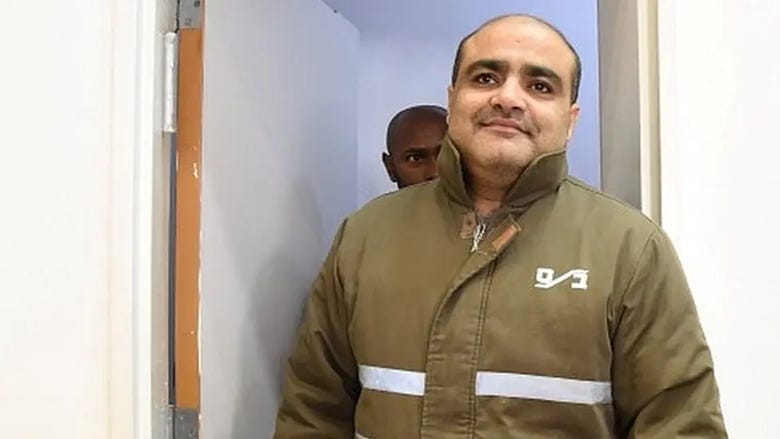
Early August 2016 was the point in the U.S. Presidential Election when Donald Trump, the presumed no-hoper candidate, was feuding with the Muslim Gold Star family, hinting broadly that if he lost it was because the vote was rigged, and being renounced by increasing numbers of elected Republicans. Amid this carry-on, it was little noticed that Israel charged Mohammad el-Halabi, the director of the World Vision charity in Gaza, with being a senior HAMAS operative who had diverted humanitarian funds to terrorist activities.
THE CHARGES AGAINST MOHAMMED EL-HALABI
El-Halabi (b. 1978) was arrested on 15 June 2016 and confessed in Shin Bet custody “that he has been a HAMAS member since his youth and had undergone organizational and military training in the early 2000s”, according to Israel.1 “In 2005, HAMAS dispatched El-Halabi to infiltrate World Vision.”
The Israelis said HAMAS had good reason to believe El-Halabi could infiltrate World Vision, which had worked in the Palestinian Territories since 1975, because his father, also a HAMAS member, had “served as head” of the United Nations Relief and Works Agency (UNRWA) “educational institutions” for years, and El-Halabi himself had been employed by the United Nations Development Programme (UNDP) in the Gaza Strip, ostensibly providing jobs to “‘farmers’ in areas close to Gaza’s border with Israel who in fact acted as lookouts for HAMAS”.
The U.N. was—and is—one of the major donors to World Vision, a global Christian NGO that had an annual budget of $2.7 billion and 46,000 staff working in one-hundred countries in 2016. The U.N. and its agencies worked closely with World Vision in Gaza.
After El-Halabi worked his way up to become director of World Vision, “he controlled the budget, equipment, and aid packages”, Israel’s statement went on. El-Halabi thereafter diverted 60% of the charity’s annual budget for Gaza to HAMAS, amounting to over $7 million per year, and used his position to provide specialist equipment and logistical support to the terrorist group, specifically to its military units, Al-Qassam Brigades (Kataib Izzadeen al-Qassam).
Items “ordered on behalf of World Vision” supposedly to assist Gazans in agricultural enterprises—“inter alia, iron rods, digging equipment, pipes, and building materials”—were in fact used “to construct HAMAS military outposts and to dig terror tunnels”, according to Israel. A British government donation of $80,000 (£60,000), given in cash, was stolen entirely to pay the salaries of the HAMAS operatives building a military base codenamed “Palestine”. A project to build greenhouses was used as cover for “sites where terror tunnels were being dug” and another humanitarian effort to rehabilitate fishermen “was actually used to provide motor boats and diving suits for HAMAS’ military marine unit.” During the period of Muslim Brotherhood rule in Egypt (mid-2012 to mid-2013), “El-Halabi diverted tens of thousands of dollars of the aid organization’s funds to purchase weapons in the Sinai”.
“Another regular method of acquiring equipment for HAMAS”, said Israel, was for El-Halabi to arrange for trucks coming through the Kerem Shalom Crossing between Israel and Gaza to drop their supplies at World Vision-flagged warehouses that in reality belonged to HAMAS: “HAMAS operatives would pick up the supplies in the dead of night.” In this way, the humanitarian aid “that World Vision had intended to go to the needy”—“packages of food, basic commodities, and medical supplies”—was given “almost exclusively to HAMAS terrorists and their families”, Israel reported El-Halabi testified. During the 2014 round of fighting in Gaza, “the terrorists received [World Vision] food packages to sustain them above and below ground, including in terror tunnels.”
The standard means of fraud, by Israel’s account, involved inflating construction costs and sending the difference to HAMAS, and registering HAMAS terrorists and activists as “ghost” employees or among the unemployed eligible for World Vision relief monies. (The latter, according to Israel, was a particular favourite for paying Al-Qassam Brigades, whose terrorists received about one-third of the unemployment budget.) The aftermath of the 2014 war gave HAMAS additional opportunities to fundraise, Israel said. There were World Vision-overseen fundraisers for injured Palestinian children, and children in need of “psychological support” and other healthcare, and HAMAS raked off the cash for its terrorists and their families, sometimes by registering fake children on the lists for aid
Finally, according to the Israeli indictment, El-Halabi had used his status and the protections it gave him to travel within Israel “to engage in serious terrorist activity”, among other things “locating and marking (via GPS) sites near the Erez Crossing that potentially could be used as egress points for HAMAS attack tunnels”.
The Israelis said their “investigation revealed much information concerning additional figures in the Gaza Strip” who exploited the complex of U.N. agencies and “humanitarian” NGOs who collaborated with them for terrorist purposes. “El-Halabi’s statements portray a troubling picture in which U.N. institutions in Gaza are in fact controlled by the Islamist terrorist organization HAMAS”, Israel concluded.
In June 2022, El-Halabi was found guilty on a raft of terrorism charges and in August 2022 he was sentenced to twelve years in prison.
THE REACTION TO THE CHARGES
The whole ecosystem of political warfare that has become so familiar recently quickly whirred into action. The United Nations and associated custodians of “international law”, the “human rights” activists, “humanitarian” NGOs, Western academics, and the prestige media united in condemnation of Israel.
World Vision denied in 2016 that it was even possible El-Halabi was guilty of the charges: they adhere to “the humanitarian principles of impartiality and neutrality”, you see, which means the organisation “rejects any involvement in any political, military, or terrorist activities”. And if that was not enough, “World Vision has detailed procedures and control mechanisms in place to ensure that the funds entrusted to us are spent in accordance with applicable legal requirements”. So there was “no reason to believe that the allegations [against El-Halabi] are true”.
When El-Halabi was convicted, Tim Costello, a Baptist minister and former CEO of World Vision Australia (executive director of Micah Australia by then), and Conny Lenneberg, a former regional director for World Vision International in the Middle East, took to the pages of The Sydney Morning Herald to declare: “The verdict overnight announces the demise of the rule of law in Israeli courts.” There was “not a shred of evidence … to substantiate the key charges”, the authors insisted. “El-Halabi was recognised by the U.N. as a humanitarian hero for the calibre of his leadership and commitment to the international humanitarian principles of humanity, neutrality, impartiality and independence. … This case was only ever about discrediting humanitarian work in Gaza.”
Costello et al. were used by an advocacy journalist at the ABC (Australia’s BBC) to further the anti-Israel narrative. El-Halabi’s father, Khalil El-Halabi, was given space in Western newspapers, despite Israel naming him as a HAMAS member, to claim his son “sits in an Israeli jail on the basis of trumped-up charges”, guilty of nothing more than “selfless work supporting Gaza’s people”. El-Halabi Senior also highlighted that El-Halabi Junior “was profiled as one of the U.N.’s ‘Humanitarian Heroes’.” Ostensibly straight news reports by The Associated Press and in The New York Times maintained an air of neutrality, framing the case as a he-said-she-said episode, while telling mostly the defence story and quoting from “human rights” activists who unanimously condemned Israel. The Guardian did its own purported investigation and all will be surprised that it concluded El-Halabi was the victim of an Israeli frame-up.
After an initial wait-and-see statement, the U.N. rallied to El-Halabi’s cause. The amusingly-named U.N. Human Rights Council began including El-Halabi in its encyclicals, the basic themes being that he denied the charges and so did World Vision, which settled the matter, yet Israel continued cruelly torturing him and subjecting him to a secret show trial.
The day before the conviction, the Office of the United Nations High Commissioner for Human Rights remained on-message, expressing “serious concerns” over the proceedings, claiming there was a “lack of evidence” El-Halabi had done anything wrong and that there were “credible allegations of ill-treatment in detention”. “U.N. human rights experts”, the notorious Francesca Albanese among them, were up next to say: “Convicting a humanitarian aid worker in serious violation of the right to a fair trial and on baseless charges of ‘terrorism’ is further evidence of Israel’s egregious misuse of counter-terrorism measures to suppress voices of human rights defenders.” The Albanesistas were also sure to point out El-Halabi “was reportedly subject to ill-treatment” [italics added].
By late 2023, the Albanese-led “U.N. experts” had transitioned to a straightforward activist campaign, demanding Israel “reverse the conviction” of El-Halabi and release him “immediately”. “Israel is violating international law”, the “human rights” luminaries said, and “using ‘counter-terrorism’ legislation to silence, penalise, and punish Palestinians who engage in legitimate human rights and humanitarian work”.
El-Halabi was released in February 2025, after serving nine years of his twelve-year sentence. Some might have taken notice of El-Halabi being freed because he was among the convicts HAMAS demanded as part of the deal Israel made to recover her hostages taken during the 7 October 2023 pogrom. But not Amnesty International, which put out a statement celebrating El-Halabi’s release and summarising Amnesty’s coverage of the case.
El-Halabi was a “prisoner of conscience”, who had been “tortured, tried in secret hearings, and convicted after a grossly unfair trial”, said Amnesty: this was “a flagrant miscarriage of justice”. Erika Guevara Rosas, Amnesty’s Senior Director for Research, Advocacy, Policy, and Campaigns, was quoted saying El-Halabi “was unjustly targeted by Israeli authorities for his humanitarian work”. “His horrifying ordeal behind bars demonstrates how Israel’s discriminatory justice system helps to maintain the cruel system of apartheid against Palestinians”, Rosas added.
Omar Shakir, the recently-departed Israel and Palestine director at Human Rights Watch, let it be known in June 2022 that the legal proceedings were a “mockery of due process and the most basic fair trial provisions”, and El-Halabi “should long ago have been released. To continue to cruelly detain him is profoundly unjust.”
WHAT THE CAPTURED HAMAS FILES SAY
The HAMAS documents recovered by the Israel Defence Forces (IDF) from Gaza, seen by The Jerusalem Post and NGO Monitor, leave no doubt that El-Halabi was a senior HAMAS operative at the time he was director of World Vision in Gaza. Not one single participant in the nearly decade-long global disinformation campaign to deny that El-Halabi was a terrorist and vilify Israel for prosecuting him as such has yet so much as acknowledged the discovery of these documents, which was reported two weeks ago, let alone apologised for being so egregiously, categorically wrong.
A key document, entitled, “The Detainee in Zionist Prisons Mohammed Khalil Mohammed el-Halabi”, and dated 11 March 2020, was prepared by the counter-espionage division of HAMAS’s “Ministry of Interior and National Security” (MoINS) in Gaza. The document records the illicit activities El-Halabi undertook on HAMAS’s behalf as part of a counter-intelligence assessment trying to identity the security breach that led to his exposure.
HAMAS was clearly alarmed by Israel’s discovery of El-Halabi because the group had put in place elaborate procedures to shield him from detection. Among other things, El-Halabi “was in contact with [only a] very few parties of brothers in the positive”, the document says. “The positive” is a euphemism used by HAMAS in internal communications to refer to Al-Qassam Brigades.2
The document goes on to describe how tightly HAMAS kept watch over World Vision’s activities and staff. “[A]ll the names of employees working in the association [World Vision] were detailed, under the assumption that the secret witness [in El-Halabi’s trial] is one of the association’s employees working in the Gaza Strip”, the document said, adding that “all the names of employees in the association were examined with information found on the ‘security guide’,” referring to HAMAS’s database of individuals deemed “security threats”.
HAMAS’s effective control of World Vision paid off: they were able to identify who tipped off the Israelis. The 11 March document says: “the indications and evidence have been pointing to Mohammed Khalil Mehdi as the one who gave all the Halabi information.” Mehdi was subsequently apprehended by HAMAS and interrogated. It is most indicative that a copy of the transcript of HAMAS’s interrogation of Mehdi was found “on [El-Halabi’s] personal computer that was seized by the Shabak [a.k.a. Shin Bet]”. Mehdi’s fate is unclear, but it must be presumed he is dead or in Israeli protective custody by now because he was cited by name in the public verdict of the Israeli courts in 2022 as giving evidence “consistent with the operative mechanisms that were detailed by the defendant [i.e., El-Halabi]” in his confession.
The difficulty of gathering and presenting evidence from figures like Mehdi is the reason for the much-complained-about Israeli secrecy during the investigation of El-Halabi. Israel’s methods are as open to criticism as anybody else’s, on the proviso it is acknowledged that there is simply no easy way for liberal States to convert information gathered from counter-intelligence investigations into evidence that can be presented in a legal setting.3
One might also note the irony that the “audit” World Vision said it had conducted, which purportedly cleared El-Halabi, was carried out entirely in secret,4 and the whole organisation has since been convulsed by revelations of its “toxic” culture of secrecy, specifically bullying staff who challenge the leadership, “even … through protected, legitimate channels”, and “routinely” using non-disclosure agreements “to silence staff leaving after negative experiences”.
It may well be this tendency to silence staff who raise uncomfortable issues that led World Vision to fire Mehdi, but the context points to the explanation being the extent of the terrorists’ control over World Vision Gaza. The timing is suggestive: Mehdi was dismissed right after HAMAS identified him as the whistleblower. And this occurred as part of a broader campaign by HAMAS to intimidate witnesses who could provide evidence about El-Halabi to Israel.
A document from 3 March 2020, authored by MoINS’s Branch of Foreign Associations, an element of HAMAS’s Interior Security Mechanism (ISM), reported that the previous day HAMAS had detained World Vision Gaza’s “head of security and safety” as he tried to traverse the Beit Hanoun Crossing (or Erez Crossing). The man had, like many of World Vision’s staff, been placed under surveillance some time earlier “as part of monitoring of the latest updates concerning the case of Mohammed el-Halabi”, the document notes, and “the Division of Crossings and Borders” therefore flagged his attempted crossing. The man was questioned by HAMAS and disclosed that he had been “requested to testify in the Zionist court”, i.e., to Israeli investigators, according to the HAMAS document.
Needless to say, such testimony was never given. A separate HAMAS report from March 2020 boasts: “Our monitoring and coordination with all relevant parties in the case had a role in thwarting multiple schemes to bring about the conviction of Mohammed el-Halabi.” It did not end there.
The minutes of a 15 April 2020 meeting of HAMAS’s “Committee of Non-Governmental Associations”, an MoINS coordinating body for the various HAMAS intelligence, military, and criminal “justice” agencies that deal with the NGOs in the Strip,5 record that the World Vision “head of security and safety” had said during interrogation that another World Vision colleague had been contacted by a lawyer working on El-Halabi’s trial and asked to meet with “Israeli intelligence” at the Beit Hanoun Crossing. The upshot was that this person had been placed under surveillance and all World Vision staff were now “prohibited from going out through the [Beit Hanoun] crossing”.
Perhaps the most significant revelation in the HAMAS documents is that the group had an agent “present at the trial [of El-Halabi] on 21 November 2019”. It speaks to HAMAS’s espionage capabilities, acquired by the organisation’s absorption into Iran’s Islamic Revolutionary Guards Corps (IRGC), that it had a spy at a closed-door hearing inside Israel. It is a revelation freighted with a horrible sense of foreboding, knowing now that four years later such capabilities would play a part in enabling the Simchat Torah pogrom.
IMPLICATIONS
Part of the absurd “genocide” accusation against Israel is the claim that the IDF has targeted NGOs providing sustenance and care to Gaza’s civilians. Time after time, Israel has insisted that the targeted individuals were terrorists—often providing the name and rank—and, therefore, legitimate targets, in many ways doubly so, since if they were falsely using civilian organisations and facilities as shelter that is another war crime. Almost invariably the response from the disinformation ecosystem has been the same as it was over El-Halabi.
Now that the war is effectively over, there has been some loosening of message discipline and facts are beginning to trickle out bearing on this issue. Yesterday, for example, a series of “martyrdom” notices were released. Palestinian Islamic Jihad (PIJ), one of the IRGC units that invaded Israel alongside HAMAS on 7 October, celebrated Fadi Jihad Mohammed al-Wadiya, the deputy head of its Military Manufacturing Unit (MMU), who was sent to his paradisical abode by an Israeli airstrike in June 2024. PIJ muted its pleasure about this at the time because, for political warfare purposes, it was much more beneficial to mention only Al-Wadiya’s employment as a physiotherapist for Doctors Without Borders (Médecins Sans Frontières or MSF). MSF’s statement, complete with heart-rending photographs of Al-Wadiya treating children, castigated Israel for killing “a health care worker while on his way to provide vital medical care to wounded victims of the endless massacres across Gaza”. Killing Al-Wadiya was “cynical and abhorrent”, MSF went on, “another brutal example of the senseless killing of Palestinian civilians”. When presented with the intelligence of Al-Wadiya’s real employer, MSF as much as said Israel was lying. As recently as October 2025, MSF mourned the “tragic loss” of Al-Wadiya and said it was “outraged” at Israel for his death.
Samir Suleiman Abu Shawish was said to be a civilian employee of MAAN Development Centre, a Palestinian NGO that cultivates “human resources for sustainable development”, when Israel killed him in April 2025: PIJ was proud—nearly a year later—to announce he was commander of its Yabna Battalion in the Rafah Brigade. Alaa Hassan Abdullah Asbihi, a nurse at the European Hospital near Khan Yunis killed in December 2023, was another PIJ Military Manufacturing Unit operative. Mohammed Akram Abdullah al-Kafarna, the head of the Palestinian Nursing Association and nursing supervisor at Kamal al-Adwan Hospital in Beit Lahia, mourned internationally by medical associations when he was killed in September 2025, was a HAMAS “mujahid”. The “martyrdom” notices also included several journalists—to add to the catalogue of admitted terrorists posing as “journalists” already known about—which rather qualifies activist claims about IDF savagery towards the media. Then there are the UNRWA officials involved in the 7 October carnage, some of whom Israel has settled accounts with. The U.N.’s admission it employed pogromshchiki notwithstanding, it has continued to present UNRWA fatalities as a massacre of the innocents. One could go on, but if the point has not been taken by now it is not going to be.
The IRGC tactics in Gaza are not novel. Terrorism is by definition a political enterprise and violence is often secondary to political warfare. Terrorists are generally weaker actors fighting stronger ones, usually States: they do not expect to win on the battlefield, but to foster narratives of State injustice and brutality, and where possible to provoke such things, to mobilise “their own” community and to generate international pressure that forces concessions from their enemies. To that end, jihadists have been exploiting the epistemological challenge of identifying members of clandestine terrorist organisations to portray action against them as wanton atrocities for a long time. Such an incident was crucial to the IRGC taking power in Iran in 1979 and a more continual campaign—legal in nature, of course, since it was against America—formed the basis of the whole “controversy” over the Al-Qaeda detainees at Guantanamo Bay.
A tactic this successful for this long is not going to be set aside anytime soon, and Israel has special disabilities in combatting it. Still, to have cases like Mohammad el-Halabi’s on record, where such irrefutable proof has emerged vindicating Israel’s contention that he was a terrorist operating under civilian cover, provides a starting point for a corrective after three years of propaganda. The long war against jihadism is far from over and the assumptions being inculcated in elite and popular opinion in the West will impact the ability of all democracies to defend themselves from Islamic militancy.
NOTES
Shin Bet, the Israeli domestic counter-intelligence service, is also known as the Israel Security Agency or SHABAK.
Ahmed Qasem Hussein (2021, Sept.-Oct.), ‘The Evolution of the Military Action of the Izz al-Din al-Qassam Brigades: How Hamas Established its Army in Gaza’, Al-Muntaqa: New Perspectives on Arab Studies. Available here.
The issue bedevilled the West all through the Cold War. Britain was unable to prosecute so notorious and damaging a Soviet spy as Kim Philby. The United States did manage to imprison the traitor Alger Hiss on a technicality, but the political reverberations from that echo to this day. Likewise, the U.S. actually executed the Rosenbergs for their treason, but the irregularities needed in that trial to get the evidence public while keeping the VENONA Program secret has kept alive the conspiracy theories of their innocence seventy and more years later.
For the Philby and Hiss cases, see: Christopher Andrew and Vasili Mitrokhin (1999), The Sword and the Shield: The Mitrokhin Archive and the Secret History of the KGB, pp. 160-161, 164.
The all-clear World Vision gave itself in secret was sharply at variance with the independent and public audit conducted in Israel about the charity’s operations in former Mandate Palestine, and at variance with the U.S. Senate investigation of World Vision’s activities in Sudan, if it comes to that, where the same pattern recurred of an untoward coziness with terrorists and a distinct lack of curiosity about where its funds were actually going.
One of the important entities involved in the Committee was the ISM Division of Foreign Activity, the intelligence branch with the dedicated mission of overseeing the HAMAS regime’s handing of the NGOs and U.N. agencies. The Division was led in 2020 by Ayman Rouqa (Abu Islam), an aqid (colonel) in HAMAS.