

Read the article over at The Telegraph.
Since 1979, the West has struggled to accept that the Iranian regime is not a normal government but the central node of a transnational Revolution—essentially an Islamic Soviet Union, with the same relentless drive for infiltration and political warfare.
It is this that explains why, while the killing of Supreme Leader Ayatollah Ali Khamenei was celebrated inside Iran, a number of mosques and Islamic centres in Britain—which appear to be loyal to the Islamic Revolution’s ideology—have declared themselves to be in mourning.
The Al-Zahra Centre in Watford, for instance, announced that an event would be held on the evening of March 2 for “Remembering Our Father”, with a picture of Khamenei dominating the notice.
The advertised speaker was Sayed Hussain Makke, who has publicly expressed support for the Iranian regime and its proxy Hezbollah.
With this background, the people of Derbyshire were understandably alarmed when Makke turned up last year to run a “Spiritual Warrior” camp for young boys, and Australia banned Makke from entering as a national security threat.
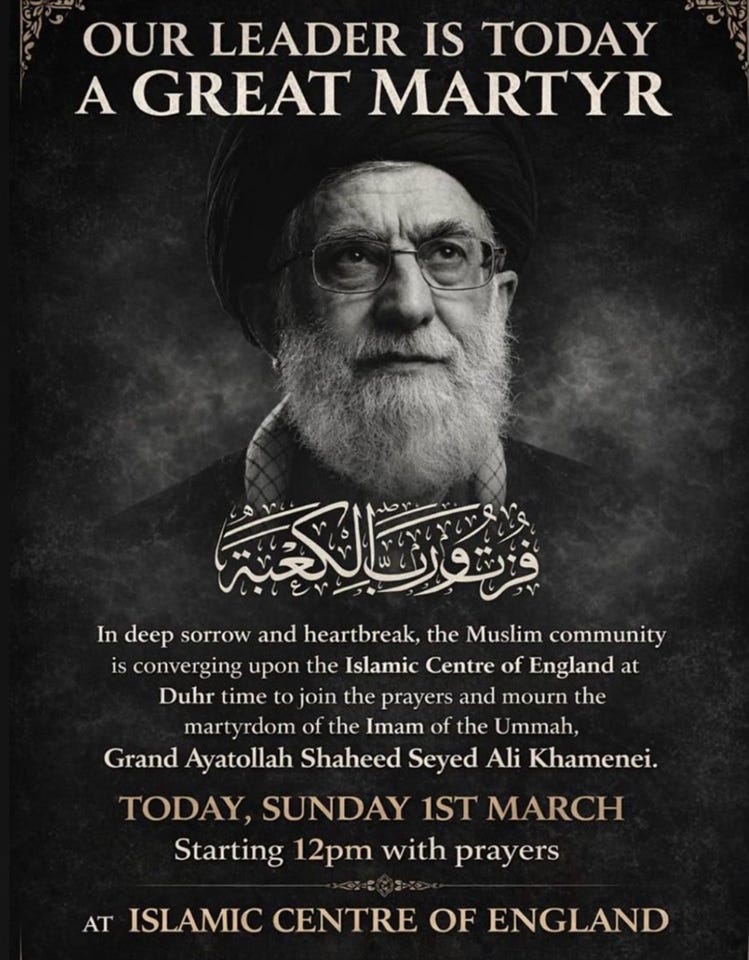
In London, meanwhile, the Islamic Centre of England (ICE), located in the leafy suburb of Maida Vale, proclaimed in a poster its “deep sorrow and heartbreak” at Khamenei’s demise and started prayers to “mourn the martyrdom of the Imam of the Ummah (global Islamic community)” on Sunday.
This is hardly surprising: ICE was allegedly controlled by the Supreme Leader’s representative in Britain until recently. The Charity Commission ostensibly ended this situation in 2025 after a three-year investigation of ICE. But little has actually changed, testament yet again to the inadequacy of the Charity Commission.
The Ahlul-Bayt Islamic Society chapter at University College London, one of the country’s best universities, sent public “condolences for the martyrdom” of Khamenei and is holding a mourning event for “the fallen”, Khamenei and his senior officials, on Wednesday.
Ahlul-Bayt bills itself as a “non-governmental” organisation, but it has defended its actions by comparing Khamenei to the Pope and—this being 2026—offered “mental health” support to those dealing with this “unimaginable loss” by encouraging them to remember “this is not the end to resistance”.
On Wednesday, a candlelight vigil will be held for Khamenei, sponsored by the Islamic Centre of Manchester (ICM), which self-describes as “one of the oldest Iranian Islamic centres in the UK” and is widely believed, certainly by anti-regime Iranians, to be associated with the Iranian regime.
This is particularly worrying in an area where communal relations are already visibly fraying. The Gorton and Denton by-election last week was marked by blatant Islamic sectarianism, and late last year there was the Heaton Park synagogue attack and a subsequent planned attack against Jews that would have been one of the worst terrorist atrocities in British history if it was not thwarted.
Both were the work of Islamic State loyalists, but they were capitalising on a surge of anti-Semitism and Islamist self-confidence triggered by the Iranian-directed pogrom in Israel on October 7 2023, a symbiosis between the Islamic State and the Islamic Republic that is depressingly familiar.
Mosques and Islamic institutions supporting Islamist Iran are not, however, unique to Britain. The evil influence of the Islamic Republic can be seen as far away as Australia.
The religious nature of the Iranian Revolution has allowed it to exploit the liberal principle of freedom of religion—and Western neuroses about “Islamophobia”. It is long past time that this ceased. Western governments should shut down religious facilities that are being used for subversion by a foreign power.