

Read the piece over at UnHerd. [Archive link]
The anti-government protests that erupted in Iran ten days ago seem to be gaining momentum. Turmoil has swept the cities. Mashhad, Tabriz, Isfahan, Shiraz, and the capital, Tehran, have been rocked by large crowds shouting, “Death to the dictator” and “Neither Gaza nor Lebanon, my life for Iran”, a condemnation of the ruling Islamists’ imperial policy in the region. Defying a violent crackdown, demonstrators have set up barricades on streets and set fire to police cars and government buildings.
There is no question the clerical despotism’s legitimacy is in tatters. This is the fifth display of mass-opposition in six years. But the very fact this has happened so many times previously should caution against optimism that this is the end of the Islamic Republic, notwithstanding many Iranians reporting that this time feels different.
Rumours that Ali Khamenei is looking to flee are almost certainly false. The Supreme Leader is not the Shah, who left his country 47 years ago this month rather than shed blood to remain in power. Khamenei has ordered unspeakable brutality to secure the regime many times, and there is no sign yet that the Guardians of the Islamic Revolution have lost faith in their mission to defend “God’s Shadow on Earth” nor been deprived of their ability to do so.
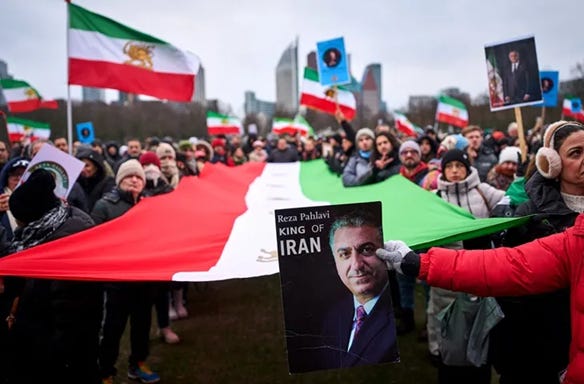
The current protests might yet prove to be a watershed, though, in consolidating Khamenei’s enemies around an alternative. The Western media barely covered Iran’s protests until 8 January, and their excuses about not having journalists in-country are laughable after two years of obsessive coverage of Gaza. What made the uprising unignorable after Thursday was the scale of its escalation, caused by a call from the exiled Crown Prince, Reza Pahlavi.
It was a risk by Pahlavi: if his call had fallen flat, he might have been fatally discredited. Instead, despite the regime cutting off the Internet, there are videos all over social media of Iranians braving gunfire to chant, “This is the last battle. Pahlavi will return!” and “Javid Shah!” (“Long Live the King!”)
Maybe this is a skilfully curated influence campaign by Iranian monarchists. Even if not, political activists are by definition a motivated minority. Our ability to test Iranian opinion is very limited. However, it seems unlikely 40-odd years of Islamic Republic outweighs a 2,500-year history of regarding the Shahanshah (“King of Kings”) as the State, ruling according to the farr (divine approval). An Iranian within the government told The Wall Street Journal, outright and unprompted, “he wanted his King back”, and two more officials echoed the sentiment.
Monarchism per se might not be the whole story behind Pahlavi being the single most popular opposition figure. Many associate his name with a time of Iranian openness to the world, prosperity, and prestige, and politically he offers secularism and patriotism—the antithesis of the isolation, deprivation, and theocratic misery of the present. Many others see Pahlavi as the only viable alternative, but it comes to the same thing. Something always beats nothing, and right now Pahlavi appears to be the best something on offer to replace the Islamic Republic.
This is the text as it was submitted. It was slightly edited before publication.