

Read the article over at UnHerd.
Below is the text as submitted, before editing
It became clear over the last few days that the long-awaited second American-Israeli military campaign against the Islamic Republic in Iran was imminent. Though Donald Trump’s administration was still ostensibly negotiating with the mullahs over the nuclear-weapons program—and there were positive noises from the Omani mediators—the President was obviously losing patience. There was also the tell of “Secretary of Everything” Marco Rubio announcing a trip to Israel next week that included no journalists, a breach of protocol so bizarre nobody could think of a precedent. The purported trip was duly declared cancelled a few hours after hostilities began on Saturday morning.
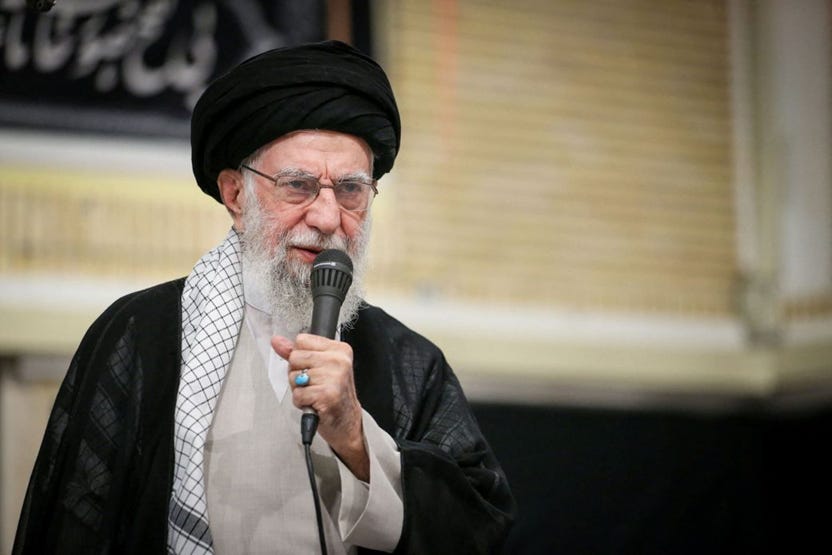
What was unusual about the operation—dubbed “Epic Fury” by the U.S. and “Roaring Lion” by Israel—was that it began in broad daylight. Administration officials soon solved the mystery, telling the press that a “target of opportunity” had presented itself, causing them to “accelerate the timeline”. The target turned out to be a meeting of the most senior leaders of the Iranian theocracy, including Supreme Leader Ali Khamenei, who was confirmed as among the dead yesterday afternoon. This was made possible by Israel’s infiltration of the Iranian regime, a factor for many years, and the Israeli spy was able to show a picture of Khamenei’s body to Trump and Israeli Prime Minister Benjamin Netanyahu.
Khamenei’s demise overshadows even the killing of Hassan Nasrallah, the leader of Iran’s Hezbollah militia in Lebanon, which was a watershed moment in the region. The only other Supreme Leader, Ayatollah Ruhollah Khomeini, founded the ideology and structures of the Islamic Republic, but he only held the post for ten years, spending much of that time in revolutionary faction fights and a war with Saddam Hussein. Khamenei has ruled for thirty-seven years—the same as the last Shah, incidentally, another of the strange little parallels between the 1978-79 Islamic Revolution and the present uprising. Khamenei consolidated absolute clerical rule, waged worldwide war against Jews, and oversaw a vast imperial expansion into the Arab world and beyond.
Now Khamenei is gone, and with him Mohammad Pakpour, the commander of the Islamic Revolutionary Guards Corps (IRGC), and many other military and intelligence leaders. The signs of hesitancy Trump was displaying two weeks ago have been dispelled. While Trump avoided saying regime change was the American mission, he called on the IRGC to lay down its weapons and told the Iranian people, “the hour of your freedom is at hand”, encouraging them to take advantage of the U.S.-Israeli intervention to seize power from the mullahs. The exiled Crown Prince Reza, who has shown some ability to influence events inside Iran, echoed Trump.
It will not be easy to see the end of such a sophisticated Islamist system, entrenched over nearly half-a-century, with tens of thousands of men who believe protecting this regime is a God-given duty. They testified to their faith by murdering thousands of Iranians in January. However, with such a complete regime decapitation on the first day of this operation, and the likelihood that the U.S. and Israel will continue targeting the second and third layers of the IRGC, as well as its hardware and infrastructure, we are in uncharted territory. There has never been a moment since 1979 when the fate of the Islamic Republic was so uncertain.