

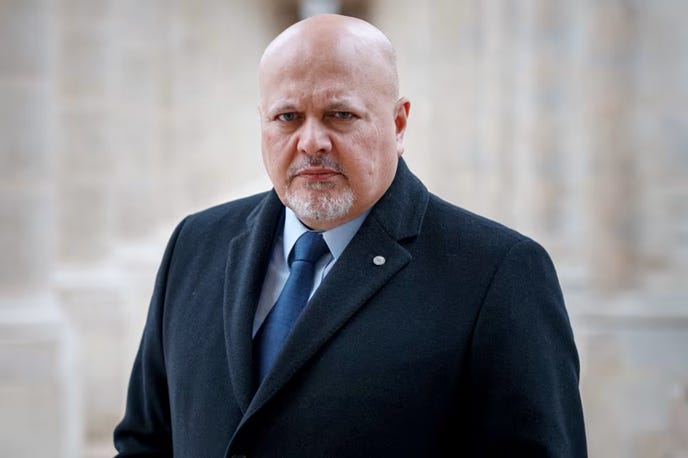
The scandal surrounding the Prosecutor of the International Criminal Court (ICC), Karim Khan, which has ground on for two years, is coming to a head.
From the moment the scandal erupted in late October 2024, three interlinked elements have been visible: Khan was accused of sexually attacking a female underling multiple times over nearly a year, of using his power within the ICC to try to suppress her complaint via inducements and intimidation, and of applying for the ICC arrest warrants against Israel’s leaders in May 2024 as part of the cover-up.
To say the case is heavily politicised is merely to reiterate that it involves an “international law” institution, and so far from trying to disentangle the issues, Khan used the tangle as his main line of defence. Khan and his surrogates have whispered to the media from the earliest days that the whole thing is an Israeli smear campaign and the accuser is a MOSSAD agent. This conspiratorial defence has not gone well.
The victim turned out to be a Malaysian Muslim woman who shares Khan’s politics, which Khan tried to exploit. Khan initially tried to prevent the victim raising the complaint by rushing to issue the warrants, in blatant violation of the ICC’s own rules of procedure and against the advice even of most ICC staff, then telling her she must keep quiet or it would derail the anti-Israel lawfare campaign they both favoured. Once the warrants were issued and the complaint was officially lodged, Khan continued with the same emotional blackmail to pressure her into withdrawing the allegations, among other things approaching “her several times in the office crying” and at least once saying, “Think about the Palestinian arrest warrants”.
When Qatar hired private investigators to find a Jewish or Israeli connection to the victim that could be used to discredit her, they not only failed to find such a connection: their activities were leaked to the media, disclosing that the Qatari hired guns believed their paymaster had “arms around” Khan and that Khan had made a “deal” with Doha to issue warrants, in exchange for which the Qataris would “look after” him.
Further evidence has also come to light that suggest sexual predation and misuse of power are patterns in Khan’s behaviour. A second female subordinate has come forward to allege she was sexually abused by Khan in a remarkably similar manner to the first accuser. And Khan publicly collaborating with the political warfare against Rodrigo Duterte, the former president of the Philippines, as preparation for issuing an arrest warrant against him, was too much for even the ICC to stomach.
Khan was suspended on 8 June by the ICC’s Bureau of the Assembly of States Parties (ASP), the executive committee of the ICC’s oversight body, and ten days later he was suspended from the Bar Standards Board, the British regulator for court lawyers. While the ASP committee stressed that its decision was “not an indication of the final outcome”, there are reasons to doubt this. Apart from being an unprecedented step, it comes after the ICC has tried everything it can to protect Khan.
When the initial complaint was made, the ICC buried it for six months, only beginning a serious disciplinary proceeding in October 2024 after a Twitter account started publishing details of the case and the media took it up. A damning investigation of Khan by the United Nations Office of Internal Oversight Services (OIOS), documenting his “nonconsensual sexual contact” with the female aide, was countered by a panel of three ICC judges, who submitted a brief to the ASP committee in March of this year claiming the U.N. report findings “do not establish any misconduct or breach of duty”.
The ASP committee has decided to overrule the ICC judges and recommend the ASP fire Khan after completing their own investigation, which draws on the U.N. report, “the underlying evidence”, and “written submissions”. The New York Times has obtained the report of the ASP committee synthesising the evidence, which concludes:
Khan “committed sexual harassment when he engaged in sexual activity with a junior member of his staff”;
Khan “later sought to dissuade his accuser from pursuing her allegations of misconduct against him”;
Khan at first refused to “clearly” deny sexual contact “with his subordinate, though he was given 30 opportunities to do so, telling an investigating U.N. team that ‘the main issue’ for him was the possibility that his accuser might have made recordings implicating him”;
Only once no recordings surfaced did Khan begin to plainly denying the sexual assault allegations, denials the ASP judged to be “devoid of credibility”.
The actual conclusion of the ASP Bureau report is strange, though. It says Khan’s behaviour was “extremely harmful” to the proper functioning of the ICC, but that behaviour is described as engaging in “a consensual sexual relationship rendered inappropriate by a power imbalance”. (The corollary is the report sidestepping the question of whether Khan retaliated against other ICC staff who provided evidence he had raped his subordinate.)
Khan’s lawyer understandably protested the recommendation of dismissal on the basis of a charge so different from the one originally brought. Khan must also be perplexed at the ASP’s premise that “inappropriate” behaviour is grounds for dismissal because the Prosecutor’s office is supposed to be occupied by “a person of high moral character”; it never has been yet.
The full ASP will vote on whether to remove Khan from office on 24 July. A finding of misconduct requires a two-thirds majority, and that is hardly foreordained.
Working against Khan, most Western governments are resolved to remove him, and his standing in the global antizionist movement, which includes a significant number of the governments voting on his fate, recently took a hit. Khan’s concern about his declining status within the antizionist movement after HAMAS’s 7 October 2023 pogrom was another factor motivating him to rush the warrants in 2024.1 In May, however, Khan made the mistake of admitting in a public interview that the evidence does not sustain the central antizionist axiom, that Israel has committed “genocide” in Gaza.
In Khan’s favour, the African States, in particular,2 and most of what we once called “the Third World”, which has an overwhelming majority in the ASP, have staunchly defended him all along, regarding the investigation against him as the work of sinister forces and repeatedly trying to terminate it. It is unclear if the ASP Bureau’s findings or even Khan’s faux pas on antizionist orthodoxy will have much impact on this bloc.
Whichever way the vote goes at the end of the month, it will do serious damage to the prestige and legitimacy of the ICC. Either the ICC will affirm to one and all it is happy to have a sex predator as its Prosecutor, or Khan will be removed and every decision he has made since 2021 will be called into question. It is the perfect opportunity for the Trump administration to take the next step in its campaign against the ICC by sanctioning the whole institution.
NOTES
In December 2023, just two months after the jihadists invaded Israel, slaughtering 1,200 people and abducting 250 more, Khan was feeling “stung by the criticism” of “pro-Palestinian activists who had labeled him a ‘genocide enabler’ and a bloc of ICC member countries in the developing world” because he had not come up with a way to use the ICC apparatus to target Israel. Khan was “increasingly lashing out at his team”, demanding they find a legal pretext for warrants against Israel’s leaders.
Khan made his name internationally in 2016 by getting ICC charges dropped on a technicality against William Ruto, then-deputy president and now president of Kenya, for involvement in the ethnic violence that followed the 2007 Kenyan election. The connections Khan made at this time have served him well professionally. The Kenyan government objected to the charges against Ruto and other officials as an “imperialist” conspiracy, and Nairobi’s gratitude to Khan was in no small part because it viewed him as a champion of “the Global South”, which the Kenyans mobilised in support of Khan’s bid to become ICC Prosecutor, a process even the “human rights” groups regarded as unusually politicised and sleazy.