

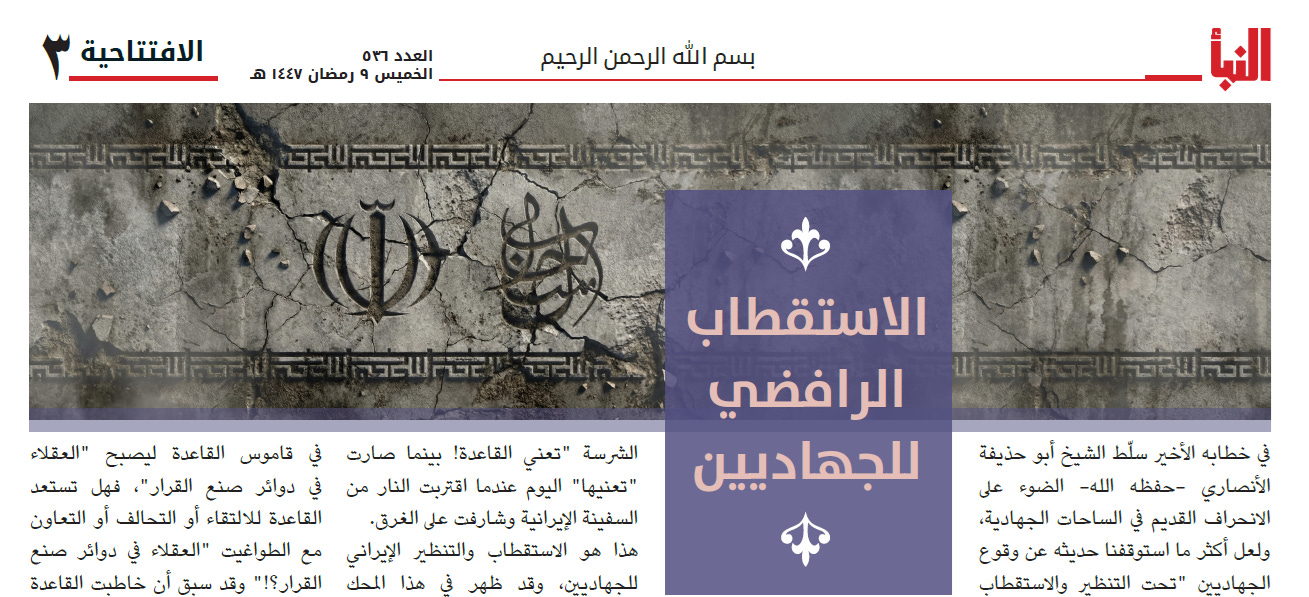
The 536th edition of Al-Naba, the weekly newsletter of the Islamic State (IS), released on 26 February 2026, had as its main editorial a polemic accusing Al-Qaeda of being co-opted by the Islamic Revolution that rules Iran. The Naba article, entitled, “The Rafidite Co-optation of the Jihadists” (al-Istiqtab al-Rafidi lil-Jihadiyeen), builds off a line in the most recent speech by the official IS spokesman, Abu Hudhayfa al-Ansari, which was given a few days earlier. A translation of the article is given below.
The basic argument Al-Naba makes is that Al-Qaeda has been drawn into the Iranian camp since its leadership took shelter there in January 2002. Since Al-Qaeda has had a relationship with the clerical regime dating back to the 1990s and Al-Qaeda’s probable emir since 2022, Muhammad Saladin Zaydan (Sayf al-Adel), is based in Tehran, one would have to concede there is a point here. By IS’s account, this association has corrupted Al-Qaeda ideologically, as demonstrated finally and incontestably by the organisation’s most recent statements that ferociously condemn the American-Israeli attack on the Islamic Republic, in marked contrast to Al-Qaeda’s silence and worse when the U.S.-led Coalition assaulted IS’s “caliphate”.
For IS, Al-Qaeda being co-opted into Iran’s “Axis of Resistance” results from the inherent flaws in its doctrinal methodology (manhaj), which, rather than separate cleanly between truth and falsehood, has seen Al-Qaeda incline favourably towards misguided Islamists when they seem popular and powerful, notably HAMAS in Gaza and the Muslim Brotherhood in Egypt. It ended in tears in those previous cases and it will again with Iran, by IS’s reckoning.
The Rafidite Co-optation of the Jihadists
In his recent address, Shaykh Abu Hudhayfa al-Ansari—may Allah preserve him—shed light on the old deviation in the jihad arenas, and perhaps what most caught our attention was his statement about the jihadists falling “under Rafidi doctrinal guidance and co-optation”,1 and not the reverse. Some may pass over this phrase without understanding it, or some may think it an exaggeration or a fallacy, while Al-Qaeda’s members [al-qa’idiyyun] will convince themselves that it is a false slander, because it was issued by the only adversary [i.e., the Islamic State] with whom they “never cease” to dissociate, nor do they accept conciliation with it, nor permit appeasement of it, nor even neutrality towards it of the kind granted to the sects of apostasy in the East and West.
In order to understand this part of the address, we go back in memory to the period of the fall of the Taliban after the American invasion [in late 2001], and the displacement of many of the leaders and families of Al-Qaeda towards the border triangle between Iran, Afghanistan, and Pakistan, especially in Zahedan [in the far-east of Iran]. There began the phase of Iranian doctrinal guidance and co-optation of Al-Qaeda, as confirmed by several recognised leaders of Al-Qaeda who are now deceased, not to mention the testimonies they left behind.
Iran exploited the condition of displacement and the siege imposed on Al-Qaeda, and opened its doors to them in order to contain and absorb them as a functional weapon within its “Axis [of Resistance]”, which had already absorbed many other Islamic movements, including the Palestinian organisations [i.e., HAMAS and Palestinian Islamic Jihad] that were expelled in the 1990s to Marj al-Zuhur in southern Lebanon; the leaders of Hizb al-Shaytan [“the Party of Satan”, i.e., Hizballah/IRGC] rushed to them and engaged in ideologically guiding and co-opting them, which produced this stark Palestinian factional alignment behind the Iranian Axis [that they are willing to stick with] until the end.
Iran repeated the same tactic with Al-Qaeda, to the extent that some leaders of the two experiences described the Iranian role as “a generous host”! In fairness, some of the hawks of Al-Qaeda rejected this Iranian approach for various reasons that were not purely methodological, while other leaders submitted and acquiesced, so Iran contained them for years and stored them [in reserve] for its black day, and by now they are at the top of Al-Qaeda’s [leadership] pyramid.
We have come to read statements from the “General Command” of Al-Qaeda, whose outward appearance is of Sunni alignment but whose inner reality is Iranian alignment, as if they were issued by one of the branches of the “Axis of Resistance”, albeit with a crude wrapping in the name of the umma and [pretended concern with] the fate of the umma. It is known that the term “umma”, as Al-Qaeda uses it, is an evasive term used to paper over all the methodological contradictions and everything that the umma cannot tolerate from the sects that are waging war against it.
It is necessary for us to point out that what we mean by Rafidite doctrinal guidance here is not in the methodological sense of Shi’isation; Iran has not imposed Shi’ism on its “Sunni” proxies and pawns. Iran does not want them as a Rafidite mass, but rather as functional pawns that stand with it in the face of the “sole pole” [i.e., the post-Soviet unipolar alliance led by the United States], as it was called in the most recent statement of Al-Qaeda.
The most recent statement of Al-Qaeda [released on 4 February 2026], which came after the American–Iranian tension reached its peak and coincided with other statements from the arms of the “Axis of Resistance,” stated that these American deployments “are not to fight a specific State” and that these “events concern it [i.e., AQC] and concern every Muslim”, that “all are targeted”, that “the legal position is an obligation to fight [the Americans]”, and that it does not permit “silence or watching”.
We did not find even a tenth of a tenth of this Al-Qaeda [call to] mobilisation and [use of the] language of decisiveness and fighting during the raging Crusader campaign against the cities of the Islamic State in Iraq and Syria. Instead, its marathon speeches were overflowing with hatred and incitement against the mujahideen at the height of the Crusader assault upon them, and that global assault, according to Al-Qaeda, did not “target all” nor did it “make fighting obligatory”! Nor did that fierce assault “concern” Al-Qaeda! Whereas it has come to “concern” it today when the fire has drawn near to the Iranian ship and it is close to sinking.
This is the Iranian co-opting and doctrinal guidance of the jihadists, and it has appeared with complete clarity in this test, to the point that even the Crusader journalists singled it out and found it objectionable, while the followers of Al-Qaeda split over it into factions and sects: one group denied it entirely, thereby denying a long record from the history of its leaders; another group turned a blind eye to it; and another group began to justify and legitimise this alignment, invoking the same discourse adopted by the Ikhwani outfits at the height of the war on Gaza, which promoted a narrative whose meaning is that Iran and its Axis constitute the last line of defence for the umma of Islam!! This is what is implicit in Al-Qaeda’s most recent statement, which addressed the “governments of the region”, saying that they “will be eaten the day others are eaten”. So who is this “one being eaten” whom Al-Qaeda fears for, and with whom it threatens its opponents?!
In an insult to the intelligence of its followers, Al-Qaeda attempted to justify its Iranian alignment by dragging Afghanistan into the discussion, claiming that America’s “eye is fixed on Khorasan and the [Taliban’s Islamic] Emirate!”, the Emirate which the Crusaders granted to the Taliban under the protection of American aircraft, just as they granted those before them rule on the back of American tanks.
Similarly, the “General Command” strove hard to justify its alignment behind Iran by drawing a comparison between the American rhetoric surrounding the campaign against Afghanistan in the past and the campaign against Iran in the present, saying that America previously raised the slogan of a “War on Terrorism” and “the liberation of the peoples of the region”, just as it does today. The [Al-Qaeda] statement, however, omitted and only implied what it clearly meant: “just as it now raises the slogan of war on Iran”.
To cap it all, there was Al-Qaeda addressing those it called “the rational ones in the circles of decision-making”, and appealing for them to display wisdom and rationality in preserving and defending the lands and the people! We did not know that the term tawaghit had acquired a new coinage in Al-Qaeda’s lexicon to become “the rational ones in the circles of decision-making”. So is Al-Qaeda preparing to meet, or ally, or cooperate with the tawaghit, these “rational ones in the circles of decision-making”?! [This is of a piece with Al-Qaeda having] previously addressed the “conscious generation” not to evade military service in the apostate armies and called upon them to “make use of it”.
In the same vein, Al-Qaeda claimed that its fighting over the last few decades “formed a solid shield … from which the major States of the East benefited in competing with the sole pole!” And it denounced the “designation of peaceful groups as terrorist” and the “overthrow” of what it called “governments that identify themselves to Islamic action”. In doing so, it is reproaching Saudi Arabia and its counterparts in a crude “pragmatic” discourse, the implication of which is: rapprochement with the Islamists is something you could have used as a shield for yourselves against the current threats, just as we were a shield for [certain] States against other States [in the past].
All of these methodological calamities were uttered in a single statement by the “General Command” of Al-Qaeda, which they claim is based in Afghanistan. What prompted us to address it was the remark of Shaykh al-Ansari in the course of his discussion of the Rafidite doctrinal guidance of the jihadists, which has produced a temporary Al-Qaeda alignment behind Iran, because Al-Qaeda is addicted to moving between axes and alignments. It had nearly raised the sign of “Rabi‘a” on the day [the Muslim Brotherhood’s Mohamed] Morsi came to power [in Egypt in 2012], and the bitter harvest became sweet; but when the ship of the Ikhwan sank, the “wise men” of Al-Qaeda returned to criticising them in the same long video series with which they had opened rapprochement toward them.
And today some of them seek refuge with Iran as a political alignment, accompanied by justifications whose invalidity has become clear at every stage, both legally and practically; tomorrow, after the Iranian ship sinks, Al-Qaeda will return to reviling and insulting Iran. Al-Qaeda will continue leaping from one vessel to another until it is finally faced with drowning—so when will you save yourself, O lost one, and make for the lifeboats?
FOOTNOTES
The phrase translated as “doctrinal guidance” and variations thereof is “tanzir”, could be rendered as “ideological framing” or “theorisation”: the notion, in this context, is that the Iranian regime has reshaped the theology of the Sunni Islamists that have allied with it.
The word translated as “co-optation” and its variants is “istiqtab”, which could also be given as “recruitment” or “attraction”: the idea is that Iran has pulled the Sunni militants into its camp.