

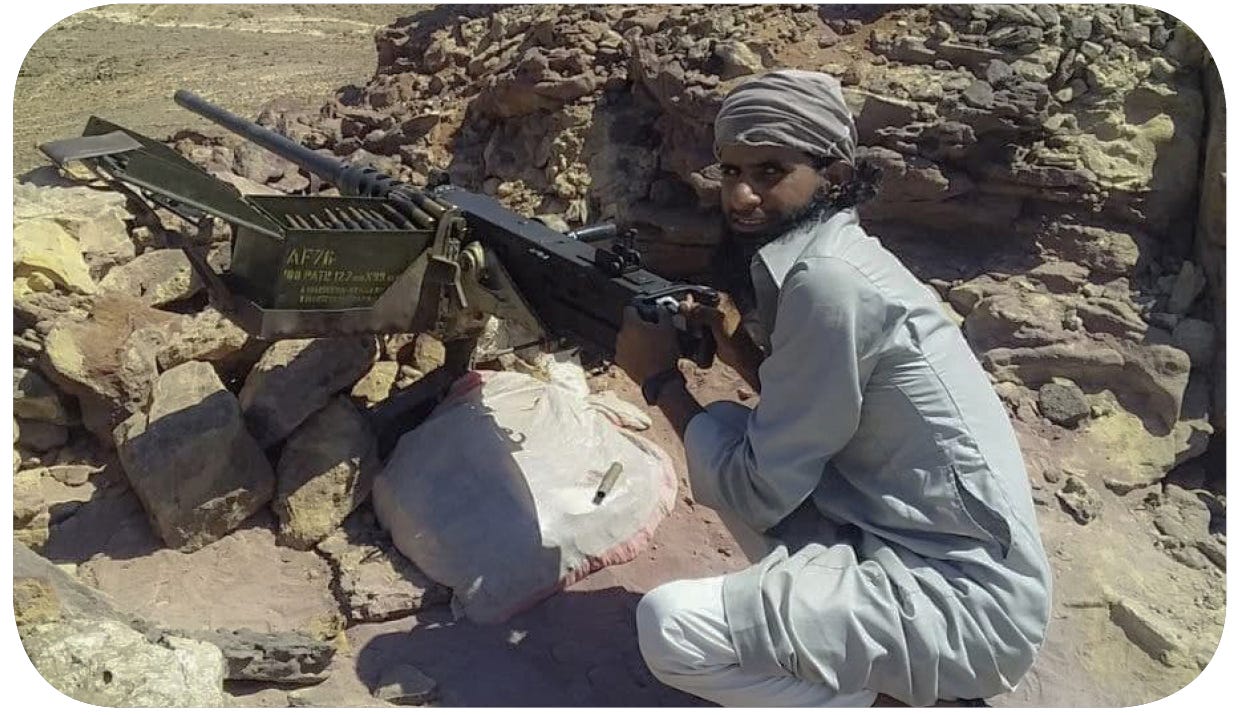
The Islamic State (IS), in the 324th edition of its weekly newsletter, Al-Naba, published on 3 February 2022, had a biography (on page eleven) of Abu Rawaha al-Ansari. An Egyptian, Abu Rawaha was reportedly an early IS operative in the Sinai, loyal to the group before the public recognition of Wilayat Sinai in November 2014, who rose through the military ranks thereafter, becoming a proficient military commander until he was killed while planting a roadside bomb in late August or early September 2021.
For anyone familiar with IS propaganda, some of the elements of Abu Rawaha’s profile are immediately recognisable as formulaic: him having led a rackety early life, seen the light of faith because of IS’s missionary work, dissociated himself even from close relatives who did not follow him into jihadism, and his sentimental devotion to, and inspiring piety for, his underlings. This is because IS uses the biographies of its historic leaders to motivate and guide its current members. These biographies are not merely intended to present an image of IS’s members to outsiders, important as this is to understand analytically and from a counter-terrorism perspective; some of those outsiders are potential recruits, after all. The biographies are also used to train those who have joined IS in the ideology and behaviour expected of them.
A translation of Abu Rawaha’s biography in Al-Naba 324 is given below.
Abu Rawaha al-Ansari—May Allah Accept Him—From the Knights of the Caliphate in Central Sinai
The soldiers of the Caliphate continue their jihad in all the wilayat [provinces] of the Islamic State, despite all the dangers, hardships, and plots surrounding them on every side, after they have tasted the sweetness of faith in God Almighty and the delight of giving in His path. Is there anything more precious than the soul, which a person offers as a sacrifice to God Almighty so that He alone may be worshiped and all others disbelieved in?
Our story today is about one of the knights of the Caliphate from central Sinai [wasat Sina], among those whom God Almighty guided to the path of righteousness, which they adhered to until they departed this world upon it; we consider them so, and God is their judge.
His Guidance, Influenced By the Call of the Mujahideen
He is the brother Abu Rawaha al-Ansari—may God accept him—from al-Azazima tribe in the Wadi Lisan area of central Sinai, located specifically south of al-Qusayma, near the imaginary border with Palestine.
He was born in the year 1413 AH [July 1992 – June 1993 AD] and grew up like the rest of the sons of his region, turning toward the world and its pleasures, preoccupied with collecting its wealth and goods. In that border area, smuggling operations across the border were widespread, bringing great profits to those involved, and most of his peers worked in them.
Meanwhile, the mujahideen in that region were striving to spread the call to monotheism [tawhid] among the people amid an environment in which Sufism and ignorance were widespread.
Indeed, by the grace of God, the call of the mujahideen bore fruit, as God Almighty guided Abu Rawaha to the path of righteousness at the beginning of the year 1431 AH [i.e., early 2010 AD], after he was influenced by the da’wa [missionary activity] and incitement efforts that the mujahideen persistently carried out in that region, a region the Jews were eager to keep submerged in the mire of desires and corruption.
His Separation from the Apostates and Polytheists
Abu Rawaha—may God accept him—came to know the doctrine of monotheism, so he adhered to it and was among the best of those who responded to the call of faith. He abandoned the world and its ruins, and clung to the firmest bond, obeying the commands of the Book [i.e., Qur’an] and the Sunna in word and deed.
Among his most distinguishing traits was the clarity of his belief in al-wala wal-bara [loyalty (to Muslims) and disavowal (of infidels)]. He openly declared his disavowal of the mushrikeen [idolaters, polytheists] and murtadeen [apostates] from among the sons of his own tribe, even of his closest friends who had long accompanied him in worldly life, but whom he abandoned and withdrew from when they departed from their deen [lifeway, Islam]. He showed them enmity and hatred until they would believe in God alone, never compromising on that or seeking anyone’s favour at the cost of God’s anger, in accordance with the saying of He the Exalted: “You will not find a people who believe in God and the Last Day loving those who oppose God and His Messenger, even if they be their fathers, or their sons, or their brothers, or their clan” [Qur’an 58: 22]. Ibn Kathir, may God have mercy on him, said: “They do not show affection to those who oppose [God], even if they are among the closest of relatives.”
His Joining the Ranks of the Mujahideen
With the beginnings of the emergence of military activity of the mujahideen in Sinai, especially after the famous raid [on 17 April 2013] against the disbelieving [or infidel: al-kafirun] Jews at Umm al-Rashrash [Eilat (Israel)] and other blessed attacks, Abu Rawaha decided to join the ranks of the mujahideen after realising the individual obligation incumbent upon him, represented by the duty of jihad in the cause of God Almighty. For there is no way to support faith and monotheism except through jihad and fighting in the cause of God Almighty. And whoever fights without the creed of monotheism, or claims monotheism without the creed of jihad, has gone astray, led others astray, and deviated from the path of salvation—and the evidences are many.
Abu Rawaha remained a soldier in the ranks of the mujahideen, stationed at the frontiers of the Muslims, preparing equipment with his brothers, despite their small number and limited resources, and despite the aggression of the Jews and apostates against them.
Among the First to Pledge Allegiance to the Caliphate
After God Almighty bestowed His grace upon the Muslims with the declaration of the Islamic Caliphate and its call for the mujahideen everywhere to hasten to pledge allegiance [bay’a] and hold fast to the group, Abu Rawaha and his brothers were among the first to strive to pledge allegiance to the Islamic State. They quickly made their decision and declared their allegiance to the Caliphal State, after which the allegiance of Wilayat Sinai and its joining the group of the Muslims [Jamaat al-Muslimeen] was announced. Thus Abu Rawaha, along with his mujahideen brothers, entered a new stage of jihad upon the path of the Prophetic methodology.
His Progression in Jihadi Work
As for his duties in the ranks of the mujahideen, he worked at first as a fighting soldier among the soldiers of the Caliphate in Wilayat Sinai, and after he distinguished himself among his brothers by his vitality [or exuberance: nashat] and zeal [or creedal determination: himmat], he was chosen to be an emir of one of the military groups in the Jabal al-Kharm area in central Sinai.
Due to his experience of the layout of the area and its realities, he was selected to be responsible for the security detachments [al-mafariz al-amniya] that operate in the central Sinai zone against the sahwat and spies.
In the middle of 1439 AH [February 2018 AD], when the apostate Egyptian army announced the launch of its “Failed Confrontation” [al-Mujabaha al-Fashila] campaign, Abu Rawaha returned to work in the ranks of the military groups where he served as emir of one of these groups in Jabal al-Helal [Mount Helal], and later he was moved to work as a military official [mas’ulan askariyan] for the mujahideen in one of the areas of al-Maghara in central Sinai.
During the years of his jihad Abu Rawaha mastered many military skills. He became proficient in emplacing explosive devices and booby-trapped vehicles against the patrols of the apostates, and he also mastered setting up tight ambushes for the apostate militias that today fight in the service of the taghut on behalf of the apostate Egyptian army, and behind them the disbelieving Jews who are running the war against the mujahideen in Sinai.
In the Two Attacks of Al-Rukayb and Al-Manjam
Abu Rawaha (may Allah accept him) participated in many attacks and raids against the apostate Egyptian army and its militias. Among them was the attack on the site of al-Rukayb in al-Maghara area of central Sinai at the end of the year 1441 AH [July 2020 AD], where he (may Allah accept him) was an emir of one of the units participating in the attack, which resulted that day in the killing and wounding of ten members of the army. During it, Abu Rawaha was slightly injured in his hand due to an airstrike.
Abu Rawaha (may Allah accept him) also took part in the attack on a gathering of apostate militias in al-Manjam area in the middle of last year, 1442 AH [August 2021 AD], which left seven of them dead.
Just as Abu Rawaha was a courageous lion in battles against the apostates, he was also merciful and compassionate toward his mujahideen brothers: gentle in companionship, close to them, beloved by them, always meeting them with his cheerful, smiling face. He was consistent in performing the night prayer [qiyam al-layl], spending his nights standing in recitation of the Noble Qur’an in the land of devotion, maintaining the fasting of Mondays and Thursdays despite the harshness of the mountainous desert environment of central Sinai. Yet he was the true sustenance of the mujahid, for fasting and standing [for the night prayer] are the constants of the mujahideen, their provision, and their driver onward upon the path.
His Killing, May Allah Accept Him Among The Martyrs
After thirteen years that Abu Rawaha spent on the frontiers of the Muslims in ribat, fighting, and exposing himself to the places of death in the cause of Allah Most High, during which the Jews and apostates could not succeed in reaching him, Allah decreed that he be killed in the month of Allah [i.e., Muharram] in the year 1443 AH [August – September 2021], as a result of an explosion that occurred while he was planting a bomb on one of the routes in central Sinai with the intention of targeting a patrol of the apostates. Thus he was killed (may Allah accept him) and his pure blood flowed in the battles of separation and dissociation [ma’arik al-mufasala wa al-mujanaba] from the tawaghit and their apostate allies. So we ask God to accept him among the martyrs and to raise his rank to Illiyin [the Loftiest Station, the realm above Heaven (Jannah)].