


Over the weekend, I visited Lincoln Cathedral and nearly missed a small tomb on the way out. Circling back, I saw it was that of Little Saint Hugh. The name is forgotten now but this eight-year-old boy’s death in 1255 became the basis of a nation-wide anti-Jewish hysteria. The scale of the popular mobilisation and the drawing in of the State, indeed of the King himself, led to the arrest of nearly 100 Jews and the judicial murder of more than a dozen people. It was a momentous event in English history,1 a signal that Jewish life was becoming untenable in the country. It was also an ominous harbinger for the whole of Christendom, solidifying and disseminating themes and ideas that colour European perceptions of Jews to this day.
LITTLE SAINT HUGH
Essentially nothing is known of Hugh’s life except that he was born around 1247, went missing in late June 1255, and his body was discovered down a well about two months later, on 29 August.2 While many legends would arise to satisfy the popular curiosity about Hugh’s brief life after he became famous, the most consequential legend was the one about what had happened to him between his disappearance and death, which made him famous in the first place.
A contemporary chronicler, Matthew Paris, a Benedictine monk based at Saint Albans, recorded in his Chronica Majora:
This year, about the feast of the apostles Peter and Paul [29 June], the Jews of Lincoln stole a boy called Hugh, who was about 8 years old. After shutting him up in a secret chamber where they fed him on milk and other childish food, they sent [messages] to almost all the cities of England in which there were Jews, and summoned some of their sect from each city to be present at a sacrifice to take place at Lincoln, in contempt and insult of Jesus Christ. For, as they said, they had a boy concealed for the purpose of being crucified; so a great number of them assembled at Lincoln, and then they appointed a Jew of Lincoln judge, to take the place of Pilate, by whose sentence and with the concurrence of all the boy was subjected to various tortures. They scourged him till the blood flowed, they crowned him with thorns, mocked him, and spat upon him; each of them also pierced him with a knife, and they made him drink gall, and scoffed at him with blasphemous insults, and kept gnashing their teeth and calling him Jesus, the false prophet. And after tormenting him in divers ways they crucified him, and pierced him to the heart with a spear.
When the boy was dead, they took the body down from the cross, and for some reason disembowelled it; it is said for the purpose of their magic arts. The boy’s mother, when her son had been missing several days, sought for him diligently, and the neighbours told her that they had last seen him playing with some Jewish boys of his own age, and going into the house of a Jew. So the mother entered the house suddenly and saw the boy’s body lying in a well; the bailiffs of the city were then cautiously summoned, the body was found and drawn up. It was a remarkable sight which then presented itself to the people; the mother’s cries and lamentations provoked all the citizens assembled there to tears.
There was present John of Lexington, a man of learning, wise and prudent, who said, “We have heard sometimes that Jews have dared to attempt such a thing in insult of our crucified Lord Jesus Christ;” and then addressing the Jew whose house the boy had entered whilst at play, and who, as being for that reason a greater object of suspicion, had been arrested, “Wretched man, dost thou not know that a speedy end awaits thee? All the gold in England would not suffice to ransom or save thee. Yet unworthy though thou art, I will tell thee how thou canst save thy life and limb from destruction. Both of these will I save thee, if without fear or falsehood, thou wilt expose unto me all that has been done in this matter.”
Then the Jew, whose name was Copin, thinking that he had found a way of escape, answered: “My lord John, if thou wilt pray my words with deeds, I will show wondrous things unto thee.” Then when John zealously urged and encouraged him, the Jew continued: “What the Christians say is true. Almost every year the Jews crucify a boy in injury and insult to Jesus. But one is not found every year, for they do this privately, and in remote and secret places. This boy whom they call Hugh, our Jews crucified without mercy, and after he was dead, and they wished to hide his corpse, they could not bury or conceal it. (This they wished to do, as the body of an innocent boy was considered useless for augury, which was the reason for disembowelling it.) In the morning when they thought it was hidden away, the earth vomited and cast it forth, and there it lay unburied on the ground to the horror of the Jews. At length they threw it into a well, but still they could not hide it, for the mother never wearied in her search, and finding the body informed the bailiffs.”
The Jew was kept in chains, and the body given to the canons of Lincoln, who had asked for it, and who, after displaying it to an immense number of people, buried it honourably in the church of Lincoln, as if it had been that of a precious martyr. …
Then the guilty man said, “… I will tell the truth to you all. Nearly all the Jews in England agreed to the death of this boy, and from nearly every English city where Jews live, some were chosen to be present at this sacrifice as at a Paschal [Passover] offering.”3
Remarking on the punishment meted out to Jews afterwards, Paris wrote that “if any Christians pitied them, they were only dry tears which their rivals the Caursines shed.” Caursines were also known as Cahorsins, the name originally derived from Cahors in southern France, before becoming a general term for foreign—mostly French and Italian—Christian merchants, bankers, and money-lenders. Paris disliked these “Transalpine usurers”, and his mocking suggestion here is that the Caursines might affect sorrow for the Jews, with whom they had some relations as part of what we might call the finance sector, but secretly the Caursines would be happy at the destruction of their Jewish competitors. The association of Jews with banking and money—a predicament significantly imposed upon them in medieval Europe—has, of course, been an enduring stereotype.
The other elements of the narrative likewise remain alarmingly familiar: Jews targeting children for murder; the extraction of blood and organs; Jews being collectively guilty; and a Jewish defector giving moral confidence to the accusers by providing “insider” proof of the Jews’ malevolent beliefs and designs. The only element that has gone is the specifically religious one, of the Jews’ child-killing being a re-enactment of Christ’s Passion, with mockery of Christian doctrine and torture preceding an excruciating death, usually on an ersatz Cross.
THE ENGLISH ORIGINS OF THE BLOOD LIBEL
These elements of anti-Jewish conspiracy theory did not come together spontaneously at the time of Hugh’s death—and death is all we know for sure: there is no certainty that it was murder. The template for “ritual murder” accusations, what would evolve into “the blood libel”,4 was already more than a century old in 1255 and had begun in England.
Around the time of Passover and Easter in 1144, a 12-year-old boy, William of Norwich, was found either hanging from or under a tree in the woods on the outskirts of the city. The imprecision over how William is found is part of a larger ambiguity, namely, once again, whether he was murdered at all: it is possible it was a suicide. Regardless, it was soon declared that “the Jews dwelling in the city enticed the boy to enter their houses”, whereupon he was seized, tormented by having his head shaved and wounded with a crown of thorns among other things, strung up as if on a Cross, and his flank pierced deeply, producing torrents of blood.5 Such details were “known” because a Jew who defected from his people attested to them, and revealed that Jewish scripture demanded an annual Christian child sacrifice.6 The attempts to hide William’s body after he had endured “all the tortures wherewith our Lord was tortured” were thwarted by God revealing the location of the “holy martyr”, and his body was given to monks, who buried it at Norwich Cathedral where the status of Saint William was proved by a steady flow of miracles.7
The remarkable narrative continuity across the 111 years separating William and Hugh is explained to some extent by the ritual murder script becoming formulaic through repetition. That being said, the number of ritual murder accusations remained relatively small into the mid-thirteenth century. There were a half-dozen or so cases in England between 1144 and 1255,8 and about the same number on the Continent after it arrived there in 1171. The frequency of ritual murder accusations against Jews increased in the second half of the thirteenth century and continued to rise thereafter into the Early Modern period. Correlation might not be causation, but it is difficult to conclude that the Little Hugh case, which was unprecedented in a number of respects, had no influence on this.
A KINGLY INTERVENTION
What is notable about the pre-1255 ritual murder accusations in England, other than their relatively small number, is their relatively contained impact. With one exception, the pre-Hugh ritual murder panics had never resulted in legal prosecutions, and it is striking that the one exception, in Winchester in 1225, saw four of the accused acquitted outright, while the two Jews convicted of murdering a child were not convicted of ritual murder.9 The pre-Hugh cases were also highly localised: the “boy martyrs” became folk Saints in their towns, and their shrines might draw pilgrims from the surrounding countryside, but never from much further afield.10
The contemporary evidence shows that early on after Hugh’s body was discovered, there was an unusual popular potency to the case and it was already breaking out of the usual kind of containment. This might have been because there was such a “cooperative” Jewish witness, Copin, who was eagerly ratifying the most lurid fantasies in the Christian anti-Jewish imagination and casting the affair as the work of English Jewry in toto. Whatever the cause, there was a climate of popular anger—most immediately focused on Copin, whose life being spared was considered an outrage, and more broadly against the Jews whom he had implicated—and it was spreading beyond Lincoln, reaching as far as Matthew Paris, a hundred miles to the south, in the environs of London.
This trendline suggests it is improbable the government would not ultimately have been forced to do something more to appease the mob. But luck played the decisive role—as it so often does in history—in deciding the nature of events.
King Henry III (r. 1216-1272) had been in the north of England—the proper north, as Geordies would say, near the Scottish border—organising a coup against the Regent of Scotland.11 On 23 September 1255, Henry set out for home, departing from Alnwick, thirty miles north of Newcastle.12 Exactly how, when, and where Henry heard of the furore in Lincoln is uncertain. By one account, Hugh’s mother accosted Henry with the news as he was on the road south, though even there it is not clear if she diverted the King or merely went out to meet him as he approached a city he always planned to pass through.13 What is clear is that Henry III arrived in Lincoln on 3 October 1255,14 took direct control of the Hugh ritual murder case, and in so doing brought it before the whole of England—and to peoples beyond.15
The official stamp of approval for a ritual murder accusation from an anointed Monarch was a unique development. Until this point, the most important secular powers (and the clerical ones, as we shall see) had rejected these accusations against Jews as devoid of truth.16 Just a few years earlier, the Holy Roman Emperor had denounced the blood libel as a malicious hoax, declaring the Jews “completely absolved of this imputed crime” and specifying they were under Royal protection, i.e., that attacking Jews was equivalent to rebellion.
Though Henry III’s reasons for departing from this consensus cannot be known for sure, his unusually intense piety has to be considered an important factor.17 Such piety was reflected in the very landscape of the Kingdom, with the construction of hospitals and upkeep of religious sites, even the rebuilding of Westminster Abbey because Henry had taken the penultimate Anglo-Saxon King, Edward the Confessor (r. 1042-1066), as his patron saint. There were other benign effects from the rule of this “Most Christian King” (rex Christianissimus), as his contemporaries called him, including vast government expenditure on charity to feed the poor, orphans, and other vulnerable people. But there was a dark side, the one most ingrained in Christianity: a very negative attitude towards Jews, whom Henry ordered formally segregated in 1253, and he developed a fixation with trying to convert them to Christianity. With such a predisposition, it is less surprising Henry took the ritual murder accusation at face value.
That Henry had sold the right to tax his Jewish subjects to his brother, Richard, Earl of Cornwall, and could only get at Jewish wealth if they were convicted of crimes and thus forfeited their property to the Crown, is regarded as important by some historians.18 The balance of probability is that this materialist consideration is given outsize consideration by modern materialist historians who struggle to give ideology its due weight.
Henry immediately upbraided the local baron in Lincoln, John of Lexington, for promising Copin his life. The King had Copin hanged without further ado, and his body tied to a horse’s tail and dragged through the streets.19 On the King’s orders, there was then a round-up of Jews. 91 or 92 Jews (sources conflict) were arrested and—crucially—transported with Henry to the capital, being imprisoned in the Tower of London. The salience and legitimacy of the ritual murder charge, already high because of the King’s personal involvement, was accentuated by the geographic movement of the Jewish prisoners to centre-stage in England.
The Jewish prisoners were in the Tower by 22 October 1255, and on 22 November, Feast Day of Saint Cecilia, they were indicted before the King (coram Rege) on felony charges of having “crucified and put to death” Hugh “in contempt of the Christian faith”. Eighteen of the Jews refused to submit to an all-Christian jury and asked that some Jews be included, as was their right. In the atmosphere of the moment, this was popularly viewed as an admission of guilt, and Henry III circumvented any further process on the issue by having all eighteen Jews summarily hanged. The remaining 70-odd prisoners went on trial in February 1256; were found guilty; and condemned to death.
In the event, the death sentences were never carried out. By the end of 1256, all the convicted Jews had been released. It is interesting that even in this most sensational case, those executed were not convicted of ritual murder, and those so convicted were freed in short order.
THE CHURCH, THE JEWS, AND THE BLOOD LIBEL
The release of the Jews convicted in the Little Hugh case was secured by the protests of Richard, the King’s brother, and above all the Catholic order of Franciscans.20 This may seem surprising, since the conventional image now is of the medieval Catholic Church as a bastion of antisemitism. In reality, while the inflammation of Jew-hatred in medieval Europe can certainly be traced to developments in Church doctrine, the Church per se advocated the protection of Jewish life and property, and consistently worked to suppress the blood libel.
The backdrop against which the ritual murder accusations arose was the Papal Revolution, a process of radical transformation begun in the mid-eleventh century that intended to cleanse and purify Christendom. An immediate concern was divesting secular rulers of their role in the Church,21 but alongside administrative and social reform there was an inherent militancy that manifested quickly and intensified over time. The Norman conquest of England in 1066 was an early example; the “armed pilgrimage” to recover Jerusalem in the 1090s a more instructive one, beginning as it did with the “People’s Crusade” massacring Jews on the Rhine. It showed that the logic of sending Christian warriors to cleanse Muslims from the Holy Land was not easily distinguished in popular perception from the need to cleanse Europe of Jews, who were sociologically the only minority inhibiting the uniformity of Christendom and theologically occupied the special place of having killed God.
The Church as an institution offered no support to this conduct. On the contrary, Christian clergy condemned it vociferously at the time and bishops helped Jews escape the pogromshchiki where they could. The disgust with what was done is evident even in the later chronicles, which are otherwise euphoric about the success of the First Crusade. One chronicler went so far as saying the disaster that befell the People’s Crusade was divine retribution for their atrocities against the Jews. Around 1120, a Papal Bull was issued, Sicut Judaeis, in no small part as a reaction to the Rhine massacres and the bloodbath after Jerusalem fell, which condemned violence against Jews, forbade stealing or desecrating Jewish property (specifically cemeteries), ruled coerced conversions an affront to God, and demanded that Jewish holy festivals and practice be protected. The serial reissuing of the Bull as a reminder to Christians is encouraging about Church intent, and less so about its efficacy.22
In 1247, eight years before the Hugh of Lincoln case, the Papacy issued Lachrymabilem judaeorum, which explicitly condemned the blood libel as just that: a scandalous lie that had led to even more scandalous behaviour towards Jews. A specific reference was made to Fulda, Germany, where in 1235 the blood libel “proper” had emerged, with accusations of Jews extracting the blood of a Christian child for ritual purposes and eating the child’s heart on Passover, which sparked a pogrom. It did not take long for this to become the charge of using blood in Passover matzah. The Pope ordered “faithful Christians” to desist from such falsehoods and the related falsehood that using human blood in religious rites was prescribed by the Tanakh, “since in the Old Testament [Jews] are instructed not to use blood of any kind, let alone human blood”. Christians were warned they would be excommunicated if they persisted with the blood libel.
In 1272, there was another explicit Papal condemnation of the blood libel. It reiterated a lot of the key points in the 1247 Bull, while adding in blunt terms that sometimes people just lose their children and accusing Jews of responsibility without evidence was abominable; that it was obvious in some cases “the parents of these very children, or some other Christian enemies of these Jews, secretly hide these very children in order that they may be able to injure these Jews” or “extort” them; “[a]nd most falsely do these Christians claim that … the Jews offer sacrifices from the heart and the blood of these children”. The Pope decreed that Christians making these claims were to be ignored by the courts, adding: “we order that Jews seized under such a silly pretext be freed from imprisonment, and that they shall not be arrested henceforth on such a miserable pretext”. Anti-Jewish incitement was forbidden and it was ordered that Jews be “maintained in that status and position” they have had since antiquity. The threat of excommunication for Christians who defied the Pope was renewed.
It may seem paradoxical that the Catholic Church ordered Jews protected even as it promulgated the hostile theology that endangered them and mandated restrictions on Jewish life all across Latin Christendom—indeed, escalatingly so. As the Church’s revolution proceeded and the concept of “heresy” reached maturity in the thirteenth century, the restrictions became ever-more onerous, notably the 1215 ruling that Jews wear distinctive clothing—implemented in England eventually as making Jews wear a yellow badge—and in 1267 Christians were banned from having sexual relations with Jews.23 But this was tolerance in the old sense, which as the late Bernard Lewis put it, “is by modern standards an essentially intolerant idea”, where a dominant group permits a subordinate group security and “some though not all of the rights and privileges” the dominant group enjoys, provided the subordinate group recognise their subordination and behave according to rules the dominant group lay down and enforce.
It is a testament to the limitations of the Roman Church even at the height of its powers in Latin Christendom that it could not ensure this bare minimum was upheld in many places and the blood libel craze rumbled on for centuries, the last lethal outbreak taking place after the Holocaust in Catholic Poland.
THE LEGACY OF LITTLE SAINT HUGH
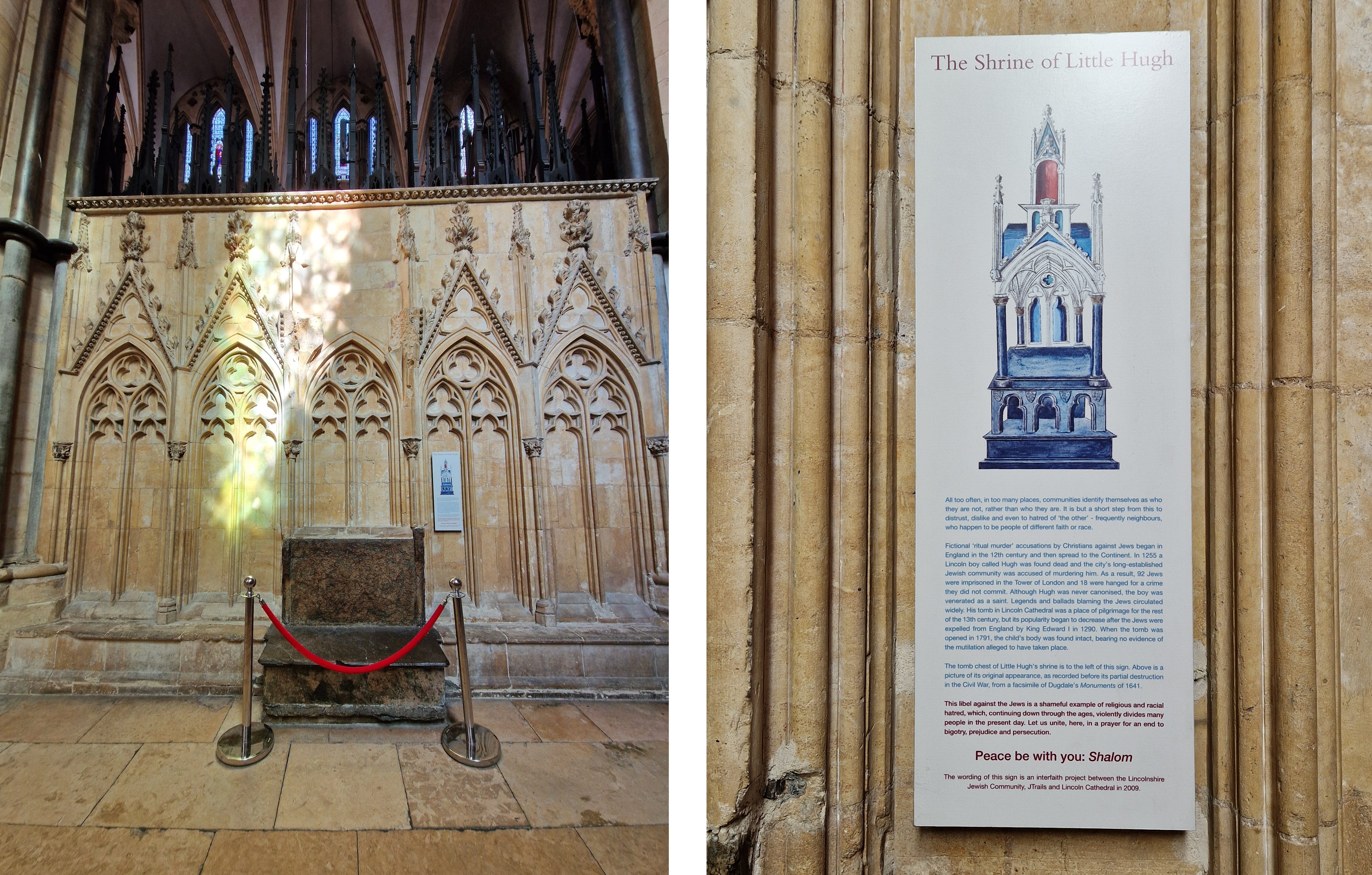
Since 1220, there had been a Saint Hugh from Lincoln, the city’s bishop from 1186 until his death in 1200. It was to differentiate the “boy martyr” that he was hailed as Little Saint Hugh, and there was another difference: “the papacy pointedly refused to confirm this canonisation”.24 It made little difference to the popularity and vibrancy of the cult of Little Saint Hugh. England’s King had confirmed the ritual murder accusation and executed, as far as anyone was concerned, nineteen of the perpetrators: that was more than enough for the English people, who marked the boy Saint’s Feast Day every year.25 As the plaque at Lincoln Cathedral says, “the boy was venerated as a saint [anyway]. Legends and ballads blaming the Jews circulated widely. His tomb in Lincoln Cathedral was a place of pilgrimage for the rest of the 13th century”.
None of the other “ritual murder Saints” acquired such a large cult in their own time, and none were so long-lasting as Little Saint Hugh’s. Indeed, Little Hugh gradually eclipsed William of Norwich and the others. It is telling that when Geoffrey Chaucer, writing The Canterbury Tales a century and more on, at the end of the fourteenth century, wished to invoke a notorious crime against children by the “cursed Jews”, it was for “yonge Hugh of Lincoln” that he reached.
Little Hugh’s cult seems to have been fading by the second quarter of the fifteenth century, and the Reformation in all practical senses brought it to an end. There is no sign of resistance when the Protestant iconoclasts “ravaged and desecrated” Hugh’s shrine and tomb. (The tomb was damaged further in 1644 when the Puritan rebels sacked and looted Lincoln Cathedral during the First English Civil War. What remains now is part of the original.) The ebbing of the Little Saint Hugh cult might suggest declining popular antisemitism in England, but that would rather miss the point.
The ritual murder craze over Hugh in 1255 was a sign that the Jews’ time in England was drawing to a close. Jewish communities had only been planted in England after 1066 and within a century the ritual murder accusation had emerged. In September 1189, at the coronation of King Richard I (“the Lionheart”), there had been an outbreak of lethal antisemitism that escalated into 1190, most gruesomely at York. Church restrictions and Royal “taxations” (confiscations) increased over the next few decades. English Jews were visibly marked, segregated, and intermittently attacked during civil disturbances under Henry III, and in the shadow of the Little Saint Hugh case, especially under Henry’s son Edward I (r. 1272-1307), all of this got worse. Just in the 1270s, Edward introduced new harshly discriminatory legislation and staged a judicial massacre of over 250 Jews, having partly prepared the ground by getting involved in one of the two blood libel cases that decade. On every front the space for Jews was being shrunk and in 1290 Edward I took the final step by ordering the expulsion of all Jews from England. France followed his example in 1306.
The only official refuge for Jews in England after this was the “House of Converts” (Domus Conversorum), set up by Henry III in 1232, where entry relied on a renunciation of Jewishness; there were never more than 100 residents. It would be 350 years before Jewish life recommenced in England.
FOOTNOTES
A conspiracy theory creating a properly national convulsion in England was unprecedented, and in the eight-hundred years since there are only really two events that withstand comparison: the Hopkins Witch Panic during the Civil Wars (1645-47) and the Popish Plot (1678-81).
Even here there is some ambiguity. For reasons I do not understand, Little Hugh is often reported—not only in online sources, but reputable books—to have disappeared in late July 1255, thus to have only been missing for one month when he was found dead. However, the primary contemporary source, the monk Matthew Paris, is quite clear that the disappearance took place “about” the Feast Day of Saints Peter and Paul, i.e., 29 June.
The accounts that say Hugh was nine years old, and therefore born in 1246, are less troublesome. Paris writes that Hugh “was about 8 years old”, and he probably was, but it is an open question if even Hugh’s mother would have known his exact birthday. It would be another seven centuries before the registration of births and the issuing of birth certificates became even nominally mandatory in England.
See: Joseph Jacobs (1894), Little St. Hugh of Lincoln, Boy and Martyr: Researches in History, Archaeology and Legend, p. 4.
Jacobs, Little St. Hugh of Lincoln, Boy and Martyr, pp. 4-5.
The term “blood libel” had appeared in Russian, German, and Yiddish in the late nineteenth century, but its first use in English was in 1911, in connection with the Beilis Case that was then-unfolding in Russia. The phrase “blood accusation” had been used in English back to the mid-nineteenth century and before that the reference was generally to “ritual murder”.
John Capgrave (c. 1440), Nova Legenda Angliae, cited in: Joseph Jacobs (1893), The Jews of Angevin England: Documents and Records from Latin and Hebrew Sources, Printed and Manuscript, for the First Time Collected and Translated, pp. 19-21.
The Jewish renegade who encouraged the ritual murder accusations over William of Norwich was Theobald of Cambridge, a convert to Christianity, and indeed a monk. Theobald’s “testimony” was recorded by Thomas of Monmouth, another Benedictine monk, whose hagiography, The Life and Passion of Saint William of Norwich, was begun within a few years of the boy’s death (c. 1150) and completed c. 1173.
Peterborough Chronicle (c. 1155), cited in: Jacobs, The Jews of Angevin England, p. 19.
There are records purporting to show seven ritual murder accusations after William of Norwich and before Hugh of Lincoln. There are, however, complications.
The first ritual murder accusation after William is clear-cut: the body of Harold of Gloucester was pulled out of the River Severn in 1168 and the contemporary evidence for what was said of the Jews’ responsibility for the murder of the little boy found in the River Severn is quite copious. The contemporary evidence for the next case, Robert of Bury (Saint Edmunds) in 1181, is much more fragmentary, though it is clear there was once an “official” hagiography because fragments of it are preserved in other works.
The ritual murder cases in Winchester in 1225 and 1232, and 1244 in London are much murkier—the only one where we have a definite name for the victim is Winchester in 1232 (one-year-old Stephen)—but we can be sure they happened.
The other two apparent cases may well be fabricated. The apparent 1192 case, again in Winchester, is sourced solely to Richard of Devizes, and his chronicle is heavily satirical. It is entirely possible Richard was ridiculing, not recording, the blood libel craze. The alleged Adam of Bristol case in 1183, meanwhile, may well be a back-projection from a century later.
Gavin I. Langmuir (1990), Toward a Definition of Antisemitism, p. 241.
The prestige and economic benefits of a ritual murder shrine are perhaps part of the explanation for some of the accusations. However, Winchester, which had two of the three ritual murder accusations in England in the thirty years before Little Hugh, is a challenge to this materialist notion: the city already had the prestigious (and, if one thinks in such terms, lucrative) shrine of Saint Swithun.
Henry III’s teenage daughter was married to the teenage Scottish King, Alexander III (r. 1249-1286). They had been wed at Christmas 1251, when they were both about 11 years old. Henry had at that time tried to get Alexander to outright subordinate himself and Scotland to Henry and England; the boy-King refused, and Henry let the matter lie. Henry justified the 1255 action essentially as a humanitarian intervention against a Regent who was mistreating his son-in-law and daughter.
Alan Dundes [ed.] (1991), The Blood Libel Legend: A Casebook in Anti-Semitic Folklore, p. 70.
Joseph Jacobs (1896), Jewish Ideals and Other Essays, pp. 222-223.
David Carpenter (2020), Henry III: The Rise to Power and Personal Rule, 1207-1258, p. 627.
The effect of Henry III’s involvement in the Lincoln ritual-murder case has a parallel with Austrian governmental involvement being understood to vindicate the vampire stories in Serbia in the early eighteenth century. There is a difference in intent: Henry was a believer in the accusations against the Jews, whereas the Hapsburgs were trying to pacify a recently-acquired province by suppressing a local superstition. But the fallout was much the same: Vienna sent Royal investigators to Serbia and in so doing accidentally gave vampirism Europe-wide attention and the appearance of official credence.
Most secular powers, full stop, had rejected these accusations against Jews. There was an outstanding exception, though: the first Continental ritual murder accusation was in Blois, France, in 1171, and the Count, Theobald V, was the prime mover in the case, which resulted in nearly three-dozen Jews being burned at the stake.
In terms of motive for Henry III’s piety, some suggest it is a reaction to the distinct lack of piety of his father, King John (r. 1199-1216). This may be to over-psychologise things, but it does not seem unreasonable to think that Henry regarded John, perhaps England’s worst ruler, as an anti-example of sorts.
Not content with losing most of England’s Continental holdings to France, John got into a confrontation with Pope Innocent III (r. 1198-1216), probably the most powerful holder of the Office of Saint Peter there has ever been. England was placed under an Interdiction, John himself was excommunicated, and England might have been invaded had John not submitted to Papal demands.
Henry was firmly pro-Papal throughout his reign, and, while he was unable to recover England’s losses on the Continent, he was able to hold his ground and bring an end to “the First Hundred Years’ War” (1159-1259) in such a way that England’s remaining possessions were officially recognised.
Jacobs, Jewish Ideals and Other Essays, p. 223.
Norman Roth [ed.] (2016), Medieval Jewish Civilization: An Encyclopedia, p. 567.
Jacobs, Jewish Ideals and Other Essays, p. 223.
It was this issue that led to the Emperor kneeling in the snow at Canossa to beg absolution from the icon of the reformers, Pope Gregory VII (r. 1073-1085).
Massimo Leone (2010), Saints and Signs: A Semiotic Reading of Conversion in Early Modern Catholicism, p. 254.
Tom Holland (2019), Dominion: The Making of the Western Mind, pp. 306-307.
Holland, Dominion, p. 305.
Little Saint Hugh’s Feast Day was 27 July, which might explain the supposition of so many that that is the date he disappeared on.