

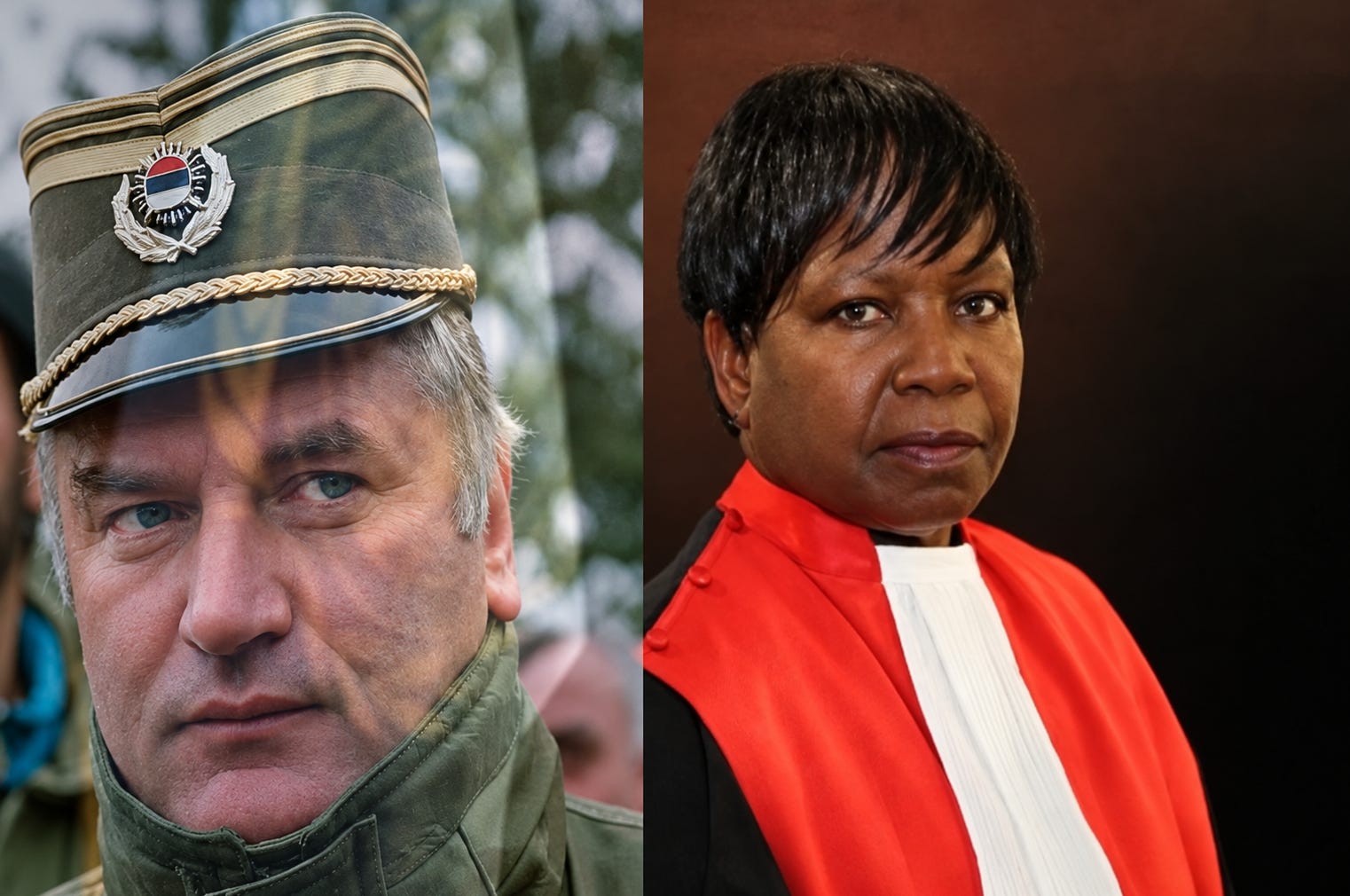
When Ratko Mladić died at the end of August, The New York Times referred to him as “the former Bosnian Serb general … held responsible for Europe’s deadliest massacre since World War II, the killing of some 8,000 Muslim men and boys at Srebrenica in 1995”, leading to his “conviction by an international tribunal on charges of genocide”. This summarises neatly what is widely known of Mladić.
What is less widely known is that in Mladić’s 2021 appeal against the International Criminal Tribunal for the former Yugoslavia (ICTY) verdict,1 the presiding judge, Prisca Matimba Nyambe, dissented. And she did not just dissent a little bit. Nyambe, in dissenting wholesale from the proposition that the evidence showed Mladić was responsible for the Srebrenica Massacre, as much as accused her colleagues, in polite legalese, of wilful gross misconduct—in the procedures of the trial, notably misusing evidence, and more broadly in misapplying legal concepts—to reach a predetermined outcome they desired for political reasons, namely Mladić’s conviction.2
Nyambe’s dissent is worth examining for the systemic issues it highlights in the practice of “international law”. The problems she identifies are real, irrespective of how one views her conclusion in this specific case. Inevitably, the dissent is a reminder that the ICTY’s single most important act, ruling that the Srebrenica Massacre was genocide, has been shadowed by grave doubts from the beginning. More broadly, to have this controversy at the last was a reflection on the entire enterprise of trying to secure “lasting peace” and promote “reconciliation” in a country ravaged by civil war through decades of judicial proceedings raking over the past based on legal premises that can charitably be described as evolving.
Procedural Faults
Mladić appealed on nine grounds. Presiding Judge Prisca Matimba Nyambe, in her dissent (pp. 261-306), agreed with eight of them.3 Nyambe’s overall conclusion was: “the nature and scale of the errors of law identified in this case” were so serious and systematic as to “invalidate the Trial Chamber’s findings on which [Mladić’s] convictions rest.” Had the deciding vote been Nyambe’s, she would have ordered a retrial.
In building to this conclusion, Judge Nyambe began with the Prosecution’s reliance on “unnamed unscheduled incidents” to convict Mladić of several crimes against humanity. Mladić “only became aware of these incidents when the Trial Judgement was rendered”, Nyambe explained, which “materially impaired his ability to prepare his defence”. Prior ICTY rulings had established that convictions can only be entered based on charges in the indictment, and the charges have to be precise because “[a] general defence cannot counter a specific accusation or incident”. Nyambe concluded Mladić’s rights under the ICTY Rules of Procedure and Evidence had been violated.
“Adjudicated facts”—findings of fact from previous trials—were misused in Mladić’s trial, Nyambe wrote, because findings against members of a “joint criminal enterprise” (JCE), basically the conspirators behind a crime, and the physical perpetrators, were used to convict Mladić based on the idea they were his “immediate proximate subordinates” whose activities were so widespread “there is no way that the accused could not have known about it”. There are three leaps of logic here—that the original finding of criminal fact was correct, that the person previously convicted was a proximate subordinate, and that Mladić did know of their crimes—before even getting to the issue of whether Mladić had the mens rea (criminal intent) to be responsible for what they had done, either by refusing to stop it or actually ordering it.
Instead of this approach, Nyambe argued the Prosecution “should have presented evidence itself” of Mladić’s criminal responsibility so it could be tested adversarially by the Defence. Nyambe contended that the Prosecution error here was caused by applying the precedent from an erroneously-decided prior Judgment that placed no limits on the use of adjudicated facts in relation to purported JCE members or physical perpetrators,4 but it was a choice to do this because there is another Judgment articulating what she regards as “the correct legal standard”: avoiding adjudicated facts when assessing the “core” of the Prosecution’s case.5
Even within the course chosen for utilising adjudicated facts, Nyambe contends there was misbehaviour: the Trial Chamber “failed to provide reasons for rejecting evidence in rebuttal of adjudicated facts and repeatedly failed to state in the Trial Judgement which adjudicated facts it was taking judicial notice of and/or which it relied on in making findings of fact”. This was part of what Nyambe viewed as a much more grievous failing in the trial: the application of a “heightened standard to rebuttal evidence” for Mladić.
The usual standard in challenging an adjudicated fact—that is, simply the right to present contrary evidence—is that the evidence have “prima facie reliability and credibility”; in the Mladić trial, the demand was for the evidence to be “unambiguous”. To even be heard in testing adjudicated facts from previous trials that were used to convict him in the “Overarching JCE”—the apparent broad scheme of the Bosnian Serbs to “ethnically cleanse” Muslims and Croats—the Trial Chamber ruled that Mladić had to prove a “specific alternative scenario”. The example the Trial Chamber gave was that if an adjudicated fact said “B killed C”, Mladić could not challenge it by presenting evidence “C was possibly/likely killed by A”; he would have to show it unequivocally, as judged by the Trial Chamber.
The result, says Nyambe, was that at Mladić’s trial, the presumption of innocence was reversed: the Prosecution was discharged from its burden of providing proof of Mladić’s guilt beyond a reasonable doubt, and an absurd burden was placed on Mladić’s defence team to, in effect, conduct its own parallel prosecutions to come up with “unambiguous” evidence somebody else was guilty in order to overturn an incriminating adjudicated fact. This approach was a “systematic error” that “infected the Trial Chamber’s approach to adjudicated facts throughout the judgement … such that the Trial Chamber’s approach to every single adjudicated fact is called into question”, Nyambe argued. The incorrect application of standards of proof, the failure to properly address exculpatory evidence, and the reliance on “untested evidence in a sole or decisive manner” resulted in “considerable prejudice to Mr. Mladić systematically throughout the Trial Judgement” and “occasioned a miscarriage of justice”.
Nyambe similarly argued there was a grievous misuse of law to convict Mladić of “terror” in the Sarajevo JCE, relating to the Serbs’ quasi-siege of that city and attendant crimes against its inhabitants (not all of which were quite what they appeared to be). The Trial Chamber treated “terror” as customary international law based on one prior ICTY verdict,6 which, Nyambe argued, was wrongly decided, having innovated a crime through reasoning reliant on a State consensus that does not exist. Therefore, an “erroneous” judgment was “recycled” against Mladić.
Additionally, wrote Nyambe, there were “disclosure violations” by the Prosecution that look very like deliberate tactical delays in the disclosure of evidence so it could be sprung on Mladić without him being able to prepare a defence. In the case of several pieces of electronic evidence, this was compounded by a “failure to provide metadata”. And on top of that the Trial Chamber arbitrarily denied Mladić the ability to present evidence. Nyambe argued:
The Trial Chamber’s summary denial of evidence was an unreasonable exercise of its discretion. The “questionable relevance” and “negligible probative value” could only be determined if the [two] witnesses had been heard, and cross-examined by the Prosecution. … This was a discernible error and the Trial Chamber’s error invalidates the findings made on Srebrenica and Sarajevo to the extent of the error identified. … The decision is so unfair and unreasonable as to constitute an abuse of the Trial Chamber’s discretion.
Nyambe noted that one of the proposed witnesses “was a member of the Srebrenica column of Bosnian Muslim men” who had since died, “thus increasing the gravity of this refusal and this error”.
Overarching Joint Criminal Enterprise
Joint Criminal Enterprise is, as Nyambe notes, a “highly controversial doctrine”. To simplify, JCE jurisprudence derives from an innovation at Nuremberg that elevated American “conspiracy” legislation into “international law”. The premise of these U.S. laws is that once a criminal conspiracy is proven to exist, its members can be tried for all the crimes committed pursuant to the conspiracy, regardless of what they have personally done. The impact of conspiracy/JCE frameworks is to lower the burden of proof against individuals, which makes sense in tackling a domestic emergency with organised crime, and less sense in adjudicating the supreme international crimes.7
Be that as it may, the ICTY dated the Overarching JCE for Bosnia from 1991 to 30 November 1995, and defined it as having “the objective of permanently removing Bosnian Muslims and Bosnian Croats from Bosnian Serb-claimed territory in Bosnia and Herzegovina”.8
Mladić became Chief of the Army of Republika Srpska (VRS) Main Staff on 12 May 1992, and the ICTY dates his involvement in the Overarching JCE from that point. Yet, as Nyambe points out, the Judgment convicts Mladić for orders and actions in 1991 when he was not even in Bosnia, let alone the VRS chain of command. (Mladić was fighting for the Jugoslav National Army or JNA in Croatia.) This violation of the basic limitations of time and geography impacts “[m]any of the crimes underpinning the Overarching JCE” conviction against Mladić, writes Nyambe. And, once again, “The Trial Judgement’s analysis … relies heavily on adjudicated facts.”
Behind this immediate problem is a larger one, Nyambe argues: “the Trial Chamber erred in almost exclusively basing its analysis of Mr. Mladić’s purported contribution to the Overarching JCE on circumstantial evidence”, and, worse, disregarded “direct evidence”. This issue of the ICTY mishandling evidence by improperly favouring circumstantial over direct evidence is central to Nyambe’s objection to the Mladić verdict.
The precedents are clear, as Nyambe documents. For any crime tried before the ICTY, the standard is supposed to be “proved beyond reasonable doubt”.9 A “high degree of probability” is not enough.10 To be “found criminally liable” in JCE terms, the accused has to be shown to have “acted in furtherance of the common purpose … in the sense that he significantly contributed to the commission of the crimes involved in the common purpose”.11 In a “circumstantial case”, a guilty verdict:
must be established beyond reasonable doubt. It is not sufficient that it is a reasonable conclusion available from that evidence. It must be the only reasonable conclusion available. If there is another conclusion which is also reasonably open from that evidence, and which is consistent with the innocence of the accused, he must be acquitted [emphasis original].12
This has been reiterated time and again: a guilty verdict for an international crime results from circumstantial evidence if it is “the only reasonable inference”,13 or “the only reasonable conclusion” [emphasis original],14 to be drawn from the totality of the evidence.
To rule that Mladić’s membership in the Overarching JCE is the only reading of the evidence is impossible, Nyambe argues, because there is direct evidence against it, in the form of the General’s “orders to the VRS to respect the Geneva Conventions and ceasefire agreements”.15 This shows, in her opinion, he “did not share a criminal intent in accordance with the Overarching JCE”. To have favoured an accumulation of circumstantial evidence to reach the opposite conclusion in these circumstances, Nyambe wrote, “violates … the principle of in dubio pro reo, which states that, where any doubt exists, it should be resolved in favour of the defendant”.
Nyambe goes on: “this defective method” of relying on circumstantial evidence and “disregarding direct evidence” is on display again in finding Mladić guilty for crimes by non-VRS Serb paramilitaries—of which there were about sixty in mid-1992—and the Ministry of Interior (MUP) police, despite possessing Mladić’s contemporary notebooks, which show his “opposition to the existence” of the paramilitaries and the MUP police operating beyond his control.
Mladić began efforts to disband the paramilitaries in July 1992 and kept at it through “the entire period” up to “the end of the alleged Overarching JCE in 1995”, Nyambe records. Mladić issued repeated orders “forbidding the cruel treatment and abuse of civilians [and] prisoners of war”, and mandated POWs be “treated in accordance with the international law of war”, Nyambe continues. The court had these dated orders from Mladić, including one saying paramilitaries that resist disarmament and the arrest of criminal militiamen should be “physically liquidated”. Mladić “cannot have been fighting to eradicate Serbian paramilitaries while at the same time contributing to their actions” and thus the Overarching JCE, Nyambe reasonably summarises. But the Trial Chamber bypassed this exculpatory evidence and “attempted to somehow portray non-existing connections and the impression of joint furtherance of common objectives with the VRS through ambiguous terminology based on circumstantial evidence”, Nyambe wrote exasperatedly. This is “unacceptable for proper analysis”.
“The Trial Chamber’s flawed approach is most evident in its use of adjudicated facts and flawed logic to establish that Mr. Mladić had command and control over the MUP”, Nyambe wrote. Despite possessing concrete evidence the MUP’s sometime coordination with the VRS did not lead to subordination, the “Trial Chamber invented a brand new mode of liability in command and control jurisprudence—‘operational supervision’.” There was not even an attempt to claim this had a “basis in the law and jurisprudence”.
Nyambe reiterates:
This disregard of direct evidence in favour of circumstantial evidence is a discernible error. … No reasonable trier of fact can choose to ignore this direct evidence and go with “more” circumstantial evidence to say that the “only” available inference is one indicative of guilt. Circumstantial evidence cannot outweigh direct evidence.
As she must have known, the ICTY, and the international courts more generally, had been in the habit of doing exactly this for a long time before 2021.
Similarly, Nyambe laments that the circumstantial evidence of Mladić’s “position in the VRS” and “the behaviour of alleged subordinates” was favoured over the legal requirement to demonstrate he “made a significant contribution to the crimes” of the JCE. Indeed, the Trial Chamber “relied on circumstantial ‘links’ rather than finding actual understanding or agreement by Mr. Mladić to support any aspect of the Overarching JCE.” Again, this inferential method had become routine at the ICTY by then.
A highly irregular aspect of the Mladić trial, in Nyambe’s view, was that “mens rea inferences are drawn prior to the actus reus being established”, i.e., criminal intent was decided before criminal actions had been discovered. To have done this precluded a “balanced analysis of [Mladić’s] mens rea”, “thereby indelibly tainting [the Trial Chamber’s] findings”.
The pattern of assuming guilt and supporting the supposition with circumstantial evidence was repeated when the ICTY, in Nyambe’s words, read “malicious meaning” into Mladić’s orders through “speculative narratives”, rather than accepting the plain words of these orders—beginning with Mladić’s first as head of the VRS on 6 June 1992—that “consistently urged adherence to the Geneva Conventions and proper treatment of civilians and prisoners of war. … Orders from the VRS Main Staff in evidence, particularly those from Mr. Mladić, were entirely lawful and legitimate.”
This was the more unforgiveable, in Nyambe’s view, because one of the ICTY’s adjudicated facts was that the VRS “was not criminal itself” and “undertook lawful combat activities”, and that the “strategic objectives” of the Republika Srpska “did not entail the systematic commission of crimes”, though even if they had the ICTY had also confirmed that “political intentions are not sufficient to establish a joint criminal enterprise”. The threshold for overcoming these presumptions or “priors” to prove criminality should have been really quite high. But it was left “completely unanswered” how “the acts and conduct of Mr. Mladić performing his routine duties as a military commander had any tangible effect on crimes which were committed in furtherance of a common [criminal] objective”, Nyambe argues. “Without such analysis, the Trial Chamber has not been able to articulate by what measure Mr. Mladić was involved in crimes committed in furtherance of the alleged common objective.
“I consider that there was a clear error in reasoning in the Trial Chamber’s conclusion that Mr. Mladić made a significant contribution to the Overarching JCE”, Nyambe wrote. The methods “used by the Trial Chamber to establish the different elements of the Overarching JCE” were so “flawed”, and the failure to “characterise through which specific conduct Mr. Mladić contributed” so total, it “invalidates the findings for this joint criminal enterprise”, Nyambe concluded.
The Context and Events at Srebrenica
The Bosnian civil war erupted in early 1992 with rapid territorial conquests—and accompanying “ethnic cleansing”—by the three contending parties. A year later, the frontlines were largely static. Srebrenica emerged as a strategic flashpoint, a rare enclave in eastern Bosnia, near the border with Serbia, retained by the Party of Democratic Action (SDA), the Islamist outfit headed by Alija Izetbegović that led the Muslim side and controlled Sarajevo and the official Bosnian government. The Bosnian Serb pretensions to be running a breakaway State, the Republika Srpska under Radovan Karadžić, were undermined by the Srebrenica enclave bifurcating their polity.
In April 1993, the United Nations designated Srebrenica a “safe zone”, and sent peacekeepers, originally Canadians and from March 1994 Dutchmen (hence known as “DutchBat”), to garrison a base in Potočari and provide tripwire patrols to protect the zone. The threat was that violations of the safe zone would trigger NATO airstrikes. The local SDA commander, Naser Orić, exploited the situation to fund his brutal local fiefdom with syphoned-off international aid, and when his 28th Division of the Army of Bosnia and Hercegovina (ABiH) ventured into the Drina Valley to massacre and expel Serbian Orthodox civilians, it could retreat behind the U.N. protective line if the VRS responded. It was to clear out this military menace and nest of war criminals, as the VRS saw it, that Operation KRIVAJA 95 was conceived and launched in early July 1995.
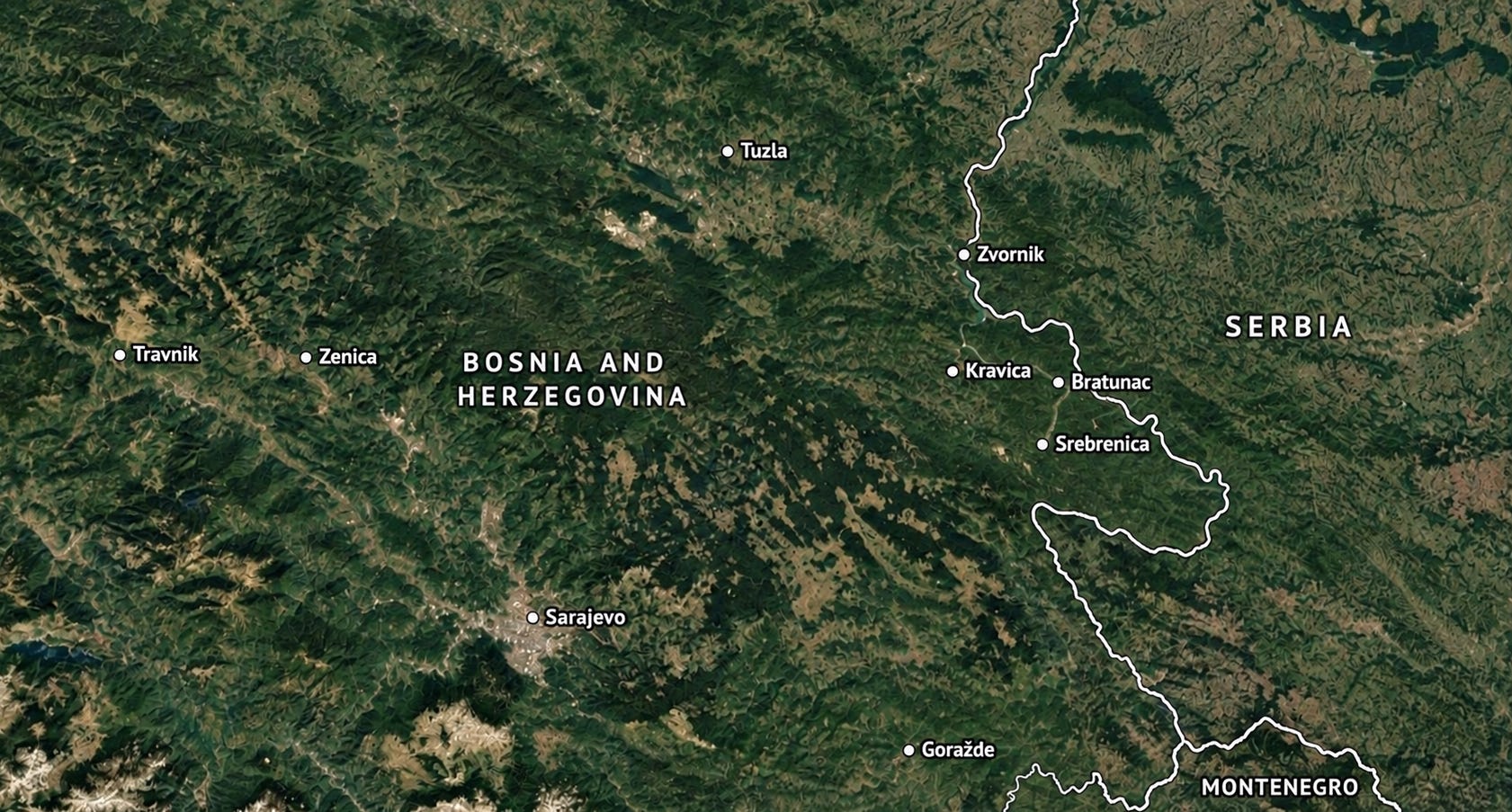
The VRS captured Srebrenica town about 16:30 on 11 July 1995. That night, the Muslim men in Srebrenica—estimated at 10,000 to 12,000, but all of these numbers are very uncertain—staged a breakout of the now-Serb-occupied enclave through the forest around Buljim. Moving in a column, containing many civilians but organised and led by soldiers, the men headed for Tuzla, the nearest SDA-controlled town. The bulk of what was left of the column, estimated at around 6,000 men, reached Tuzla on the night of 16/17 July; stragglers kept coming into August and the ultimate total may have been around 8,000.16 Of those who did not make it, some were dead, about 3,000 according to a contemporary survivors’ estimate.17 They were killed either by the VRS’s effort to thwart the column—a series of engagements with Muslim troops that were, though unequal and caught civilians in the crossfire, essentially conventional—or in the appalling wave of suicides, sometimes preceded by frenzied gun and grenade attacks on their compatriots. The rest were captured, then either swapped for Serb POWs or taken to makeshift prisons in schools and warehouses in places like Bratunac and Kravica.18
The civilians remaining in Srebrenica—mainly women and children—sought protection by gathering at the U.N. base in Potočari. The VRS took Potočari on the morning of 12 July and no later than 14:00, just after Mladić famously appeared at the U.N. base, buses began evacuating the 25,000 to 30,000 Muslim women, children, and old people in Srebrenica to SDA-held territory. (The drop-off was at Kladanj and Tišća on the front line; from there, most went to Tuzla.) About 1,000 males were prevented from getting on the buses and detained by the VRS at Potočari.19 The announced reason for this was to screen for war criminals among those of military age, which in the Bosnian context, where all sides used child soldiers, meant those aged 16 to 60.
Around the time the evacuations of the Muslim women and children were complete in the evening of 13 July, massacres began against the male Muslim captives, both those detained at Potočari and those captured from the column, who had been merged by this point. About ten massacres took place up to the afternoon of 16 July, some relatively small (10 to 25 victims) and some with victim tallies estimated around 1,000. The total number of fatalities for the Srebrenica Massacre, an umbrella term for those massacred and those killed in the column,20 is estimated to be 7,000.21
Srebrenica: Forcible Transfer
Mladić was convicted for several crimes as part of the Srebrenica JCE. The first was forcible transfer as a crime against humanity, meaning the criminally coerced expulsion of a civilian population, which is the nearest approximation there is in “international law” for what is colloquially called “ethnic cleansing”, a term that has no official recognition or standing, and does not even have a stable definition in everyday use. Mladić was convicted of this crime because of the evacuation of women and children from Srebrenica. Nyambe clearly regards it as outrageous, since:
The transfer “was a humanitarian evacuation ordered, and indeed organised, at the highest levels of the UN”, which “the UN asked Mr. Mladić to assist with”;
The Dutch Defence Minister ordered the DutchBat commander, Colonel Thomas Karremans, “to obtain Mr. Mladić’s help” for the evacuation, regarding it as “an urgent humanitarian” necessity;
Mladić met DutchBat and Muslim leadership figures at Hotel Fontana, twice in the evening of 11 July and once in the morning of 12 July before he went to Potočari. Mladić was seeking the surrender of the ABiH 28th Division, an entirely legitimate military objective, and to reassure the civilians they could stay or be assisted to go wherever they wanted. At the first meeting, there is “video [which] shows that Colonel Karremans [told Mladić] that the Bosnian Muslim civilian leadership had asked to leave and conveyed the UN’s request for assistance in a humanitarian evacuation to Mr. Mladić”;
Pieter Boering, a DutchBat liaison officer present at these meetings, gave direct evidence to the Trial Chamber that “the UN did not have enough buses to do this evacuation on its own” and asked for Mladić to supply them;
The Muslim desire for the evacuation to happen was plain: by the evening of 11 July, according to a trial witness, “the Muslim civilian leaders had already ordered their own people to leave” and in the recorded footage of Mladić at Potočari on 12 July, after he tells the Muslim crowd, “Anyone who wishes to be transported will be transported … onto the territory controlled by Alija’s forces … Let the children and the women go first”, there is cheering and a Muslim man can be heard shouting out: “May you live long”; and
“Later on in the same video, Mr. Mladić talks to another gathering of civilians explicitly telling them that those who want to stay and return to their homes may do so”.
The Trial Chamber did not regard this fact pattern as exculpatory for Mladić at all. Somewhat tautologically, the Chamber regarded the ongoing military actions—the “shots and shells [being] fired around the compound”—as a factor in denying Muslims a “genuine choice” about whether to leave. The Judgment also claimed that there were “orders by the 10th Sabotage Detachment to Srebrenica Town inhabitants to leave”; there was no elaboration on what these orders were or their impact.22 But the 10th Sabotage Detachment was nominally directly subordinate to Mladić’s VRS Main Staff, and this was enough for the Trial Chamber to connect Mladić to forcible transfer, notwithstanding their own evidence elsewhere in the Judgment that the command situation with this shadowy elite formation was considerably more complex even in theory,23 and the evidence from previous trials that the Detachment was acting in Srebrenica without authority from the formal chain of command, at Main Staff or Corps level, as early as 10 July.24
Meanwhile, in the hands of the Trial Chamber, the Hotel Fontana meetings became a sort of multi-part Wannsee Conference where Mladić laid out his genocidal plan, proving he “intended to eliminate the Bosnian Muslims in Srebrenica by killing the men and boys of Srebrenica and forcibly removing the women [and] young children”.25 This despite, as Nyambe notes, the meetings being on video; despite Defence and Prosecution expert witnesses saying Mladić’s filmed remarks were appropriate for a military operation; and despite the fact Mladić was speaking to U.N. and Muslim representatives, a most unlikely audience for such a confession.26
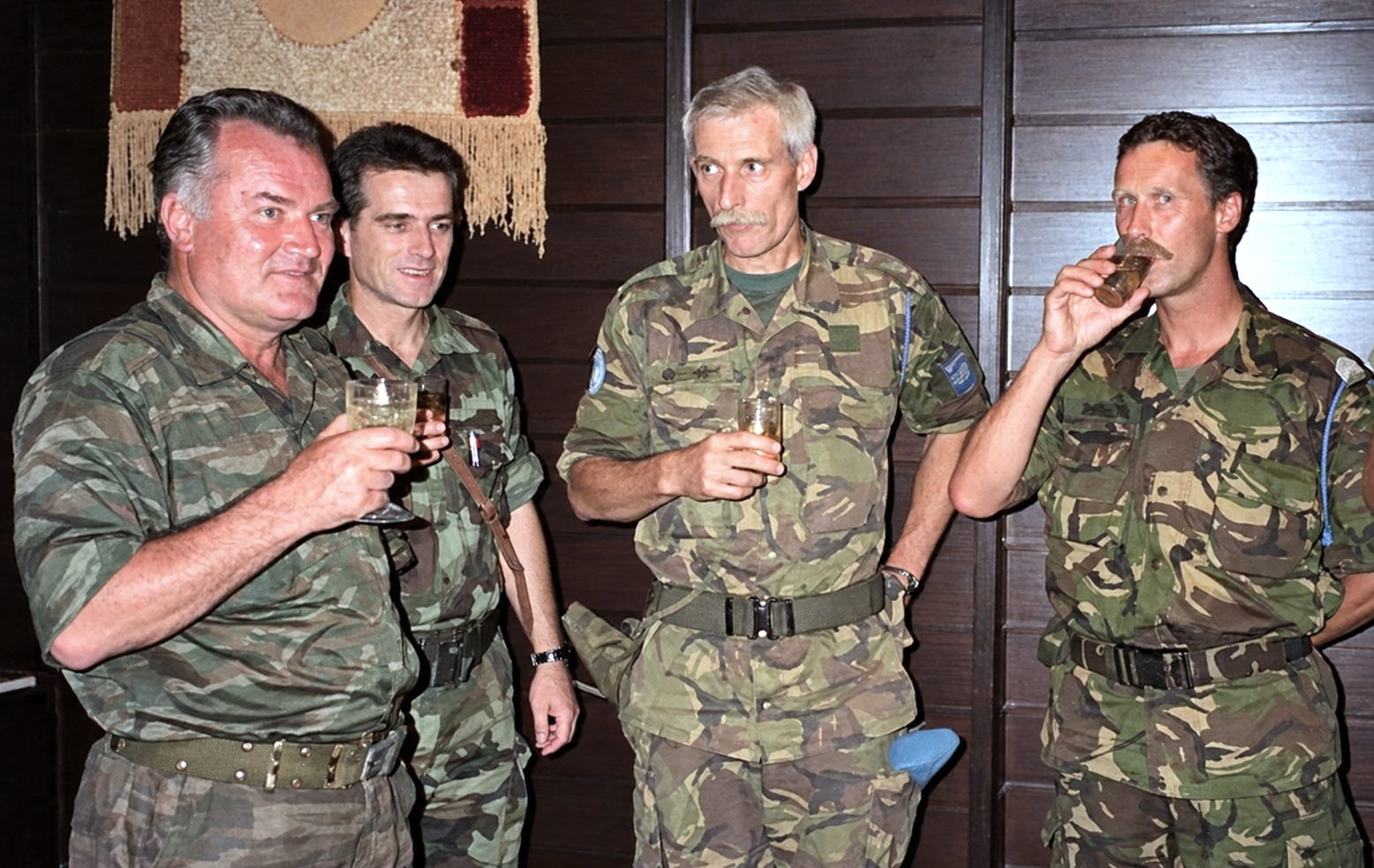
The Trial Chamber was able to interpret the evidence to “convert this humanitarian evacuation into the crime of forcible transfer” using the testimony of three other witnesses, writes Nyambe.
Most importantly, the Trial Chamber “selectively relied upon” the testimony of Robert Franken, the DutchBat deputy. Nyambe emphasises the point that the Trial Chamber relied on Franken “only when it supported its erroneous conclusion”. Franken did tell the Chamber that in his view the evacuation had been an order from Mladić, not a choice from the Muslims. However, Franken also gave evidence that the order for the evacuation came from the top of the United Nations, and the U.N. was intimately involved in organising what it contemporaneously viewed as a humanitarian measure. In just a few paragraphs of the Trial Judgment, “Franken is selectively cited out of context no fewer than 61 times”, Nyambe notes.
Then there was Eelco Koster, “an even lower-level [DutchBat] subordinate who had a direct encounter with Mr. Mladić”, notes Nyambe. Koster characterised this conversation in a way the Trial Chamber used in Mladić’s conviction, but it turned out the “entire exchange is video recorded” and once it was translated it became clear Koster’s memory was wrong because he had been given “an incorrect contemporaneous interpretation”.
Finally, there was Captain Momir Nikolić, the Assistant Commander for Intelligence and Security in the Bratunac Brigade of the VRS Drina Corps in the relevant period and the “key insider witness”. Nikolić is cited 35 times against Mladić in this section of the Judgment, and his testimony casts a long shadow over the ICTY Srebrenica findings in general, including for details like placing the 10th Sabotage Detachment in Srebrenica early on.27
Ab initio, Nikolić is a problematic witness: he was testifying about crimes he was implicated in, thus had an obvious incentive to blame-shift. Mladić was convicted for the “opportunistic killings” at Potočari partly due to Nikolić’s testimony.28 But Mladić was physically at Potočari for about an hour on 12 July, on film most of the time, while Nikolić was “in charge of everything at that point”, according to Boering. Another Bosnian Serb “insider” witness, “RM-265”, testified to seeing opportunistic killings “in the presence of” Nikolić. And Nikolić was “identified by the DutchBat and other witnesses as the main instigator of abuses relating to the buses [at Potočari], not Mr. Mladić”, Nyambe notes. It did not end there.
The ICTY judged Nikolić was in “a position of authority” during the massacres, “largely … implementing rather than giving orders”, a coordinator and organiser of actions that “were of significant importance to the overall ‘murder operation’.”29 By Nikolić’s own account, he worked as a close subordinate of Lt. Col. Vujadin Popović,30 the Security Chief of the VRS Drina Corps, an absolutely central figure in the Srebrenica massacres by the findings of the ICTY,31 and conveyed orders from others who had command responsibility for the massacres.32 Nikolić admits participation in the subsequent cover-up, arranging the movement of bodies.33
Perhaps evidence in a case such as Srebrenica can only come from a man whose “arms [are] soaked in blood”, as Nyambe describes Nikolić. But this depends on the trustworthiness of the witness. Nikolić “lacked credibility and was evasive”, per Nyambe.34 A lot of Nikolić’s evidence against Mladić was not witness testimony at all; it was “primarily hearsay”. And Nikolić was serially contradicted by RM-265 on matters where the latter was a witness. Where credulity gives way altogether is once it is understood that Nikolić, with no chance of an acquittal as one of the primary identifiable perpetrators at Srebrenica, was testifying under a plea deal. Nikolić pleaded guilty and testified against others, including Mladić, in exchange for the genocide charge and possible life sentence being dropped. As Nyambe puts it, “Momir Nikolić had a HUGE incentive to lie” [emphasis original], and his evidence would have been of suspect probative value, even if so much of it was not admitted rumour.
“In view of the above”, Nyambe summed up, “I find that there was no forcible transfer of Bosnian Muslims from Srebrenica, nor was there a common objective for the alleged joint criminal enterprise under a correct view of the above evidence and under the appropriate standard.”
Srebrenica: Genocide
Turning to Mladić’s genocide conviction over Srebrenica, Nyambe deals with a smaller issue first: “It is noteworthy that the Krivaja-95 Military Operation was conceded to be a legitimate military operation due to the failure to demilitarise the Srebrenica ‘safe area’.” Mladić’s March 1995 Directive 7.1, which replaced Karadžić’s Directive 7 as the framework for VRS activity, “directed that civilians not be targeted and that the laws of war be followed including the Geneva Conventions.” “Therefore”, Nyambe assesses, “the Trial Chamber’s conclusion that Krivaja-95 intended the ethnic cleansing of Bosnian Muslims from Srebrenica is an impermissible inference, unsupported by the evidence.” Nyambe points out that this is really supplementary to the forcible transfer issue, but part of what mars the Trial Judgment is a blending of “ethnic cleansing” into genocide.35
There are a couple of other discrete subsidiary issues. One relates to the fact that Mladić was not in Srebrenica for the entire duration of the massacres: Mladić departed Srebrenica in the afternoon of 13 July 1995, went to Serbia, and returned to Bosnia either late on 16 July or early 17 July to attend to the Serbs’ offensive against Žepa.36
There were “four routine orders” issued “by others under Mr. Mladić’s name” in the Srebrenica Massacre period, Nyambe wrote: “none of them related to Srebrenica, and each had log entries showing they did not come from Mr. Mladić’s office”. Mladić attended a wedding and visited a hospital in Belgrade. Most relevantly, Mladić was engaging with the international community in Dobanovci, to allow the Red Cross access to the Srebrenica prisoners of war and to arrange an “all for all” swap for Serb detainees held by the Muslim government, as well as peace negotiations to bring about a permanent ceasefire to end the war. With Mladić tied up in “complex peace negotiations”, “no reasonable trier of fact could conclude” he was capable of “exercising effective control in Srebrenica”, Nyambe argues.
The Trial Chamber itself acknowledged at one point that it was routine for Mladić’s deputy to take over things when Mladić was physically absent,37 contradicting its ultimate conclusion that the four orders proved Mladić retained command and control of the VRS. This conclusion “is contrary to evidence and is therefore a discernible error”, Nyambe argues. Likewise, “agreeing to allow the ICRC access to Srebrenica prisoners of war before exchanging them cannot be used to support knowledge of, nor a purported contribution to, any joint criminal enterprise to exterminate, let alone commit genocide against these same persons.”
A significant issue of law is raised by Nyambe concerning Mladić’s participation in the Srebrenica JCE: “under the jurisprudence, conduct and statements before the pertinent joint criminal enterprise and outside its temporal scope cannot be used to prove” the complicity of an accused. “However, as to the Srebrenica JCE, the Trial Chamber does precisely erroneously rely on that type of evidence”. The Trial Judgment agreed with the Prosecution that the Srebrenica JCE did not exist until the night of 11/12 July 1995, yet the contents of the Hotel Fontana meetings from hours earlier were used to convict Mladić. These meetings, in Nyambe’s view, even if they are considered evidence of other crimes, simply cannot be evidence of the genocide charge because they are outside the “temporal scope” of the purported Srebrenica JCE.
The adjudicated facts issue is present in the genocide case, too. “For example”, Nyambe writes, “the Trial Chamber relied on Adjudicated Fact 1476 to establish Mr. Mladić’s criminal responsibility for the killing of all of the 7,000-8,000 victims” and that “all were victims of crimes and all were civilians”. Nyambe’s objection to using adjudicated facts for a “core” charge is concretised in this instance because she believes the adjudicated fact is wrong. “It must be emphasized that any illegal killings in Srebrenica that were outside of combat are reprehensible, but they are not tied to Mr. Mladić”, Nyambe wrote, and the underlying adjudicated fact used to sustain the opposite claimed to know something it cannot.
Despite the fact that “[t]he column of men and boys set out from Srebrenica in combat formation and armed”, writes Nyambe:
the Trial Chamber disregarded its own finding that armed elements of the column of men in Srebrenica had casualties. The Trial Chamber further disregarded the Prosecution’s own demography expert, Witness Ewa Tabeau, whose evidence indicated that 70 per cent of the victims were registered as soldiers of the ABiH. It also disregarded evidence rebutting Adjudicated Fact 1476 and showing that bodies in the mass graves came from different events in different years and included legitimate casualties of combat, such as suicides, minefields, “kamikaze” attacks, etc.
The issue of bodies at Srebrenica being discovered with blindfolds, implying “execution-style” murders, assumed an outsize prominence in the coverage, but it was always numerically rather small,38 and Nyambe points to the evidence that it might have been smaller than that: “Both Defence and Prosecution forensic experts relating to the alleged blindfolds said they could have been bandanas dropped over the eyes as bodies decayed, bandanas as seen in the footage of the ABiH fighters that arrived in Tuzla from Srebrenica.”
While Nyambe believes “we will never know the true number of actual legitimate casualties and those related to acts of the crime of murder” at Srebrenica, she argues that “[t]he Trial Chamber erred in not performing any analysis” to even try to determine these figures. The “lack of analysis by the Trial Chamber” means it “failed to establish the number of victims and their relation to any crime, let alone genocide.”
As adumbrated above, the baseline for an ICTY conviction is evidence “proved beyond a reasonable doubt”, criminal liability in a JCE means making a significant contribution to the common plan, and when a case is circumstantial a conviction is only possible if there is no reasonable non-criminal interpretation of the evidence. When “the charge is genocide”, Nyambe explains, “the evidence must, in accordance with [these] stated high standards, establish specific intent, dolus specialis”.39 This can be done circumstantially, but it is very difficult because it relies on proving the mental state of the accused: this is an extremely high bar.
Nyambe’s central argument is that the Trial Chamber did not come close to clearing this bar: “Without any direct orders, without any direct evidence linking Mr. Mladić to any killings, the Trial Chamber committed its gravest error.”
The Trial Chamber, in Nyambe’s view, rewarded the Prosecution’s spurious effort to get around the lack of direct evidence for Mladić’s “agreement to a criminal plan requiring specific intent to commit genocide” by relying “on circumstantial evidence and hearsay”. This was partly, again, by improper use of adjudicated facts, and most momentously by relying on the testimony of Momir Nikolić.
Nikolić tried to produce direct evidence, claiming he was sent to ensure the road was safe for Mladić’s departure on 13 July, and then:
he met Mladić at the crossroads in Konjević Polje. … There were detainees visibly present at Konjević Polje that afternoon … Mladić exited his vehicle, approached a group of detainees, and addressed them, stating that everything would be all right … Returning to the vehicle, the witness asked Mladić what would really happen to the detainees. Mladić responded by smiling and making a sweeping gesture with his right hand from left to right approximately at the middle of his body. Mladić then laughed and entered the vehicle, which left for Vlasenica. … [This] was understood by Nikolić to mean that the prisoners were to be killed.40
It is an inherently strange story with a dubious pedigree,41 and even for the ICTY it was too slender a reed on which to hang a genocide prosecution, not least because additional discredit was heaped on it when a witness in a position to know flatly denied it ever happened. The ICTY declared itself “unable to establish beyond reasonable doubt that the encounter” took place and rejected it as evidence.42 Even if all the considerations about Nikolić laid out above were going to be ignored for some reason, there is the old principle of falsus in uno, falsus in omnibus (false in one thing, false in everything). It is, to put it unobtrusively, suggestive that the Trial Chamber used Nikolić as a load-bearing witness after he was found unreliable within the four corners of its own proceedings.
Nikolić’s evidence was accepted that he spoke to Popović outside Hotel Fontana on 12 July and Popović at this early stage blatantly said all the Muslim men (“balijas”) would be murdered once the women and children were gone.43 This conversation is a crucial part of the evidence the ICTY relies upon to date the initiation of the Srebrenica JCE that it ruled Mladić participated in, and to rule that the JCE had “the primary purpose of eliminating the Bosnian Muslims in Srebrenica”, using the “crimes of genocide, extermination, and murder”.44
Nikolić’s evidence was further accepted by the Trial Chamber to place Mladić at a 09:30 meeting on 13 July with Popović, the Zvornik MUP police chief Dragomir Vasić, and the Drina Corps deputy commander, General Radislav Krstić.45 Other little incidents of this kind are cited from Nikolić,46 none quite the smoking gun his “hand gesture” story would have been, but a pervading influence nonetheless in a circumstantial case, building up the stitching in a tapestry that binds Mladić to the massacres.
Toxic as Nikolić’s influence is to any sense of fairness or truth in the Mladić verdict, it is striking that while Nikolić appears “everywhere that there are killings, either directing them or as an accomplice”, as Nyambe notes, his connections to Mladić are always so tenuous. This is not an inferential point alone. Witness RM-265, whose credibility was never questioned by the Prosecution, testified to the criminality of Nikolić and Popović, but he “did not implicate Mr. Mladić in any of” what they did, wrote Nyambe. “No fewer than five insider witnesses, three from the Defence, two from the Prosecution, gave direct evidence that the only meeting [Mladić attended] during this critical time period was related to Žepa and contained only legitimate military instructions”, Nyambe adds. Further, Popović “was implicated by another Prosecution insider witness from the VRS, a high-ranking officer, Witness RM-376, who also does not implicate Mr. Mladić in any of the events”.
What is especially notable from RM-376 is that he testified to seeing Popović trying to recruit civilian volunteers to carry out the massacres because VRS officers refused. “This begs the question”, Nyambe notes, if Mladić and the VRS Main Staff were the organisers of the Srebrenica massacres, “why would security officers aligned with Witness Momir Nikolić, not even in the direct chain of command to Mr. Mladić, be in charge of the killings, and why would they be asking for non-army volunteers to do the killing”? Surely Mladić could just have issued his orders “through the normal chain of command”.
Nyambe bluntly argues that “the Trial Chamber erred” by trying “to make [Nikolić] the illusory link to Mr. Mladić with the joint criminal enterprise that could not be proven in accordance with the prevailing legal jurisprudence and thus resorted to the legal fiction of guilt by implication.”
As to what did happen at Srebrenica, Nyambe’s view is that “individuals from the local area, the MUP, and even Momir Nikolić and other rogue members of the VRS security professional line of command, took it upon themselves to conduct acts of revenge and killings of prisoners of war … during the time-period when Mr. Mladić was not in the area and contrary to any orders of Mr. Mladić”. This cadre, she concludes, acted without “his knowledge at that time [when the] VRS security line had its own parallel chain of command, separate and apart from the normal chain of command, such that it could exclude Mr. Mladić.”
This is not an unreasonable interpretation of the evidence. The creation of a parallel chain of command at Srebrenica that circumvented the VRS Main Staff is visible in outline,47 and among those who physically carried out the massacres were elements of the Bratunac and Zvornik Brigades of the VRS Drina Corps, sections of the MUP police, and local Serbs, though Nyambe’s list of perpetrators has a significant omission: the 10th Sabotage Detachment.48
It will be noticed, however, that Nyambe is vague about exactly who was responsible. This, too, is reasonable. Shortly before the Mladić verdict but after the bulk of the evidence had been publicly presented, another ICTY judge noted that, “based on the evidence in the case file”, he did “not have an answer to this question” of “who took the decision to execute thousands of victims and why”.49 The Dutch government’s historical investigation said the same thing.50 This is not especially surprising, since even the perpetrators struggled to pin down where the orders were coming from.51 It does leave a mystery at the heart of the Srebrenica Massacre, though, the adjudicated facts of the ICTY notwithstanding.
FOOTNOTES
The ICTY, created in 1993, was formally wound-up in 2017 after the Mladić verdict. Mladić’s appeal was heard before the International Residual Mechanism for Criminal Tribunals (IRMCT).
That there was an issue with the partiality of the judges in the Mladić Appeal was demonstrated in 2018 when three of them were removed (out of five) for intolerable bias.
The one exception relates to the Bosnian Serb army that Mladić commanded taking United Nations peacekeepers hostage in an effort to deter NATO airstrikes in May-June 1995.
The verdict Nyambe effectively called for overturning was: Prosecutor v. Karemera et al., Appeal Judgment, International Criminal Court for Rwanda (ICTR), 16 June 2006. Available here.
Prosecutor v. Dragomir Milošević, ‘Decision on Interlocutory Appeals Against Trial Chamber’s Decision on Prosecution’s Motion for Judicial Notice of Adjudicated Facts and Prosecution’s Catalogue of Agreed Facts’, Appeal Judgment, ICTY, 26 June 2007. Available here.
Prosecutor v. Stanilav Galić, Appeal Judgment, ICTY, 30 November 2006. See specifically paras. 91-98. Available here.
The U.S. had conspiracy laws on the books in the nineteenth century, but only started to use them routinely in the 1930s to combat the mob in the Prohibition era after the standard legal approaches had demonstrably failed to uphold public order, epitomised in the notorious Al Capone case. The most famous such law is Racketeer Influenced and Corrupt Organizations (RICO) Act of 1970.
Utilising the “conspiracy” concept at Nuremberg, and thus embedding it in the “international law” that was consciously being constructed as a precedent, was contested particularly by the French, who, habituated to an inquisitional model of justice, regarded it as a travesty. The Soviets, by contrast, who had planned for a show trial and were only slightly disappointed, naturally loved the conspiracy/JCE premise.
Prosecutor v. Ratko Mladić, Appeal Judgment, ICTY, 8 June 2021, para. 5 (p. 2). Available here.
Prosecutor v. Milan Milutinović et al., Appeal Judgment, ICTY, 26 February 2009, paras. 772, 1149. Available here.
The case Nyambe references here is yet another example of the arbitrary functioning of the ICTY. The Appeal acknowledges that the Trial Judgment claiming that “beyond reasonable doubt” and a “high degree of probability” were interchangeable—and that neither meant “certainty or proof beyond a shadow of doubt”—was “confusing and not in accordance with the standard of proof of a criminal trial”, but it denied the appellant’s claim anyway. See: Prosecutor v. Milan Martić, Appeal Judgment, ICTY, 8 October 2008, paras. 56-57. Available here.
Of course, what is given with one hand is taken away with the other: the sentence immediately following what Nyambe quotes reads: “Beyond that, the law does not foresee specific types of conduct which per se could not be considered a contribution to a joint criminal enterprise.” And it goes on: “one’s contribution to a joint criminal enterprise need not be in and of itself criminal, as long as the accused performs acts (or fails to perform acts) that in some way contribute significantly to the furtherance of the common purpose.” The wonder is that there were any acquittals at the ICTY. See: Prosecutor v. Mićo Stanišić and Stojan Župljanin, Appeal Judgment, ICTY, 30 June 2016, para. 110. Available here.
Prosecutor v. Zejnil Delalić et al. (“Čelebići Case”), Trial Judgment, ICTY, 20 February 2001, para. 458. Available here.
Prosecutor v. Milan Lukić and Sredoje Lukić, Appeal Judgment, ICTY, 4 December 2012, para. 149 (p. 53). Available here.
Prosecutor v. Ljube Boškoski and Johan Tarčulovski, Appeal Judgment, ICTY, 19 May 2010, para. 99 (p. 39). Available here.
On the ceasefires, it can be noted that U.S. intelligence reported that “the Bosnian Serbs until [at least late 1994] were the best at observing the agreement on ceasefires and humanitarian relief”. (U.S. intelligence also said the SDA government was the most intransigent in negotiations, partly because it had the backing of the U.S. State Department, and “many of the humanitarian problems in Sarajevo” were “caused by the Muslims”. The CIA tends to align with the State Department view, but for once they clashed over Bosnia, where State was publicly pro-SDA and the intelligence side concluded that “there were no ‘good guys’. All the parties did unspeakably brutal things to all the other parties”.)
A workable overview of this is given in: Central Intelligence Agency (2002), Balkan Battlegrounds: A Military History of the Yugoslav Conflict, 1990-1995, pp. 520-526 (of this PDF).
United Nations General Assembly (1999, Nov. 15), ‘Report of the Secretary-General pursuant to General Assembly Resolution 53/35: The Fall of Srebrenica’, p. 88. Available here.
Prosecutor v. Ratko Mladić, Trial Judgment, ICTY, 22 November 2017, paras. 2641-2654. Available here.
Prosecutor v. Radislav Krstić, Trial Judgment, ICTY, 2 August 2001, para. 66. Available here.
There is nothing inherently unusual about this naming convention. For example, “the Saint Bartholomew’s Day Massacre” refers to a targeted assassination of the Protestant leadership in Paris in August 1572, the wave of anti-Protestant pogroms by Catholic civilians that this touched off in the city, and the series of massacres of Protestants around the country in the six weeks afterwards that varied in their levels of elite control and mob carnage.
As of June 2026, the International Commission on Missing Persons (ICMP) had forensically identified 7,023 bodies at the various burial sites that it says were victims of the Srebrenica Massacre in its broad sense.
One of the ICTY rulings declared itself “satisfied beyond reasonable doubt” that the number of “executions”—the murders of unarmed captives—accounted for “at least” 5,336 of the dead, and entertained the possibility that the total number of slain was as high as 7,826 based on the “missing”. See: Prosecutor v. Vujadin Popović et al., Trial Judgment, ICTY, 10 June 2010, para. 664. Available here.
A Prosecution witness at the same trial (para. 617) estimated 1,000 combat deaths. A 1999 U.N. report estimated the combat deaths at 3,000, and Nyambe in a 2012 dissent agreed this was plausible. See: UNGA, ‘The Fall of Srebrenica’, p. 88; and, Prosecutor v. Zdravko Tolimir, ‘Dissenting and Separate Concurring Opinions of Judge Prisca Matimba Nyambe’, Trial Judgment, 12 December 2012, para. 84. Available here (p. 566 of PDF).
The Muslims tend to use a figure of 8,000 and airbrush the combat deaths—and suicides and “friendly fire”—in the column, and the Serbs tend towards lower totals and a near-exclusive focus on the combat deaths.
Prosecutor v. Mladić, Trial Judgment, ICTY, para. 3159.
Prosecutor v. Mladić, Trial Judgment, ICTY, paras. 240-245.
Prosecutor v. Radislav Krstić, Trial Judgment, ICTY, para. 278.
Prosecutor v. Mladić, Trial Judgment, ICTY, para. 5128. See also paras. 2461, 2471, 4970.
In addition to DutchBat—officially the United Nations Protection Force (UNPROFOR)—there was “a UN interpreter named Petar” at least at the first meeting. See: Prosecutor v. Mladić, Trial Judgment, ICTY, para. 2459.
Nyambe also cites Richard Butler, a prosecution witness, who testified of the Hotel Fontana videos: “Srebrenica has just been captured, General Mladić is seeking the surrender of the 28th Division rather than to continue to engage them in battle, the fact that he would offer a cease-fire and the fact that he would make the necessary provisions to allow for those individuals to travel to, in this case the Hotel Fontana, to negotiate that surrender, I mean, that’s all technically proper”.
Prosecutor v. Vidoje Blagojević and Dragan Jokić, Trial Judgment, ICT, 17 January 2005, para. 172. Available here.
Nyambe does not get into this, but the opportunistic killings are laced into the genocide charge by blending them with the separation of men and women, and “forcibly removing” the latter, to blame Mladić for “causing serious bodily or mental harm”, one of the acts listed in the Genocide Convention. See: Prosecutor v. Mladić, Trial Judgment, ICTY, para. 2936.
The ICTY’s support for this style of argument has significantly loosened the definition of “genocide”. It has allowed Convention acts to be used as “inferential” evidence of “special intent”, when the Convention requires—or required—the reverse, that intent be directly demonstrated before the Convention acts become relevant. It has also effectively incorporated “ethnic cleansing” or deportation into the genocide category.
Prosecutor v. Momir Nikolić, Sentencing Judgment, ICTY, 2 December 2003, para. 135. Available here.
Testifying at Popović’s trial, Nikolić “placed himself and his superior in the Security Branch within the chain of command responsible for arranging the executions.” See: Prosecutor v. Vujadin Popović et al., Trial Judgment, ICTY, para. 284.
It must be said that Popović’s conviction relied on “cumulatively … circumstantial evidence”, and a spot check of the individual elements comprising this does not inspire confidence.
A contemporary logbook documents that on the afternoon of 16 July 1995, “Popović requested a bus with a full tank and 500 litres of D2”, and this seems to have been delivered to Pilica. This fuel request was taken as evidence of Popović’s involvement in the massacres: “The Trial Chamber based this conclusion on the fact that the request was made on the same day as the Pilica Area Killings and that the following day the bodies were buried at the Branjevo Military Farm.”
One of the worst individual massacres—the ICTY estimate is 1,000 killed—took place near Kozluk, in the Zvornik municipality, on 15 July 1995. The Muslim captives brought to Kozluk had been held at a primary school in the village of Ročević. The ICTY ruled that Popović had attended the Ročević school that morning, and, infuriated at finding insufficient soldiers to carry out the murders, ordered a subordinate to find civilian volunteers. The sole source for Popović saying this, or even being present at Ročević, is, Srećko Aćimović, who claims to be the subordinate in the story, and Aćimović was testifying (like Nikolić) because he was a criminal seeking to minimise his own culpability.
There is a severe problem with one of the most damning pieces of evidence against Popović. Witness PW-101 identified a “lieutenant colonel or colonel at most” being “present at the field near Orahovac while executions of those detained in the Grbavci School were taking place”, and when “a young boy emerged from the pile of corpses calling for his father”, this figure shouted at the soldiers, “Just finish him off”, which they refused to do. The ICTY’s reasoning in identifying Popović as this “lieutenant colonel”—and rejecting Popović’s appeal on this point—is remarkably feeble.
See: Prosecutor v. Vujadin Popović et al., Appeal Judgment, ICTY, 30 January 2015, paras. 1079, 1098-1104, 1109-1110. Available here.
For example, Nikolić claims he conveyed orders from Colonel Ljubiša Beara, the Security Administration Chief—the overseer of VRS counter-intelligence and internal security—to arrange the transfer of prisoners to the killing fields in Zvornik. See: Prosecutor v. Momir Nikolić, Sentencing Judgment, ICTY, para. 35.
Nikolić’s testimony was that Popović ordered him to exhume and rebury the bodies. See: Prosecutor v. Blagojević and Jokić, Trial Judgment, ICT, para. 415.
Nyambe’s analysis holds up this far: once one starts looking into the details, Nikolić’s testimony is everywhere, and not in an ancillary role, but frequently as the only evidence for key aspects of the ICTY findings over Srebrenica.
One example Nyambe gives—not the most serious, as we shall see—is that Nikolić “downplayed his role in the Hotel Fontana meetings”, which is rather serious given the criminal centrality the ICTY gave them. And there is an intrinsic problem in establishing a baseline with Nikolić, as Nyambe points out, because, according to a witness, Nikolić “destroyed documentary evidence which could have compromised him in relation to Srebrenica crimes”, possibly at a level to preclude a deal with the Prosecution.
The ICTY’s complete integration of “ethnic cleansing” and genocide is set out in the very charges of the Mladić Judgment, where the Srebrenica JCE, in which Mladić is accused of playing a leading role, is held to be a genocidal plan defined as intending to “to eliminate the Bosnian Muslims in Srebrenica … by killing the men and boys and forcibly removing the women, young children, and some elderly men from the area”. See: Prosecutor v. Mladić, Trial Judgment, ICTY, para. 4.
Variations of this phrasing are then used repeatedly as the Judgment renders its verdict. See, for example: paras. 4987, 5096, 5099, 5108, 5130.
Beyond all the legalese, the exact match in the timeframes of Mladić’s absence from Bosnia and the Srebrenica massacres is really striking, and permits of two diametrically opposed readings: (1) rogue actors in the VRS military-intelligence structure used the window of Mladić’s absence to massacre the Muslim captives; or (2) Mladić’s absence was a part of the massacres conspiracy to provide him with an alibi.
“In Mladić’s absence, reports were to be submitted to [Deputy Commander and Chief of Staff of the VRS Main Staff, General Manojlo] Milovanović.” See: Prosecutor v. Mladić, Trial Judgment, ICTY, para. 4299.
At the trial establishing Srebrenica in “international law” as a genocide, it was noted that investigators had “discovered at least 448 blindfolds on or with the bodies”. See: Prosecutor v. Radislav Krstić, Trial Judgment, ICTY, para. 75.
In evidence at Mladić’s trial, it was clarified that “approximately 298 were, in fact, attached either around the head or the face”.
For the first case to establish dolus specialis as the standard, see: Prosecutor v. Jean-Paul Akayesu, Trial Judgment, International Criminal Tribunal for Rwanda (ICTR), 2 September 1998, paras. 498, 517, 540. Available here.
Prosecutor v. Mladić, Trial Judgment, ICTY, paras. 5119-5120.
Nikolić’s “hand gesture” story about Mladić was not presented directly to the Trial Chamber, but told to a Prosecution investigator, Bruce Bursik, in 2003, as part of an assessment of his evidence during his own trial. Subsequently, Nikolić “corrected 12 out of 15 paragraphs from his original statement of facts and acceptance of responsibility”. See: Prosecutor v. Mladić, Trial Judgment, ICTY, para. 5121.
Prosecutor v. Mladić, Trial Judgment, ICTY, para. 5127.
Prosecutor v. Mladić, Trial Judgment, ICTY, paras. 4938-4939.
Prosecutor v. Mladić, Trial Judgment, ICTY, para. 4987.
Prosecutor v. Mladić, Trial Judgment, ICTY, para. 5007.
Prosecutor v. Mladić, Trial Judgment, ICTY, paras. 5063, 5068.
Nikolić himself “admitted to hiding crimes from superiors, including the VRS Main Staff”, Nyambe documents.
The Trial Chamber rejected the evidence on a parallel chain of command when it made the first genocide ruling against Krstić, but the subsequent Appeal—while virulently rejecting again the parallel command argument—cleared Krstić of genocide on the basis that the Trial Chamber had erred in assuming he shared in the JCE of the elements of the Drina Corps that participated in the massacres. The ICTY clearly had a lexicographical allergy to “parallel”, but the evidence presented by Krstić’s witnesses was quite persuasive and the ICTY ultimately conceded the substance of the point. See: Prosecutor v. Radislav Krstić, Trial Judgment, ICTY, paras. 263-272.
In some ways all of the questions about responsibility for the Srebrenica Massacre devolve to the question of who had operational control of the 10th Sabotage Detachment from 13-16 July 1995, and the fact is we do not know.
The 10th Sabotage Detachment was formally directly subordinate to the VRS Main Staff. However, in practice, the Detachment operated under the Corps commanders. During combat operations, the Main Staff would either assign or accede to a request for Detachment personnel to be attached to a Corps group. The only exceptions were particularly complex missions, where a Main Staff official would accompany the Corps to direct the Detachment.
At Srebrenica, the Defence and Prosecution experts agreed that this system had not operated. There was no evidence, documentary or otherwise, that the Main Staff had assigned 10th Sabotage Detachment personnel to the Drina Corps, and there was no evidence in any case that the 10th Sabotage Detachment had been subordinated to the Drina Corps.
This became a particularly contentious point relating to the Branjevo Farm massacre on 16 July 1995, which the 10th Sabotage Detachment and some soldiers from the Bratunac Brigade of the VRS Drina Corps perpetrated. The Trial Chamber acknowledged that it had been “unable to conclude that the 10th Sabotage Detachment was formally resubordinated to the Drina Corps Command on 16 July 1995”, but, in that way that became so characteristic of the ICTY, it concluded nevertheless: “The Drina Corps Command must have been fully aware of the presence of this unit within its zone of responsibility” [emphasis added].
See: Prosecutor v. Radislav Krstić, Trial Judgment, ICTY, paras. 279-281.
Prosecutor v. Zdravko Tolimir, ‘Separate and Partly Dissenting Opinion of Judge Antonetti’, Appeal Judgment, 14 July 2015, p. 142. Available here.
Netherlands Institute for War Documentation (NIOD), Srebrenica: A ‘Safe’ Area: Part IV — The Repercussion and the Aftermath until the End of 1995 (2002), p. 88. Available here.
Prosecutor v. Blagojević and Jokić, Trial Judgment, ICT, para. 350.