

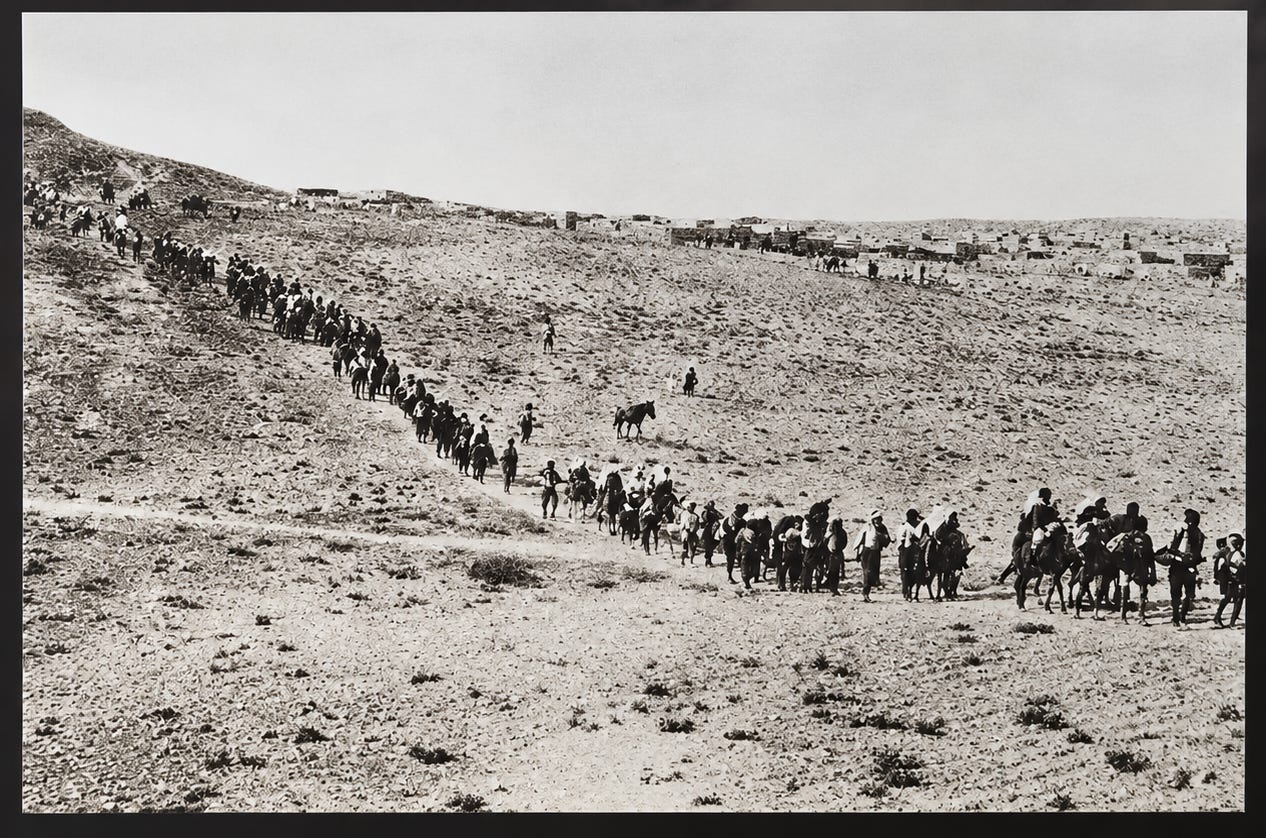
As regular readers of this newsletter will know, the numbers game over historical wars and atrocities, never mind ongoing conflicts, is a highly dubious business, where the usual pattern is figures established by political actors, based on little or no reliable underlying evidence, becoming totemic through repetition. The case of the Armenian deportations and massacres in 1915-16 holds to the pattern.
The Black Book
Probably the most authoritative source on the Armenian numbers is the so-called Black Book of Talat Pasha, found among the possessions of the former Ottoman Interior Minister and Grand Vizier after he was assassinated by an Armenian terrorist in Berlin in 1921.1 The documents have been claimed as proof, from the architect of the genocide himself, that a million Armenians were subject to “race extermination” by the Ottoman government.2 In fact, the 77-page black-cover notebook or journal, which does not seem to have been written in Talat’s hand, says nothing whatsoever about his intentions with the deportations.3
What the Black Book records is that about 1.1 million Armenians, out of a pre-war population given as 1.5 million, were “missing” from the Ottoman registry in 1917,4 with no indication of whether they had been deported, killed, migrated to Russia, or defected to join the Russian or French volunteer units, and “significant numbers of Armenians [listed as ‘missing’ in the Black Book] turned up later”.5
The Black Book’s provincial breakdown shows a wide variance in the application of deportation. While the Eastern Six Provinces were almost entirely cleared of Armenians,6 the proportion of Armenians remaining in the fifteen Central and Western Provinces ranged from 98% to 15%. The overall average of Armenians remaining in the Centre and West of Anatolia was about 45%, and seven of those provinces retained half or more of their Armenians.7 To the extent this bears on the genocide debate, it lends weight to the non-exterminatory interpretation of Ottoman conduct.
There being no evidence in the Ottoman archives of a decision to annihilate the Armenians, the genocide case is built by inference.8 An oft-made argument is that the deportations, instead of being a response to the Armenian rebellion in alliance with invading Russians in the east, were “neither a military necessity nor a contingency of war”,9 and this is demonstrated by deportations far from the warzone in Anatolia. Such an indiscriminate policy, the argument goes, indicates that the deportations were cover for a premeditated attack on the Armenians “as such”, in the language of the Genocide Convention. The thesis is troubled on its face by the simultaneous landing of the British and French—who had their own connections with the Armenian committees—at Gallipoli, extending the warzone from east to west, plus the wholesale exemption from deportation of Armenians in Constantinople, Smyrna (Izmir), and Aleppo.10 And the Black Book, assuming its authenticity,11 adds further evidence against the thesis.
Armenian Deportees and Deaths
The Black Book suggests 250,000 to 280,000 Armenians were never deported or were relocated within Anatolia.12 Walter Rössler, the German Consul in Aleppo, reported in December 1915 that 500,000 Armenians had been “spared from being deported”. Rössler’s evidence is problematic. An eyewitness he might have been, Rössler’s bias for the Armenian cause was well-known, a possible incentive to minimise the figure. More importantly, Rössler obviously did not gather this data personally, and he did not claim otherwise. Rössler said his un-deported number was “estimated”, and the only sources cited in his cable are “circles which must be taken seriously, as they are usually better informed than others”.13 Still, there are contemporary scholars who consider 500,000 a plausible total for Armenians not deported out of Anatolia.14
As to the numbers who were deported, Arnold Toynbee, a British intelligence operative responsible for wartime propaganda against the Ottomans, estimated in a 1917 product that there were 1.2 million deportees.15 Boghos Nubar, the Armenian representative in Europe, said the total was 600,000 to 700,000 in 1918.16 Turkey has also given the 700,000 figure.17 And Johannes Lepsius, the famous German Protestant missionary advocate for the Armenians, estimated 1.4 million in 1919.18 At the present time, Donald Bloxham is an outlier in implying there were 1.5 million deportees.19 Taner Akçam, relying on the Black Book, writes, “one can confidently say that the number of deported Armenians was around 1.2 million”,20 and this is generally considered the high-end figure. On the low end, Fuat Dündar, using the same Black Book, has estimated 800,000,21 and Raymond Kévorkian estimates 850,000.22 All of these are specialist scholars on the genocide-recognition side of the debate. Most non-specialists either give the 800,000 to 1.2 million range,23 or pick a number from within it; around 900,000 seems to be popular of late.24
A reason to suspect that this range for the deportees is too high is that there was a mass-movement of Armenians out of the Six Provinces—especially Van, Bitlis, and Erzurum—before the deportations were ordered and several more waves of refugees up to 1918 as the Ottomans and Russians fought bitterly on a shifting front-line, a significant cause of the “missing” tally in the Black Book.25 Toynbee and Lepsius do try to take some account of the refugees, though their estimates hover around 200,000, and the lower estimates in modern scholarship just for the Armenians who departed into the Russian Caucasus—without factoring in those who emigrated to Western Europe or the United States—range from 250,000 to 400,000.26 Some demographers put the figure at half-a-million.27
When it comes to the fatalities, Toynbee’s 1916 “Blue Book”, his most enduring messaging product, said an estimate of 600,000 Armenians killed in 1915 would “not be far wrong”.28 Lepsius claimed that German diplomats estimated “between 800,000 and one million” in October 1916. A commission in 1919 created by Mustafa Arif Deymer, the Interior Minister of the post-war Turkish government, which was set on vilifying its predecessor and operated under Allied occupation, estimated that 800,000 Armenians were killed during the deportations.29 The Armenian leadership in 1919 claimed: “One million Armenians have perished during this War”.30 It is possible to see the approximate convergence of these numbers as supporting evidence for their validity. It is also possible to see the convergence as evidence of cross-contamination among actors in the same milieu.
The same consideration would apply in noting that Talat made an official announcement in May 1916 that there had been 300,000 Armenian “losses”,31 and the Turkish government has said that on the available evidence “it can be concluded that the number of the Armenian losses was around 300,000”.32
Armenian Population Statistics
What would provide some solidity is reliable denominators—that is, numbers for the total Ottoman-Armenian population before the First World War and after its end. But alas, there are only competing claims on this issue, too.
The Ottoman census department recorded 1.3 million Armenians in 1914, and some sceptical demographers have gone as high as 1.7 million.33 The Armenian Patriarchate recorded 2.1 million Ottoman-Armenians in 1913, and some Armenian historians have gone as low as 1.9 million.
In 1919, the Armenian National Council of Constantinople estimated there were 1.25 million Ottoman-Armenian survivors, and George Montgomery, an American official at the Paris Peace Conference, presented an apparently detailed study showing 594,000 Armenians remaining in the rump Ottoman realm, with 450,000 in Russia and 60,000 in Iran, a total of 1.1 million.34 The same year, Lepsius estimated 845,000.35
The Turkish government has suggested a survivors’ figure of 980,000,36 and Armenian activists tend to favour a figure around 600,000.37 Demographers on both sides of the debate have produced surprisingly consistent estimates of 836,00038 and 881,00039 Armenian survivors.
What To Make of It All
From these numbers, it would be possible to calculate an Armenian death toll anywhere from 50,000 to 1.5 million.
It can be pointed out that the Armenians in 1919 were trying to maximise their survivor tally to argue to U.S. President Woodrow Wilson that they were a nation of sufficient size to qualify for his promised self-determination. But excluding numbers because they were politically generated is not going to leave much data. Decisions on inclusion and exclusion are intrinsic to data analysis, of course, but it makes nonsense of the idea that turning to the numbers eliminates subjectivity.
Take Dr. Montgomery’s overall figure, which is so close to the Armenian Council estimate and would allow a similar hyper-low-end fatality estimate. Is that going to be excluded, too? Or used in a weighted average? Or will Montgomery’s number for Armenians within Ottoman territory be used instead? Any one of these decisions could be justified, and then the process repeats for the next datapoint and the one after that. Dozens of decisions—large and small, conscious and unconscious—taking every analyst on a different route through the garden of forking paths. It is interpretation all the way down, and the demographers cannot rescue us from this because they are working with the same uncertain datapoints and making their own decisions on whether and how to use them.
Overall, then, in the Armenian case we see the usual pattern of incredibly spongy figures, with the underlying numbers marred by hearsay and agenda, and conclusions that depend on layers of assumption and interpretation, none of which can be taken for granted. These numbers might be all we have, but it does not make them any better. Attempting to work with these statistics provides so many researcher degrees of freedom in selecting a way through that it amounts to choosing your own adventure. The honest answer to the empirical numbers questions surrounding the Armenian catastrophe is that we do not know and probably never will.
FOOTNOTES
The “Black Book” documents were originally transcribed into a book by Turkish journalist Murat Bardakçı at the end of 2008, Talât Paşa’nın Evrak-ı Metrûkesi (“The Remaining Documents of Talaat Pasha”). Bardakçı vigorously disputes that the documents prove a genocidal program.
Ara Sarafian (2009, April 24), ‘Talaat Pasha’s Black Book Documents His Campaign of Race Extermination, 1915-1917’, The Armenian Reporter. Available here.
Sarafian, a British historian of Armenian descent, published an English-language book based on the documents in 2011 with a more sensational title than Bardakçı’s: Talaat Pasha’s Report on the Armenian Genocide.
Edward Erickson (2013), Ottomans and Armenians: A Study in Counterinsurgency, p. 216.
Ara Sarafian (2011), Talaat Pasha’s Report on the Armenian Genocide, p. 6.
The Black Book statistics are slightly difficult. The numbers given directly are: an Empire-wide 1914 Armenian population of 1.25 million and 284,000 Armenians located, mostly in the Anatolian provinces, but the documents open with a note explaining that “[b]ecause of the incomplete nature of the data” these are undercounts and the true totals should be considered 1.5 million and 350,000 to 400,000, respectively (see: Sarafian, Talaat Pasha’s Report on the Armenian Genocide, p. 20). The Black Book specifies that the figures do not include Armenian Protestants, who were exempt from deportation (see: Ümit Kurt (2021), The Armenians of Aintab: The Economics of Genocide in an Ottoman Province, p. 98). And, while a blanket figure of 80,000 is used for Constantinople (itself a serious undercount), the data for the rest of European Turkey is so radically incomplete as to be effectively absent (see: Sarafian, Talaat Pasha’s Report on the Armenian Genocide, pp. 20-36).
Erickson, Ottomans and Armenians, p. 215.
Five of the Six Provinces had their Armenian populations reduced to between 1% and 3%. Sivas was slightly exceptional: 9% of its Armenians remained. See: Sarafian, Talaat Pasha’s Report on the Armenian Genocide, pp. 46-52.
Erickson, Ottomans and Armenians, p. 216.
A book produced shortly after the Great War by Aram Andonian, an Armenian advocacy journalist, purported to contain Ottoman telegrams sent by Talat as Interior Minister explicitly ordering the extermination of the Armenians. The Andonian Documents were central to activism demanding recognition of the Armenian genocide for a long time, and even now they sometimes show up in ostensible academic work. Among serious scholars, the “Talat telegrams” have been regarded as one of the infamous historical fabrications, to rank alongside The Protocols of the Elders of Zion and The Hitler Diaries, for over forty years. See: Bernard Lewis (2011), The End of Modern History in the Middle East, pp. 80-81.
For an in-depth examination of the Andonian Documents, see: Maxime Gauin (2011), ‘Forgeries vs. Historical Research: Aram Andonian’s “Memoirs of Naim Bey” and the Contemporary Attempts to Defend Their “Authenticity”,’ Review of Armenian Studies. Available here.
Taner Akçam (2011), The Young Turks’ Crime against Humanity: The Armenian Genocide and Ethnic Cleansing in the Ottoman Empire, p. 125.
Guenter Lewy (2005), The Armenian Massacres in Ottoman Turkey: A Disputed Genocide, p. 207.
There is evidence in the Ottoman archives of Talat sending cables to provincial authorities from September 1916 to the summer of 1917 demanding to know the number of Armenians in their jurisdictions. It is possible the data gathered in these surveys is what survives in the “Black Book”. See: Akçam, The Young Turks’ Crime against Humanity, pp. 239-242.
The Black Book records (very roughly) that of the 284,000 total registered Armenians, 202,000 were in Anatolia and 82,000 were in the Arab provinces. Adjusting in line with the note that the true total should be considered 350,000-400,000, it would give an Armenian population in Anatolia of between 248,000 and 284,000.
Wolfgang Gust [ed.] (2014), The Armenian Genocide: Evidence from the German Foreign Office Archives, 1915-1916, p. 497.
Erickson, Ottomans and Armenians, p. 218.
Arnold Toynbee (1917), The Murderous Tyranny of the Turks. Available here.
Lewy, The Armenian Massacres in Ottoman Turkey, p. 197.
The text of Nubar’s 11 December 1918 letter to Jean Gout, a French Foreign Ministry official, is available here (p. 14).
Centre for Strategic Research (2005), Armenian Claims and Historical Facts: Questions and Answers, p. 31. Available here.
The Centre or SAM is a research and advisory body to Turkey’s Foreign Ministry, and its products are official outputs of that entity. SAM functions nominally as a think tank, but fundamentally it supports the Turkish government’s strategic messaging and decision-making.
Johannes Lepsius (1919), Germany and Armenia, 1914-1918: A Collection of Diplomatic Documents. Available here.
Donald Bloxham (2005), The Great Game of Genocide: Imperialism, Nationalism, and the Destruction of the Ottoman Armenians, p. 1.
Akçam goes on to name-check the two contemporaries directly: “Consequently, Toynbee’s estimate of 1.2 million or the German pastor Lepsius’s estimate of 1.3 million [sic] Armenians deported are perhaps close to the truth.” Lepsius’s (suspiciously exact) estimate is 1,396,350 deportees. See: Akçam, The Young Turks’ Crime against Humanity, p. 258.
Fuat Dündar (2010), Crime of Numbers: The Role of Statistics in the Armenian Question, pp. 150-151.
Raymond Kévorkian (2011), The Armenian Genocide: A Complete History, p. 693.
Benny Morris and Dror Ze’evi (2019), The Thirty-Year Genocide: Turkey’s Destruction of Its Christian Minorities, 1894-1924, p. 486.
For example: Alan Kramer (2025), Concentration Camps: A Global History, p. 97; and, Simon Sebag Montefiore (2026), The Cauldron: The Making of the Modern Middle East, p. 49.
The Black Book indirectly acknowledges this dynamic in recording 700,000 displaced Muslims (we can assume Turks and Kurds) from the Russian-occupied zone who were relocated to various parts of Anatolia, but it does not provide the data to be so specific about the Armenians.
Michael M. Gunter (2011), Armenian History and the Question of Genocide, p. 56.
Justin McCarthy (2010), Population History of the Middle East and the Balkans, p. 289.
“The Blue Book” or “Bryce Report” is formally: Viscount Bryce (1916), The Treatment of Armenians in the Ottoman Empire 1915-16: Documents presented to Viscount Grey of Fallodon, Secretary of State for Foreign Affairs By Viscount Bryce. Toynbee’s contribution was: ‘A Summary of Armenian History up to and Including the Year 1915’. The relevant section is available here.
Vahakn Dadrian [ed.] (1997), The Ottoman Empire: A Troubled Legacy: Views, Comments, and Judgments by Noted Experts Worldwide, p. 112.
Boghos Nubar and Avetis Aharonian (1919, Feb. 26), The Armenian Question Before the Peace Conference, p. 22. Available here.
Dündar, Crime of Numbers, p. 151.
The Turks nominally cite Nubar’s figures, not Talat’s. See: Armenian Claims and Historical Facts: Questions and Answers, p. 40.
Lewy, The Armenian Massacres in Ottoman Turkey, pp. 196-197.
Lewy, The Armenian Massacres in Ottoman Turkey, p. 199.
Lepsius wrote in Germany and Armenia (1919) that “845,000 [Ottoman-Armenians] were still alive”, based on his “very broad estimate” that there were 1,845,000 Armenians in 1914 and “approximately one million had perished”. Lepsius went on: “approximately 200,000 remained in their home towns, 200,000 were scattered elsewhere, 250,000 had fled to the Caucasus, and 200,000 remained in the concentration camps [in Syria] as starving beggars.” Some may be convinced by this arithmetic; others may see a red flag in this much detail resting on “approximately”.
The Turkish Foreign Ministry product ostensibly cites Nubar in 1919 saying there were 280,000 Armenians within the Ottoman Empire and 700,000 had “emigrated to other countries”, and makes clear it sees these numbers as reasonable. See: Armenian Claims and Historical Facts: Questions and Answers, p. 40.
For example: Gerard J. Libaridian [ed.] (1985), A Crime of Silence: The Armenian Genocide, p. 120 (a product of the “Permanent Peoples’ Tribunal”).
Dündar, Crime of Numbers, p. 151.
McCarthy, Population History of the Middle East and the Balkans, p. 290.