

In the historiography for the first few decades after the Second World War, the 20 January 1942 Wannsee Conference was often portrayed as the moment when the Nazis took the decision to implement the “Final Solution”, that is the extermination of European Jewry. In fact, that decision had been taken and implementation had begun between July and December 1941.
The exterminatory phase of the Shoah began with the Einsatzgruppen that followed the German army into the Soviet Union rounding up and shooting Jews in the occupied areas. This was the so-called Holocaust by Bullets, the most infamous incident of which was the massacre at Babi Yar. By September 1941, the Nazi killer brigades in the occupied East were systematically slaughtering Jews in the villages and towns of Ukraine, and experiments had begun, principally organised by Schutzstaffel (SS) official Walther Rauff, with using carbon monoxide to murder Jews in mobile gas vans. On 8 December 1941, the first death camp, Chelmno, became operational.
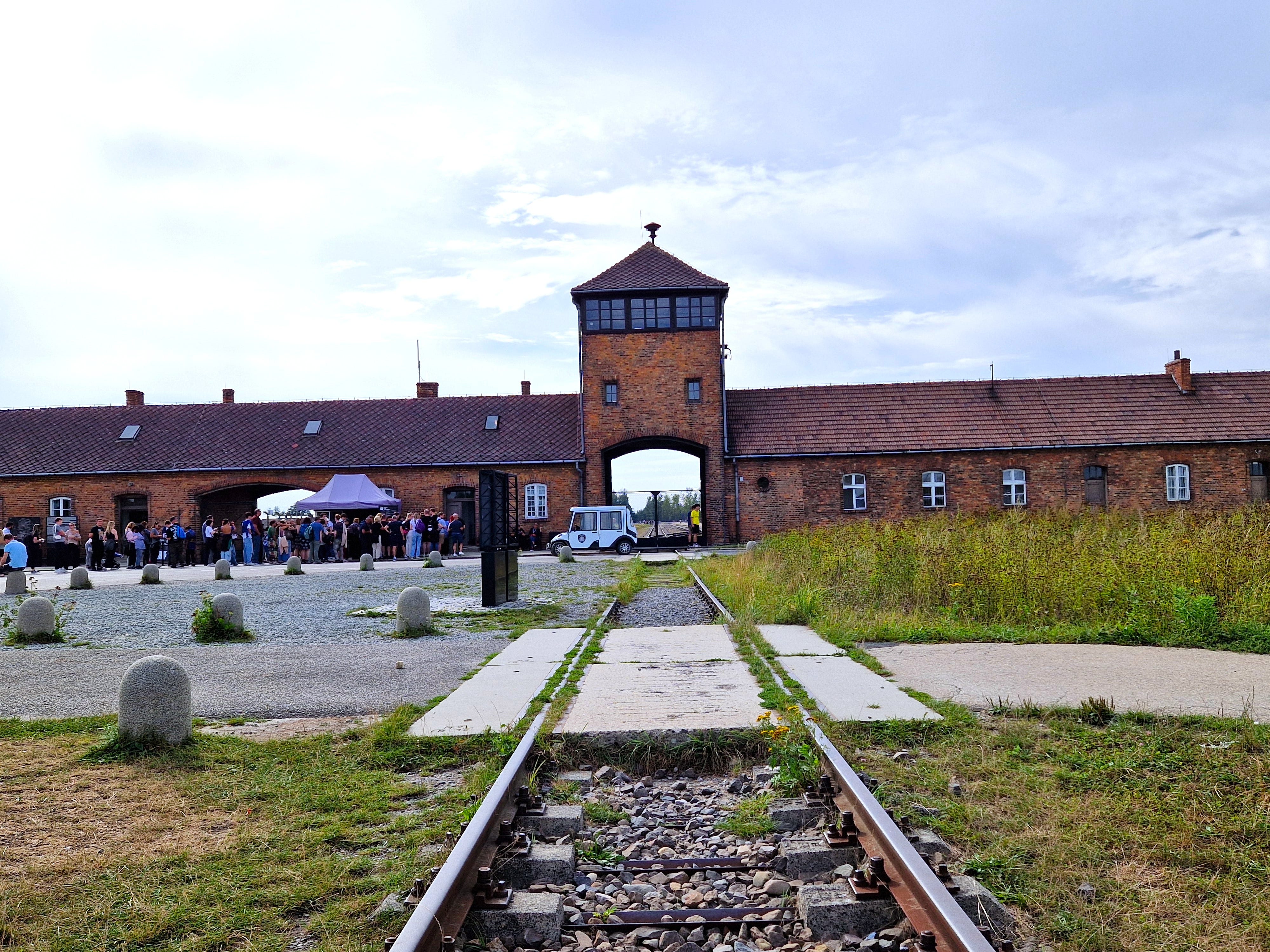
The Wannsee Conference was a coordination meeting to bring the ministries of the fractious Nazi State into harmony as the Holocaust was expanded into a Continent-wide, industrialised genocide, aimed at creating a Jew-free Europe, hence the meeting discussed murdering Jews in countries not conquered by the Nazis, including Britain. It was in the months after Wannsee that Zyklon B (hydrogen cyanide), which had been experimented with from late August 1941, came into use at the stationary death camps, and by mid-1942 it was being used in the large-scale extermination of Jews in the gas chambers at Auschwitz-Birkenau.
The Wannsee meeting was called by the SS, the ascendant element of the Nazi government. It was chaired by Reinhard Heydrich, the deputy of Reichsführer Heinrich Himmler and Director of the Reich Security Main Office (Reichssicherheitshauptamt or RSHA). The organiser of the conference—the man who prepared the paperwork, arranged the food and drink, etc.—was Adolf Eichmann, at the time a relatively junior SS officer working under Heydrich.
The Wannsee Conference lasted no more than two hours, and probably more like ninety minutes, but we cannot be sure because it was wilfully organised as a secret gathering, knowledge of it kept from all but the most senior Nazi officials, limiting the number of witnesses, and very little was committed to paper about Wannsee, so historians have few sources to work with.
Some details of the meeting were extracted from Eichmann during his trial in Israel in 1961, but caution has to be exercised regarding these for two obvious reasons: (1) Eichmann was speaking from memory nearly two decades after the event; and (2) Eichmann was speaking in a context where he had major incentives to be misleading if not outright untruthful, because he was trying (unsuccessfully, as it turned out) to minimise his guilt and avoid the death penalty.
By Eichmann’s account, stenographic notes were taken at Wannsee, but he then edited them to remove “vulgarisms” and make the text reflect (the more euphemistic) National Socialist “official language”, notably “evacuated” and “treated accordingly” to mean extermination of Jews. The original notes were destroyed and Heydrich then reviewed Eichmann’s amended text, ordering further changes. Thirty copies of the final cleaned-up version of the minutes were made and distributed within the Nazi State to a very tight circle of officials.
This Wannsee Protocol (Das Wannsee-Protokoll) produced by Eichmann is the only contemporary official record of the Wannsee Conference produced by the Nazi regime, and the sole surviving copy is Number 16, the one belonging to Martin Luther, the Undersecretary (Unterstaatssekretär) in the German Foreign Office. The probable reason Luther’s papers survived is because he was in no position to burn them as the Allies closed in and in the panic nobody else thought to do it. Luther was arrested in February 1943 and imprisoned at Sachsenhausen concentration camp, where he died on 13 May 1945, it seems genuinely of natural causes, after plotting an internal coup to replace Foreign Minister Joachim von Ribbentrop.
The Wannsee Protocol was discovered in late 1946 by Kenneth Duke, a member of the American staff for the International Military Tribunal (IMT) or Nuremberg Trials, who was responsible for microfilming documents that could serve in evidence, and who went on to a career focused on the Nazi Foreign Office archives, among other things. In March 1947, Duke handed the Protocol on to Dr. Robert Kempner, a German-born Jewish refugee, the deputy of the American chief prosecutor at the IMT, Robert H. Jackson, and himself the U.S. prosecutor in the Ministries Trial, the eleventh of twelve “Subsequent Nuremberg Proceedings” or “Subsequent Nuremberg Trials”, held before U.S. military courts in 1947-48. It was at this moment that the only other primary evidence about the Wannsee Conference was gathered. Kempner interrogated several of the attendees who were in Allied custody and at the Ministries Trial he grilled several others about Wannsee.
Kempner most extensively questioned Friedrich Wilhelm Kritzinger, who had been State Secretary in the Reich Chancellery and died before the trial. The Reich Chancellery was the central administrative office of the German State, as distinct from the Nazi Party machinery (the two were never fully integrated), coordinating the work of the ministries and handling communication between the ministries and Hitler. As such, Kritzinger occupied a position immediately below one of the most powerful men in Nazi Germany, Chief of the Reich Chancellery Hans Lammers, the effective head of the pre-Nazi civilian State bureaucracy and the bridge between it and the Führer, which also made him one of the gatekeepers to Hitler.
Others Kempner questioned in one way or another were:
Otto Hofmann, an SS-Gruppenführer, head of the Race and Settlement Main Office (Rasse- und Siedlungshauptamt or RuSHA).
Josef Bühler, State Secretary for the General Government (Generalgouvernement), i.e., the part of conquered Poland perhaps most associated with the Holocaust, and Deputy to Governor-General Hans Frank. Bühler tried to deny he had understood that Wannsee was about organising the physical annihilation of the Jewish people, but the demonstration of his guilt, not least by the Protocol where he is recorded asking that wholesale extermination be carried out in his district first, was quite important in showing that all parts of the Nazi apparatus—the Party, civilian administrative State, and the military—were active participants in a genocide that became a national project for the Germans. Bühler was subsequently extradited to Poland, by then under Soviet Communist rule, where he was executed in August 1948.
Wilhelm Stuckart, State Secretary of the Interior Ministry. Stuckart, a lawyer who co-authored the Nuremberg Race Laws that deprived Kempner of his German citizenship in 1935.
A translation of the Wannsee Protocol is given below.
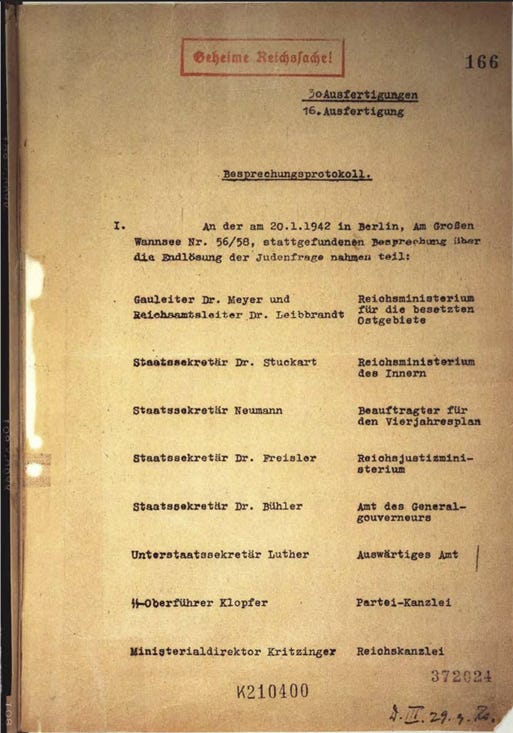
— — PAGE 1 — —
30 Copies [Made]
16th Copy
Discussion Protocol [or “Minutes of the Meeting” (Besprechungsprotokoll)]
I.
The following took part in the discussion held on 20 January 1942 in Berlin, at Am Grossen Wannsee No. 56/58, concerning the Final Solution of the Jewish Question [die Endlösung der Judenfrage]:
Gauleiter Dr. [Alfred] Meyer and Reichsamtsleiter Dr. [Georg] Leibbrandt: Reich Ministry for the Occupied Eastern Territories
State Secretary [Staatssekretär] Dr. Stuckart: Reich Ministry of the Interior
State Secretary [Erich] Neumann: Plenipotentiary [or “Commissioner”] for the Four-Year Plan [Beauftragter für den Vierjahresplan]
State Secretary Dr. [Roland] Freisler: Reich Ministry of Justice
State Secretary Dr. [Josef] Bühler: Office of the Governor-General
Undersecretary [Martin] Luther: Foreign Office
SS-Oberführer [Gerhard] Klopfer: Party Chancellery [Partei-Kanzlei]
Ministerial Director [Friedrich Wilhelm] Kritzinger: Reich Chancellery
— — PAGE 2 — —
SS-Gruppenführer [Otto] Hofmann: Race and Settlement Main Office
SS-Gruppenführer [and head of the Gestapo, Heinrich] Müller: Reich Main Security Office [Reichssicherheitshauptamt]
SS-Obersturmbannführer [Adolf] Eichmann
SS-Oberführer Dr. [Karl Eberhard] Schöngarth, Commander of the Security Police and the SD in the General Government: Security Police [Sicherheitspolizei] and SD [Sicherheitsdienst]
SS-Sturmbannführer Dr. [Rudolf] Lange, Commander of the Security Police and the SD for the General District [Generalbezirk] of Latvia, as representative of the Commander of the Security Police and the SD for the Reich Commissariat Ostland [“Eastern Land” (Baltics and Belarus)]: Security Police and SD
II.
The Chief of the Security Police and of the SD, SS-Obergruppenführer Heydrich, communicated at the outset his appointment by the Reich Marshal [Hermann Göring] as Plenipotentiary for the Preparation of the Final Solution of the European Jewish Question [referring to a letter Göring wrote to Heydrich on 31 July 1941] and pointed out that this meeting had been convened in order to create clarity on fundamental questions. The wish of the Reich Marshal to have transmitted to him a draft concerning the organisational, substantive, and material matters with regard to the Final Solution of the European Jewish Question requires the prior coordination of all central agencies directly involved in these questions with a view to the harmonising their actions.
— — PAGE 3 — —
Lead responsibility for conducting the process of the Final Solution of the Jewish Question lay, without regard to geographical boundaries, centrally with the Reichsführer-SS and Chief of the German Police [i.e., Heinrich Himmler].
The Chief of the Security Police and the SD then gave a brief retrospective account of the struggle conducted thus far against this opponent. The most essential elements were:
a) the pushing back [zurückdrängung] of the Jews from the individual spheres of life of the German people,
b) the pushing back of the Jews from the living space [lebensraum] of the German people.
In the execution of these efforts, the acceleration of the emigration of the Jews from the territory of the Reich was, as the only possible provisional solution, undertaken in an intensified and systematic manner.
By order of the Reich Marshal, a Reich Central Office for Jewish Emigration was established in January 1939, the direction of which was entrusted to the Chief of the Security Police and the SD. It had, in particular, these tasks:
a) to take all measures for the preparation of an increased emigration of the Jews,
b) to direct the stream of emigration,
c) to accelerate the carrying out of emigration in individual cases.
The objective of the task was to cleanse [säubern] the German living space of Jews by legal means.
— — PAGE 4 — —
All authorities were clear about the disadvantages that such a forcing of emigration brought with it. However, in view of the absence of other possible solutions, it had to be accepted for the time being.
The emigration work was, in the period that followed, not only a German problem, but also a problem with which the authorities of the destination countries had to concern themselves. The financial difficulties, such as increases in the vorzeigegelder [“presentation fees”, money Jews fleeing Germany had to demonstrate possessing before countries would take them in] and landing fees on the part of the various foreign governments, lack of ship space, continually tightened immigration restrictions or prohibitions, extraordinarily hindered the emigration efforts. Despite these difficulties, since the Machtübernahme [(Nazi) Seizure of Power] up to the cut-off date of 31 October 1941, a total of approximately 537,000 Jews were caused to emigrate. Of these:
from 30 January 1933 from the Altreich [“Old Reich”, Germany proper]: approx. 360,000
from 15 March 1938 from the Ostmark [“Eastern March”, Austria]: approx. 147,000
from 15 March 1939 from the Protectorate of Bohemia and Moravia: approx. 30,000
The financing of emigration was carried out by the Jews themselves or by Jewish-political organisations. In order to avoid the verproletarisierten Juden [“proletarianised Jews”, those stripped of property, reduced to poverty] remaining behind, the principle was followed that the wealthy Jews had to finance the emigration of the propertyless Jews; for this purpose, an appropriate levy or emigration tax was prescribed, graduated according to wealth, which was used to meet the financial obligations arising in the course of the emigration of propertyless Jews.
— — PAGE 5 — —
In addition to the Reichsmark revenues, foreign currency had been required for presentation and landing fees. In order to preserve the German foreign-currency reserve, the Jewish financial institutions abroad were induced by the Jewish organisations within the country to take care of the procurement of corresponding foreign-currency funds. In this way, by means of gifts from these foreign Jews, a total of approximately 9,500,000 dollars had been made available up to 30 October 1941.
In the meantime, the Reichsführer-SS and Chief of the German Police [Himmler], in view of the dangers of emigration during wartime and in view of the possibilities of the East, has prohibited the emigration of Jews.
III.
In place of emigration, there has now emerged as a further possible solution, following the appropriate prior approval by the Führer, the evacuation of the Jews to the East.
However, these actions are to be spoken of merely as provisional possibilities [or “makeshift expedients” (ausweichmöglichkeiten)]; nevertheless, practical experience is already being gathered here which is of significant importance with regard to the coming Final Solution of the Jewish Question.
In the course of this Final Solution of the European Jewish Question, approximately 11 million Jews come under consideration, who are distributed among the individual countries as follows:
— — PAGE 6 — —
A
Altreich [Germany proper]: 131,800
Ostmark [Austria]: 43,700
Ostgebiete [Eastern Territories]: 420,000
General Government: 2,284,000
Bialystok [Nazi District in Poland]: 400,000
Protectorate of Bohemia and Moravia: 74,200
Estonia: Jew-free [judenfrei]
Latvia: 3,500
Lithuania: 34,000
Belgium: 43,000
Denmark: 5,600
France / Occupied Territory: 165,000
Unoccupied Territory: 700,000
Greece: 69,600
Netherlands: 160,800
Norway: 1,300
B
Bulgaria: 48,000
England: 330,000
Finland: 2,300
Ireland: 4,000
Italy including Sardinia: 58,000
Albania: 200
Croatia: 40,000
Portugal: 3,000
Romania including Bessarabia: 342,000
Sweden: 8,000
Switzerland: 18,000
Serbia: 10,000
Slovakia: 88,000
Spain: 6,000
Turkey (European part): 55,500
Hungary: 742,800
USSR: 5,000,000
Ukraine: 2,994,684
White Russia excluding Bialystok: 446,484
Total: More than 11,000,000
— — PAGE 7 — —
In the case of the stated numbers of Jews in the various foreign States, however, these concern only Glaubensjuden [Jews by religion/faith], since the definitions of Jews according to racial principles are still lacking there in part. The treatment of the problem in the individual countries will, in view of the general attitude and conception, encounter certain difficulties, especially in Hungary and Romania. Thus, for example, even today in Romania a Jew can obtain, in exchange for money, appropriate documents which officially certify him as having a foreign nationality.
The influence of the Jews upon all spheres in the USSR is known. In the European territory there [i.e., European Russia] live approximately 5 million Jews; in the Asian region, [there are] scarcely a quarter of a million Jews.
The occupational classification of the Jews residing in the European territory of the USSR was approximately as follows:
In agriculture: 9.1 %
as urban workers: 14.8 %
In trade: 20.0 %
employed as State workers: 23.4 %
in the private professions – medicine, press, theatre, etc.: 32.7 %
Under appropriate direction, the Jews are now, in the course of the Final Solution, to be brought in a suitable manner to labour deployment in the East. In large labour columns [arbeitskolonnen], with separation of the sexes, the Jews fit for work will be led into these territories while building roads, whereby without doubt a large part will fall away through natural diminution [or “natural reduction” (natürliche Verminderung)].
— — PAGE 8 — —
The eventual final remaining stock [of Jews] will, since this will undoubtedly concern the most resistant part, have to be treated accordingly, because this element, representing a natural selection [natürliche Auslese], would, if released, become the nucleus [lit. “germ cell” (Keimzelle)] of a new Jewish revival. (See the experience of history.)
In the course of the practical implementation of the Final Solution, Europe is to be combed through from west to east. The territory of the Reich, including the Protectorate of Bohemia and Moravia, will have to be dealt with first, if only due to the housing question and other socio-political necessities.
The evacuated Jews will first be brought, train by train, into so-called transit ghettos [Durchgangsghettos], in order from there to be transported further to the East.
An important prerequisite, SS-Obergruppenführer Heydrich further explained, for carrying out the evacuation at all, is the precise determination of the circle of persons under consideration.
The intention is not to evacuate Jews over the age of 65, but rather to transfer them to an old-age ghetto [Altersghetto]—for which Theresienstadt is envisaged.
In addition to these age groups—of the approximately 280,000 Jews present in the Old Reich and the Ostmark [Austria] on 31 October 1941, about 30 per cent are over 65 years of age—the Jewish old-age ghettos will furthermore receive severely war-damaged [i.e., disabled] Jews and Jews with war decorations (Iron Cross, First Class). With this
— — PAGE 9 — —
expedient solution, many interventions will be eliminated at a stroke.
The beginning of the individual larger evacuation operations [Evakuierungsaktionen] will depend to a great extent upon military developments. With regard to the handling of the Final Solution in the European territories occupied and influenced by us, it was proposed that the relevant officials of the Foreign Office should confer with the competent officials of the Security Police and the SD.
In Slovakia and Croatia the matter is no longer all too difficult, since the most essential core questions in this respect have already there been brought toward a solution. In Romania, the government has in the meantime likewise appointed a Plenipotentiary for Jewish Affairs [Judenbeauftragten]. For the regulation of the question in Hungary, it is necessary, in the near future, to impose upon the Hungarian Government an adviser for Jewish affairs.
With regard to the initiation of preparations for the regulation of the problem in Italy, SS-Obergruppenführer Heydrich considers a connection with the Chief of Police in these matters to be appropriate.
In occupied and unoccupied [i.e., Vichy] France, the registration of the Jews for evacuation will in all probability be able to proceed without great difficulties.
Undersecretary Luther stated in this connection that, in the event of an in-depth treatment of this problem in certain countries, such as the Nordic States, difficulties would arise, and that it is therefore advisable for the time being to postpone these countries.
— — PAGE 10 — —
In view of the small numbers of Jews involved here, this postponement does not in any case constitute a significant restriction.
The Foreign Office foresees no great difficulties for southeastern and western Europe.
SS-Gruppenführer Hofmann intends to send along to Hungary, for general orientation, an official of the Race and Settlement Main Office when the matter is taken in hand there by the Chief of the Security Police and the SD. It was determined that this official of the Race and Settlement Main Office, who is not to become actively involved, should temporarily be assigned officially as an assistant to the Police Attaché.
In the course of the Final Solution measures, the Nuremberg Laws are, so to speak, to form the basis, whereby a prerequisite for the complete clearing up of the problem is also the solution to the questions of mixed marriages and persons of mixed ancestry.
The Chief of the Security Police and the SD, with reference to a letter from the Chief of the Reich Chancellery [i.e., Hans Lammers], discusses first, in theoretical terms, the following points:
1) Treatment of first-degree Mischlinge [lit. “mixling” or “hybrids”].
First-degree Mischlinge [i.e., half-Jews] are, with regard to the Final Solution of the Jewish Question, placed on an equal footing with Jews.
— — PAGE 11 — —
The following are exempted from this treatment:
a) First-degree Mischlinge who are married to persons of German blood, from whose marriage children (second-degree Mischlinge) have resulted. These second-degree Mischlinge are, in essence, placed on an equal footing with Germans.
b) First-degree Mischlinge for whom exemption permits have hitherto been granted by the highest authorities of the Party and the State in any sphere of life whatsoever. Each individual case must be reviewed, whereby it is not excluded that the decision may once again be rendered to the disadvantage of the Mischling.
The prerequisites for an exemption permit must always be fundamental merits of the Mischling in question himself. (Not merits of the parent or spouse of German blood.)
The first-degree Mischling who is to be exempted from evacuation will be sterilised—in order to prevent offspring and to clear up the Mischling problem definitively. The sterilisation takes place voluntarily. However, it is a prerequisite for remaining in the Reich. The sterilised “Mischling” is thereafter freed from all restrictive regulations to which he has hitherto been subject.
2) Treatment of second-degree Mischlinge.
As a matter of principle, second-degree Mischlinge are assigned to the persons of German blood, with the exception of the following cases, in which second-degree Mischlinge are placed on an equal footing with Jews:
— — PAGE 12 — —
a) Origin of the second-degree Mischling from a bastard marriage [Bastardehe, i.e., where both partners are Mischlinge].
b) Particularly unfavourable racial appearance of the second-degree Mischling, which already outwardly marks him as among the Jews.
c) Particularly poor police and political assessment of the second-degree Mischling, which permits recognition that he feels and behaves like a Jew.
However, even in these cases exceptions are not to be made if the second-degree Mischling is married to a person of German blood.
3) Marriages between full Jews and persons of German blood.
Here it must be decided from individual case to individual case whether the Jewish party is to be evacuated, or whether, taking into consideration the effects of such a measure upon the German relatives of this mixed marriage, he is to be transferred to an old-age ghetto.
4) Marriages between first-degree Mischlinge and persons of German blood.
a) Without children.
If no children have resulted from the marriage, the first-degree Mischling is to be evacuated or transferred to an old-age ghetto. (The same treatment as in marriages between full Jews and persons of German blood, point 3.)
— — PAGE 13 — —
b) With children.
If children have resulted from the marriage (second-degree Mischlinge), they are, if they are placed on an equal footing with Jews, to be evacuated together with the first-degree Mischling or transferred to a ghetto. Insofar as these children are placed on an equal footing with Germans (the normal cases), they are to be exempted from evacuation, and thereby the first-degree Mischling as well.
5) Marriages between first-degree Mischlinge and first-degree Mischlinge or Jews.
In these marriages (including the children), all parties are treated as Jews and therefore evacuated or transferred to an old-age ghetto.
6) Marriages between first-degree Mischlinge and second-degree Mischlinge.
Both parties to the marriage are, without regard to whether children are present or not, to be evacuated or transferred to an old-age ghetto, since any children would, in racial terms, as a rule exhibit a stronger Jewish blood admixture [Bluteinschlag] than second-degree Jewish Mischlinge.
SS-Gruppenführer Hofmann takes the position that extensive use must be made of sterilisation, especially since the Mischling
— — PAGE 14 — —
placed before the choice of whether he is to be evacuated or sterilised, would prefer to undergo sterilisation.
State Secretary Dr. Stuckart stated that the practical implications of carrying out the solution possibilities just communicated for the clearing up of the mixed-marriage and Mischling questions in this form would be an endless amount of administrative work. In order, on the other hand, to take account of the biological facts in all cases as well, State Secretary Dr. Stuckart proposed proceeding to compulsory sterilisation.
For the simplification of the mixed-marriage problem, furthermore, possibilities would have to be considered with the aim that the legislator might, for example, say: “These marriages are dissolved.”
With regard to the question of the effect of the evacuation of the Jews upon economic life, State Secretary Neumann declared that the Jews presently employed in labour deployment in war-essential enterprises could not at present be evacuated so long as no replacement labour was available.
SS-Obergruppenführer Heydrich pointed out that these Jews would in any case not be evacuated under the guidelines approved by him for carrying out the evacuation actions currently in progress.
State Secretary Dr. Bühler stated that the General Government would welcome it if the Final Solution of this question were begun in the General Government, because, for one thing, the transport problem does not play a predominant role here
— — PAGE 15 — —
and reasons relating to labour deployment would not hinder the course of this action. Jews would have to be removed from the territory of the General Government as quickly as possible, because it is precisely here that the Jew represents an eminent danger as a carrier of disease, and because, on the other hand, through continued illicit trade, he permanently brings the economic structure of the country into disorder. Of the approximately two and a half million Jews under consideration, moreover, the majority of cases are unfit for work [arbeitsunfähig].
State Secretary Dr. Bühler further stated that responsibility for the conduct of the solution of the Jewish Question in the General Government lies with the Chief of the Security Police and the SD, and that his work would be supported by the authorities of the General Government. He had only one request: to solve the Jewish Question in this territory as quickly as possible.
In conclusion, the various kinds of possible solutions were discussed, whereby both Gauleiter Dr. Meyer and State Secretary Dr. Bühler took the position that certain preparatory work in the course of the Final Solution should be carried out immediately in the territories concerning themselves, though disturbance of the population would have to be avoided.
With the request of the Chief of the Security Police and the SD to the participants in the meeting that they provide him with appropriate support in carrying out the solution work, the meeting was closed.