

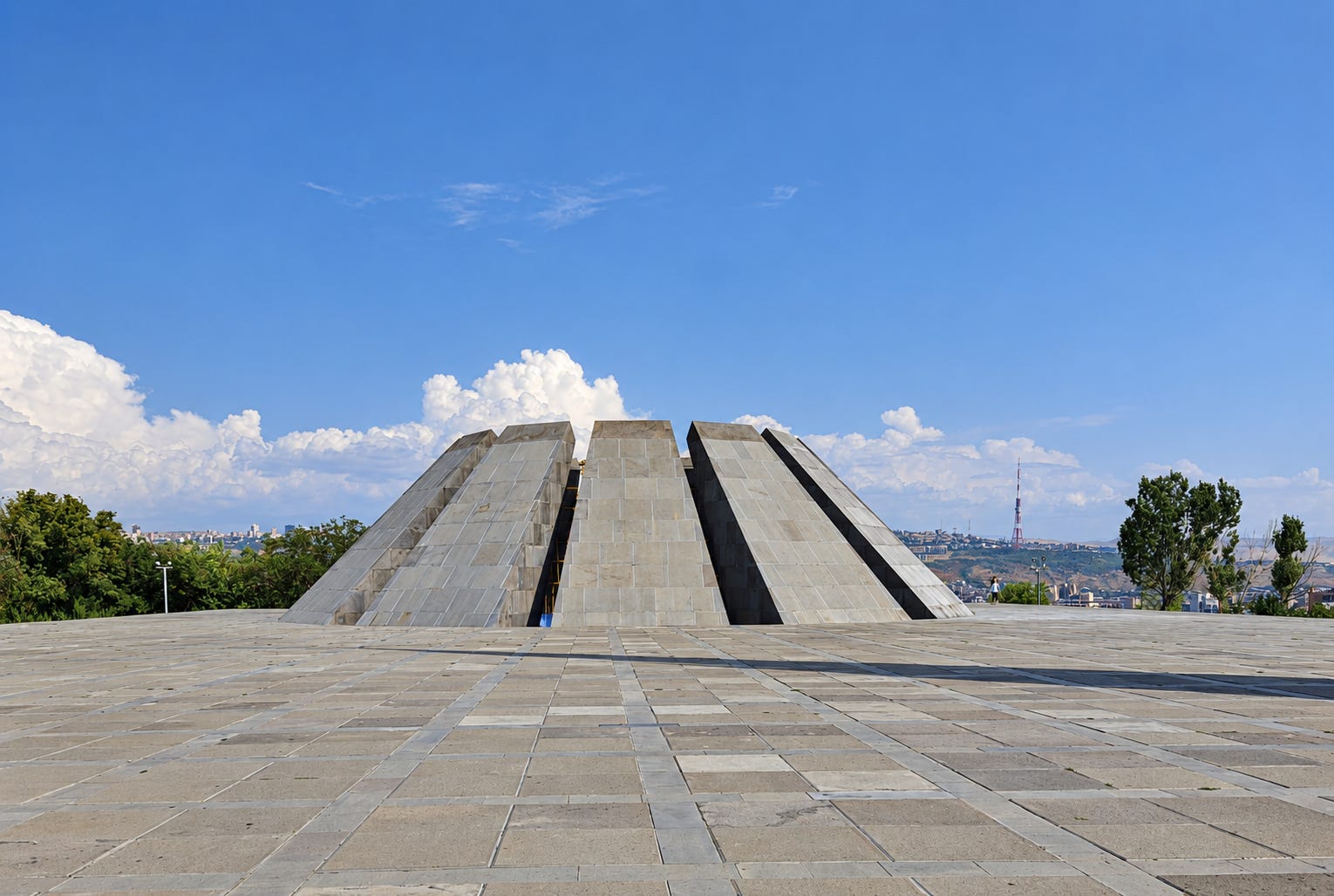
The Armenian Genocide Museum-Institute is within a memorial complex at Tsitsernakaberd (lit. “Swallow’s Fortress”) in Yerevan, which also contains the Sanctuary of Eternity monument and the 140-foot Stele that date back to 1967 when Armenia was part of the Soviet Union and Moscow had just begun to back in earnest the Armenian genocide-recognition movement, within the “Socialist Republic” and in the Armenian diaspora. The museum was opened after the liberation from Communism, in 1995.
I was recently in Armenia and visited the museum. There are forty main text panels: I photographed all except one (I do not know how I missed it) and have transcribed the whole presentation below. Some of the photographs are incorporated, too.
So far as I can tell, the entire text from the museum is not available anywhere else on the web, which is a shame. The museum was created as a project of the Armenian State. It remains overwhelmingly State-funded, while accepting donations, and though it is nominally overseen by a Board of Trustees—consisting of historians and other scholars, State officials, and political figures, including Members of Parliament and community representatives—the Board is subordinate to the government, as was recently demonstrated. In short, the museum’s presentation is the nearest we have to the official Armenian version of the contested history of the terrible events of 1915.
