

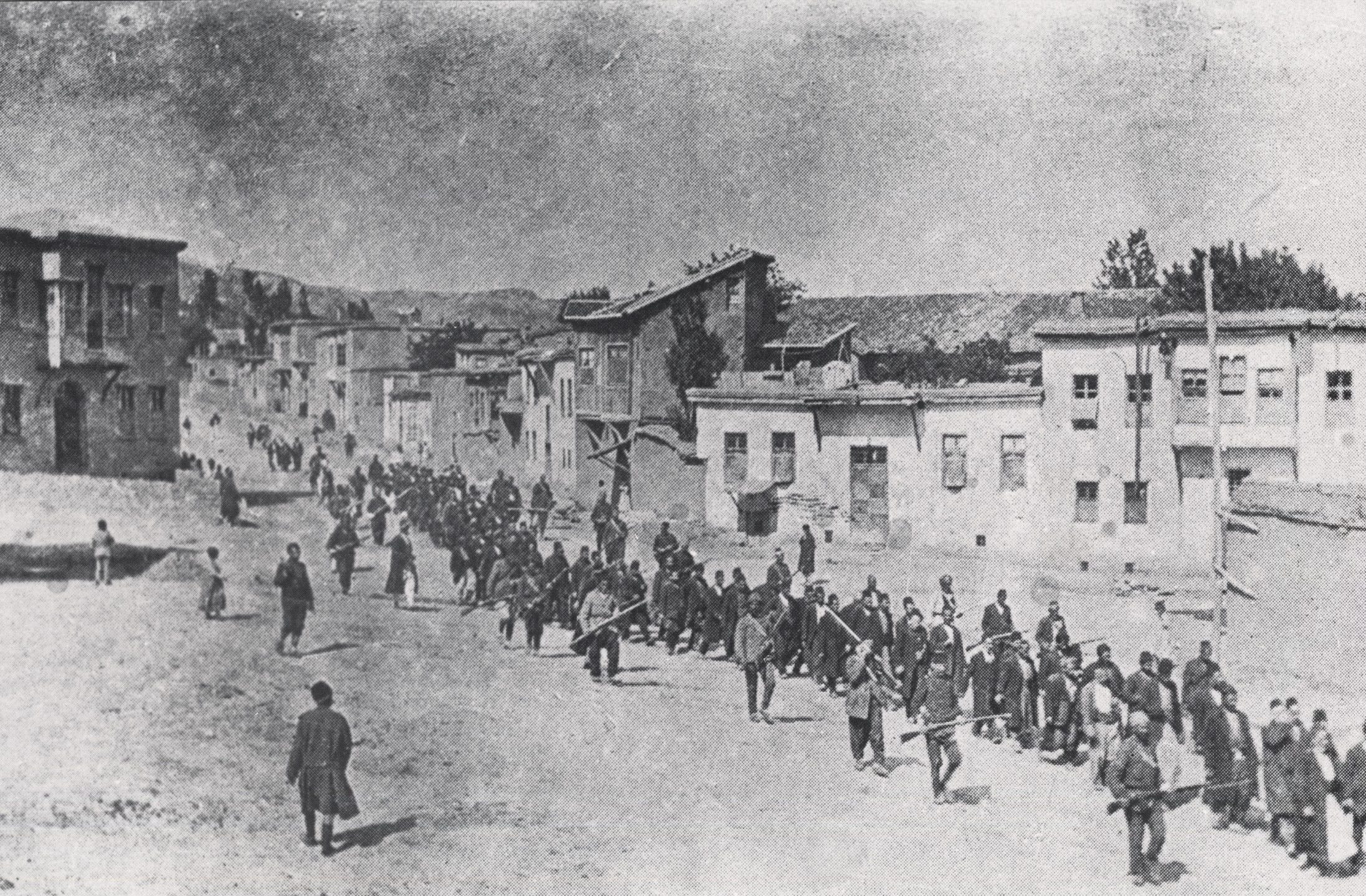

The argument over whether what happened to the Armenians in the Ottoman Empire in 1915-16 constitutes genocide is the subject of a forthcoming post. Putting that article together has proven to be partly an engagement with the changing state of academic and public opinion in the West, which has now overwhelming settled on the conclusion that genocide is the correct description. A brief sketch of this intellectual history seemed interesting enough for a standalone piece.
THE EARLY HISTORY
Politics has loomed large over this subject from the beginning. There was significant Entente propaganda related to the Armenian massacres during the First World War. Britain was particularly prominent in this: one intelligence operative, Arnold Toynbee, produced The Treatment of Armenians in the Ottoman Empire (a.k.a. “The Blue Book”) in 1916,1 which expressed the genuine British outrage at the calamities inflicted on the Ottoman Christians, but also had an eye on drawing the United States into the war.2 This was among the reasons Entente propaganda also often blamed Germany as much as the nationalist Ottoman government of the Young Turks or Committee of Union and Progress (CUP).3 The attempt to prosecute accused CUP war criminals in 1919-20 was by the virulently anti-CUP post-war Turkish government that operated under Allied occupation and had political incentives to produce “legal” findings that vindicated Allied wartime propaganda,4 an objective made easier by the procedures in no way resembling fair trials.5 Toynbee’s work and the newspaper reports of the Constantinople trials are still cited as primary sources.
The other main public works around this time were memoirs, from diplomats (most prominently, the U.S. Ambassador to the Sublime Porte, Henry Morgenthau6), missionaries, Armenian survivors, and other eyewitnesses—or alleged eyewitnesses. Because another important phenomenon after the Great War was Armenian revolutionaries and activists fabricating luridly incriminating documentary testimony to influence Western opinion and policy towards Turkey, including the infamous Naim-Andonian Documents that contain forged telegrams purportedly from Ottoman Interior Minister Talat Pasha explicitly ordering the annihilation of the Armenians.7 Once the political contestation over the post-war settlement had ended in the early 1920s, there was a precipitate fading of interest as Europe retreated into itself and Mustafa Kemal Atatürk worked to embed his secular revolution in Turkey.
There was some revival of interest in the 1940s, again for political reasons, when activists and statesmen, in the shadow of the Holocaust, were pushing to encode genocide in “international law”.8 Indeed, Raphael Lemkin, coiner of the word “genocide” in 1944, was influenced by the Armenian case and saw it plainly as an example, though this is complicated because what Lemkin meant by genocide and the actual definition in the Genocide Convention are clean different things. The Convention was precise in defining genocide as “acts committed with intent to destroy, in whole or in part, a national, ethnical, racial, or religious group, as such”. Lemkin’s concept of genocide was far more amorphous, incorporating not only violence against property, such as churches and libraries, which he termed “cultural genocide”, but social processes like assimilation.9
THE COLD WAR
Aggressive Soviet designs against Turkey from the late 1940s into the 1950s prompted further interest in the Armenian Question. Moscow had prevailed in the Second World War, conquering much of Eastern Europe from its former Nazi ally, and then set about conquests further afield. The Soviets tried military means in places like Iran, Greece, and Korea, and political means elsewhere, notably in Turkey.
The Soviets wanted to “revise”—read: control—the situation on the Turkish Straits, the Dardanelles and Bosporus, and the Armenians were Moscow’s chosen lever. In 1946, the Soviets initiated a global active measures campaign to present the “Armenian Soviet Socialist Republic” as the fulfilment of Armenian national aspirations, mobilising a massive wave of “repatriation” (nerkaght),10 then made territorial claims in eastern Turkey by proclaiming these were “Armenian historical lands” that should be added to Soviet Armenia and re-populated with Armenians.11 It was against this backdrop that a rare book on 1915 was published in Turkey, The Armenians in History and the Armenian Question (1950), by one of the few surviving prominent CUP officials, Esat Uras, effectively arguing the Russians were at it again in using the Armenians to try to dismember the Turkish State.12
Turkey joining NATO in 1952 forced Moscow Centre to adjust its methods of political warfare, turning away from the Armenian heartlands to the diaspora. The Soviets landed on the nascent Armenian genocide-recognition campaign as a mechanism to instrumentalise the Armenian diaspora, especially in the United States.13 It is impossible to imagine that the Cold War context, where Turkey was “a valued associate of the United States”, had no influence on the general aversion of Western elites to discussing the Armenian massacres up to the 1960s, and the view of academic historians who dealt with 1915 that it was as an “unrelieved tragedy”, which came about because of the Ottoman belief the State faced an existential crisis due to the internal Armenian rebellion in alliance with the invading Russians, a belief “doubtless greatly exaggerated, but [with] enough basis in fact” that nobody could say they would not have done the same to “save themselves” in similar circumstances.14
[The Soviets encouraging the genocide-recognition movement] created some minor initial difficulties within Soviet Armenia, but the Soviet Revolution’s official theology had adapted to incorporate the “national liberation movements” within the Third World Strategy, and it was easy enough to channel Armenian national sentiment into this program. Space was made for Soviet Armenian publications arguing that 1915 was genocide, and these books, translated into English and other Western languages, circulated in Armenian émigré activist circles. These works were foundational to the movement that would in time pressure Western legislatures to recognise Turkey as guilty of genocide, and in parallel emerged Armenian terrorist organisations that targeted Turkish diplomats and civilians in the name of revenge for the genocide and forcing Ankara to abandon its policy of “denial”.
There were two main terrorist groups: the Justice Commandos of the Armenian Genocide (JCAG), later rebranded the Armenian Revolutionary Army (ARA), the “deniable” terrorist wing of the Dashnaks,15 one of the nationalist-socialist revolutionary groups that led the 1914-15 rebellion in the Ottoman Empire, which had moved into alignment with the Soviet Union in the 1960s, and the Armenian Secret Army for the Liberation of Armenia (ASALA), an outright KGB creature.16 It was the activities of these terrorists in particular and ASALA specifically, in the early 1970s, the success of their “propaganda of the deed” amid the chic for the “guerrilla” or fedayeen embodied in the Soviet-dependent Palestine Liberation Organisation (PLO), that brought the Armenian massacres back into the international discussion in a serious way.
The heightened interest, and focusing of resources, paved the way for the genocide-recognition movement to gain a foothold in academia—and, of course, triggered the counter-campaign by the Turkish government,17 to smother a too-long-delayed confrontation with the truth or to combat a scandalous libel, as one prefers.
Two of the prime movers in setting up the Western academic infrastructure of Armenian genocide-recognition were Richard G. Hovannisian and Vahakn Dadrian, both Armenian-Americans. Hovannisian was born in California in 1932 to a father who survived the deportations. Dadrian was born in Constantinople in 1926 and emigrated to the U.S. in 1947. Both were involved in Armenian diaspora politics, a milieu where the institutions—from youth groups up to lobby organisations like the Armenian National Committee of America (ANCA)—are affiliated with the Dashnaks. It was moving in such circles Hovannisian met his academic mentor, Simon Vratsian, the last Prime Minister of the short-lived, Dashnak-led First Armenian Republic (1918-20), and Dadrian became closely associated with the Zoryan Institute, which is not a Dashnak institution, exactly, but it did have among its founders Gerard Libaridian, a hereditary member of the Dashnak Party.
A lot of the Armenian literature on 1915 available in the early 1970s was either the Soviet historiography itself, by authors like E. K. Sarkissian and R. G. Sahakian, or was derivative of these works and shaped by their methods. What Hovannisian and Dadrian wanted to do was create an academic corpus making the genocide case in a format respectable by Western standards. The dynamics in the Armenian diaspora would assist in this. As Libaridian later noted, there was a significant Armenian cultural upwelling from the 1970s onwards, which overall sharpened a collective identity, but it was a minefield trying to focus on specifics. The one issue that united everyone—the church, religious dissidents, the Dashnaks, the anti-Dashnak nationalists, the Communists who believed Soviet Armenia was the sole legitimate vehicle of national aspirations—was advocating for recognition of the genocide. Libaridian found this somewhat stifling: he had wanted the Zoryan Institute to look to the future as well as the past, to focus on issues like Armenian-Turkish reconciliation, but he was in a tiny minority. 1915 was “the beginning and end of everything” for Zoryan’s donors, researchers, and students, and he ultimately departed.
There was resistance to Hovannisian, Dadrian, and their allies at first. The reaction of some scholars who engaged the emerging genocide-recognition literature was downright contemptuous, seeing the dismal failures in handling sources and so on as inevitable in what was so obviously a political-activist project dressed up as scholarship.18 Specialists working in the Ottoman archives were similarly dismissive, contending that inter alia the Hovannisian-Dadrian theories fell to pieces on impact with the historical records that “manifest numerous efforts [by the Ottoman government] to investigate and correct a situation in which [peoples of all ethnicities and faiths] were being killed by a combination of revolts, bandit attacks, massacres and counter massacres, and famine and disease, compounded by destructive and brutal foreign invasions”, where everyone, “Muslim and non-Muslim alike, had their victims and criminals”.19 It is instructive of the atmosphere in this debate that the response to author of this assessment, Jewish-American scholar Stanford Shaw, a professor of Turkish history based at UCLA, was to publicly vilify him for months before Armenian terrorists bombed his home in California in October 1977.20
THE TIDE TURNS
The initial resistance notwithstanding, the balance of academic opinion was to shift remarkably quickly. The reputational and physical threats played their part. Another factor was the academic neglect of prior decades, which provided an institutional blank slate on which Dadrian in particular could instantiate the basic contours of Armenian Genocide Studies that still powerfully influence the research agenda to this day.21 For instance, Dadrian responded to the earlier criticism by acknowledging that the Ottoman documents show a policy wherein “the deportees were to be protected, fed, and safely transported, and sanctions would be applied to those officials who mistreated the deportees or allowed them to be mistreated by others”, but he developed an argument that behind this “beguiling appearance of benevolence” were mechanisms of deception, a “two-track” system that hid the real orders for genocide.22 This argument is now part of the furniture in Armenian Genocide Studies, often rehearsed using the exact same sources and interpretations as Dadrian.23
Another contingent factor was that the Armenian genocide-recognition movement had become seriously organised in the 1960s, simultaneous with Jewish activism to undo the repression of the memory of the Holocaust at Nuremberg, and throughout the 1980s the movement in its academic form would converge with scholars of Jewish history and Holocaust-awareness,24 notably Israel Charny and Robert Melson, to enshrine the Armenian massacres in the broader Genocide Studies field as “the first holocaust”. These scholars cited one another in building up a foundational literature, and their sense of moral mission, of uncovering a hidden truth and righting a long-standing injustice,25 was attractive to the young just entering academia and more established scholars, and to scholars from disciplines as broad as history, the law, the political and social sciences, sociology, psychology, even medicine and English literature.26
The Armenian genocide-recognition movement also benefited from being part of the zeitgeist. It was in the 1980s that the trend of national and ethnic groups campaigning to have their past or present suffering classified as genocide really took off,27 and these political campaigns fed into an increasing academic fashion for regarding the Convention definition of “genocide” as too narrow and restrictive.28 The push came from other angles, too, notably those who wanted to criminalise war itself as genocide,29 a push that has not been abandoned. “Genocide” coming to be used very loosely in everyday language cannot be blamed on popular misunderstanding, since by now there are academic arguments for describing as “genocide” events where there is no bloodshed at all.30 Whether one calls it a paradox or just cynicism, the underlying effort has been to disassociate “genocide” from the Holocaust to make it more widely available, even as the word’s value to the various claimants derives entirely from the association, and the Armenians were far from alone in tacitly acknowledging this by framing their case in terms of its apparent similarities to the Holocaust.31
By the early 1990s, the Armenian genocide-recognition movement had prevailed in sentiment in academia,32 and its institutional dominance was essentially complete by the end of the decade, though Ottoman history has been a slight holdout.33 A signifier of this was the passage of a resolution in 1997 recognising the Armenian genocide by the International Association of Genocide Scholars (IAGS), an organisation much better known now than it was then. Another indicator was the publication of a book of essays edited by Hovannisian in 1999, where he decried the “uneasiness of civil libertarians” with “legislative and judicial prohibitions on denial” that the Armenian massacres were genocide.34 “The Armenian Genocide is not a hypothesis but a certainty”, wrote another contributor: to contest this is to victimise the “traumatised” and generally become “an accomplice to the prolongation of the effects of the genocide”, which must be stopped, by the courts if necessary; “the freedom of the historian” is not a relevant consideration in this picture.35
One could mark the change in just a few years. In 1994, Armenian activists in France sued Bernard Lewis for “negationism” because he had expressed the view that what happened to the Armenians in 1915 and the Nazi Holocaust of the Jews were different. During the trial, few academics or journalists actively defended the effort to prosecute Lewis for thought crimes; they mostly kept quiet, and there was even a smattering of articles worrying about the free speech implications.36 By the 2010s, mainstream academic journals were publishing articles saying that any appearance of debate on the Armenian genocide was “manufactured” by bad actors equivalent to tobacco industry lobbyists creating doubt about the link between smoking and lung cancer,37 and several more European States had passed laws making it a criminal offence for one side in an historical debate to express themselves.38
THE BROADER ACADEMIC CONTEXT
The process for establishing and reinforcing an academic orthodoxy is by now tolerably well-known: the citation cascade, asymmetric scepticism and burdens of proof in peer-review depending on whether the author supports the hegemonic view or dissents from it,39 a handful of books from the dominant faction becoming curricula references, the visible consensus deterring dissidents even wanting to enter the field, those dissidents who try to enter experiencing difficulties with hiring boards, and the dissidents already in the system getting gradually squeezed out by the decisions on promotion and tenure, the sources and allocation of grant money, the escalating social pressure and reputational cost of non-conformity, and, not to put too fine a point on it, death.40
To know of this process does not in itself prove or even suggest the consensus in any one field is wrong. It works very well to keep flat-earthers out of physics and creationists out of biology. By this stage, however, it would also be naïve to take for granted that an academic consensus generated by so very human a process represents reality.
To throw the issue into some relief we can look at Science, where (unlike history) there is generally (at least in theory) only one correct answer to a question, and still the issue of consensus and the evidentiary metrics it rests on arises. Parapsychology or “psi”—telepathy, clairvoyance, precognition, psychokinesis—is a real thing by the standard evidence criteria of Science, having to its name a dozen meta-analyses validating hundreds of studies with statistically significant effects.41 Yet all of Science is not currently preoccupied with rewriting the laws of physics to take account of this because what everyone (except the factional devotees of psi) understands is that “psi is a control condition for science, an unwitting jester in the court of academia”: the actual revelation from these studies is that “the published literature [of Science as a whole] provides only a contorted reflection of the true state of affairs” and that “the academic system is broken [because] our standard scientific methods allow one to prove the impossible”.42
The brokenness can be seen from the other direction, where there is a consensus in Science that a phenomenon is real. A phenomenon can be validated by numerous converging lines of evidence from scholars in a wide range of disciplines applying their various techniques—with the consensus so solid that research has moved beyond arguments about validity to mapping the technical details of its functioning—and it is no guarantee that the phenomenon in question does, in fact, exist. For example, until recently, 5-HTTLPR was considered by scholars in genetics (molecular, human, and several other subfields), psychiatry, psychology, neuroscience, neuroimaging, and psychopharmacology to be an important genetic factor in causing depression, and then it was not. This is not intrinsically a problem: self-correction is what Science is about, after all. No, the problem was, as Scott Alexander explained:
We “figured out” how 5-HTTLPR exerted its effects, what parts of the brain it was active in, what sorts of things it interacted with, how its effects were enhanced or suppressed by the effects of other imaginary depression genes. This isn’t just an explorer coming back from the Orient and claiming there are unicorns there. It’s the explorer describing the life cycle of unicorns, what unicorns eat, all the different subspecies of unicorn, which cuts of unicorn meat are tastiest, and a blow-by-blow account of a wrestling match between unicorns and Bigfoot.
As Alexander went on to note, this was a case that exemplified why minimising the “replication crisis” was misguided: the problem was not people overstating effects or the context-dependency of same. “The problem is more like ‘you can get an entire field with hundreds of studies analyzing the behavior of something that doesn’t exist’.” The fallout from 5-HTTLPR has virtually demolished candidate genes as a field.
Nor is Science immune to a false consensus driven by politics and self-interest. The ideological capture of the academic apparatus and medical bodies determining the “treatments” for children who believe they are transgender is now clear for all to see. A particularly tragic and larger-scale case is research into Alzheimer’s disease. Sharon Begley reported in 2019: “for decades, believers in the dominant hypothesis [that the build-up of beta-protein amyloid plaques cause Alzheimer’s] suppressed research on alternative ideas: They influenced what studies got published in top journals, which scientists got funded, who got tenure, and who got speaking slots at reputation-buffing scientific conferences.” Undoubtedly, there were some malign actors,43 but in the main “the amyloid camp was neither organized nor nefarious”, Begley wrote. “Those who championed the amyloid hypothesis truly believed it, and thought that focusing money and attention on it rather than competing ideas was the surest way to an effective drug.”
If this is the situation in so “hard” a subject as medical Science, one’s wariness—not nihilistic distrust, but scepticism—should be set higher in general for the findings of “softer” subjects like history, the humanities, and social sciences, and higher still for politicised fields therein.
Post has been updated about the Soviet “repatriation” campaign, the Dashnaks’ Cold War alignment, and the attack on Shaw
FOOTNOTES
Toynbee himself referred to the Blue Book as a work of “propaganda”, though with the underlying desire to reveal the truth of the Armenians’ mistreatment. See: Lillian Etmekjian (1984), ‘Toynbee, Turks, and Armenians’, The Armenian Review. Available here.
Donald Bloxham (2005), The Great Game of Genocide: Imperialism, Nationalism, and the Destruction of the Ottoman Armenians, p. 23.
Sean McMeekin (2010), The Berlin-Baghdad Express: The Ottoman Empire and Germany’s Bid for World Power, pp. 256-258.
Taner Akçam (1999), A Shameful Act: The Armenian Genocide and the Question of Turkish Responsibility, p. 239.
Guenter Lewy (2005), The Armenian Massacres in Ottoman Turkey: A Disputed Genocide, pp. 65-73. Available here.
The book is Ambassador Morgenthau’s Story (1918).
Lewy, The Armenian Massacres in Ottoman Turkey, p. 111; Bernard Lewis (2004), From Babel to Dragomans: Interpreting the Middle East, pp. 388-389; Michael M. Gunter (1987), ‘Gunter Response to Dadrian Article’, International Journal of Middle East Studies. Available here; and, Erik Zürcher (2004), Turkey: A Modern History, pp. 115-116.
William A. Schabas (2009), Genocide in International Law: The Crime of Crimes, p. 19.
Taner Akçam (2011), The Young Turks’ Crime against Humanity: The Armenian Genocide and Ethnic Cleansing in the Ottoman Empire, pp. xxvii-xxviii.
About 90,000 Armenians from around the world moved to Soviet Armenia in “the Great Repatriation” (1946-1949). The Soviets had hoped for more and Moscow was disappointed at the time with the political effects of the campaign, since the world did not rally behind the Armenian Cause and against Turkey. Within a decade, however, Moscow would understand the significance of its achievement in energising Armenian national sentiment and bringing much of the Armenian cultural-political activist apparatus into the Soviet orbit. In an interesting continuity with Imperial Russia, it was also in the late 1940s that Moscow simultaneously began engaging on the Kurdish issue as another anti-Turkish pressure point, a program that culminated with the founding of the Kurdistan Workers’ Party (PKK) and the onset of a decades-long insurgency inside Turkey. See: Jamil Hasanli (2022), Stalin’s Early Cold War Foreign Policy: Southern Neighbours in the Shadow of Moscow, 1945-1947, chapter two.
A key unintended consequence of the Soviet “repatriation” campaign was diminishing the Christian population of Aleppo city, and thereby Christian prestige and influence in the Arab world more broadly. In 1944, according to French Mandate statistics, Aleppo was over-one-third Christian (about 112,000 in a population of 325,000), with over-half the Christians were Armenians (60,200), many of them deportees from 1915-16 and their descendants. Aleppo’s antiquity and size gave it great cultural heft, shaping social and political trends in Syria and beyond, and Christians were an outsize influence in the life of the city. In the regional order as it was to become, the other two major Christian urban centres were marginalised, Jerusalem by being a divided city and then an Israeli city, and Beirut by being in Lebanon, a tiny country whose very Christian identity took it out of the mainstream. Aleppo could have given Christians more of a seat at the Arab table. With the migration of tens of thousands of Armenians from the Levant to the Soviet Union, it was not to be.
Svetlana Savranskaya and Vladislav Zubok (2011), ‘Cold War in the Caucasus: Notes and Documents from a Conference’, Woodrow Wilson International Center for Scholars. Available here.
Doğan Gürpınar (2016), ‘The Manufacturing of Denial: The Making of the Turkish “Official Thesis” on the Armenian Genocide between 1974 and 1990’, Journal of Balkan and Near Eastern Studies. Available here.
Onur Isci (2023), ‘Turkey at a Crossroads: The Soviet Threat and Postwar Realignment, 1945-1946’, Diplomatic History. Available here. See also: Bernard Lewis (2012), Notes on a Century: Reflections of a Middle East Historian, pp. 286-287.
Lewis V. Thomas and Richard N. Frye (1951), The United States and Turkey and Iran, p. 61.
Michael M. Gunter (1986), ‘Review of ASALA: Irrational Terror or Political Tool by Anat Kurz and Ariel Merari’, Turkish Studies Association Bulletin. Available here.
One of the best books on this: Francis P. Hyland (1991), Armenian Terrorism: The Past, The Present, The Prospects.
Gürpınar, ‘The Manufacturing of Denial’.
Dyer, ‘Turkish “Falsifiers” and Armenian “Deceivers”.’
Stanford J. Shaw and Ezel Kural Shaw (1977), History of the Ottoman Empire and Modern Turkey, Volume II: Reform, Revolution, and Republic: The Rise of Modern Turkey, 1808-1975, p. 316.
The terrorist attack on Shaw’s house was claimed by a group calling itself “The Armenian Group of 28”. See: United States Congress (1996), The History of the Armenian Genocide: Hearing Before the Committee on International Relations, House of Representatives, One Hundred Fourth Congress, Second Session, May 15, 1996, p. 39.
Stephan H. Astourian (2021), ‘Armenian Genocide Studies: Development as a Field, Historiographic Appraisal, and the Road Ahead’, Genocide Studies International. Available here.
Vahakn N. Dadrian, ‘Documentation of the Armenian Genocide in Turkish Sources’, in: Israel W. Charny [ed.] (1991), Genocide: A Critical Bibliographic Review, Vol. 2, p. 100.
Akçam, A Shameful Act, pp. 182-184.
On the question of whether Dadrian’s sources say quite what he said they do, see: Erman Şahin (2008), ‘Review Essay: A Scrutiny of Akçam’s Version of History and the Armenian Genocide’, Journal of Muslim Minority Affairs. Available here.
Gürpınar, ‘The Manufacturing of Denial’.
Astourian, ‘Armenian Genocide Studies’.
Historians and legal scholars (genocide being a legal question) are obvious enough. A political scientist like Roger W. Smith doing comparative genocide research is also unsurprising. Sociology in theory might have a role and in practice the explanation is more straightforward: Dadrian was a sociology professor who cultivated disciples, one of whom, Taner Akçam, is arguably the most prominent scholar in this field at the present time. Psychologists like Ani Kalayjian working on “generational trauma” and George Green on the radicalisation processes that lead to genocide one can just about see. Yves Ternon’s turn from being a medical doctor to a historian is more unusual, as was Peter Balakian making the same journey from being a poet and English professor. That being said, while some historians were not impressed with Balakian’s 2003 book, it was popular and one reviewer said: “Balakian’s training in English literature and American studies has served him especially well”.
Somewhat overlapping with the Armenian activists, descendants of Ottoman Greeks (first from the Pontus region and subsequently from Anatolia generally) started lobbying in the 1980s to have their suffering during the 1915-16 deportations and the 1923 “population exchange” recognised as genocide. The Ukrainian diaspora first seriously mobilised to call for recognition of the Soviet terror-famine (Holodomor) during collectivisation and dekulakisation as genocide in 1983, the fiftieth anniversary of the atrocity. Native peoples in Canada also began their organised genocide-recognition campaign in the 1980s. In the 1990s, Namibia began advancing the claim that Germany’s counter-insurgency measures against a rebellion by the Herero and Namaqua peoples of then-South West Africa in 1904-08 were genocidal, and in 2021 Germany formally agreed with Windhoek. The campaign has since transformed into a nasty squabble over reparations.
There were two major contemporary claims of genocide in the 1980s. One was Guatemala, where government troops perpetrated anti-civilian massacres in the course of suppressing a Communist insurrection, and the other was Iraq, where Saddam Husayn’s regime acted with its customary indiscriminate brutality against a Kurdish rebellion that was assisting the invading Islamic Revolution. Operation ANFAL, as Saddam termed it, involved deporting Kurds from the border zone with Iran and other military zones to the interior, expelling Feyli Kurds to Iran, mass “disappearances”, and wholesale massacres of towns and villages, most infamously using chemical weapons of mass destruction at Halabja. In addition, the Khmer Rouge “Killing Fields” in Cambodia of the 1970s were reaching public and academic consciousness in the 1980s and were folded into the genocide discourse. Indonesia’s conduct in occupied East Timor was beginning to be spoken of in the same way, though Timor became much more visible in the 1990s alongside Bosnia, Rwanda, and Kosovo.
Frank Chalk and Kurt Jonassohn (1985), ‘A Conceptual Framework for Studies of Genocide’, Joint Session of the Canadian Historical Association and the Canadian Sociology and Anthropology Association. Available here.
Barbara Harff and Ted Robert Gurr (1988), ‘Toward Empirical Theory of Genocides and Politicides: Identification and Measurement of Cases since 1945’, International Studies Quarterly. Available here.
Helen Fein (1993), Genocide: A Sociological Perspective.
Beth Van Schaack (1996), ‘The Crime of Political Genocide: Repairing the Genocide Convention’s Blind Spot’, Yale Law Journal. Available here.
Johannes Morsink (1999), ‘Cultural Genocide, the Universal Declaration, and Minority Rights’, Human Rights Quarterly. Available here.
Maggi Eastwood (2007), ‘Review of What Is Genocide? by Martin Shaw’, Journal of Hate Studies. Available here.
A lot of the scholars since the 1980-1990s who have tried to expand “genocide” to include war itself have, while presenting their arguments in nominally pacifist terms, pretty clearly been geared towards indicting Western States; such books and articles are overcome with flights of ambiguity when (or if) they confront anti-Western belligerency. One cannot help noticing how often the wording of these arguments is indistinguishable from the more “sophisticated” Holocaust-denial literature that emerged in the 1960s.
Take Revisionism and Brainwashing: A Survey of the War-Guilt Question in Germany After the Two World Wars (1962) by Harry Elmer Barnes, a history PhD from Columbia University, one of the leading “academic” Holocaust “revisionists” in the early phase. A theme Barnes advances is that war is the supreme evil because it creates dynamics and incentives that induce even good men to do wicked deeds. Barnes tips his hand in blaming Britain and America for starting the war by resisting Hitler, but there are whole passages of the book that could appear in a modern academic paper—and some essentially have. Barnes places area bombing and the Holocaust on par as terrible crimes worthy of condemnation and remembrance. This grossly false moral equivalence between genocide and war, developed as a talking point by those who lamented the demise of the Third Reich, is now taken seriously beyond the fringes in Western academic and popular literature.
The later Left-coded pacifists converging with neo-Nazis, theoretically their ideological foes, can seem ironic, but the alliance was not new. George Orwell wrote of “objectively pro-Fascist” pacifists or “Fascifists” in the 1940s. Moreover, the convergence is quite logical, since the project of both is to relativise the Holocaust. And, crucially, the line of descent is actually the other way around.
Barnes began writing in the 1960s under the influence of, and while in correspondence with, Paul Rassinier, “the father of Holocaust denial”, who had been campaigning to convince Western publics the Holocaust was a hoax for a decade. What motivated Rassinier, a socialist and pacifist since turning on the French Communist Party in the 1930s, was the fear that “stories” about gas chambers—he was one of the first to deny their existence—would create such enmity against Germany that it would make peace among the nations impossible. Other Rassinier themes, notably denying the six million dead and arguing that such claims originate as a “swindle” by “Zionists” seeking reparations from West Germany, are favourites of neo-Nazis to this day. What has made Rassinier so enduring is that he has the “credibility” of being, in his personal politics and record, anti-Nazi. Rassinier was part of the French Resistance and spent time in the Nazi concentration camps of Buchenwald and Dora-Mittelbau. See: Stephen E. Atkins (2009), Holocaust Denial as an International Movement, p. 146.
Leora Bilsky and Rachel Klagsbrun (2018), ‘The Return of Cultural Genocide?’, European Journal of International Law. Available here.
Akçam, The Young Turks’ Crime against Humanity, pp. xxix-xxx, 288-289.
Robert Melson (2015), ‘Contending Interpretations Concerning the Armenian Genocide’, Genocide Studies International. Available here.
Richard Antaramian, Dzovinar Derderian, and David Gutman (2024), ‘Reflecting on Armenians in Ottoman Historiography’, Review of Middle East Studies. Available here.
Richard G. Hovannisian, ‘Denial of the Armenian Genocide in Comparison with Holocaust Denial’, in: Richard G. Hovannisian [ed.] (1999), Remembrance and Denial: The Case of the Armenian Genocide, p. 227.
Yves Ternon, ‘Freedom and Responsibility of the Historian: The “Lewis Affair”,’ in: Remembrance and Denial, pp. 244-247.
In defining where the line is on contesting a genocide claim, Ternon settled on the Soviet terror-famine in Ukraine in the 1930s and the Khmer Rouge carnage in Cambodia in the 1970s as examples where scepticism is “admissible within the limits of scientific debate” (perhaps because he is a medical doctor by background, Ternon consistently writes as if the historical method is a scientific matter). Ternon justifies this pronouncement on the incredible grounds that “their reasons [are] based on statistics or interpretation of the United Nations Genocide Convention” (p. 239). Setting aside the difficulties of making criminal speech laws on such a foundation, it is absurd to pretend this is a distinction with the Armenian massacres, where the debate hinges on interpreting the Convention, and demographic statistics are far from unknown in the discussion over the 1915-16 atrocities.
Lewis, Notes on a Century, pp. 294-295.
Marc A. Mamigonian (2015), ‘Academic Denial of the Armenian Genocide in American Scholarship’, Genocide Studies International. Available here.
The States that ban “genocide denial” in the Armenian case are: Switzerland, Slovakia, and, inevitably, Greece. There have been efforts for a ban in Belgium, too.
Once the academic publishing infrastructure of a field has been brought under the control of a dominant orthodoxy, the challenge of dissenters—who are forced to publish in whatever outlets will have them, some of which will have dubious affiliations, or start their own journals—is nullified by the circular argument that the opponents of orthodoxy only publish in non-mainstream venues. In this way, the dissidents’ work is declared discredited without any (felt) need to even engage its evidence and arguments.
Robert K. Merton (1968), ‘The Matthew Effect in Science’, Science. Available here; Deborah A. Prentice (2012), ‘Liberal Norms and Their Discontents’, Perspectives on Psychological Science. Available here; and, Samir Haffar, Fateh Bazerbachi, and M. Hassan Murad (2019), ‘Peer Review Bias: A Critical Review’, Mayo Clinic Proceedings. Available here.
Elements of this, and other institutional problems, are covered in: Stuart Ritchie (2020), Science Fictions: How Fraud, Bias, Negligence, and Hype Undermine the Search for Truth.
Etzel Cardeña (2018), ‘The Experimental Evidence for Parapsychological Phenomena: A Review’, American Psychologist. Available here.
Eric-Jan Wagenmakers, Ruud Wetzels, Denny Borsboom, Rogier A. Kievit, and Han L. J. van der Maas (2011), ‘A Skeptical Eye on Psi’, Perspectives on Psychological Science. Available here.
Underlining the authors’ point that this is not some unique issue with the psi research, a recent systematic review of the meta-analyses for homoeopathy concluded that the “quality of evidence for positive effects” was either “high” or “moderate”, and: “There was no support for the alternative hypothesis of no outcome difference between homoeopathy and placebo.”
Charles Piller (2025), Doctored: Fraud, Arrogance, and Tragedy in the Quest to Cure Alzheimer’s.
A provocative essay. The story of a consensus, even a correct one, that comes at the expense of the historical conversation. This has never ever ever ever ever ever ever happened in any other contentious domain that comes to mind, nope, cannot think of a single one.