

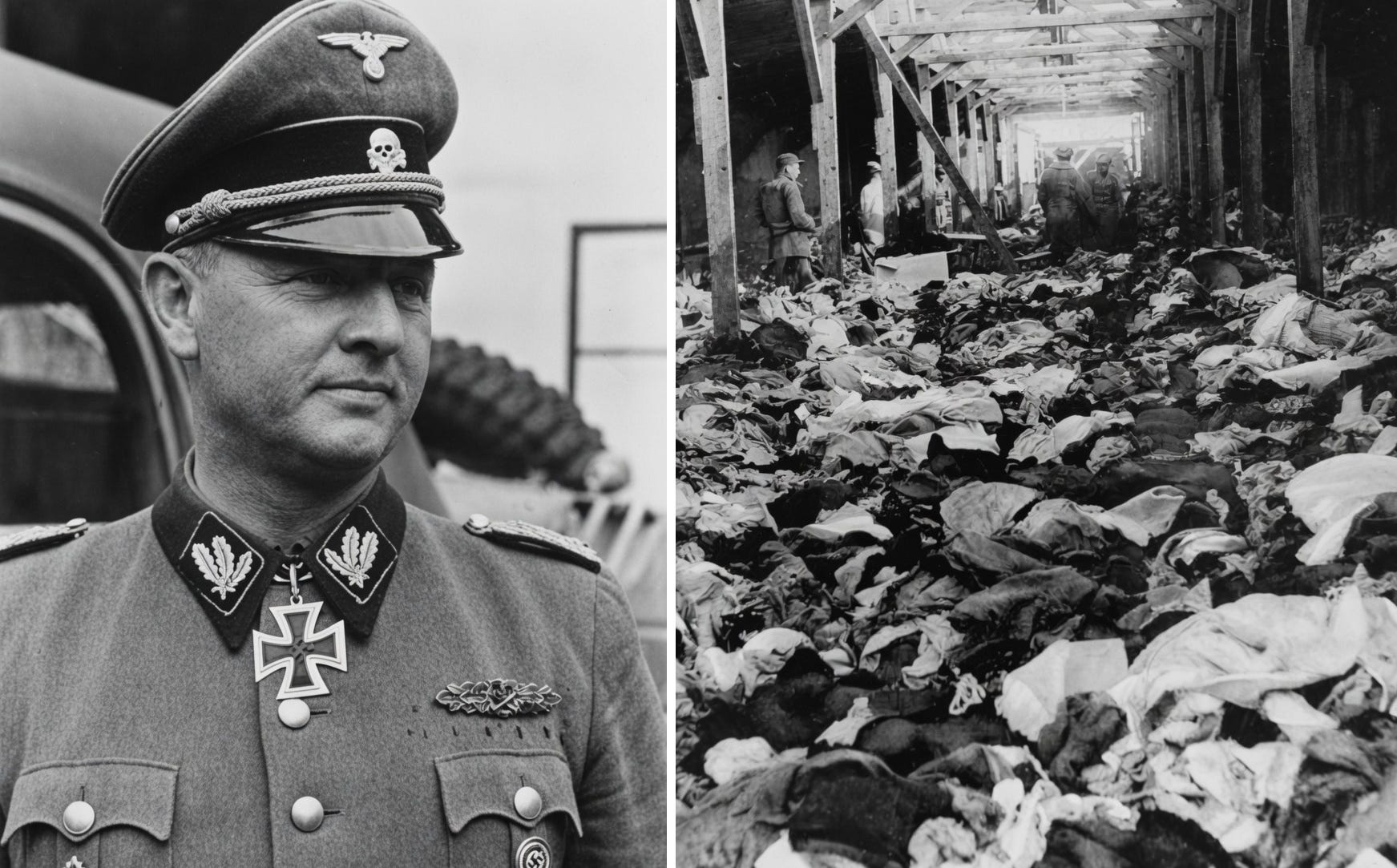
In a recent essay on the nature of the Nazi regime, the key underlying dynamic I examined was the way its “polycratic” structure sustained a cumulative radicalisation in ideology and behaviour. The genocide of six million Jews in Europe was the escalation point reached before the Third Reich was demolished, and I went into some detail about how the Nazi system produced this horror.
HOLOCAUST HISTORIOGRAPHY AND THE FÜHRER ORDER
To summarise briefly: why the Holocaust happened is straightforward—because Adolf Hitler wished it to—but how and when the decision was taken is debated. The debate turns largely on whether there was a Führer Order for the Holocaust. While no such document has ever been found, this is not surprising. There was extensive destruction of Nazi documentation, and Hitler routinely conveyed orders verbally anyway, so, if there was a Führer Order, it was almost certainly never written down in the first place. Accentuating the difficulties, the surviving records are written according to a euphemistic official Nazi discourse that leaves room for interpretation, and Hitler—like Lenin—deliberately cultivated uncertainty within the regime about his role in the worst crimes.1
Historians are broadly divided into two camps, those who argue for a moment between July and December 1941 when a Führer Order was issued, and those who argue there was no “moment”, but rather an iterative process between Hitler at the centre and various lower officials in the occupied territories, where the Führer endorsed, rather than originated, the escalatory steps of the Shoah.
In assessing the evidence historians are working with in coming to these divergent conclusions, one aspect I highlighted was:
SS operatives involved in implementing the Final Solution … have uniformly testified that their orders came directly from Hitler. There is no reason to doubt the SS men were substantially correct, that Hitler stood behind the fundamental decision for the Holocaust and every decision of significance as it escalated. But it does not settle the question of a Führer Order because none of the SS officials heard Hitler’s verbal instruction(s) personally; they all heard of Hitler’s will through [Heinrich] Himmler. And Himmler did not specify to his subordinates whether, during his increasingly frequent face-to-face meetings with Hitler from the summer of 1941 onwards, the Führer had approved or initiated genocidal measures.
This article, taking account of some new evidence, can be regarded as an extended footnote on this point.
MYSTERY SOLVED?
Last year, the London Times reported on the existence of tapes from 1977 recording the deathbed testimony of Bruno Streckenbach, and contended they were of “historical significance” in resolving the Führer Order question.
Who was Bruno Streckenbach?
In the crucial period, Streckenbach was a senior member of Himmler’s SS-police complex, one of the two most radical elements of the power cartel (the other was the Party organisation proper, out of which the SS emerged), and by the summer of 1941 the SS was the most individually powerful regime sector, the one leading in conceiving and implementing the Holocaust.
Streckenbach’s rise owed a lot to his status as an “Old Fighter” (Alter Kämpfer), meaning he had been loyal to Hitler before the Nazis took power 1933, in the “Period of Struggle” (Kampfzeit) when the cause seemed hopeless. Streckenbach became involved with extreme nationalist politics soon after the Great War. He participated in the Kapp Putsch in March 1920, the only Rightist coup attempt against the Weimar Republic other than Hitler’s 1923 “Beer Hall Putsch”. Streckenbach joined the Nazi Party and the Stormtroopers (Sturmabteilung or SA) in late 1930. In late 1931, Streckenbach signed up with the Schutzstaffel (SS), a rather marginal element of the Nazi Movement at that time.
In 1933, the 31-year-old Streckenbach was made chief of the State political police (what became the Gestapo) in Hamburg, his hometown, and moved to conquered Poland in October 1939 to serve as head of the Security Police (the combined State criminal and political police) and Sicherheitsdienst or SD (the SS’s Party intelligence agency). While the incomplete integration of Party and State was a fundamental driver of Nazi regime fragmentation in general, Himmler ameliorated this factor in the security realm by personally taking over both elements in 1936 and institutionalising the merger of police and SD within the Reich Security Main Office (RSHA) in September 1939.
The operational chief of the RSHA was Reinhard Heydrich, a Himmler protégé and the man most directly responsible for organising the Holocaust. After a power struggle of the kind that was so common in the Nazi regime, Heydrich removed the leader of one of the RSHA’s seven principal Departments (Amt) in January 1941, and Streckenbach was called to Berlin to fill the role.
It was in this position, as head of RSHA Amt I (Administration and Personnel), that Streckenbach played his part in the Final Solution. Streckenbach left the post in February 1943. Declining the request to take a police role in Austria, Streckenbach transferred to the front as part of the Waffen-SS.
At the time of the Nuremberg Trials, Streckenbach was believed dead, but in fact he had been captured by the Red Army on 10 May 1945 at the conclusion of the Soviet reconquest of Latvia. The Germans in the besieged “Courland Pocket” did not hear of Berlin’s capitulation until that point, making them some of the last troops fighting. Streckenbach was taken to the Soviet Union and held in a prisoner-of-war (POW) camp until 1955, when he was returned to West Germany.2 There were some desultory efforts by Bonn to bring legal charges against Streckenbach, but by the time there was any seriousness to the project, in the early 1970s, he was too ill to stand trial. Streckenbach died in Hamburg on 28 October 1977, aged 75.
The New Evidence
A caveat here is that I am relying on the Times report of Streckenbach’s testimony. The tapes were discovered by Thomas Weber, a professor of history at the University of Aberdeen, and the testimony was given, over four hours, to Gerd Heidemann, who was, like so many self-described “investigative journalists”, a political oddball and lurid character in his own right.3
Streckenbach claimed he first heard about the extermination of Jews in the summer of 1941 from “an old friend called Erwin Schulz, a volunteer officer in an Einsatzgruppe”, the Times explains.
The Einsatzgruppen were mobile SS units that followed the Wehrmacht into the Soviet Union when Operation BARBAROSSA began on 22 June 1941, ostensibly as security-intelligence forces to lock down occupied territory by working with collaborators to comb out resistant (or potentially resistant) anti-Nazi elements, including race enemies, Communists, and NKVD spies. In practice, the four Einsatzgruppen immediately acted as death squads focused on murdering Jews. The Einsatzgruppen’s anti-Jewish massacres were initially relatively small-scale and targeted mostly men, before escalating into wholesale extermination of Jewish villages and towns. By mid-August 1941, genocide was definitively underway. The atrocities were sometimes carried out by inciting local pogroms and more usually in organised mass-shootings. The most infamous single atrocity in this phase—known as the Holocaust by Bullets—was the slaughter of 34,000 Jews over two days at Babi Yar, then-a ravine on the northern outskirts of Kiev.
From Streckenbach’s reported comments in the Times on his meeting with Schulz, where Schulz said he “had by that point overseen the executions of up to a hundred people in western Ukraine”,4 it can be assumed that this was early on, i.e., not later than July 1941. Schulz “was purportedly uncomfortable with the mass killings of Jews that he had witnessed”, the Times goes on:
Streckenbach said: “[Schulz] was trembling, trembling like I am now, and he says: ‘What do we do?’ And I say: ‘We can’t do anything at all. I can’t leave. You know—it was an order’.”
Streckenbach said he had then gone straight to his immediate superior: Reinhard Heydrich …
“Heydrich was very quiet, very matter-of-fact,” Streckenbach said. “He sat on this large conference table that he had, he sat on the edge, and said: ‘Be quiet now, Streckenbach. Now you listen to me very carefully. Keep your mouth shut. Don’t get involved. We can’t do anything about it. It’s the order from the Führer, for us of all people. He’s chosen the SS to carry out this order. Neither the Reichsführer [Himmler] nor I could do anything about it’.”
There are fairly glaring problems with this. Streckenbach was the spokesman for Himmler and Heydrich to lower officials from the spring of 1941, and in that role conveyed the Commissar Order to the Einsatzgruppen at Pretzsch before the German invasion of the Soviet Union, explaining that it meant they should liquidate “Jews and Soviet political commissars” on sight.5 In other words, the idea Streckenbach learned of the Einsatzgruppen atrocities through a chance encounter is ridiculous, as is the notion that Himmler and Heydrich were reluctantly obeying a Führer Order to exterminate Jews. The same view must be taken of Streckenbach’s claim “that he had only heard about the full preparations for the Holocaust at the end of the war”, given that, as the Times notes, “Streckenbach effectively [became] Himmler’s No 2 in the RHSA from [June] 1942”, after Heydrich’s assassination.
It is fair to point out that assessing the exact ranking of Nazi officials is treacherous because there was no systematic relationship between the institutional titles people held and the actual power they had conferred upon them by Hitler personally or one of the barons at Hitler’s Court—like Himmler. But the Times summary is a reasonable one for the situation at RSHA for the six months after Heydrich’s demise, when Himmler ran the RSHA directly with Streckenbach as his principal subordinate. Streckenbach himself said in 1977 he was the day-to-day administrator of the RSHA in this period, and the evidence suggests that if he exaggerates, it is not by much.6 There is simply no way someone in this position at RSHA when the mass-murder of Jews in gas chambers was at its height was unaware of what the SS was doing.7
At one point in his testimony, Streckenbach essentially concedes this point, recalling an instance where he lambasted his SS colleagues for their supposed ineptitude and half-heartedness in annihilating Jews: “You either have to do it systematically—all 15 or 16 million Jews [in the world]—or not at all, but you can’t [just] do a few hundred thousand. That was how we figured at the time. That was the order of magnitude.”
Streckenbach as a narrator of details is self-evidently to be treated with scepticism, but this does not discredit the core of his story: being told by Heydrich that the order for the Holocaust came from Hitler directly. Weber remarks to the Times that “[w]hile Streckenbach had clearly sought to portray himself in a good light, … there had been no incentive for him to lie about the issue [of a Führer Order] at the end of his life, when there was no prospect of him being prosecuted”, and this seems correct.
With that in mind, here is what Streckenbach said when asked directly about Hitler’s involvement: “This is something that interests every one of us: was Hitler the initiator, did he know, did he give the order? Personally, I have to tell you: I simply can’t imagine that any man apart from or below Hitler would have started these things on his own initiative” [emphasis added].
How it Fits With the Prior Evidence
Adolf Eichmann, the primary logistical coordinator of the Holocaust, and one of his deputies, Dieter Wisliceny, as well as Rudolf Höss, the Commandant of Auschwitz, “all asserted after the war that the orders passed on to them to implement the ‘Final Solution’ derived from Hitler himself.” Of note, too, all of them, like Streckenbach, gave “testimony [that] is inaccurate in a number of ways and cannot be trusted with regard to detail”. Similarly, “Second- and third-tier SS leaders directly implicated in the ‘Final Solution’ were in no doubt … they were fulfilling ‘the wish of the Führer’.”8 The Einsatzgruppen officers said the same thing.
Otto Ohlendorf, commander of Einsatzgruppe D, assigned to the German 11th Army under Army Group South—which advanced through Bessarabia, southern Ukraine, and the Crimea—said under cross-examination at Nuremberg: “The order for the liquidation [of Jews] came from the Führer of the Reich, and it was to be carried out by the Reichsführer-SS Himmler.” Ohlendorf said Streckenbach “transmitted” this order at the training camps in Pretzsch in May 1941, and many others at the Einsatzgruppen Trial confirmed this. Walter Blume of Einsatzgruppe B—attached to Army Group Centre, moving through what had been eastern Poland, Belarus, and western Russia, heading for Moscow—was emphatic that at a 17 June 1941 meeting, at the Prince Albrecht Palace in Berlin, Heydrich had openly discussed a “Führer Order” to murder “all Jews”. Numerous Einsatzgruppen officers present testified that Heydrich had said: “Eastern Jewry was the intellectual reservoir of Bolshevism” and in the “Führer’s opinion” must be “exterminated”.9
Dr. Walther Stahlecker, commander of Einsatzgruppe A, responsible for the worst crimes in the early phase of the Eastern Blitzkrieg as it went through the Baltics towards Saint Petersburg behind Army Group North, noted in a report to the RSHA in October 1941 that his troops had operated “from the beginning” under “basic, general orders for cleansing operations aimed at a maximum elimination of the Jews”. This was a written report about the Holocaust, so the language is inflected with official Nazi euphemisms and explicit mentions of the Führer are scrupulously avoided, but it makes clear that the Einsatzgruppen officers at Nuremberg were not retrospectively inventing a “just following orders” defence: their real-time understanding had been that mass-murder was an order right from the top.
The Times headline said Streckenbach “reveals” that “Hitler gave [the] first order for Holocaust”. The headline of a derivative report said Streckenbach “confirms” that “Hitler ordered [the] Holocaust”. But, as can be seen, the truth is Streckenbach simply joins the list of SS officials involved in the Final Solution to testify that they were told by Himmler and/or Heydrich—and, therefore, believed—the initiating Holocaust Order came from Hitler. Which leaves us where we began: the SS officials are unquestionably correct that “Hitler’s authority … stood behind every decision of magnitude and significance” as the Holocaust escalated, but whether there was an originating Führer Order guiding this or it was a more ad hoc process where Hitler gave “verbal consent to propositions usually put to him by Himmler” remains debateable.10
FOOTNOTES
Christopher R. Browning (1991), Fateful Months: Essays on the Emergence of the Final Solution: Revised Edition, p. 37.
In this, Streckenbach is the direct opposite of Martin Bormann, Hitler’s private secretary and arguably by the end the most powerful man in the Reich other than the Führer. Bormann went missing as Berlin fell, but was so widely believed to be alive that he was tried in absentia—and sentenced to death—at the main Nuremberg session for the twenty-two most senior Nazis. A common rumour was that the Soviets had snatched Bormann as they conquered Germany and were holding him for their own purposes. It took three decades to confirm that Bormann went down with the regime.
The Streckenbach recordings have been given to the Hoover Institution Library and Archives, along with Heidemann’s other papers, and are publicly available in full there.
It is to be hoped that the word “execution”, which refers to a legal outcome for criminals, is being used here to paraphrase what was said by someone operating in a Nazi framework. It would be very dispiriting if linguistic precision has slipped so far that Britain’s newspaper of record is misusing the word to refer to murder.
Frank McDonough (2008), The Holocaust, p. 49.
Streckenbach’s standing was such that he was in the running to officially succeed Heydrich as RSHA chief, and it is not entirely clear why he was passed over in favour of Ernst Kaltenbrunner in January 1943.
A smaller issue is Streckenbach “describ[ing] Himmler as a chaotic and frequently distracted boss”. This does not ring true at all. Himmler combined his ruthless skill in the Nazi political game, outplaying rivals to annex to himself ever-expanding powers, with a diabolical genius for administration, organising his bureaucratic empire into a coherent machine by keeping on top of the details.
Ian Kershaw (2008), Hitler, the Germans, and the Final Solution, p. 109.
McDonough, The Holocaust, pp. 49-50.
Kershaw, Hitler, the Germans, and the Final Solution, p. 109.