

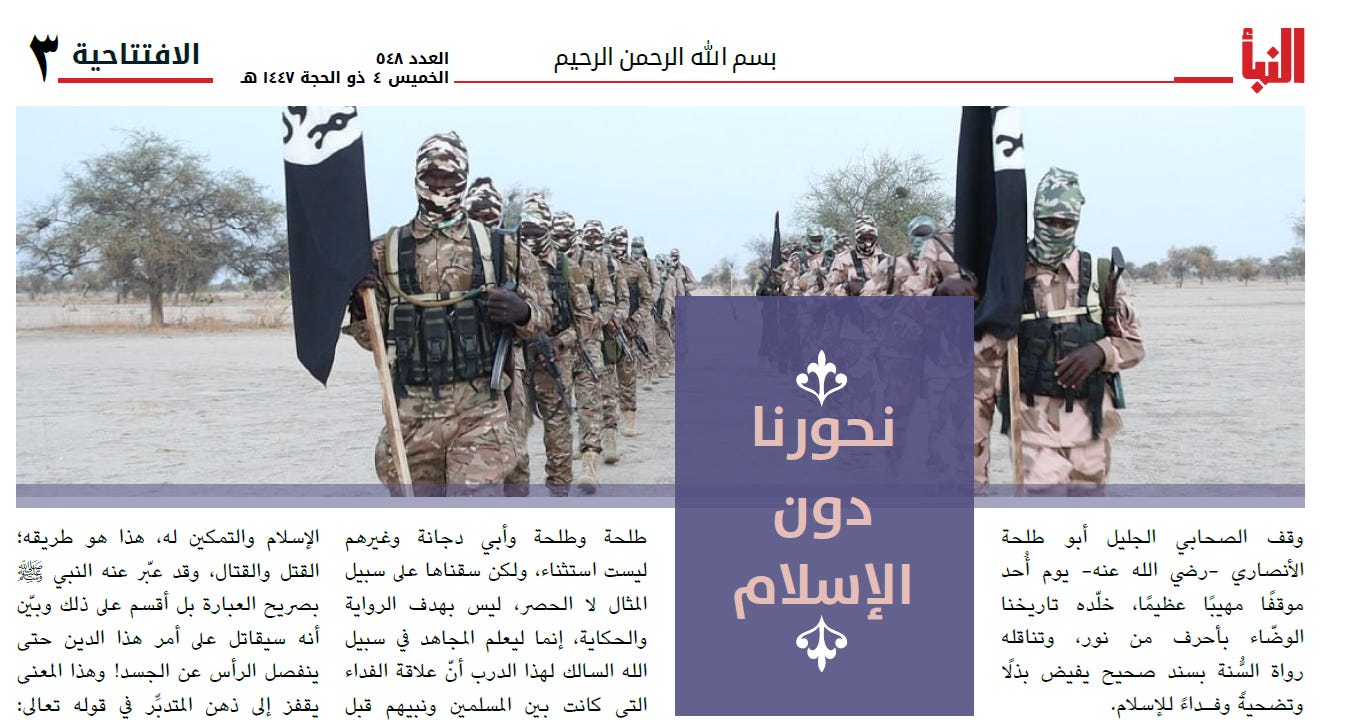
A translation is given below of the main editorial in the 548th edition of Islamic State’s Al-Naba newsletter, published on 21 May 2026. The article, entitled, “Our Throats Before Islam”,1 i.e., that the jihadists will sacrifice their lives to defend the faith, is an interesting example of a recurring motif in IS propaganda, namely using Islamic history to justify atrocities and incite Muslims to violence against non-jihadist Muslims and non-Muslims.
The Naba article draws on the Islamic Tradition—the early biographies of the Prophet Muhammad, the hadith that record the sayings and actions of the Prophet and the lives of the Companions (Sahaba), select legal rulings—and a smattering of Qur’an verses to build an argument that presents IS’s ideology as the only legitimate interpretation of Islam, one which places jihad and the killing of Jews, Christians, and hypocritical Muslims above all other obligations.
This has always been IS’s method, to arrange the sacred history accepted by the mainstream of Islam to buttress radical conclusions. IS are not alone among Islamists in doing this. There is much less discussion of ideological warfare in the West these days when it comes to countering jihadism, and this is perhaps for the best given how badly those efforts have gone. But should interest revive, challenging the certainty about history that underlies the jihadist project would be an area to focus on.
In the case of this Al-Naba article, the immediate problem is that the Tradition, which largely interprets the Qur’an, since the text of the Qur’an is far from self-evident in its meaning (as the Qur’an itself acknowledges2), dates from about two-hundred years after Muhammad’s death (albeit we do not know exactly when Muhammad died) and was generated in the context of consolidating an Imperial creed to explain a world transformed by the Arab conquests. In Christian terms, this would be like constructing the life of Jesus by relying on the Gnostic Gospels that were written to make theological arguments around two centuries after Christ’s death, thus have little historical grounding in the realities of first-century Judea. Making it better known simply that there is a question mark over this history, even without the detail, might introduce just enough doubt to halt a potential jihadist recruit.
