

The Origins of the Karabakh Conflict
Imperial Russia, under its policy of “defensive expansionism”, conquered a series of Muslim-ruled khanates in the Caucasus from the Qajar Persians in the 1810s and 1820s. The mixed population of Armenian Christians and Turkic-speaking Muslims in the area would be afflicted by nationalism through the nineteenth century, and the First World War created opportunities for the nationalist elites to put their theories into practice.
The hopes of Tsarist Russia to use Armenian revolutionary nationalism to defeat and dismember the Ottoman Empire led the Armenians into the great catastrophe of 1915 when “Western Armenia” was lost forever amid the deportations. But the collapse of Russia itself into the civil war engendered by the Bolshevik coup gave the Armenians a second chance and they seized it, as did the Caucasian Muslim leaders who identified as Azerbaijanis or Azeris. Apart from the opportune circumstances as their former master disintegrated, the States of Azerbaijan and Armenia proclaimed in mid-1918 had reason to think history was on their side, given U.S. President Woodrow Wilson’s rhetoric, particularly focused on Russia, about self-determination for nations heretofore supposedly oppressed by the multiethnic Empires.
The experience of trying to translate the concepts of Armenia and Azerbaijan as nation-states from the minds of intellectuals into actually existing entities, however, was a war of all against all. There being no agreed boundaries in the wreckage of the Russian Empire, the Armenians and Azeris used their freedom to try to create some, resulting in an internecine ethno-irredentist on-off war against one another, wherein they variously manipulated and were manipulated by the Bolsheviks, the Ottomans, and the British. The conventional invasions and stirring up of compatriot minorities behind the lines resulted in a bitter conflict marked by omni-directional massacres and expulsions, though both sides would enshrine memories where they were “suffering and innocent, eternally the massacree and never the massacrer”.1
Wilson’s debilitating stroke in October 1919 and the shattering of the anti-Bolshevik forces around the same time weakened the moral and practical climate for self-determination,2 and a year later it was all over in the Caucasus. The moment the Bolshevik regime had any sense of security, it set about expanding the Revolution, starting by restoring the old Imperial frontiers. The Miracle on the Vistula spared Poland and the Baltics, and shored-up Finland’s freedom, but that was the exception. From Ukraine to Mongolia, Lenin’s Revolution crushed those who had been so foolish as to believe his promises on the “Nationalities Question”. The Azeris and Armenians, having exhausted each other, folded quickly when the Red Army came for them.
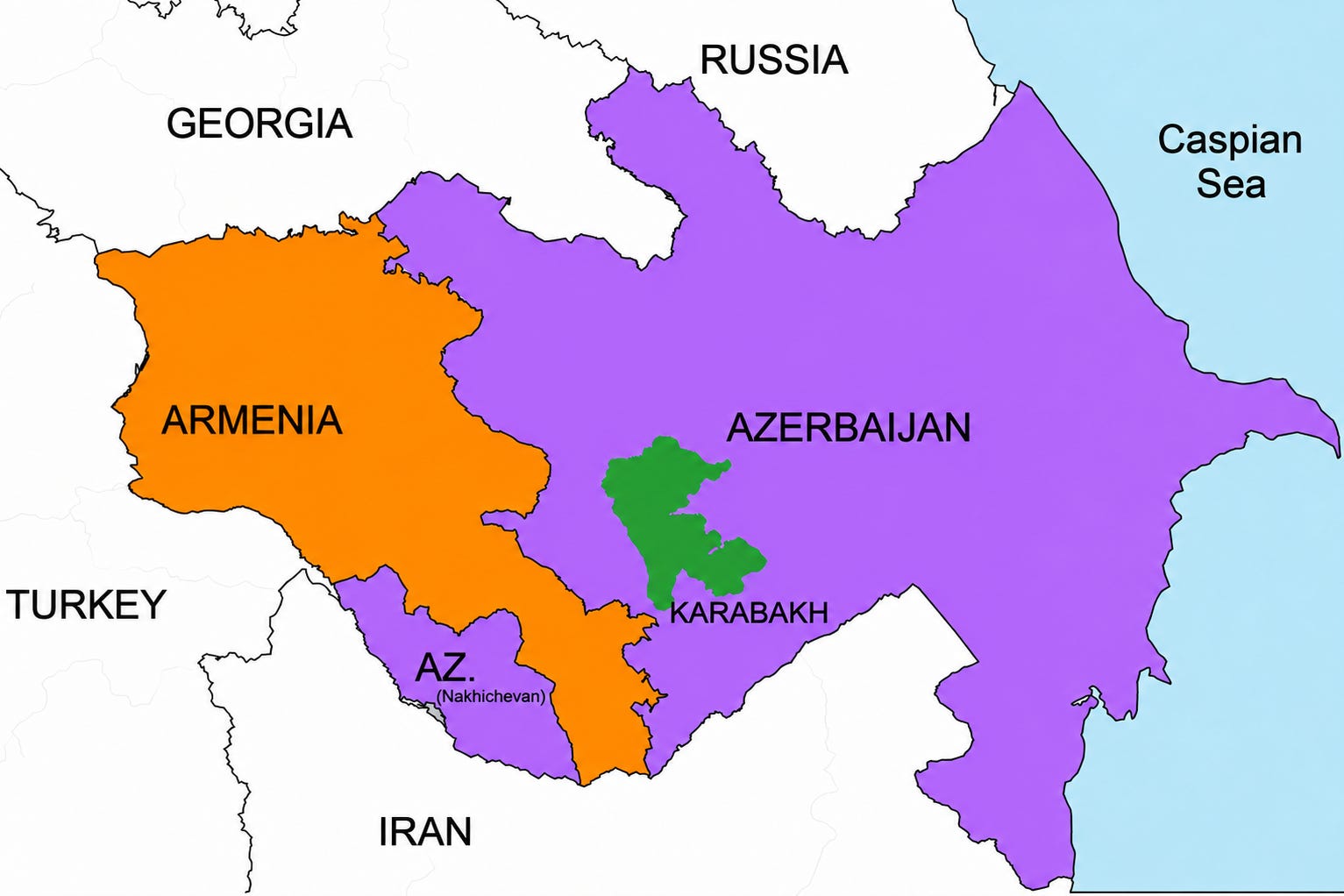
It was the Soviets who first created Armenia and Azerbaijan as polities with defined frontiers in 1920, essentially on the basis of control on the ground. Both sides requested boundary adjustments and the Soviets, as Imperial overlord, had to decide. A particular area of dispute was the Nagorno-Karabakh region, an Armenian-majority enclave that had seen intense Armenian-Azeri fighting and was mostly occupied by the Azeris when the Red Army arrived. The Armenian argument for the Karabakh as part of their natural territory was heard and the Soviets—inevitably after much discussion in a committee—decided on 4 July 1921 to redraw the internal borders so the Karabakh was in the Armenian Soviet Socialist Republic. For reasons still unclear, the Kavbiuro reversed itself the next day, deciding to leave the Karabakh in the Azerbaijani SSR, and made it an autonomous oblast in 1923.3 Such was the Karabakh’s status for more than half-a-century.
The Resumption of the Karabakh Conflict
Under the “New Thinking” of Mikhail Gorbachev after he became General-Secretary in 1985, the Terror that held the Soviet Empire together was scaled back, opening the space for the Karabakh conflict to be resumed.
Gorbachev’s key aim was to rein-in the KGB and erode its anti-reformist allies in the bureaucracy. It was within this framework Gorbachev purged Heydar Aliyev, an old Chekist, from the Politburo in October 1987. Aliyev had been ruler of Soviet Azerbaijan (1969-82) and he retained influence there after being elevated to the capital. Aliyev was inter alia patron of the Karabakh soviet, ensuring it was dominated by Baku-loyal Armenians. Aliyev’s fall furnished Armenians in the nomenklatura, in the Karabakh and in the Armenian SSR, with a chance for “bureaucratic insurgency”. The insurgents’ hope was to acquire Gorbachev’s patronage so they could displace Aliyev’s people, and have the Karabakh handed to the Armenian SSR by staging demonstrations to convince Gorbachev this was the popular will of the oblast.4 Which it probably was: over-75% of the Karabakh population was Armenian,5 and every time there had been a political thaw letters and petitions from Armenians asking for the Karabakh to be made part of the Armenian SSR had flooded into Moscow.6
Armenian insurgent bureaucrats diverted “administrative resources to sponsoring popular rallies” in the Karabakh and Yerevan calling for “reunifying” the Karabakh and Armenia, which began in February 1988. Even at this early stage, however, it was apparent that the bureaucratic insurgents’ “carefully planned” campaign was “provincially naïve”: they were unleashing forces they could not control.7 The bureaucrats believed the crowds were a means to an administrative end—having the Karabakh transferred to Soviet Armenian jurisdiction—but the crowds had ideas of their own, which for some included expelling the Karabakh Azeris.8 This miscalculation was compounded by the Armenian nomenklatura being divided among themselves. Some believed the system was eternal and they had to achieve their goals through Moscow Centre. Others were envisioning a radically different future, and they had more than imagination to work with.9
Over the previous two decades, an Armenian “internal diaspora” had been created in the Soviet Union, with many Karabakhi members, which would emerge in 1988-89 as the Pan-Armenian National Movement (HHSh). The HHSh network stretched from Yerevan to Tashkent, and was able to reach into the Karabakh. HHSh tested its capacity with the Karabakh Armenian protests. When the KGB did not crush them immediately, the HHSh was emboldened.10 HHSh, with the advantage of its strategic depth outside the Karabakh, was swiftly able to compete for popularity and power with the remnants of Aliyev’s Armenians and those looking to the Centre, and to coordinate and sustain activities in the Karabakh on an unprecedented scale.11
The speed and organisational skill with which the Armenian nationalists acted convinced many Azeris that the Armenians had Moscow’s sanction.12 In truth, the Soviet leadership, which looked on Armenian nationalism with as much distaste as it had for any other, however willing Moscow had been to instrumentalise it, was taken off-guard, hence its improvised responses—intended to restore calm—often backfired.13
After about a week of protests by Armenians, in the Armenian SSR and in the Karabakh—in the enclave’s capital, Stepanakert or Khankendi,14 and in Askeran in the Khojaly District—the Karabakh Regional Soviet voted for the oblast to be administered by the Armenian SSR on 20 February 1988.15 Moscow rejected the resolution out of hand, but news was already spreading of two Azeri women raped in Stepanakert/Khankendi, and two days later the atmosphere was inflamed further when an Azeri protest march was attacked in Askeran. Two Azeris were killed, one by a policeman in murky circumstances, and the other by an Armenian villager with a hunting rifle—“the first victim of intercommunal violence”, as Thomas de Waal puts it in Black Garden, his classic study of the Armenian-Azerbaijani conflict.16
Less than a week later, on 28 February, another milestone in the Soviet Union’s demise took place with the first explosion of peacetime ethnic violence in Sumgait/Sumqayit, a grim Communist-built town twenty miles north of Baku. Two days of incitement at rallies boiled over into a horrifying Azeri pogrom against Armenians in Sumgait that lasted until 29 February. The official tally about thirty Armenians murdered, but the mutilation and burning alive of victims made counting the dead difficult, and nobody ever comprehensively documented the rapes.17
The Armenians continued lobbying Moscow to transfer the Karabakh to them until July 1988 when the Supreme Soviet definitively ruled the Karabakh was staying in the Azerbaijani SSR. Switching tactics, a campaign of popular terror with official backing unfolded against the Azeri minority in the Armenian SSR. By the late summer, this evolved into the wholesale deportation of the Azeris to the Azerbaijani SSR, though it did not stop the terror.
In November 1988, for instance, twelve Azeris in Vartan, a village in north-east Armenia, were burned alive.18 Around the same time, Armenians in the Azerbaijani SSR were massacred at Kirovabad/Ganja: nobody knows from that day to this how many were killed, but the Armenians claimed 130 fatalities and it was enough for the “human rights” groups to start raising the spectre of “genocide”, a word central to the political warfare and identity of both sides. The Karabakh was already following in microcosm the broader dynamics, with the Armenians expelled from the main Azeri town of Shusha and the Azeris expelled from the main Armenian town of Stepanakert/Khankendi.19 The tit-for-tat massacres and expulsions lasted another half-decade, each side convinced from beginning to end—and long afterwards—that they were the real and sole victim.
The Soviet “special regime” for the Karabakh—effectively direct rule from Moscow—put in place in late 1988 became official in January 1989 and brought down levels of overt violence. But political fragmentation and the proliferation of (relatively) organised armed units was overtaking the Karabakh. In late November 1989, amid the shock to the Soviet system of Gorbachev failing to send the Red Army to thwart the Captive Nations’ bids for freedom, a calamitous decision was taken to transfer the new Karabakh “Organisational Committee” to the Azerbaijani SSR, i.e., to put the Karabakh under direct rule from Baku. In retaliation, the Armenian SSR declared full “reunification” with the Karabakh on 1 December 1989.20
Armenians were euphoric; Azeris were enraged. Intercommunal village clashes in the Karabakh escalated. As a by-product, the Azeri nationalist opposition, the Popular Front, was empowered—and Moscow’s alarm turned to panic as the nationalists usurped power on the streets from the Communist authorities in Azerbaijan. These two trends met fatefully in Baku in January 1990.
The Armenians in Baku—a terrified remnant of what had once been a community of 200,000 (10% of the city’s population)—were set upon in a ferocious pogrom on 12 January 1990. Violence raged in various ways for a week and at the conclusion of it perhaps ninety Armenians were dead. The survivors were packed onto boats across the Caspian to Turkmenistan, and from there flown to Yerevan. “With this terrible flourish”, writes De Waal, “Armenia and Azerbaijan completed their ethnic cleansing of each other’s populations.”21
Barely had the pogromshchiki gone home when there was another massacre in Baku on 20 January 1990, this time of Azeris—perhaps 130 of them—by the Soviet army as it repressed the nationalists and installed a “healthy” Communist regime led by Ayaz Mutalibov.22 It was within the formal boundaries of the Soviet Union what had happened multiple times in the contiguous Soviet Empire—in East Germany in 1953, in Hungary in 1956, in Czechoslovakia in 1968, in Afghanistan in 1979—and for a time it seemed similarly successful. But time was running out.
Militarising the Karabakh Conflict in the Soviet Context
As Gorbachev plotted a new Union Treaty to save the U.S.S.R., he now had a reliable ally in Azerbaijan—if he met the quid pro quo of Moscow taking a hard line on the Karabakh and the Armenians in general. This was not a difficult sell. The Karabakh situation had nearly spiralled out of control after the “Black January”, and the façade of order brought by the deployment of Soviet state of emergency forces and the new Azeri “special police” or OMON was breaking down. The Armenian Nationalist Movement led by Levon Ter-Petrosyan (LTP) completed its capture of Yerevan in the summer of 1990, one of the first non-Communist governments to take power in a Soviet republic, and began infiltrating fedayi into the Karabakh, reviving the name used by the Armenian guerrillas or terrorists (as you prefer) in the early part of the twentieth century. The Armenian fedayi blew up bridges, invaded Azeri villages, took hostages, assassinated local officials, and caused general mayhem.23
The mingling of Moscow and Azeri politics in approaching the Karabakh in 1990-91, and the fact those two elements were mingled, while the Armenians were on a different trajectory, laying the foundations for independence by constructing their own domestic military-security capability—and a paramilitary apparatus in the Karabakh—was to crucially determine the course of the First Karabakh War.24
After Baku delivered its vote in mid-March 1991 for Gorbachev’s referendum on a reformed Soviet federation—and the Armenians (with five other SSRs25) boycotted it entirely—Moscow delivered Operation RING at the end of April, sending Soviet troops to support the Azerbaijani SSR in securing the Karabakh. “Operation RING marked the beginning of the open, armed phase of the Karabakh conflict”, writes De Waal. Its public objective was eliminating the Armenian paramilitaries. Its undeclared objective was altering the demographics to clear the Armenian populations surrounding the Karabakh and replace them with a “ring” of loyal Azeris. Militarily, the RING operation proceeded smoothly if brutally, and by mid-June 1991 the Armenians, in Yerevan and the Karabakh, were putting out feelers asking for a compromise.26
However, there was a problem inherent to Operation RING: it was, as De Waal argues, “the first and last ‘Soviet civil war’,” with uniformed elements of the Soviet State fighting each other, which did not augur well for the Soviet Union’s durability.27 And in terms of the dynamics of revolutionary warfare—where military victories come and go but political victories endure—RING heavily redounded to the Armenians’ advantage.
The entanglement of Operation RING with Moscow politics made it an issue for the Russian SSR, led by Boris Yeltsin, which wanted to rein-in the Soviet security establishment even further—a common objective with the Armenian SSR. Yeltsin sent representatives down to the Caucasus and they returned declaring themselves appalled by the killings and deportations of Armenians. While the Soviet Union lasted, it was effective political warfare to destabilise the KGB faction and Azerbaijan. Beyond that, the campaign revived the Russian-Armenian political relationship that had been such an important factor in the previous Armenian independence struggle and would influence the next one, to Baku’s detriment. In parallel, the Armenians had been radicalised and unified. The ranks of the fedayeen swelled, and Armenian moderates were sidelined. These dynamics came into sharp focus soon after Valery Grigorian—the Karabakhi Armenian leader who tried for a compromise of restoring the enclave’s autonomy within Azerbaijan—was branded a “collaborator” by his own and shot down in the street in Stepanakert/Khankendi on 10 August 1991.28
Soviet citizens awoke on 19 August 1991 to find Tchaikovsky’s Swan Lake playing on a loop on State television, the first they knew of the coup d’état led by KGB chairman Vladimir Kryuchkov. The KGB, having triumphed over the Dissidents in the late 1970s, was out of patience with Gorbachev, who had constrained the Chekists’ war against “ideological subversion”, and refused to change course even as deviationism of all kinds tore the U.S.S.R. apart.29 So far as the gekachepisty were concerned,30 the coup was a rescue operation “to prevent society from sliding into a nationwide catastrophe”. For Azerbaijan, this was vindication: Mutalibov had bet on the Communist security sector and now Baku’s loyalty would be rewarded with an even harsher crackdown on the Armenians.31
Except, as everybody knows, the putsch was a shambles; it collapsed on 21 August and hastened the fragmentation of the Soviet Union it was designed to forestall. Yeltsin emerged as the undisputed victor, after rallying Moscow for a counter-coup, and, in the disarray as Gorbachev cleaned house at the KGB, a vacuum opened up in the Karabakh, into which the Armenians—understanding that their bet on independence had been vindicated—started re-inserting guerrillas, occupying villages cleared during Operation RING.32
The End of the Soviet Union
Changing lanes rapidly, Azerbaijan declared independence on 30 August 1991. Mutalibov had himself elected president in an absurdly rigged plebiscite nine days later, but the internal trouble that would rack Azerbaijan in the coming war was already visible. Heydar Aliyev, who had gained popularity by publicly opposing the “Black January” events that installed Mutalibov, got himself elected speaker of parliament in Nakhichevan and swiftly built up an independent powerbase in the exclave.33 Still, Mutalibov’s manoeuvre strengthened significantly Baku’s position over the Karabakh. Under the universally recognised, if regularly abused, principle of uti possidetis juris (“as you possess under law”), States emerging from decolonisation inherit their pre-existing administrative boundaries as international frontiers, meaning the Karabakh was—and remains—part of Azerbaijan’s sovereign territory.
When Armenia declared independence on 23 September, it had already orchestrated “a sleight of hand that allowed Armenia to say that it was only an interested observer [in the Karabakh], not a party to the conflict”, as De Waal explains. To avoid the political opprobrium that attaches to expansionist designs on neighbouring countries—this being six months after Saddam Husayn’s annexation of Kuwait had been reversed in a United Nations-blessed, U.S.-led operation—Yerevan had prodded the Karabakh Armenians to declare an independent “Nagorno-Karabakh Republic” on 2 September 1991. The argument was that autonomous oblasts, no less than SSRs, had a legal right to independence. Armenia initially had some internal tension, too, namely between the HHSh in Yerevan and the Dashnak leadership under Artur Mkrtchian in Stepanakert. But Yerevan, unlike Baku, resolved this quickly by eliminating Mkrtchian.34
There was a moment at the last when it seemed the descent into all-out war would be avoided. Yeltsin, using his newfound prestige, mediated the Zheleznovodsk Accords, which both sides signed. Announced the same day as Armenia’s independence, the accords were blown apart with the helicopter shot down by the Karabakh Armenians on 20 November 1991. All twenty-two on board were killed, including thirteen Azeri government officials, and Russian and Kazakh representatives coming to implement the peace deal. There was then a brief “war of laws”. Azerbaijan abolished the Karabakh’s autonomous status on 26 November, making it officially a province like any other with no special rights—a response of sorts to Armenia’s claim autonomous zones were entitled to independence. This was the point where Stepanakert was formally renamed Khankendi. Yerevan retaliated with a referendum on independence in the Karabakh on 10 December: the Armenians voted “yes” nearly unanimously and the Azeris boycotted.35
There would be no de jure declarations of war in the Karabakh, not least because Armenia pretended throughout it was not a party to the conflict. Nor is a de facto beginning of armed conflict easy to detect; the nearest to a candidate is the Soviet-Azeri Operation RING in April 1991, but, of course, that was initiated in response to the Armenian guerrilla warfare. Most historians date the outbreak of the First Karabakh War to February 1988, i.e., the Armenian vote to transfer the Karabakh to Armenia, and, in the sense that the cliché “war is politics by other means” contains an implicit vice versa, one would have to say this is reasonable. The militarisation of the conflict thereafter—amid massacre and counter-massacre, expulsion and counter-expulsion, and Soviet measures aimed at pacification—was incremental and uneven, but nevertheless inexorable. As the flag of the Soviet Union was lowered over the Kremlin for the last time on 25 December 1991, all political avenues to a settlement in the Karabakh were closed and the military struggle was already underway.
The Post-Independence Nagorno-Karabakh War
While neither Armenia nor Azerbaijan had a conventional army as 1992 dawned, Armenia had far more access to resources and instruments that could be used for making war in the near-term.
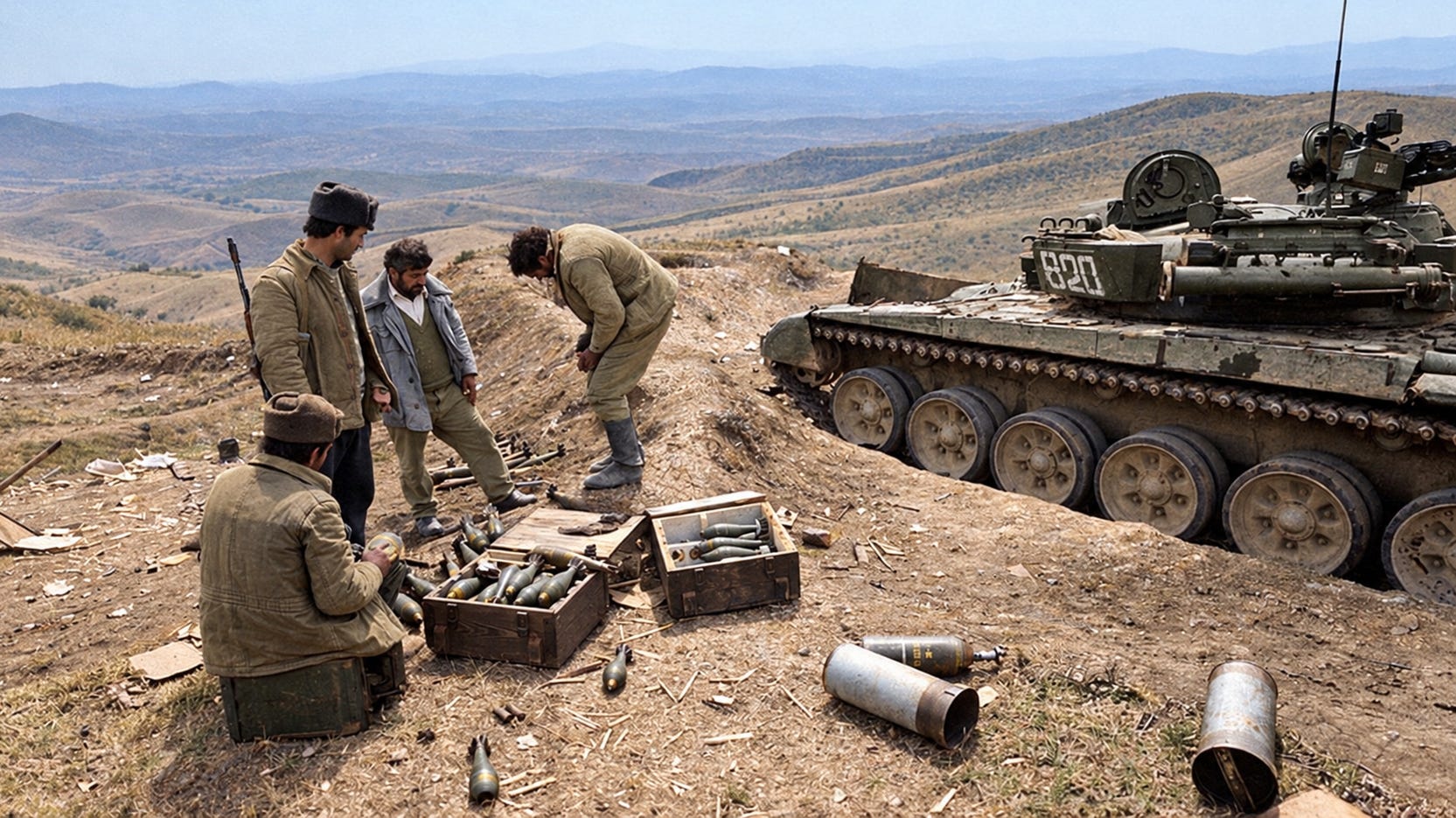
There were thousands of Armenian veterans of the Red Army, many infantry with frontline training and experience, in Afghanistan and elsewhere, plus senior officers with the prestige and administrative skills to organise and lead these men. The new Armenian Chief of the General Staff Norat Ter-Grigoriants, for example, had been the deputy head of the Soviet General Staff. There were also Russians who had been high-ranking Soviet officers that joined the Armenian cause as “advisers”, like retired Lieutenant General Anatoly Zenevich.36 Still, it took time to construct a cohesive Armenian army, and longer still for Yerevan to all-but openly deploy the army to the Karabakh, tacitly dropping the pretence it was not a combatant.
Until then, the Armenians in the Karabakh had the great advantage of the 366th Motorized Regiment. Based in Stepanakert/Khankendi since August 1988, about fifty of the 350 men in the 366th were Armenians, including one battalion commander. The 366th had been selling weapons to the Armenian guerrillas and using their own weapons against the Azeris for a price—usually vodka—even before the August 1991 putsch. By January 1992, the Armenians in the 366th had functionally defected and the Regiment “borrowed” its ten tanks—the only such heavy armour in the Karabakh—to the Armenians many times.37
For all that, until early 1993, the most important Armenian armed force was the fedayeen: the battle-hardened guerrillas already in the Karabakh hills were joined by “a new flood of … volunteers” from Armenia proper in late 1991 and early 1992, writes De Waal. “The situation was chaotic. Weapons were being handed out to men who had displayed nothing more than a willingness to go and kill.”38
“Azerbaijan was in a much weaker position”, as De Waal explains, in two interlinked ways. First, militarily. The militant godless distrusted Muslims, so Azeris in the Red Army had more often been cooks or builders than professional soldiers. The main basis for an Azeri army was OMON, which on its best day was, by structure and culture, more a police force than a military unit. OMON had played only a supporting role to the Soviets in the Karabakh,39 and was mostly known for its abusive behaviour at the Khojaly Airport it took over, shaking down passengers and sexually abusing women.40
Second, politically. Mutalibov had created a Defence Ministry in October 1991, but for the aforementioned reasons there were few officers to staff it. Worse, when Azeri armed factions began to appear, they were spawned by the Popular Front and other opposition elements. Mutalibov inclined to annex these forces by having them brought under the Defence Ministry,41 then realised this was unworkable and tried to impede their creation altogether, fearing, correctly, that these militias would be used inside Azerbaijan against him. “For many [Azeri] politicians, the war effort was less important than the domestic power struggle”, as De Waal bluntly puts it.42
The upshot was that the Azeri cause in the Karabakh in the opening phase was outsourced to criminals over whom Baku had varying levels of control, and these Azeri gangsters fought each other nearly as much as the Armenians.43
The mosaic of Armenian and Azeri villages in the Karabakh at the end of 1991 was regarded by both sides as a problem. “The less numerous Karabakh Azerbaijani villages found themselves in dozens of small traps, at the mercy of Armenian fedayin”, writes De Waal, while “the Armenians found themselves in one large trap”, namely Stepanakert/Khankendi, which was “surrounded by Azerbaijani settlements”: “Aghdam and the plain of Azerbaijan” to the east; Khojaly to the north with the Karabakh’s only airport; and to the south, on higher ground, was Shusha. “Stepanakert’s only link to the outside world was by helicopter across the mountains to Armenia.”44
The Armenians made the first organised move to “reduce the line of the front”, as one fedayi euphemistically put it, intimidating the Karabakh Azeris to flee their villages. The Azeris soon responded in kind, trying to redraw the demographic map to their advantage.45 The term “ethnic cleansing” was coming into common use at this time in association with Bosnia’s nasty civil war. It described the intentions and conduct of the Karabakh’s warring parties, too, but the Caucasus never received anything like the media coverage devoted to the Balkans.
“Most of the [Karabakh] conflict was irregular, improvised, even intimate”, De Waal concludes. “The lack of any rules of engagement made it more brutal. Both sides revived the practice of the early 1900s employed by the Armenian guerrilla commander Andranik: chopping off the ears of enemy dead as war trophies. … [O]ften this was, literally, a neighbors’ war.”46
Aftermath
The Armenian move to break the siege of Stepanakert/Khankendi took them first to Khojaly, which was captured, with assistance from the Soviet 366th Regiment, in late February 1992 in circumstances the Azeris call “genocide”, a claim that will be examined in the next post. Though the fallout destabilised Azerbaijan’s politics, toppling the ruler, Ayaz Mutalibov, and Shusha fell to the Armenians in May 1992, events seemed to break Baku’s way. Russia withdrew the 366th and over the summer of 1992 a major Azeri offensive captured most of the northern Karabakh. But the 366th had left their equipment and the Armenians staunched the Azeri tide by September 1992. In February 1993, the Armenians launched a counter-offensive spearheaded by Yerevan’s army.
The fact of an inter-State war now barely concealed, the Armenians took Kelbacar in April 1993 and soon recaptured the northern Karabakh. Azerbaijan’s stressed politics snapped this time: a military rebellion in June 1993 created months of turmoil that ended with Heydar Aliyev in power. Armenia took full advantage of Azerbaijan’s internal chaos, rolling through the Azeris’ Karabakh headquarters at Agdam, and on to Fuzuli and Jabrail. A costly Azeri push in the southern Karabakh from December 1993 to February 1994 recovered Horadiz, but not much else. The Armenians were back on the offensive when a Russian-mediated ceasefire went into effect on 12 May 1994.
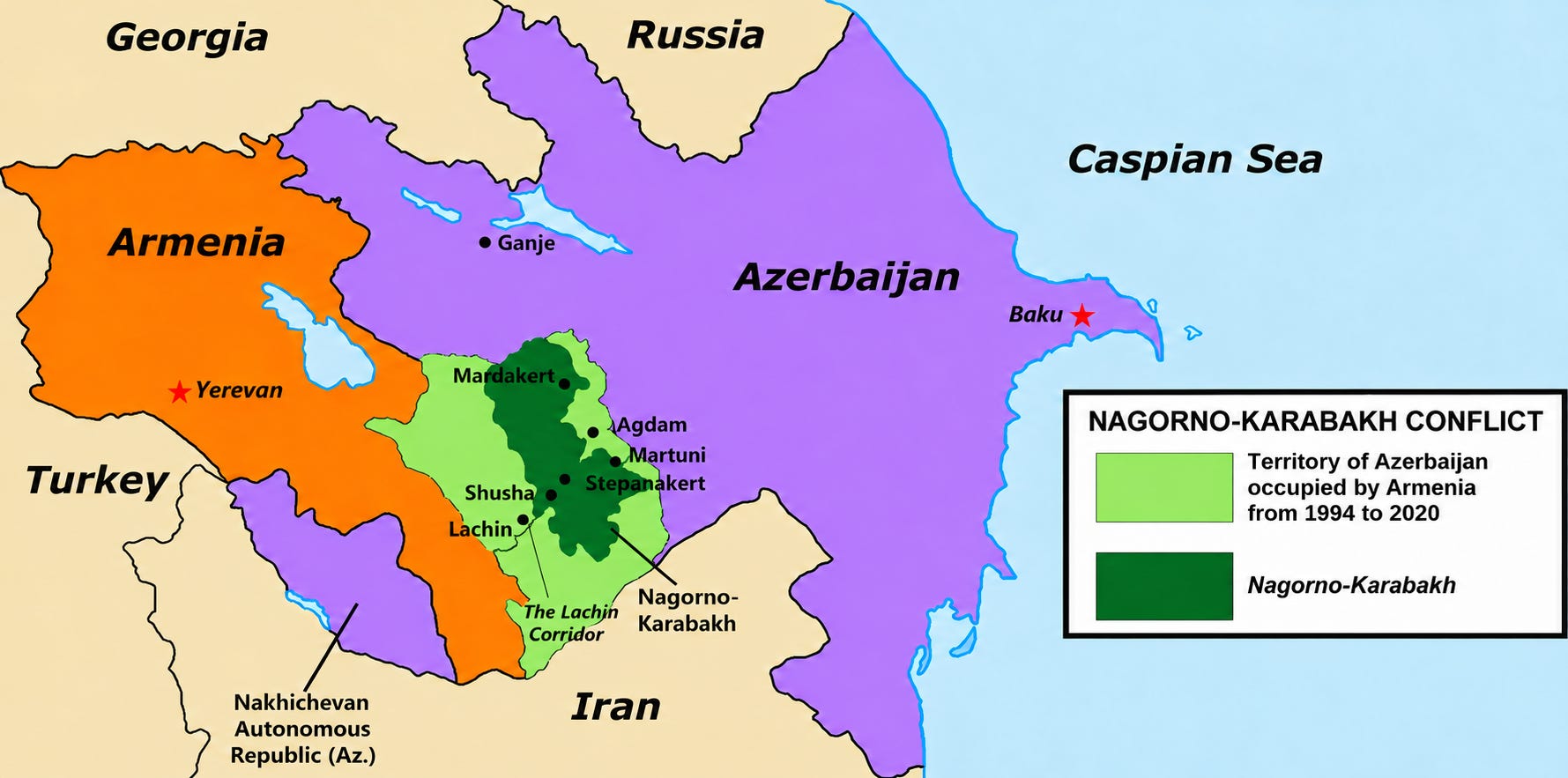
Each ethno-religious group in the Karabakh had fled or been expelled when the other side captured their area during the war. Since the conflict froze with Armenia holding the Karabakh—and a significant surrounding zone—the Azeris emptied out entirely. For a quarter-century this was the status quo, but it was always fragile because Armenia lacked legitimacy. The fig-leaf of Karabakh autonomy under the “Republic of Artsakh” notwithstanding, the “international law” situation was that Armenia occupied 13.5% of Azerbaijan’s territory.47
Aliyev’s son, Ilham, who succeeded to the throne in 2003, set about using Azerbaijan’s oil money to cultivate a favourable political environment in the West for reconquest, the (in)famous “caviar diplomacy”, and to build an army, with Turkey’s help, capable of pulling it off. The Armenians continued relying on Russia for protection, and only at the end realised it was a mirage. Backed by Turkish (and Israeli) drones, and Turkish advisers, Azerbaijan shattered Armenia’s hold on the Karabakh in a six-week campaign in September-November 2020, but left in place the shell of Armenian administration. A two-day demonstrative Azeri offensive in September 2023 forced the total Armenian capitulation and withdrawal. Within a week, the entire Karabakh Armenian population of more than 100,000 had emptied out. Of the Azeris settled in the Karabakh since then as Azerbaijan seeks to integrate the province, 40,000 are reportedly returnees from the 1990s.
FOOTNOTES
Rebecca West (1941), Black Lamb and Grey Falcon: A Journey Through Yugoslavia, p. 20.
The Communist premise being that ultimately nations would be dissolved in a global brotherhood of man, and in the meantime the nations would be held in trust in Lenin’s big prison, the Bolsheviks obviously had little respect for Wilson’s Fourteen Points. But the Allies were not that much more sympathetic to Wilson, regarding him as embodying an irritating combination of naivety and hubris. Famously, the French Prime Minister Georges Clemenceau remarked with acid contempt, “Even the good Lord contented Himself with only ten commandments”.
Franziska Smolnik (2016), Secessionist Rule: Protracted Conflict and Configurations of Non-State Authority, pp. 41-42.
Georgi M. Derluguian (2005), Bourdieu’s Secret Admirer in the Caucasus: A World-System Biography, pp. 191-192.
The final Soviet census in 1989 recorded approximately 189,000 inhabitants of the Karabakh, 145,500 or 77% of them Armenian, and 40,700 or 21.5% Azeris. See: ‘Nagorno-Karabakh: Viewing the Conflict From the Ground’ (2005, Sept. 14), International Crisis Group, p. 4. Available here.
Thomas de Waal (2003), Black Garden: Armenia and Azerbaijan through Peace and War, p. 16.
Derluguian, Bourdieu’s Secret Admirer in the Caucasus, pp. 191-192.
Witnesses from the time report that Armenians in Yerevan in February 1988 were chanting slogans such as: “Armenia without Turks” and “Armenia belongs to the Armenians”. Older Azeris I spoke to in Stepanakert/Khankendi similarly reported that Armenian protesters in the earliest stages, on what was then Lenin Square (now Victory Square), were chanting and waving placards calling for the expulsion of Azeris.
It is probable that the extent of such slogans and placards is exaggerated as part of the competitive victimhood propaganda in the historiography, intended to emphasise that such aggressive Armenian designs were present before the hideous Sumgait pogrom against the Armenians at the end of February 1988. It is even possible they are all lying, but I do not think so. The evidence, as I read it, is that there was a fundamental distrust and fear on both sides from the beginning, amounting to a view of coexistence as existentially dangerous, which is what underlay the expulsionist conduct of the two armies when war came.
Derluguian, Bourdieu’s Secret Admirer in the Caucasus, p. 192.
Derluguian, Bourdieu’s Secret Admirer in the Caucasus, p. 192.
De Waal, Black Garden, pp. 15-16.
Azeris still believe this, if the conversations I had in Azerbaijan six weeks ago are anything to judge by.
De Waal, Black Garden, pp. 15-16.
As so often, even the naming is political in this conflict.
More precisely, the Armenians on the Regional Council voted for Karabakh unity with Armenia; the Azeris boycotted. See: De Waal, Black Garden, p. 12.
De Waal, Black Garden, p. 15.
De Waal, Black Garden, pp. 32-37.
De Waal, Black Garden, pp. 61-62.
De Waal, Black Garden, p. 69.
De Waal, Black Garden, pp. 71-72.
De Waal, Black Garden, pp. 87-90.
De Waal, Black Garden, pp. 92-95.
De Waal, Black Garden, pp. 108-113.
De Waal, Black Garden, pp. 113-114.
Latvia, Lithuania, Estonia, Georgia, and Moldova were the others who boycotted.
De Waal, Black Garden, pp. 114-122.
De Waal, Black Garden, p. 120.
De Waal, Black Garden, pp. 114-122.
Vasili Mitrokhin and Christopher Andrew (1999), The Sword and the Shield: The Mitrokhin Archive and the Secret History of the KGB, pp. 329-332.
The word derives from GKChP (ГКЧП), the Russian abbreviation for “State Committee on the State of Emergency”, the name the putschists gave to their junta.
De Waal, Black Garden, pp. 159-160.
De Waal, Black Garden, p. 160.
De Waal, Black Garden, p. 161.
The official cause of Mkrtchian’s death in April 1992 is accidentally shooting himself while cleaning a gun. There must even be people who believe that. See: De Waal, Black Garden, p. 161.
De Waal, Black Garden, p. 162.
De Waal, Black Garden, pp. 162-163.
De Waal, Black Garden, pp. 166-167.
De Waal, Black Garden, pp. 162-163.
De Waal, Black Garden, pp. 163-165.
De Waal, Black Garden, p. 110.
For those familiar with Syria at the present time, this solution will sound familiar, and the potential downsides will be readily apparent.
De Waal, Black Garden, pp. 163-165.
Even in Azerbaijan’s notional army forward post in the Karabakh, at Aghdam, on the plains below Stepanakert/Khankendi, a half-hour drive from the Karabakhi Armenians’ capital, gangsters had the run of the ground. The Azeri strongmen in Aghdam were figures such as Yaqub Mamed, whom Azerbaijan itself “later arrested and charged with drawing the pay of dead soldiers whom he kept frozen in cold storage tanks”, and Asif Makhamerov, a murderer recently released from prison. See: De Waal, Black Garden, p. 165.
De Waal, Black Garden, p. 166.
De Waal, Black Garden, p. 166.
De Waal, Black Garden, pp. 168-169.
Another politicisation of the numbers surrounding the Karabakh is the false claim that Armenia occupied 20% of Azerbaijan. All of Baku’s official statements use this figure, and it is invariably cited in conversations with “ordinary” Azeris.