

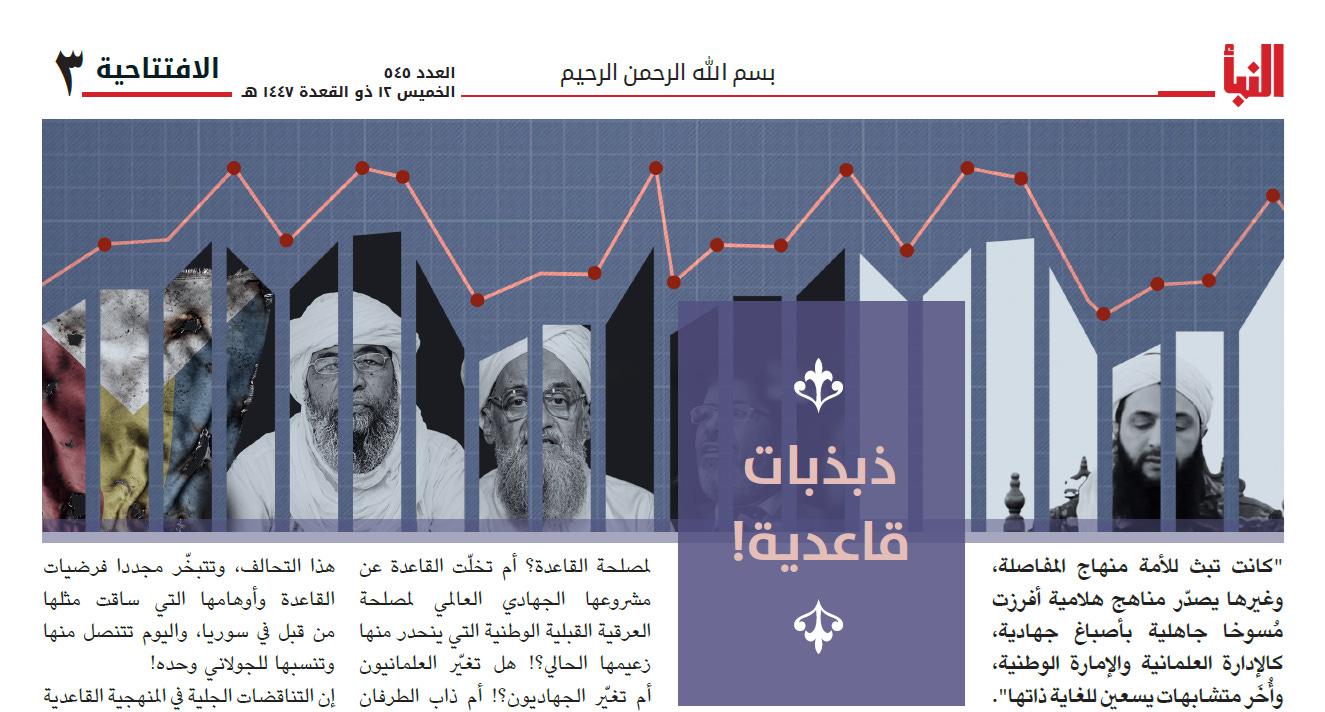
The 545th edition of Al-Naba, the Islamic State’s weekly newsletter, was published on 30 April 2026, and had as its main editorial a polemic against Al-Qaeda for allying with the tribal-separatist Tuaregs in Mali. A translation of the editorial is given below.
The trigger for the editorial is the major advances made in northern Mali, starting on 25 April, by Al-Qaeda’s Jamaat Nusrat al-Islam wal-Muslimeen (JNIM), in partnership with the Azawad Liberation Front (FLA1). While unmentioned by Al-Naba, part of what enabled this rapid shift in fortunes is that when the moment came, the Russian forces that the Malian junta had brought in to replace the French and Western counter-terrorism mission folded without much of a fight, though they remain nominally in place as the insurgents move on the capital, Bamako.
The Islamic State is unimpressed with this development, noting among other things that it has happened once before and ended in tears, a reference to the events of 2012-13, when a Tuareg rebellion combined with the jihadists to conquer northern Mali, before the alliance broke down, paving the way for France to reverse their gains. Conceivably this could happen again, which would certainly embarrass Al-Qaeda, but for IS the focus of the Naba editorial is on the ideological dimension.
It was ostensibly differences in ideology, between Al-Qaeda’s transnational Islamic vision and the Tuaregs’ ethno-nationalism, which caused the schism last time: what changed in the interim to make an alliance possible again? IS’s answer is that Al-Qaeda has moved away from pure Islam to appease tribal separatists. IS mocks Al-Qaeda for not only adopting into its fold secularists, nationalists, and democrats—a bad enough violation of jihadist principle—but adopting specific people it had condemned as enemies and apostates until it suddenly switched its messaging to calling them “brothers” last week. For IS, this is a replay of Syria and many other theatres, merely the latest evidence that Al-Qaeda’s methodological approach and doctrine are bankrupt.
What is perhaps most interesting is what is not in the editorial: any reference to the Islamic State in the Sahel capitalising on the chaos, reportedly taking over abandoned Russian camps in Labbezanga and Tessi, and for a time taking some sort of control in Menaka city. The likely reason for this is that IS’s position in Mali remains fluid and fragile. IS tends to keep quiet about its operational advances until it assesses that it is able to defend them, at which point it publicly celebrates its successes.
Base Oscillations! (Dhabadhabat Qa’idiyya!)
“It [the Islamic State] was broadcasting to the umma the methodology of separation [al-mufasala], while others were issuing amorphous methodologies that produced jahiliyya monstrosities with a jihadist colouring, such as secular administration, national emirates, and other ambiguous constructs all striving for the same end.”
This quotation from the last Al-Furqan speech was neither a false accusation nor speculating about the unseen without knowledge, but rather it was a careful reading of the movements of Al-Qaeda and its sisters, especially in Africa. What recently occurred in the Mali arena was not surprising, nor was it born of contingency. Rather, its indications and signs had been reaching the mujahideen one after another. It came as the product of a frenzied jahiliyya [pre-Islamic ignorance, pagan] mobilisation between the militia of Al-Qaeda and its sisters, striving in pursuit of “the same end” that the Syrian and Afghan governments achieved under the umbrella of the “international system”, whose “speck” Al-Qaeda sees in Syria while it turns a blind eye to the “log” in Afghanistan!2
Anyone following Al-Qaeda’s statements in Mali over the past two years will have noticed clearly the obvious change in its discourse and its inclination towards courting the “international community”! And its striving for holding dialogues and [reaching] understandings with parties that used to be labelled, in “traditional jihadist convention”, as enemies and apostates! If these statements had come out in earlier phases, the dervishes of Al-Qaeda would have busied themselves with rationalisations and patching them up with [claims of] “poor translation and Arabisation”, just as they did for a long time with the statements of the Taliban, until the tear grew too wide for them, so they returned years later to acknowledge them! Indeed, even worse than them, but in the statements of the “General Command”!
Al-Qaeda members spent years denying the existence of these relationships and alliances with the apostate Azawadi fronts, especially in their joint war against the Islamic State, before Al-Qaeda announced as glad tidings this alliance with “their brothers in the Azawad Liberation Front”, as it described them, whereupon its supporters began circulating the news of this alliance with all pride and admiration, after having expended every effort in denying it previously, and now they are expending their effort in legitimising it.
In truth, Al-Qaeda’s problem is not this alliance, “denied” previously and “praised” today, for it is not the first and will not be the last. They will have no difficulty in justifying it, just as they did before with similar alliances in Yemen, Libya, Syria, and elsewhere, which proved the failure and the invalidity of their justifications.
The real problem lies in the nature of the project that brought together Al-Qaeda and their apostate nationalist, patriotic brothers in Mali?!
The “Azawad Liberation Front”, with its old and new components, is a separatist, nationalist, patriotic, democratic front whose highest objective is: “the independence of the Azawad region” and obtaining “self-rule” [hukm dhati] recognised internationally or regionally, and it has not departed from this objective since the outbreak of its jahili conflict decades ago up until this very moment.
Rather, it [the FLA] used to see the presence of Al-Qaeda in northern Mali as sabotaging its efforts aimed at obtaining that purely nationalist objective, especially since its success requires international and regional support and endorsement, and especially since it had tried an alliance with these jihadists in the past, but it ended on the pretext of the divergence [ikhtilaf] of the two projects. So the question now posed is: What change has occurred in these two projects for them to agree and come together again?!
Has the apostate Azawadi front abandoned its nationalist project and its historical dream for the sake of Al-Qaeda? Or has Al-Qaeda abandoned its global jihad project for the sake of this ethno-tribal nationalism from which its current leader [Iyad Ag Ghali (Abu al-Fadl)] descends?! Have the secularists changed, or have the jihadists changed?! Or have the two sides dissolved into a new amorphous mixture of the kind Al-Qaeda’s members have become addicted to plunging into, especially after the “Arab Spring” episode, which revealed what had been hidden in the trajectory of Al-Qaeda, its methodological [or ideological: manhajiyya] turbulence and fluctuations, concealed by the bright beginnings [i.e., 9/11] and exposed by the searing trials?
Some of the leaders of this apostate Azawadi front disavowed this alliance in their statements to media outlets, saying: “If they wish to merge with us, then they must withdraw from the global Al-Qaeda organisation”, while other leaders justified their alliance by [reference to] the bond of the tribe and “cousinage”,3 and said that “the core of the organisation [i.e., JNIM], its main body and the majority of its elements, are from the Azawad of northern Mali, and they share the same political motives in opposing the Malian regime”.
So will this alliance between the two sides stop at this point? Or will it develop into a “severing of ties” [or “disengagement”: fakk irtibat] in which the bond of the tribe overcomes the bond of the deen [lifeway, Islam], proceeding according to the principle of “Azawad for the Azawadis!” on the model of “Syria for the Syrians”?! And will Al-Qaeda accept this severing of ties, if it occurs, and consider it “an interest, flexibility, and political maturity”, which it affirms and blesses? Or will it wait to see whether it serves its interest, and then remain silent about it and compromise with it, as it did with Al-Jolani at the beginning?!4 Or will it wait until it is certain that it has been sidelined, and then disown it and turn against it, and thereafter lecture about creed [or doctrine: aqeeda] and shari’a?
Or will this alliance end with the two sides fighting and turning against one another, as happened previously, thereby revealing the invalidity of the justifications that Al-Qaeda’s members marshalled behind this alliance, and causing the evaporation, once again, of Al-Qaeda’s hypotheses and illusions, the likes of which it previously advanced in Syria, and today disavows and attributes solely to Al-Jolani?!
The glaring contradictions in the Qaedaist methodology [al-manhajiyya al-qa’idiyya] are too numerous to enumerate in the present space and to track their fluctuations. One of the latest of these contradictions is the differentiation between the Afghan government and the Syrian government, despite both coming about in similar circumstances. Al-Qaeda sees in the “first” an Islamic model, while it has come to see in the “second” something else that it is still too cowardly to name openly, and instead whispers about behind the statements of its “General Command”, which have exhausted its followers and drawn them into an endless whirl of delusions and improvised patchings, in contrast to the Prophetic methodology [of the Islamic State], which is founded upon certainty, firmness, and clarity, not upon vacillation, instability, softness, and methodological vagueness.
Among the examples of Al-Qaeda’s vagueness: its differentiation between the apostate governments before and after the revolutions! Another among them: its drifting, obscure position regarding the apostate armies, which Al-Qaeda divides into “honourable” and “dishonourable”! A distinction is made between their soldiers and their officers, sometimes it pardons their soldiers and calls upon the youth to “not flee from compulsory conscription into them”! This and other oddities and suspicious things on this issue will inevitably be uncovered in the coming trials, for the truth is not veiled by the clouds of falsehood.
Thus continues the saga of turbulence and wandering in the Qaedaist methodology, which nothing will halt except a sincere return to the Prophetic methodology, and a complete disavowal of factionalism [or partisanship: al-hizbiyya] and the veneration of its figures, whom they have made a judge and a standard by which they adjust their stances, such that their leaders have become an authority over the shari’a!! And the mistakes of the past have become a guide [or evidence: dalilan] and a driver for their continuation, instead of correcting them and desisting from them. “God has full power over His affairs, but most men know not” [Qur’an 12:21].
FOOTNOTES
From the French: Front de libération de l’Azawad.
The reference is to a Hadith, according to the Tradition reported by Abu Hurayra, criticising the believer who “sees the speck in his brother’s eye and forgets the log in his own eye”. The saying is clearly drawn from the Bible, where it is recorded as part of Jesus’s Sermon on the Mount (Matthew 7:3).
The phrase used is bani al-umuma (بني العمومة), literally “sons of the paternal uncles” (male cousins on the father’s side).
Al-Jolani is Abu Muhammad al-Jolani, the kunya of Ahmad al-Shara, the current president of Syria, who was originally sent into the country in 2011 as an operative of the Islamic State, leading a front-group called Jabhat al-Nusra, which broke away from its IS parent organisation by declaring allegiance directly to Al-Qaeda in 2013 and in subsequent years, in a very convoluted manner, publicly severed ties with Al-Qaeda, too.