

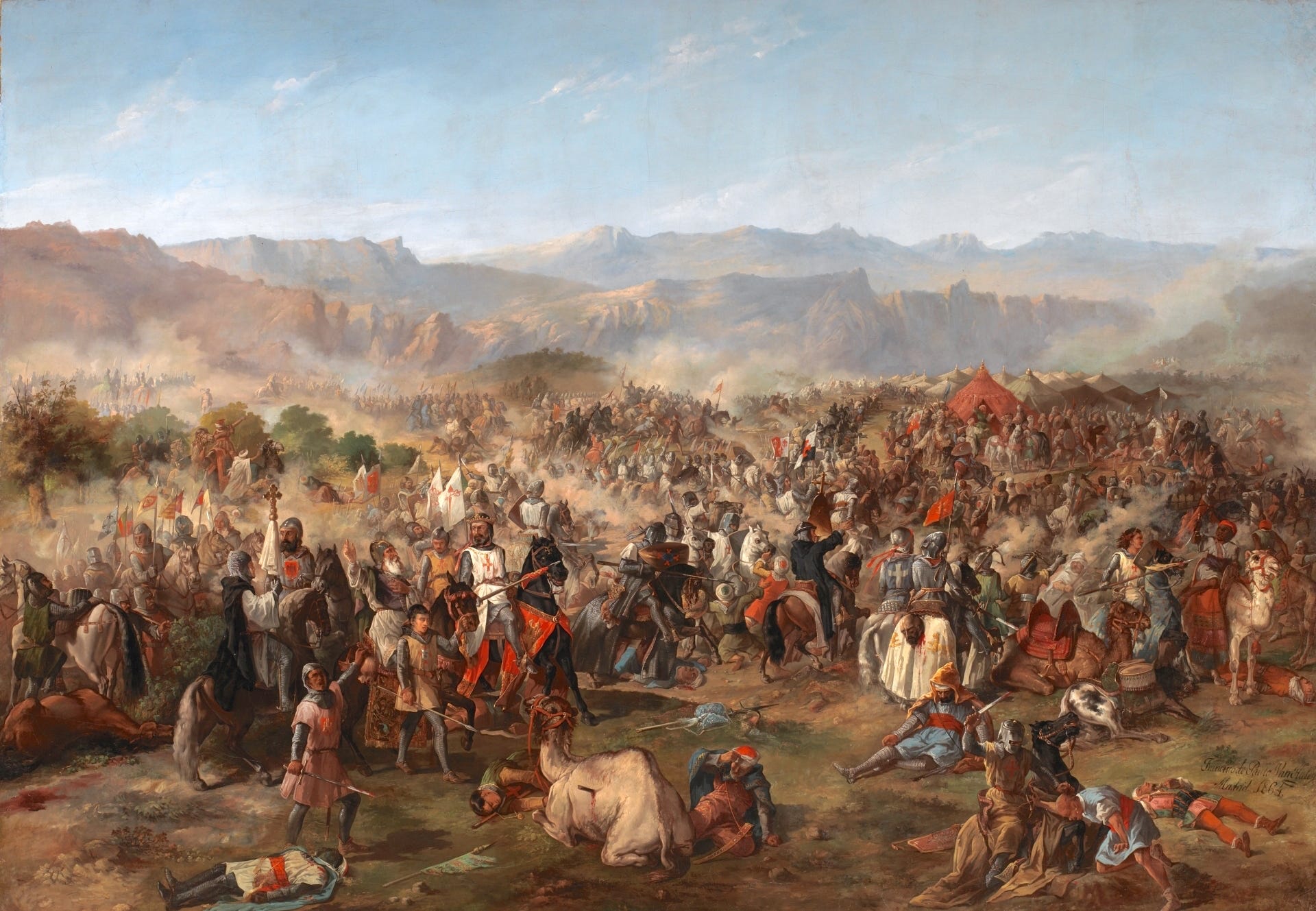
The Arabic word deen (دين)1 is often translated as “religion”, and it does refer to Islam, but this is not the same thing.
CHRISTIANITY AND “RELIGION”
The word “religion” derives from the Latin religio, meaning that which binds man to the heavens.2 In the pagan Roman Empire, this was about practice, not belief: “The focus of the term was on public, communal behaviour towards the gods of the state”.3 “Sacrificial offerings, the chastity of virgins, [and] the whole range of priesthoods” counted as religiones,4 and the purpose of offering these sacrifices and rites was to ensure the protection of cities from the wrath of the gods.5
Christians would adopt the word religio, but, as happened with much of the Classical inheritance, turned it to an entirely new meaning.6 The Church was the sole religio for Christians with God, and the State was seen as a separate realm. Jesus had said, “Render … unto Caesar the things which are Caesar’s, and unto God the things that are God’s”,7 and Christians set out into the world with this understanding.8 The early history of Christianity, as a tiny sect suffering official persecution for three centuries, was the context for this, but the view did not change after Christianity triumphed in the Roman Empire. In the 420s AD, a century after the first Christian Emperor, Augustine contrasted the eternal and unchanging dimension of religion, the City of God, with the saeculum, a word initially denoting the span of human life that had come to mean the limits of living memory. Mortality defined the saeculum, a realm where the saecularia (secular things) were in constant flux as memory faded from one generation to the next, and in time death would take all things—men, the cities, the Empire itself.9
Christendom would split shortly after the millennium, with the Orthodox East and Latin West departing on variant courses. Yet in both there remained the unique duality of Church and State. Whether in harmony or discord, with one or other dominant, they were two separate institutions.10 The Papal Revolution would remake Latin Christendom to embed Augustine’s distinction between religio and the saeculum society-wide,11 and in the sixteenth century a second bout of revolution and schism would convulse the West that further sharpened the distinction. “By the end of the seventeenth century, it was … more and more common [for Western Christians] to confine religio and the religiones to the realm of the inner self”,12 to define the public space as “secular”. Especially in the wake of the French Revolution that accentuated the trends of the prior two upheavals, Western notions travelled East and ultimately far beyond Christendom.
It may seem obvious to many that an exhausted Continent after the Wars of Religion would want to remove religion from politics, to make it a private matter rather than an issue States fought over, but, as Brent Nongbri has so well put it, “the isolation of something called ‘religion’ as a sphere of life” that can be “separated from politics … is not a universal feature of human history. In fact, in the broad view of human cultures, it is a strikingly odd way of conceiving the world.”13
“Religion” and the “secular” do not exist objectively, irrespective of culture and geography: the worldview wherein reality can be divided this way is a historically contingent creation of Christian theology, institutionalised in the Latin West by the medieval Papacy.14 The illusion to the contrary results from the remarkable success of the West in its period of global preponderance at repackaging the distinctive assumptions of Latin Christendom as the common property of mankind.15
ISLAM AND THE DEEN
“Islam is not merely a system of belief and worship, a compartment of life … distinct from other compartments which are the concern of nonreligious authorities”, the late Bernard Lewis once explained. Islam “is the whole of life, and its rules include [among other things] civil, criminal, and even what we would call constitutional law.” Reflecting this, deen “conveys much more” to Muslims than “religion” does to Christians.16
The difference begins with the etymology. Deen is clearly related to the Hebrew word din (דין), and has cognates in other Semitic languages, Aramaic and Syriac among them, which derive from a root meaning “law” or “judgment”. The interaction in Arabic, by way of dayn (“debt which falls due on a given date”), led to deen denoting “custom”.17 (Some have argued deen is a Persian loanword, but this is not convincing.18) “What ties these terms together”, notes Nongbri, “is that they refer to social transactions, a far cry from the sort of private, internal, apolitical sense of ‘faith’ or ‘religion’.”19
“Deen” in the sense of “custom” would lead to the idea of “direction” (huda), as in a guide, the guide being God, and the direction being the suitable one for each person—linking back to the Semitic root of “judgment”. This is the framework for the Qur’anic term Yawm al-Deen (the Day of Judgment), when God will give direction to each human being, and the emergence of “deen” to signify “the corpus of obligatory prescriptions given by God, to which one must submit”, in the words of Louis Gardet.20 The close association between deen and islam (submission) was present early, in the phase when the Arab creed was an indeterminate Biblical monotheism. For the Ishmaelites or Hagarenes, as the Arab conquerors were known, the true expression of allegiance to God (the deen) was submission to Him (islam).21 The outlook would remain when what was by then an Imperial creed crystallised into a more exclusivist format—when, so to speak, “Islam” became a proper noun—around the ninth century AD.
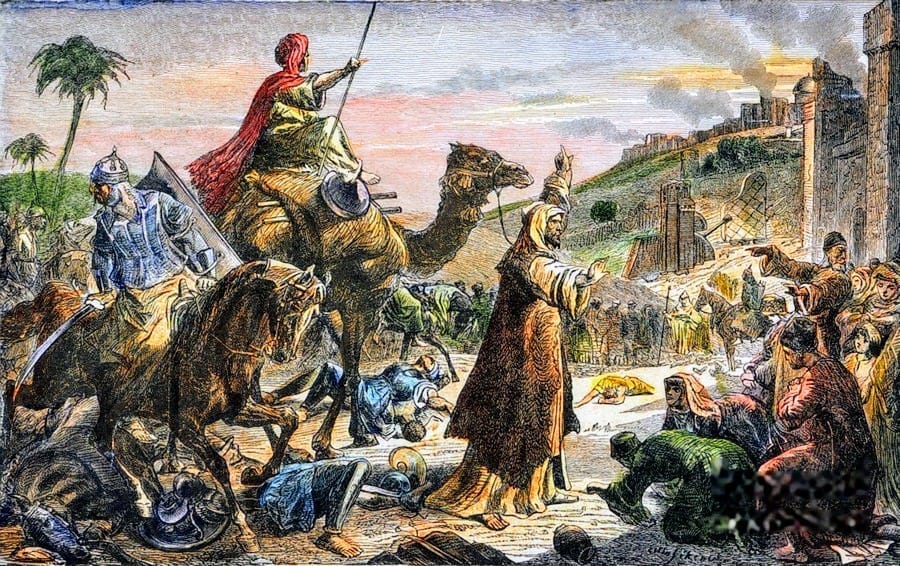
The transition from the early creed—what the Qur’an calls Millat Ibrahim (the Way of Abraham)22—to Islam as we know it involved the generation of a Tradition that further “defined the obligations and prescriptions laid down by God” encompassed in the word deen, Gardet explains, and, while there was some contest about the details, these included: faith in Him; correct practice in daily living and worship, significantly following the example of the Prophet Muhammad and the Companions (Sahaba); and upholding the Holy Law (Shari’a), which regulates both the private and public spheres.23
As in Christianity, the historical context shaped Muslim understanding.24 In contrast to Moses, who was prevented from entering his Promised Land,25 and Jesus, who was crucified, the Prophet Muhammad was victorious in his lifetime. Muhammad was “the Seal of the Prophets”,26 and he was Head of State, with all that implied of enforcing the law, administering justice, making war, and making peace.
It should be emphasised, Muhammad and his Successors (Caliphs) did not create or give laws: Islam recognises no human role in legislation for God is the true sovereign of the umma (Islamic community) and the duty of His temporal deputies is merely to uphold God’s Holy Law.27 This is why, when the Tradition describes Muhammad putting his enemies to death, it reads to Christians as if they were enemies of Muhammad’s government and Islam, but the Tradition makes no such distinction. This complete fusion of what Christians consider “religion” and “politics” is what explains Islam’s pitiless treatment of apostates: to abandon the faith was not to make a personal choice; it was to defect from the umma, thus apostasy carried (and still carries) the connotation of treason,28 which until very recently all were agreed was a capital offence.
From this perspective, there is one sense in which “deen” conveys less than “religion”. “Religion” is intimately bound to the Church in Christianity, a whole apparatus with its own history, hierarchy, and sacramental role. There is no equivalent in Islam: the mosque is a building for worship and study, not an institution, and the imam, the “one who is in front”, is a functionary, not an ordained figure.29 (Shi’ism’s apparent exception to this rule is a very recent innovation.30) In classical Islam, therefore, to speak of “Mosque and State” is meaningless. Consequently, deen lacks the implied institutional meaning that “religion” has, and the languages of Islamdom—Arabic, Turkish, and Persian—were devoid of the pairs of words that signify the two realms: “religious” and “secular”, “sacred” and “profane”, “spiritual” and “temporal”, “ecclesiastical” and “lay”. It was not a deficiency in these very rich languages. Rather, the concept of the rival spheres did not exist, so no vocabulary was needed to describe them.31
SECULARISM AND ISLAM
Unlike in Christendom, where the pattern was countries containing religions, in Islamdom there was the deen containing countries. In Europe, the territorial unit—England, say—was the primary identity and the subjects could (eventually) have different beliefs about God. In the Middle East, there was some variation in political affiliation by territory—occasionally a local dynasty arose—and they were certainly aware of ethnic and cultural differences, but identity was defined by creed.32 There were Muslims, the umma with the Caliph at its head, and non-Muslims. That this classification was the only one that mattered can be seen in, for example, nineteenth-century Ottoman newspapers, which carried items such as: “There was an accident on the bridge, and one unbeliever was injured.”33 There was no polemical point being made; it simply reflected the Muslim assumption about the basic division in humanity.
Islamdom’s first experience with secularism was in the form of the French Revolution,34 which aroused some curiosity as it presented itself as non-Christian. The contemporary impact was minimal, but the long-term consequences, in inspiring reformers and transmitting the idea of nationalism, was very great.35 The first serious steps toward Westernisation, that is remoulding Islam along Christian lines, happened in the mid-nineteenth century, when the Ottoman Sultan was forced by the British to (nominally) abolish the jizya (non-Muslim poll tax) and slavery, and justified it in most Protestant terms by explaining that the words of the Qur’anic text did not really mean what they had for twelve centuries. Muhammad, it turned out, was an abolitionist all along.36 There were subsequent reforms of this kind, but discussing and internalising the justifications for them was hampered by an elemental problem.
Even as the notion of “secularism” began to filter into Islamdom, there were no words to describe it, and the vocabulary that did develop remains stamped with its alien origins. The Turks, interfacing for Islamdom with Christendom, were the first to encounter secularism, in the French Revolutionary period, and were then the first to apply it in the 1920s, creating a Republic that officially disestablished Islam. The word for “secular” in the Turkish Constitution is laik, a word obviously borrowed from the French laïque. The Persians also took in laik and adopted “secular” unadorned (سکولار). As Arabic is both a Muslim and Christian language, there was a word to hand for “secular”, “temporal”, etc.: alamani (lit. “worldly”). The word’s etymology and Christian roots would be occluded, and it would be revocalised as ilmani, but for many Muslims this did little to hide its foreignness.37
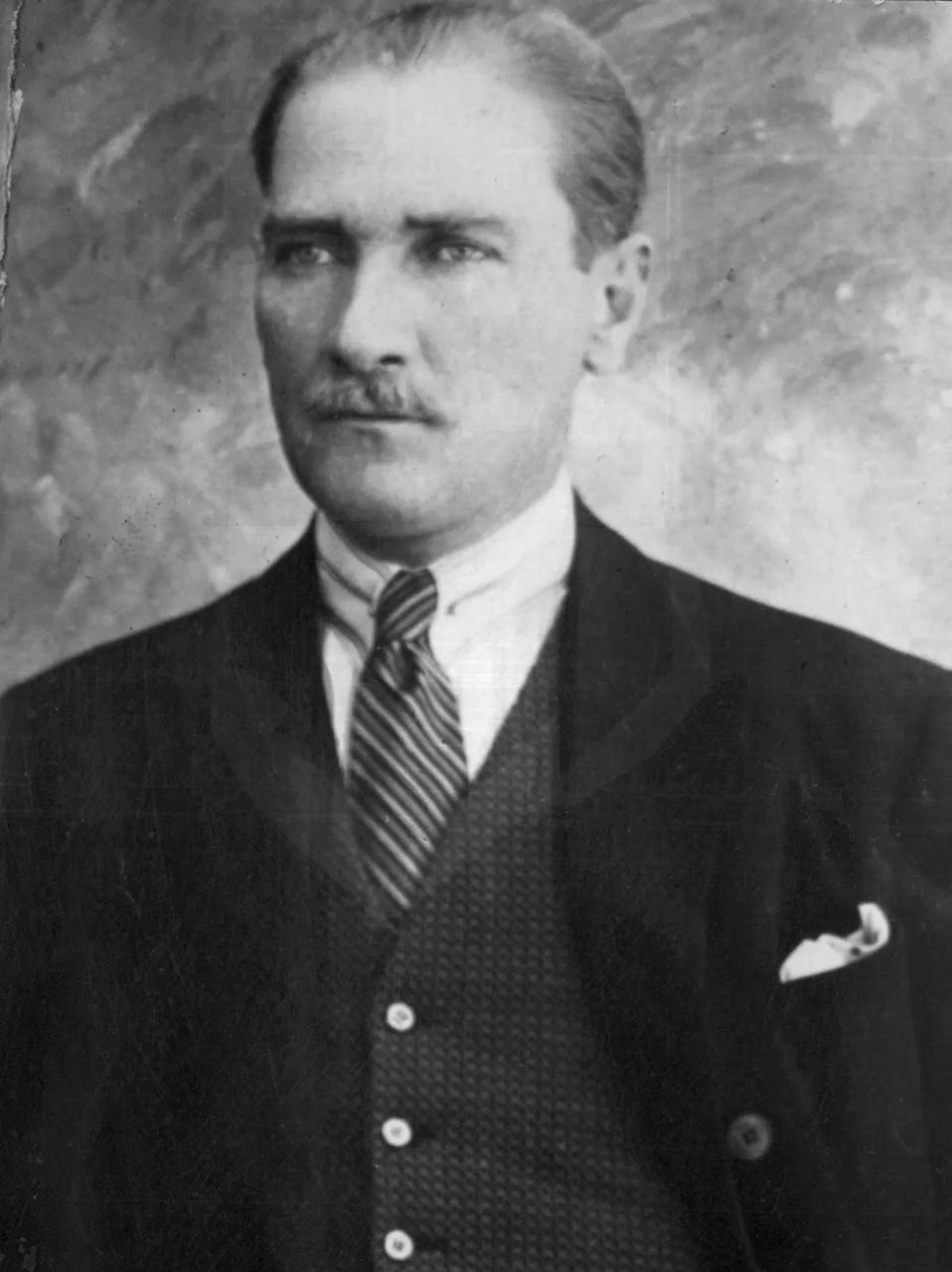
The turning point was Mustafa Kemal Atatürk’s decision, having directly remade Turkey as a Western nation-State, to abolish the Caliphate in 1924. This removed the linchpin of the umma, forcing upon the rest of Islamdom fundamental questions of legitimacy, allegiance, and identity, and did so at just the moment Western power and influence was at its height in the region.
Some, like the Muslim Brotherhood (Al-Ikhwan al-Muslimeen), tried to bar the road, arguing that Islamdom had been brought low by too much “modernisation”, a thin disguise for Westernisation, which had taken Muslims very far from the authentic Islam that was the answer to the crisis. But the Brethren were contesting the laws of gravity in the circumstances. Most Muslim governments and intellectual elites took the opposite view, and in so doing—in arguing the disaster resulted from insufficient modernisation—they implicitly blamed Islamic rule for the backwardness. A brief liberal era dawned under Western tutelage and then Arab nationalism—hostile to the West but committed to Westernisation, a construct largely of Christian Arab intellectuals—swept all before it, until it, too, failed, symbolised in the defeat of the Arab war on Israel in 1967. After this, on the seventh day of the Six-Day War as some say, the long debate about what went wrong intensified in Islamdom and the Islamist prescription for how to put it right found more of an audience.
Islamism in its various forms—Sunni and Shi’a, Ikhwani and jihadi-Salafist, political and terroristic—shares the same core “objective of undoing the secularizing reforms …, abolishing the imported codes of law and the social customs that came with them, and returning to the Holy Law of Islam and an Islamic political order”.38 This was the central point in the writings and speeches of Ayatollah Ruhollah Khomeini, the leader of the Islamic Revolution in Iran in 1978-79, the first major victory of the Islamists, which has had an enormous impact in shifting the regional balance of sentiment and power against the modernisers/Westernisers.
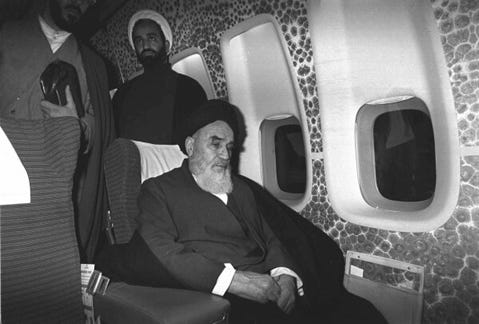
Khomeini set out his vision in a manifesto a decade before the fall of the Shah. The argument, and charge, dominating the book is that Westerners and more particularly Westernisers, since Islamist ire has always been focused most intently on the internal enemy,39 have sought to limit the scope of Islam’s role in Muslim society, to negate the deen and shunt the scholars charged with upholding it off to the side, leaving them, like Christian clerics, to administer their houses of worship and speak only on matters of personal spirituality. It was this trend Khomeini was determined to reverse:
Do not allow the true nature of Islam to remain hidden, or people will imagine that Islam is like Christianity …, a collection of injunctions pertaining to man’s relation to God, and the mosques will be equated with the church. … God, Exalted and Almighty, by means of the Most Noble Messenger, sent … laws and practices for all human affairs and laid injunctions for man extending from even before the embryo is formed until after he is placed in the tomb. In just the same way that there are laws setting forth the duties of worship for man, so too there are laws, practices, and norms for the affairs of society and government. … All the voluminous books that have been compiled from the earliest times on different areas of law, such as judicial procedure, social transactions, penal law, retribution, international relations, regulations pertaining to peace and war, private and public law—taken together, these contain a mere sample of the laws and injunctions of Islam. There is not a single topic in human life for which Islam has not provided instructions and established a norm.40
Khomeini went on:
[Foreign “imperialists”] have tried with their propaganda and insinuations to present Islam as a petty, limited affair, and to restrict the functions of the fuqaha [jurists] and ulema [scholars, theologians] to insignificant matters. … The propaganda institutions of imperialism have whispered to tempt and persuade us to separate the deen from politics, that the ruhaniyat [Shi’a ulema] must not interfere in social matters, and that the fuqaha do not have the duty of overseeing the destiny of the community of Islam. Unfortunately, some people have believed them and fallen under their influence, with the result that we see.41
The irony is Khomeinism accentuated, rather than reversed, the Christianisation of Islam. The Revolution in its iconography was inflected with Marxism (a Christian heresy)—notably acting in the name of the “oppressed” (mostazafeen)—and in power the Khomeinists have created something unprecedented in the history of Islam, rule by men who can only be described as “clergy” in the Christian sense.42 All indications are that most Iranians have decided clerical entanglement in politics has gone too far and would like to try the secular remedy Christians adopted when they came to the same view.
The situation in Turkey is murky, though there are some signs of similar dynamics to those in Iran. In the Arab world, the trendline is much clearer. The polarisation since the 1970s has rendered the popular understanding of ilmani more as “godlessness” or atheism, even “immorality”, while those identifying with the word have become fewer and harder-edged in their attitude towards Islam.43 The attempt for a time to switch to “civil State” as a more genuinely neutral alternative has not been very effective, partly because it was closely associated with Egypt’s “Arab spring” experiment, which saw the Muslim Brotherhood elected and then removed in a bloody military coup, a sequence that satisfied nobody. The deeper problem is one that lexicography cannot paper over. What was apparent in the early 2000s, that secularism was “in a bad way in the Middle East”,44 that there was an increasingly “widespread Muslim rejection” of the concept,45 on ideological and utilitarian grounds, for being both alien and ineffective in reversing the socio-political decline, is even more true two decades later.
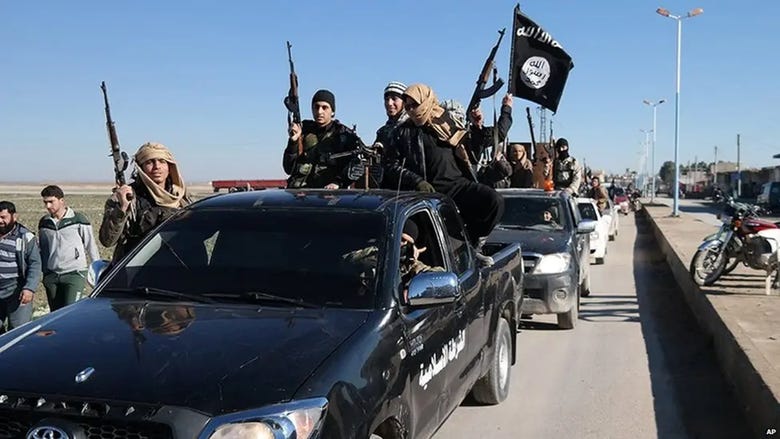
It is no accident, as the comrades used to say, that the most virulent form of Islamism since Khomeinism, the Islamic State (IS), emerged in the Arab world. When IS speaks of al-ilmaniyyun (the secularists), it uses the term virtually interchangeably with kufr (infidels, unbelievers) and murtadeen (apostates), and includes them on the list of subversives and traitors, with democrats and nationalists, who import and imitate Western ways that undermine Islamic society and the shari’a. The centrality of this belief in IS’s worldview is demonstrated in the movement’s reaction to the Gaza war. IS has exploited the increased space for antisemitism and Islamic militancy since 2023, especially in Europe and her daughters,46 but it has refused to embrace the populist and popular Palestine Cause as such, repeatedly condemning HAMAS and its allies and supporters as “nationalist” deviants, warring against Israel for the sake of the territory in former Mandate Palestine, rather than waging a jihad for the deen that targets Jews as part of a global campaign against infidels.
Marking ten years since the proclamation of the caliphate in 2024, the IS spokesman began his speech by saying IS’s greatest achievement was to have established a polity where Muslims were “governed by the deen of their Lord”, itemising the comprehensive system of State institutions that “spread virtue and suppressed vice”, and “demolished the idols of jahiliyya [pre-Islamic ignorance], patriotism, and nationalism”. The core of IS’s project, consistent with the Islamist movement since the 1920s, is to cleanse Islamdom of alien accretions,47 particularly those from Christendom and specifically secularism, and thereby restore the popular understanding of Islam to its (imagined) pure and pristine origins, thus enabling the restoration of the all-encompassing deen to govern the life of believers and the society they live in, namely a unified Islamic State for all Muslims.
IS’s methods provoke overwhelming revulsion in the Muslim world; the caliphal vision in principle rather less so. “The Islamic State … draws on, and draws strength from, ideas that have a broad resonance”, writes Shadi Hamid. “[Muslims] may not agree with the group’s interpretation of the caliphate, but the notion of a caliphate is a powerful one, even among more secular-minded Muslims” [italics original].48
ISLAM AND EUROPE
If secularism has not fared well in Muslim lands, what of Muslims in secular lands? The question of Muslim populations in Europe is a novel and recent one, emerging after the Second World War.49 What was not new was the source of the frictions encountered by the Muslim newcomers, which echoed the problems experienced by Jews, Christendom’s only minority for much of its existence. Muslims, after all, were being normal in their expectations of the writ of the divine. It was Christendom that had the strange perceptions on this front.
Christians had long used the term Ioudaismos as if it was a Jewish counterpart to Christianity, but what it had signified at those times when Jews used it was the Jewish way of life, the totality of what it meant to be Jewish: the language, customs, culture, and practices of a nation (ethnos) bound to one another and to a sacred territory centred on Jerusalem.50 The Christian offer of salvation by dissolving this distinctiveness and joining a universal brotherhood was more successful in the guise of the French Revolution, which provided a model that spread across Europe in the nineteenth century: Jews who set aside the Mosaic Law and other attributes of peoplehood could individually become citizens who followed the religion of “Judaism”.51 The backlash to this, Jews advocating a return to Ioudaismos in full, including a renewed drive to restore the Children of Israel to their homeland, would become known as “Zionism”.
Muslim migrants in the late twentieth century entered a Europe that in its own estimation had moved beyond tolerance—an inherently intolerant concept, suggesting a dominant group is putting up with certain things from minorities—to acceptance and equality. Works like James George Frazer’s The Golden Bough in the late nineteenth century had embedded the framework of “world religions”,52 a secular veneer on the Christian presumption that its values are universal, and “religious freedom” was the order of the day in the West, not least as a counterpoint to the half of Europe lost to the Soviet Union. Yet, as Tom Holland has written, this was exactly the problem: the notion “that all religions were essentially the same”, and that secularism “was neutral between all religions”, was a conceit “only those who believed in the foundation myths of secularism”, those who are products of Christendom, could believe.53 Western secularists in their own minds were treating all equally by asking, crucially without admitting what they were doing, the same price of acceptance from everybody: that they force their creed into the Christian mould.54 But the cost was not equal for all. Muslims felt the demand to undergo this Procrustean process as deeply traumatic—and understandably resisted it.55
The tension with Jews traditionally was between their particularism and the universalist aspirations of Christian States. The issue looked similar with Muslims in the early phase, when their numbers were small, the question being merely “integration”, i.e., getting the newcomers to accept Christianised perceptions of identity. The analogy with the Jews broke down fairly quickly, however, because the faultline with Muslims was not just their wish to retain their distinctiveness, but their rival universalism. Islam is a proselytising, “triumphalist” creed; its ideal is for all of humanity to see its truth. As Muslim numbers increased, and the second and third generations proved more “radical” than the first,56 the question of who should accommodate to whom became a live one.
The Muslim role in Western politics is increasing, in part through the Islamist alliance with the far-Left—the unholy alliance of the Black and the Red, as the Shah called this revolutionary force which toppled him—and more broadly as European Muslims gain proficiency in navigating a democracy. The “Muslim vote” is no longer ignorable in many countries, and between elections Muslims have availed themselves of all the usual means of influencing policy: forming organised elites to engage the State, communal mobilisation, turning economic power to political ends, sectional lobbying, securing representation across civil society, and the rest of it. This increasing Muslim assertiveness comes as Western hegemony fades, and with it the illusion that Christian assumptions are the norms of mankind.57 The loss of Western self-confidence that caused this retreat abroad infuses the approach domestically, a policy of the pre-emptive cringe.58
“Islam and Islamic values now have a level of immunity from comment and criticism in the Western world that Christianity has lost and Judaism has never had.” When Bernard Lewis said that nearly twenty years ago, the West had already been living under a de facto Islamic blasphemy law for some time. Left-wing anti-religious iconoclasm, once a powerful force in Western politics, has been replaced with a concern for Islamic sensitivities that extends even to a suffocating ambiguity about the morality of massacring the Charlie Hebdo staff. In the collision between the post-1945 Western taboo on antisemitism, and the prevalence of antisemitism among Muslims, it is the former that has given way. If some Muslims have the sense that it will be “third time lucky”, that demography and migration will accomplish what was thwarted at Tours and Vienna, one must grant that they have come by the perception honestly.
Such an outcome is by no means certain. There are countervailing indicators. Some younger Muslims have gone as far as joining with their non-Muslim counterparts in defining themselves primarily by Left-wing politics, including the social liberalism. Muslims rejecting Islam, even implicitly, is a fringe phenomenon and likely to remain so, but it is an interesting data point. The most remarkable thing is how many Muslims have internalised the idea of “the secular”, reshaping their identity from being part of an umma following the deen to being citizens of European countries who have a “religion”. Perhaps this will become the dominant perception of the faith and resolve the “integration” question. While it seems unlikely in the lifetime of anybody reading this given Islam’s exceptional resistance to secularisation, it remains a possibility. Another option, if neither side can reshape the other in its image, is the perpetuation of some version of the status quo, with Islam as an undigested component of Western societies, the stresses and strains of the relationship in various phases more and less visible and severe.
CONCLUSION
The main point I hope to have carried is that to translate deen as “religion” is an error. “Religion” is inadequate and misleading, projecting Christian assumptions onto a phenomenon born of a civilisation where such assumptions do not apply. A better one-word translation of deen would be “lifeway”.
FOOTNOTES
Also transliterated “dīn”.
Louis Gardet, ‘Dīn’, in: Bernard Lewis, Charles Pellat, and Joseph Schacht [eds.] (1991 [orig. 1965]), The Encyclopaedia of Islam, New Edition: Volume II, p. 293.
Mary Beard, John North, and Simon Price (1998), Religions of Rome, Volume 1: A History, p. 216.
Marcus Minucius Felix, Octavius: 6.2, quoted in: Tom Holland (2019), Dominion: The Making of the Western Mind, p. 136.
Brent Nongbri (2013), Before Religion: A History of a Modern Concept, pp. 28-29.
Another prominent example is the Greek word “suneidesis” (Συνɛίδησις), used by the Stoics like Epictetus and Seneca the Younger to mean a person’s inner-awareness of their constitution, a means for assessing whether their actions have been in accordance with intellect and nature, thus likely to lead to peace and joy (or gossip and accusation if not).
When Saint Paul uses “suneidesis”, it is often translated as “conscience”, and it refers to the moral witness in a person that testifies before God. The key for Paul is that love of God is the way to obtain real knowledge in terms of conscience, the way to live in accordance with His moral design, leading to liberation and salvation. Paul borrowed the word “suneidesis” in the context of explaining to Jews how Gentiles could know the Law (Halakha), because in his perception the Law established in the second covenant by Christ’s sacrifice is “written not with ink but by the Spirit of the living God, not on tablets of stone but on tablets of flesh, that is, on the heart” (1 Corinthians 3). As such, the judge is not individual reason, and prizing intellectual “knowing” over the Word of God will lead to error. Unlike the Greco-Romans, Paul believed conscience could be weak or defiled, needing to be governed by faith and love, and that had a communal dimension, requiring that individuals limit their freedom and act responsibly to take account of the consciences of others.
Matthew 22:21.
The Gospel of Matthew in which the quote appears was the most loved by the Early Church. The conventional origin date for gMatthew is 75-85 AD, but the internal contents point strongly to an earlier date—specifically before the Roman sack of Jerusalem in 70 AD, and generally to the period when the Jesus Sect was still more tightly enmeshed in the Jewish world, at a nascent stage of the mission to the Gentiles. Crucially, gMatthew’s dating relies significantly on the dating of the Gospel of Mark, the first Gospel, since it is clear gMatthew draws on gMark and was written shortly afterwards. The conventional date of gMark is c. 65-75 AD, but there is good reason to think gMark was completed c. 40 AD: taken together with the internal clues of gMatthew, it is likely gMatthew was written c. 50-60 AD. See: Maurice Casey (2014), Jesus: Evidence and Argument Or Mythicist Myths?, pp. 80-96.
Holland, Dominion, pp. 203-204.
In Eastern Europe, especially in Russia as the claimed inheritor of Byzantium, where the idea of Church-State separation was resisted for longer, it still took the form of advocating symphonia, harmony or accord: the cooperative unity of two separate components, not their merging.
Holland, Dominion, pp. 261-263.
Nongbri, Before Religion, p. 34.
Nongbri, Before Religion, pp. 2-3.
Holland, Dominion, p. 610.
Holland, Dominion, pp. 463-467.
Bernard Lewis (1990), ‘Europe and Islam’, The Tanner Lectures. Available here.
Gardet, ‘Dīn’, in: The Encyclopaedia of Islam, New Edition: Volume II, p. 293.
Gardet, ‘Dīn’, in: The Encyclopaedia of Islam, New Edition: Volume II, p. 293.
The word in question is dēn, from Middle Persian (Pahlavi), another word often mistranslated as “religion”, but which might better be given as “revelation”. It is a Zoroastrian concept, deriving from the Avestan daēnā, which denotes both a goddess and a person’s inner moral quality or spiritual awareness, something closer to “conscience” in the way Saint Paul would use it centuries later (see footnote six), and it ultimately connects to a root meaning “to see”, in the sense of gaining understanding. Thus, despite the superficial similarity of the words, dēn and deen/dīn, they are not quite the same thing, and to the extent there is any overlap it seems to be a case of convergent evolution.
See: Manya Saadi-nejad (2021), Anahita: A History and Reception of the Iranian Water Goddess, p. 93; and, Matthew D Niemi (2021), ‘Dissertation: Historical and Semantic Development of Dīn and Islām from the Seventh Century to Present’, Indiana University, Bloomington. Available here.
Nongbri, Before Religion, pp. 41-42.
Gardet, ‘Dīn’, in: The Encyclopaedia of Islam, New Edition: Volume II, p. 293.
Holland, Dominion, p. 212.
See, for example: Qur’an 2:130-135, 3:95, 4:123-126, and 6:161.
Gardet, ‘Dīn’, in: The Encyclopaedia of Islam, New Edition: Volume II, pp. 293-294.
Lewis, ‘Europe and Islam’.
Moses was the prophetic model Muhammad esteemed above all others, and this fact likely explains the Islamic Tradition that developed wherein Muhammad died before the conquest of the Land of Israel, in contradiction to the contemporary evidence, which suggests Muhammad led the invasion.
Qur’an 33:40.
Bernard Lewis (2002), What Went Wrong? Western Impact and Middle Eastern Response, p. 101.
Shaikh Abdur Rahman (1972), Punishment of Apostasy in Islam, p. 3.
In the revolutionary process that transformed the early Arab creed into what we know as Islam in the eighth and ninth centuries, a class of ulema (scholars) developed in Islamdom and it was the consensus among these men, who developed the Hadith and consolidated the shari’a, that determined the definition of the deen. In sociological terms, one might compare the ulema to the clergy in Christendom, and, indeed, Islamic history is to a significant extent the record of the contest to define the faith—and thus exercise State power—between the ulema and the Caliph.
Into modern times, there are examples of the ulema class playing a significant role in countries, for example Saddam Husayn empowered a layer of mid-level imams in the Sunni Arab areas of Iraq under the auspices of his “Faith Campaign”, which remade the structure and functioning of society in those zones during his rule and played an important part in setting the stage for what happened after he was deposed.
If there is a sociological parallel between the ulema and the clergy, however, there is no theological parallel. “Islam recognizes no ordination, no sacraments, no priestly mediation between the believer and God”, and the various Islamic figures one might be tempted to call “clergy”—the alim, qadi, or imam—had the role of “a teacher, a guide, a scholar in theology and law, but not … a priest”. See: Lewis, ‘Europe and Islam’.
The line of Shi’i Imams that began with Ali, the fourth Caliph, and ended with the occultation of Muhammad al-Mahdi in 874 AD, were in effect a divine dynasty—blessed by God to rule the umma, their sacrality a matter of descent. This is unrelated to imams in the modern sense, or the medieval sense come to that, who are merely teachers and administrators at mosques.
Shi’ism would develop something like a “clerisy” in the later part of the nineteenth century, when the hawzas, the old centres of learning in Najaf and Qom, began to transition into hierarchical institutions. The word “ayatollah” came into use to designate particularly esteemed jurist-theologians, and in time there would be “grand ayatollahs”, determined significantly by the extent of their following, hence such individuals are often referred to as a “source of emulation” (marja-e taqlid). There was still, however, no sense of ayatollahs being intermediaries between the Muslim believer and God.
The idea that the ayatollahs should rule the State is Ruhollah Khomeini’s innovation in the twentieth century, based on an interpretation of the concept of velayat-e faqih (guardianship of the Islamic jurist) that is rejected by the traditional Shi’a ulema.
Bernard Lewis (1995), ‘Secularism in the Middle East’, Revue de Métaphysique et de Morale. Available here.
Lewis, What Went Wrong?, p. 102.
Bernard Lewis (2010), Faith and Power: Religion and Politics in the Middle East, pp. xiv-xv.
Not that the Turks knew it as “secularism”, a was coined in English by the Birmingham-born George Holyoake, an “Owenite” (socialist utopian) activist and newspaper editor, in 1851 according to many sources, though 1846 and 1843 are given in other sources. Unsurprisingly from this origin—Holyoake was one of the last people imprisoned for blasphemy in Britain in 1842—the word initially had a meaning closer to “irreligious”, more like laïcité. Holyoake used it to advocate for a moral code excluding considerations of God. But within a reasonably short time it came to have its ostensibly neutral meaning.
Lewis, What Went Wrong?, p. 104.
Holland, Dominion, pp. 489-490.
Lewis, ‘Secularism in the Middle East’.
Lewis, What Went Wrong?, p. 106.
Muhammad Abd al-Salam Faraj, the ideological theorist behind Egyptian Islamic Jihad (al-Jihad al-Islami al-Misri), the group that murdered President Anwar al-Sadat in 1981, explained the group’s actions thusly:
Fighting the near enemy is more important than fighting the distant enemy. … These rulers [of Muslim countries] only exploit the opportunity offered to them by the nationalist ideas of some Muslims, in order to accomplish purposes which are not Islamic, despite their outward appearance of Islam. The struggle of a jihad must be under Muslim auspices and under Muslim leadership, and concerning this there is no dispute. The cause of the existence of imperialism in the lands of Islam lies in these self-same rulers. To begin the struggle against imperialism would be a work that is neither glorious nor useful, but only a waste of time. It is our duty to concentrate on our Islamic cause which means first and foremost establishing God’s law in our own country, and causing the word of God to prevail. There can be no doubt that the first battlefield of the jihad is the extirpation of these infidel leaderships and their replacement by a perfect Islamic order. From this will come release.
See: Lewis, What Went Wrong?, pp. 107-108.
Ruhollah Khomeini (1970), Islamic Government, p. 9. Available here.
Khomeini, Islamic Government, p. 88. Translation has been modified using the original Persian.
Note, too, that the image of a whispered temptation derives from the Qur’anic vision of the Devil, a fixation of Khomeini’s, and the primary charge he had against the West—hence calling the West’s leader, the United States, “the Great Satan”. Complaints about foreign policy and the rest of it were secondary to Khomeini’s dread of what might be called American “cultural imperialism”, that is the seductive power of American popular culture: television, music, clothing (especially for women), and the liberalism that goes with it.
Lewis, What Went Wrong?, p. 109.
There was a similar issue when the Turks were trying to find a word for the 1937 Constitution that formally established the Republic as secular. The initial proposal was to use ladini, literally “non-religious”, but that too easily shaded in popular understanding into “irreligious”, and it was quickly realised this would be needlessly provocative. To the extent laik and laiklik (or laicism, “secularism”, from laïcité) caused confusion, it was preferable to visceral hostility. See: Lewis, ‘Secularism in the Middle East’.
Lewis, What Went Wrong?, p. 108.
Lewis, What Went Wrong?, p. 100.
The recent Hanukkah Massacre on Bondi Beach in Australia is a good example of this.
It has been argued that the Islamic State jihadists, like the Khomeinists, “even as they sought to cleanse Islam of foreign influences, could not help but bear witness to them. … For a millennium, Muslims had taken for granted that the teachings of their deen were determined by the scholarly consensus on the meaning of the Qur’an and the Sunna. As a result, over the course of the centuries, it had accrued an immense corpus of commentary and interpretation. Salafists, in their ambition to restore a pristine form of Islam, were resolved to pull this cladding down. … Yet the very literalness with which the Islamic State sought to resuscitate the vanished glories of the Arab empire was precisely what rendered it so inauthentic. Of the beauties, of the subtleties, of the sophistication that had always been the hallmarks of Islamic civilisation there was not a trace. … The licence they drew upon for their savagery derived not from the incomparable inheritance of Islamic scholarship, but from a bastardised tradition of fundamentalism that was, in its essentials, Protestant. Islamic the Islamic State may have been; but it also stood in a line of descent from Anabaptist Münster.” See: Holland, Dominion, pp. 578-580.
Shadi Hamid (2016), Islamic Exceptionalism: How the Struggle over Islam Is Reshaping the World, p. 11.
Classical Islam was hostile to Muslims even travelling in infidel territory, and for a thousand years, as Islam advanced into Christendom, the issue of Muslims living under infidel rule did not arise. Consideration was first given to the question when the tide turned, and the phase of Christian advances began, an era often described as “imperialism” and imbued with a moral delinquency lacking when the tide was running the other way. The general view as Sicily, Spain, and Russia were restored to Christendom was that Muslims should depart to Dar al-Islam, that to live apart from the umma and the shelter of the deen was intolerable, and in Spain particularly the decision was taken out of their hands. As the Ottomans were driven back in the Balkans, and especially once European powers started conquering the old Christian territories in North Africa, this answer became impractical: the Muslim settlers were too numerous to uproot themselves, and accommodations were made.
Still, these were all instances of an involuntary imposition of infidel rule. The voluntary movement of Muslims to what was once called Dar al-Harb (the House of War) began during the rebuilding of Europe after 1945 and as an important phenomenon it dates really to the 1960s.
Nongbri, Before Religion, pp. 49-50.
Holland, Dominion, pp. 481-82.
Nongbri, Before Religion, p. 124.
Holland, Dominion, pp. 591-592.
Holland, Dominion, p. 589.
The tolerance Muslims were used to was of the old kind. In Islamic polities, Jews and Christians were dhimmis, subordinate and “second-class”, in modern terms. But recognised second-class status was a lot more than what was on offer in Christendom until comparatively recent times. In the Ottoman system, each millet (confessional community) had broad autonomy to run its own affairs: schools, some tax collection, welfare distribution, even policing and courts. Jews could be imprisoned for breaking the Sabbath and Christians for heresy, despite neither being against the laws of the Muslim State. Reciprocity would be allowing Muslims in Europe to control education and uphold the shari’a over their own; the outcry over such efforts as there have been along these lines highlights the incompatibility of this vision with the practice of a liberal State built on the inheritance of Christian theology.
Part of what contributed to this was the physical ghettoisation of so many Muslim communities in the West. Surrounded by the likeminded, people become more likeminded still. What people become likeminded about differs, of course. In the Muslim diaspora, it was a suspicion of the “separation of religion from culture of origin”, and increasingly an alternative spread of “identify[ing] with the global Islamic community”.
Holland, Dominion, p. 610.
I think the focus on the distinction between religion and politics is basically wrong. The division between Church and State was a product of the unusual circumstances after the fall of the Western empire and always rejected in Byzantium. In the West it was widely regarded as anomalous and a source of chaos (because it was) and the view that the secular ruler was also by right head of the Church was advocated, among others, by Marsillius of Padua, Dante, Luther, Calvin, Zwingli, and Henry VIII. The main opponents of this were, obviously, the papacy, but not because they believed in a separation either. Rather they maintained that the Pope was lord of all the earth who appointed, and could depose, kings as his deputies. The fact of separation was because neither side won.
Rather, in addition to the accidental fact of institutional disunion, I'd argue that the different trajectories of Christendom and and Dar al-Islam can best be explained by the following factors:
1) Not political doctrine, but Pauline anti-legalism (or perhaps anti-Judaism) created a sphere of religiously indifferent acts, which is roughly coterminous with what we call culture.
2) For 300 years, a sizable proportion of the intellectual classes in Christendom just haven't believed in Christianity. In England, already by 1750 a good quarter of the clergy [!] are some kind of unitarian or even deist. Bolingbroke was more or less openly a heathen, to say nothing of the Whigs. Most of the American founding fathers didn't believe in a small-o orthodox version of Christianity. By the nature of things, the fact that large parts of the elite don't buy into the established religion to various degrees is going to create space for a 'secular' sphere.
Superb essay. I feel, in an untutored way, that while Islam can be grouped both with Communism and Nazism and with Christianity and Judaism, the former is the better fit. Is that opinion defensible?