

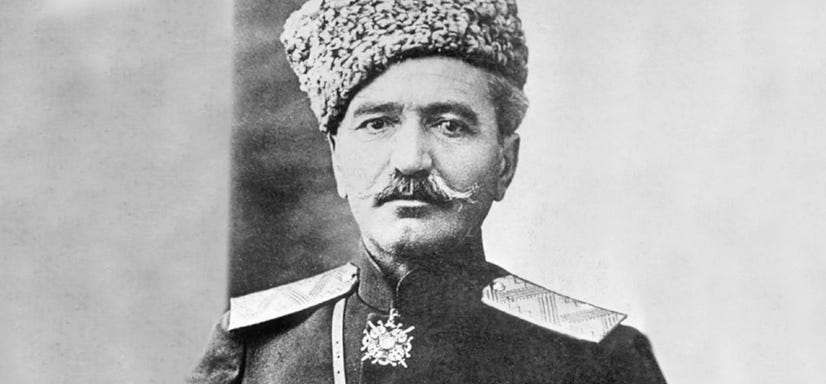
The Armenian revolutionary movement in the Ottoman Empire, which began in the late nineteenth century with the intention of creating a national polity in eastern Anatolia, produced many heroes. Armenians among themselves still celebrate many of them to this day, such as: Andranik Ozanian, Aram Manukian, Garegin Pastermadjian (Armen Garo), Garegin Nzhdeh, Drastamat Kanayan (Dro), Arshak Gavafian (Keri), Kevork Chavush, and Hrayr Dzhoghk. These men worked to inculcate the Armenian national idea and led the armed campaign that sought to make it a reality, culminating in the uprising on the eve of Ottoman entry into the First World War, which not only the Armenians could foresee was the death knell for the Empire. Their names have been occluded to varying degrees by shifting political tides.
Armenian activists and publications from 1914-15 into the 1920s were entirely forthright in celebrating the successes of the nationalist revolutionaries who fought the Ottomans and generally did not disguise that this was done in direct alliance with Russia and the Entente.1 What curtailed this kind of thing was the remnants of the brief Armenian Republic falling under Soviet rule in 1920. The Soviets denounced the wartime rebels and “the Dashnak Republic” as “bourgeois nationalists”. There were changes in the 1950s after Turkey joined NATO and particularly by the 1960s. Moscow saw the utility of the campaign to have the 1915-16 Armenian massacres recognised as genocide in instrumentalising the Armenian diaspora for political warfare against Turkey, specifically the influential Armenian community in the United States.2 This created some minor initial difficulties within Soviet Armenia, but the Soviet Revolution’s official theology had adapted to incorporate the “national liberation movements” within the Third World Strategy, and it was easy enough to channel Armenian national sentiment into this program.
Space was made for Soviet Armenian publications arguing that 1915 was genocide, and these books, translated into English and other Western languages, circulated in Armenian émigré activist circles. These works were foundational to the movement that would in time pressure Western legislatures to recognise Turkey as guilty of genocide, and in parallel emerged Armenian terrorist organisations that targeted Turkish diplomats and civilians in the name of revenge for the genocide and forcing Ankara to abandon its policy of “denial”.3 The confrontational atmosphere and broad popularity of the “guerrillas” revived the Armenian willingness to incorporate the insurgents into the story of 1915, albeit often reframing their role as resisting genocide.4
Academics have been somewhat more hesitant to complicate the genocide debate by giving full recognition to the achievements of the Ottoman-Armenian revolutionaries in developing their movement from the 1890s, the consistency and efficacy of their provocation strategy over two decades, the scale of the rebellion they managed in 1914-15, and their political versatility in securing external support.5 This is a shame because it is a very interesting story in its own right, and foreshadows so many things.
THE EMERGENCE OF THE ARMENIAN NATIONAL MOVEMENT
The organised Armenian national movement in the Ottoman Empire began in the 1860s, but it really took off in the 1870s against the backdrop of the “Great Eastern Crisis”.
A Christian revolt spread through the Ottoman Balkans starting in 1875, most importantly to Bulgaria, where the fierce government reaction electrified opinion in Christendom, leading to one of the first modern international “human rights” campaigns.6 In 1877, Russia stepped in and, after the traditional period of military calamity, overwhelmed the Ottomans. The Russian-dictated peace in the Treaty of San Stefano in March 1878 so alarmed the other European powers—especially Britain, which had propped up the Ottoman Empire through most of the nineteenth century, in no small part as a bulwark against Russia—that the Congress of Berlin was convened to revise the terms.
In the superseding July 1878 Treaty of Berlin, Britain, having signalled a willingness to go to war to prevent Russia reaching its theological-strategic dream of capturing the Ottoman capital, Constantinople, and the Straits, managed to whittle down the Russian victory.7 London could not prevent the Ottomans losing control of Bulgaria, Romania, and Serbia in the west, but it did secure the return of Macedonia to the Ottomans. Similarly, while the Russian annexation of territory containing Batum, Kars, and Ardahan—all cities with important Armenian minorities—was a fait accompli, Britain reversed Russia’s plans for the rest of the east. Russia was to have occupied the so-called Six Provinces in eastern Anatolia where the Ottoman-Christian population was most-heavily concentrated over the widest area,8 nominally only long enough to oversee “reforms”.9 The British and Ottomans understandably doubted the Russians would ever leave.
Britain instead settled for a clause on the Armenian Question in the Berlin Treaty that obliged “the Sublime Porte … to carry out, without further delay, the ameliorations and reforms demanded by local requirements in the Provinces inhabited by the Armenians”. Crucially, the Great Powers arrogated to themselves a right to “superintend [the reforms’] application”. Britain was the centre of humanitarian agitation about the “Bulgarian horrors” and demands for a morality-driven foreign policy. The clause appeared to satisfy British strategic and moral concerns, but it would provide the Russians much greater satisfaction.
The Ottoman Empire was used to being subject to European political and ideological influence,10 and to Ottoman-Christians being an important conduit. Almost as soon as the Ottomans got seriously enmeshed in the European State system they had to content with the destructive reverberations of the French Revolution, notably nationalism. Ottoman-Christians, with their conceptual and linguistic links to the West, were the most vulnerable to this Enlightenment contagion, and the Greeks were early victims. However, the Armenians were initially less affected,11 and well into the nineteenth century were known as “the loyal community”.12 The direct European interference in Ottoman internal affairs after 1878 was new, and this change cannot be disentangled from the reconfiguration of relations between the Ottoman State and its Armenian subjects over subsequent decades.
The nascent Armenian national movement burgeoned in an internationalised context, its political aspirations integrally tied to European patronage.13 The Bulgarian example—of Christian revolutionary organisations instigating a rebellion and international outrage at the Ottoman response leading to a Russian intervention that secured independence—inspired emulators among the Armenians.14 The difference was that as the Armenian revolutionary committees formed over the next decade, there was already a framework in place for their armed provocations to induce Russian intervention (and, as we shall see, this tacit cooperation that existed from the beginning would become ever-more direct over time). The 1878 treaty, which tried to square the sincere British commitments to Ottoman territorial integrity and improving the humanitarian situation for Ottoman-Armenians, had created a set-up where Russia could use the latter as a pretext to undermine the former.15
This did not go unnoticed. The Porte would come to see the Armenian national movement and the “international law” instruments surrounding it as a stalking horse for secession and foreign annexation of Ottoman territory. At a popular level, the corollary was increasing Muslim resentment towards Armenians and other Christians as a “fifth column”: a disloyal and threatening vector for foreign schemes against the Empire.
ARMENIAN “NATIONAL LIBERATION” WARFARE
The first underground Armenian revolutionary entity, established in 1885, was the Armenakan Party, whose main leader was in France.16 The party was more liberal ideologically, ambiguous about violence; and failed to establish a broad base of support or much practical influence outside of Van. The two primary Armenian revolutionary committees were the Hunchaks and Dashnaks, founded in 1887 and 1890, respectively.17 These groups are sometimes called “Armenian Narodniks” and for good reason: ideologically, both combined nationalism and socialism in the manner of the Russian Narodniki terrorist-revolutionaries; not-coincidentally, both operated in an international milieu where the Narodniki were powerful; and both were created abroad and had among their leaders Armenians who had either been born in the Russian Empire or lived there most of their lives. The Hunchaks were founded in Switzerland, specifically in Geneva by men in close proximity to exiled Narodniki,18 and the Dashnaks originate in Russia itself. There was schism and factionalism, as so often occurs with extremist groups,19 but broadly they pushed in the same direction.
The Hunchaks were overtly devoted to independence—and ultimately to irredentism, wishing to conquer “Ottoman Armenia” first, and then expand this State to include Russian- and Persian-Armenians. The Hunchaks sought to indoctrinate Ottoman-Armenian “peasants and workers” with nationalist-socialist propaganda; to stir up protests and other forms of disobedience, such as refusals to pay tax; and to “elevate the spirit of the people” via terrorism, which was always framed as “self-defence”.20 The Dashnaks spoke more ambiguously of “freedom”, defined in Marxian terms, and tended to frame their objectives in an Ottoman context, even officially expressing wariness about external support.21 In theory, this made the Dashnaks the “moderates”, willing to engage the Ottoman government and settle matters internally with concessions on national rights and autonomy. In practice, the distinction eroded by the 1900s, if not before, with both committees conducting their campaigns through a combination of a legal political party and terrorism, exactly as the Narodniks did in Russia, with the difference that the Armenian revolutionaries acted with an eye towards inducing European Great Power intervention.
In May 1893, the British Consul in Erzurum, Robert W. Graves, met a captured Armenian from one of the committees, who echoed the Russian terrorist-revolutionaries precisely in his explanation that socialist ethics meant the ends justified the means and the worse the situation was for Armenians, the better the chances were for revolution. “He was paid for this work by funds from abroad”, Graves cabled to the ambassador in Constantinople, “and the attention of the movement was, he declared, to cause such disturbances in the country as should attract attention to the oppressed condition of his fellow-countrymen and compel the interference of foreign powers.” Graves met many more Armenian revolutionaries and reflected later in his memoirs: “They were quite cynical when remonstrated with on the wickedness of deliberately provoking the massacre of their unfortunate fellow-countrymen … without any assurance that the lot of the survivors would be any happier, saying calmly that the sacrifice was a necessary one and the victims would be ‘Martyrs to the National Cause’.”22
A report commissioned by the British ambassador to the Porte, Sir Philip Currie, noted in March 1894 that “the immediate aim of the [Armenian] revolutionaries is to incite disorder, to cause inhumane reprisals, and thus to provoke the intervention of the Powers in the name of humanity.” Interestingly, the report—without knowing it—documented another similarity with the Narodniks: the Armenian revolutionaries’ support base was semi-educated young men, while the mass of Ottoman-Armenians were indifferent at best. The secular and religious leaders of the Ottoman-Armenian population had opposed revolutionary doctrines emanating from the West for nearly a century,23 evidently with some success.
Also in 1894, the Armenian Patriarch in Constantinople, Khoren Ashekian, powerfully condemned the Armenian nationalists for sowing communal strife that could only lead to disaster for Armenians when the inevitable Turkish backlash arrived and the revolutionaries’ false belief the Russians would save them was exposed. The Hunchaks responded by trying to assassinate Ashekian, twice,24 setting the template for the Armenian committees’ behaviour and that of the many revolutionary movements to come, always at least as concerned with eradicating dissent in the community they claimed to represent as combatting the State.
Cyrus Hamlin, an American Protestant missionary to the Ottoman-Armenians since the 1840s and one of the founders of the elite Robert College in Constantinople, spoke to a Hunchak leader in December 1893, who explained that the Armenian revolutionaries planned to take their “opportunity to kill Turks and Kurds, set fire to their villages and then make their escape into the mountains”, whereupon “enraged Muslims will … fall upon the defenceless Armenians and slaughter them with such barbarity that Russia will enter in the name of humanity and Christian civilisation and take possession [of eastern Anatolia].” When Hamlin denounced this as immoral, the Hunchak responded: “It appears so to you, no doubt; but we Armenians have determined to be free. Europe listened to the Bulgarian horrors and made Bulgaria free. She will listen to our cry when it goes up in shrieks and blood of millions of women and children.”25
The Hunchaks, the leading Armenian revolutionary element in the first phase, had a strategy of provocation encoded in their founding program, Article 6 of which read: “The time for the general revolution will be when a foreign power attacks Turkey externally. The party shall [at that time] revolt internally.”26 As the above shows, this was not an abstraction: it was what the Armenian terrorists across all of the committees at ground level understood themselves to be doing. Sometimes it did not work at all, as with the arson attack in then-Ottoman-ruled Thessaloniki in 1890, which the Hunchaks were almost certainly behind. A third of the city burned down, but there were no indiscriminate reprisals on Ottoman-Armenians.27 And, as the Armenian committees were soon to discover, though not to learn from, the tactic might work insofar as it provoked massacres, without bringing a decisive, Bulgarian-level European intervention.
In August 1894, Hunchak fedayi (guerrillas), consciously seeking Great Power intervention, ignited an Armenian rebellion at Sasun that spread across eastern Anatolia.28 In a foreshadowing of 1915, the official repressive measures were accompanied by horrific massacres of Armenian civilians, many carried out by the “Hamidiye”, the Cossack-modelled irregular units of Kurdish tribesmen created in 1891 to protect the eastern frontier.29 European sentiment was duly aroused and in May 1895 the Great Powers presented a Reform package to Sultan Abdul Hamid II (r. 1876-1909), which he was obliged to sign in October. But the measures were not binding and were never implemented. Nonetheless, the political effect of Great Power intervention on the back of Armenian provocations was quite profound, even in the short-term, epitomising and exacerbating the confrontational communal-political trends in the Ottoman Empire. It was taken as confirmation of the Muslims’ darkest fears, with a concomitant escalation of repression that made 1896 a year that lives in infamy for Armenians even now, and yet it was also seen as strategic vindication by the Armenian revolutionaries.30
The magnitude of the Armenian revolutionary challenge was evident in Armenian rebels contesting control of the cities, notably Zeytun (now Süleymanlı) and Van, up to a late stage in the crisis in 1896. Even after urban fighting ended, Armenian revolutionaries staged a terrorist “spectacular”, a classic “propaganda of the deed”, by occupying the Ottoman Bank in Constantinople on 26 August 1896. It was indicative of intra-Armenian dynamics that the perpetrators at this stage were the Dashnaks: the Hunchaks had been enduringly wounded, physically and politically, by the 1894-96 events, and the Dashnaks would become the leading element of the national movement. European diplomats arranged safe-passage for the terrorists to France and the European press reported on their cause sympathetically, not least because the bank seizure touched-off a wave of pogroms against Armenian civilians in the capital that killed thousands before the Ottoman government could stop them.
The Porte tried to draw a line under all this with an inquiry to, inter alia, reassure Ottoman-Armenians of the State’s good intentions and to quiet foreign criticism. It backfired, predictably and absolutely, uncovering official failings and misdeeds the Armenian revolutionaries could use in their propaganda and focusing unprecedented international critical attention on the Ottoman government.31
In July 1897, a Dashnak-led, Hunchak-supported contingent of Armenian fedayeen—the Russian-born Dashnak Sargis Mehrabyan is perhaps the best-known—invaded the Ottoman Empire from Iran and assaulted the encampment of the Kurdish Mazrik tribe on the Khanasor plain in Van Province. The raid was billed as revenge for the anti-Armenian atrocities in Van a year earlier, which the tribe was allegedly primarily responsible for. About 250 Kurds were massacred, many savagely mutilated. The Dashnaks insisted—and European reports of the event took their word—that those killed were all adult males; some accounts say women and children were among the dead.32
In March-April 1904, another Armenian revolt rocked Sasun. Hundreds of Dashnaks, led by Andranik, infiltrated the area from Russia, distributed weapons to local rebels, and began attacking Muslim villages, seemingly with the intention of provoking reprisals that could trigger European intervention. The Ottomans suppressed the revolt—the most prominent Dashnak martyr was Hrayr Dzhoghk—and thousands of Armenian civilians were reportedly massacred yet again, though the British Consul visited the area soon afterwards and said that, on the evidence he had seen, “it would be difficult to sustain charges of massacre and atrocities”.33
An Armenian revolt in Muş, west of Lake Van, in the summer of 1905, was relatively swiftly overcome, apparently with 5,000 fatalities all around.34
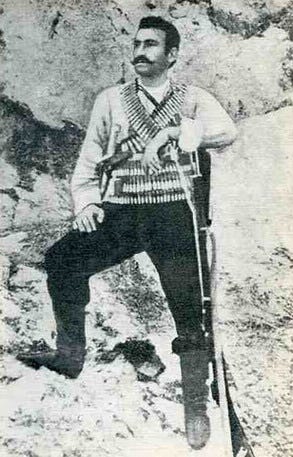
All through this period, less visible to foreign newspaper-readers, there was relentless Armenian subversion and guerrilla activity. A glimpse of this phenomenon can be seen in the life of Kevork Chavush, a Dashnak fedayi commander in the Sasun area. Working to raise nationalist consciousness among Armenians and create tensions with the State—over land, taxes, any flash-point he could find—Chavush was known as “the man with the dagger who was always ready to punish those who molested the defenceless people”. An example of what this meant was Chavush’s assassins, after the suppression of the 1904 revolt, stabbing a Kurdish chief to death in his home, along with his wife and children. Chavush was killed in a clash with Ottoman troops in 1907. Such deliberately terrorising assassinations were standard fare from the Armenian fedayeen.35
The nationalist coup in mid-1908 (“The Young Turk Revolution”), which brought the Committee of Union and Progress (CUP) to power, changed the situation for a time. The CUP, though indelibly associated with the anti-Armenian atrocities of 1915, had worked with the Armenian revolutionaries in opposition and took a liberal approach to the Armenian Question in government. The CUP equalised rights for Christians, creating increased legal space for Armenian political activism, granting Armenians permission to bear arms, and brought Christians into the Ottoman army, while taking measures to reduce the Kurdish threat to the Armenians by disbanding the Hamidiye, imprisoning renegade commanders, and appointing local administrators committed to disciplining the Kurds.36
In response, the Armenian committees officially called off the terrorism campaign, until the cooperation with the CUP broke down in early 1912.37 The official stance did not always reflect ground reality in the provinces, and in 1911, as relations with the CUP frayed, there was a “politics by day, terrorism by night” dimension to the Dashnaks.38 In the meantime, the Armenian-CUP cooperation itself created new sources of trouble, namely blocs of opponents on either side. Some Armenians favoured the old ways of subsidiarity and among Muslims the CUP policies were broadly opposed for favouring minorities.39 These ultras made themselves felt, most notably in March-April 1909, with a failed Islamist and monarchist counter-coup in Constantinople, and an Armenian uprising in Adana incited by the local bishop, Moushegh Seropian, which spiralled into communal violence throughout Cilicia that is said to have killed up to 20,000 people.40
Chavush and people like him made a lot of effort to arm Armenian civilians in eastern Anatolia, and the stated justification was a good one: self-defence against the marauding Kurdish tribes, whose menace continued despite the political changes at the centre in the 1908-12 period, not least because—as we will get to—the Kurds could acquire arms from outside.41 As in many similar situations of instability and civil strife, this individually rational solution contributed to the overarching problem it was meant to solve. The Ottomans never formally lost the Six Provinces, as they did with the Balkans, but Ottoman State collapse at the periphery was the same at either end of the Empire. The de facto rulers in the east were the Kurdish tribal chiefs, some of whose nomadic militias were implicitly allied to the State, but pinpointing who was on who’s “side” in the Russo-Ottoman borderlands is damnably difficult. Kurdish tribal leaders and sub-leaders regularly fought against Ottoman gendarmes and troops. Armenian committees fought against the Ottoman government and sometimes fought with Ottoman State forces against the Kurds. The Ottoman government intermittently paid and even armed the Dashnaks to destabilise neighbouring rivals. The one constant was Kurdish attacks on Christians, a blend of ideological sectarianism and sheer banditry.42
THE RUSSIAN DIMENSION
It was in these troubled waters that the Russians were fishing by the late 1890s, a policy of meddling in the internal politics of the Ottoman Empire, specifically in the Six Provinces, that continued uninterrupted through the outbreak of the First World War up to late 1917 and in certain respects continued after the Bolshevik coup. The Russian dimension to events in eastern Anatolia in this period is so pervasive that, as Sean McMeekin has written, it is a “serious distortion of the truth to tell the story of the Armenian tragedy of 1915 without reference (or with only passing reference) to Russia. It is akin to writing about, say, the ‘bloodbath in Budapest’ during the ill-fated Hungarian Revolution of 1956 without reference to the Soviet Union.”43
The Tsardom had a habit of working with all sides to a conflict, and seeing conflict itself as advantageous, not any specific outcome.44 In eastern Anatolia, that meant Russia being the primary armourer of the Kurds and the Armenians. As Russia had no intention of assisting any of its clients to achieve particular purposes, only a modest outlay was needed to sustain a positive feedback loop of omnidirectional chaos that weakened Ottoman State power and authority. Ottoman troops were tied down in counter-insurgency operations, while support to the Kurds—so extensive there were Kurdish language institutes in Saint Petersburg—enabled depredations against the Armenians that increased Armenian calls for Russian protection.45 Into the bargain, the Ottoman government was often blamed by foreign States and humanitarian activists for Kurdish outrages, damaging the Porte politically, and the Armenian revolutionaries felt themselves ever-more reliant on Petersburg.46
Russian ambitions went beyond hiving off the “Armenian Provinces”. It was hoped in Petersburg to dismember the whole Ottoman Empire and annex large chunks, including the capital. It was in the wake of the 1894-96 Armenian uprisings and massacres that “Russia first began serious logistical research into the possibility of staging an amphibious operation at the Bosphorus”, and the Russians intensified the development of these plans after the violence in 1909. A Russian operational plan from this period envisioned “agents from the Christian population”—Macedonians and Bulgarians in Europe, Greeks and Armenians in Anatolia—preparing the way for a Russian invasion by cutting off rail lines to Constantinople, whereupon native Christians would “burn down all the wooden bridges spanning the Golden Horn and set fire to Stambul”.47
The long Ottoman decline that began in the late seventeenth century culminated with the Ottoman defeat in the Balkan Wars of 1912-13, and the importance of this episode in shaping what happened in 1915 can hardly be overstated. Coming a year after Italy had taken Libya, it accentuated the general Ottoman sense of existential dread—that the Empire was defenceless against foreign enemies—and it was singularly unnerving, bringing the frontier dangerously close to the capital, and removing the Balkan territories that had “for long [been] the centre of gravity of the Ottoman Empire”.48 The Russian role, more reactive than enthusiastic it is true, was nonetheless key in organising the Balkan coalition that attacked the Ottomans.49
The impact of the Balkan defeat on the Ottomans heading into 1915 had at least three elements.
First, the public messaging cast a long shadow. The Russians led in lauding the outcome as a victory for Christendom, eliminating the final Islamic toehold in Europe. On the one hand, it drove home to the Ottomans that they were at their lowest ebb, in no condition to handle minor Christian States, never mind the Great Powers. On the other hand, it stoked an Ottoman Muslim thirst for anti-Christian revenge.
Second and related, the arrival in the Ottoman Empire of half-a-million Muslim refugees (Muhacir), uprooted after centuries of colonial settlement and bearing horror stories of massacres and worse, inflamed sectarian sentiment further. This was personal for some in the elite, since quite a number of the CUP leaders originated in the Balkans, including the Bulgarian-born Talat Pasha, the Party chairman and Ottoman Interior Minister (as well as Grand Vizier after February 1917). Muhacir atrocity narratives mobilised anti-Christian violence even before 1915 and in the events of 1915 a significant number of the perpetrators were the Muhacir, who had, by happenstance and some degree of design, been placed in the Christian areas.50
Third, the immediate-run Russian diplomacy and covert action that fused the Balkan events with the Armenian Question in everyone’s mind.
The Balkan Wars seemed to herald the disintegration of the Ottoman Empire. In late 1912, Russia tried to organise the Kurdish tribes in the east into a unified force that could finish the job.51 Kurdish unity cannot be accomplished by any human force and it is an open question if God Himself would fare any better. Fortunately for Russia, it had maintained a diverse portfolio of clients in eastern Anatolia, and the Armenian option proved much more fruitful.
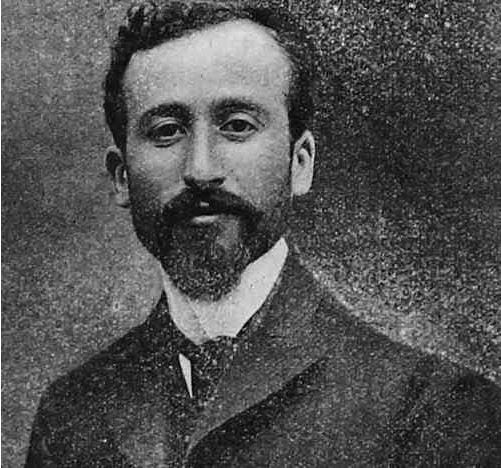
In December 1912, as the Ottoman Empire seemingly fought for its life against Russia’s allies in the Balkans, Armenian committee violence flared to life. Arshak Vramian, one of the Dashnak terrorists at the Ottoman Bank in 1896 and by this time an American citizen, told the French Vice-Consul in Van: “It does not matter if the Armenians are killed instead of living as they are living! We are determined to restart the revolutionary action we had suspended for four years”.52 Vramian had specified that he meant assassinations and the Mayor of Van, Bedros Kapamajian, an Armenian, was duly murdered.53
The same month, Russia put the Armenian Question back on the international agenda, coinciding, though not coincident, with a diplomatic-agitation mission to Europe by Boghos Nubar, a prominent Ottoman-Armenian activist. Nubar set himself up as head of the Armenian National Delegation in Paris and sent letters on behalf of the Armenian Catholicos to Russian diplomats imploring Petersburg to pressure the Porte into granting Armenian autonomy. Russian Foreign Minister Sergey Sazonov seized on this to secure British and French backing for new Reform talks, while hinting broadly that Russian occupation of eastern Anatolia was inevitable. The tell as to the real source of Russia’s angst at that time was the raising of petitions calling for Ottoman-Armenians to be given Russian citizenship (a Russian Imperial tactic not-unfamiliar at the present time). The Ottoman government had generated a plan to resettle the Muhacir displaced from the Balkans in the Six Provinces and Petersburg wanted to thwart it “because the policy would have reduced Russian influence in the region”.54
The success of the Internal Macedonian Revolutionary Organization (IMRO) in particular in the Balkans provided an inspirational model, and the Armenian revolutionaries went all-in on terrorism as the means to accomplish their goals in 1913. The Dashnaks and Hunchaks refashioned their structures in eastern Anatolia along IMRO-style paramilitary lines. The Armenian guerrillas smuggled weapons into the Ottoman Empire on an unprecedented scale in early 1913 from Iran and Russia, where the Okhranka, the Tsar’s secret police, ensured that border guards looked the other way. The Armenian committees’ ostensibly principled “anti-imperialism” was all-but openly cast aside: Dashnaks met Russian officials and made clear their view of Russian imperialism as an emancipatory force. This sentiment spread wildly among the Armenian population. Aleksandr Olferiev, the Russian Vice-Consul in Van, reported gleefully in March 1913 that the “mood of Armenians” throughout the province, previously somewhat ambiguous, was now “one of complete Russophilia … the Dashnaks are completely on our side.” The next month, Olferiev documented that Van had become “an armed camp”: “all the Armenian merchants are stockpiling guns in their stores”.55
Russian delight was slightly disrupted by the Kurdish tribes, who, sharing in the common belief of the Ottoman State’s imminent demise, were emboldened to ravage the Christians on a major scale. Peterburg rather cynically protested to Constantinople on 29 May 1913, and was then unpleasantly surprised when, ten days later, the arriving Ottoman troops in Van were joined by 500 Dashnaks in putting the Kurds to flight. Armed revolt scuppered for now, the Russians redoubled their political warfare. Despite the complexity on the ground, with its clear evidence the Ottoman government was trying to protect the Armenian population even when it meant sending troops needed for a war that was closing in on its capital, the Russians escalated the international campaign accusing the Porte of atrocities against the Armenians and demanding Reforms “according to the 1895 draft”.56
A Reform treaty, over German objections, was forced on the Ottomans in February 1914: notably, it was signed solely by Russia on behalf of the European Great Powers. The terms would have infringed Ottoman sovereignty in the Six Provinces by creating a system of European inspectorates that not only judged the reforms’ progress but administered them. Germany was able to help the Ottomans slow-roll the implementation process—and the Great War ultimately prevented the inspectors, who had been appointed, taking up their posts.57 However, the sequence of events leading up to the treaty, its terms, and the repeated, menacing remarks of Sazonov during negotiations—threatening a Russian invasion if there was one more massacre of Armenians—“confirmed for the Porte that the whole Armenian reform issue was just a Trojan horse for Russian imperialism”.58
AND THE WAR CAME
It was not foreordained that the Ottoman Empire would join the First World War on the side of the Central Powers—or at all. Britain had tried to keep the Ottomans out of it, and many in the Ottoman government, more acutely aware than ever of the Empire’s weakness, favoured neutrality. However, the Ottomans had been moving closer to Germany for some time and the longstanding Ottoman-British alliance decisively broke down simultaneous with the outbreak of war in Europe.
During Kaiser Wilhelm II’s grand tour of the Ottoman Empire in 1898, he had ostentatiously declared himself protector of all the world’s Muslims. The Kaiser was genuinely, personally drawn to Islam and the rumour Germany now had a Muslim Emperor spread widely in the Middle East. Strategically, the Kaiser was thinking at this stage of working through the Caliph to raise a global jihad that would trigger rebellion among Britain’s Muslim subjects—and the Kaiser would, by 1914, have the same idea for Russia.59 German money and weapons flooded into the Ottoman Empire, German military personnel were increasingly prevalent throughout the Ottoman army, and German diplomats became influential over Ottoman State administration and decision-making. The construction of the Berlin-Baghdad Railway, which began in 1903 and would weaken Britain’s naval strength, symbolised this entanglement. One could be forgiven for thinking in mid-1914 that the Ottoman government had already gone over to the Germans.
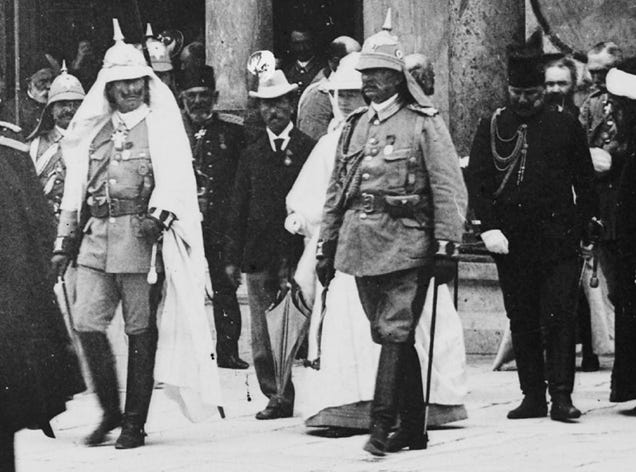
In this context, it is debateable whether Britain “requisitioning” two fully-paid-for Ottoman dreadnoughts at British shipyards on 29 July 1914—the event often pointed to by Turks as determining Ottoman policy in the First World War—was cause, catalyst, and/or pretext.60 For one thing, the Ottomans had, as Britain feared, offered to send one of the ships to Germany.61 For another, when the Porte was officially informed of the requisition on 3 August, it had already, a day earlier, signed a secret treaty with Germany promising to come into the war on the Central Powers’ side if Russia got involved. Austria joined the treaty on 5 August—the same day the Ottomans publicly declared neutrality. Ten days later, a German Admiral, Wilhelm Souchon, was made commander-in-chief of the Ottoman fleet. By this time, Ottoman and German subversive missionaries had been dispatched to the Persian Gulf (then-under British control) and to Iran and Afghanistan (surrounding British India) to encourage them to jihad against the Entente. As we shall see, the Ottomans were effectively at war with Russia by September. The Ottomans then closed the Dardanelles to Allied shipping on 1 October.62 Whatever one’s interpretation of the causality, the result was the supremacy over the Ottoman State of a CUP cadre closely bound to the German General Staff.
Overcoming the neutrality faction in the Ottoman government was accomplished by the German-allied Ottoman War Minister, Enver Pasha, conspiring with Admiral Souchon to launch a naval raid against Russia in the Black Sea on 29 October 1914. The Russians had already begun their invasion by the time they declared war on the Ottomans on 2 November. Britain and France followed with war declarations against the Porte on 5 November. The Ottoman Sultan-Caliph proclaimed a jihad against the Entente on 11 November, and three days later the proclamation was read out in Constantinople by the ulema, along with five fatwas, lavishly paid for by Germany, declaring it a duty for Muslims to wage war on the Christian enemies of Islam, except Austrians, Germans, and Americans. Theologically, this made no sense, and in practice the distinctions were difficult to hold on to. The fatwas could easily be read as sanctioning violence against Christian civilians even in neutral European countries, and the popular interpretation—manifested within days—was that the call was for war against Christians, full stop.63 It is impossible to believe that this holy warmongering was not a factor in what happened in 1915.
The British Prime Minister, Herbert Henry Asquith, was greatly saddened by this turn of events, lamenting, “The Turkish Empire has committed suicide, and dug with its own hands its grave”.64 The CUP government had entered the war hoping to reverse the Empire’s decline, but soon confronted Asquith’s prescience, buffeted by the interlinked twin existential crises for the Ottoman State of external invasion and internal Armenian rebellion, which began before the war and escalated once it was underway, led by the Armenian terrorist-revolutionary committees that openly collaborated with the Entente, especially Russia, and drew on various forms of popular participation from an Armenian civilian population that in the main saw Ottoman dissolution as liberation. It was in these circumstances that the Armenian calamity took place.
The Armenian Volunteers
The Dashnaks’ eighth World Congress—bringing together the organisation’s branches from Russia, the Ottoman Empire, Europe, and the United States—met in in late July 1914 in Erzurum,65 and concluded on 2 August 1914 with a public decision that Armenians should do their duty as citizens of their individual States, not get involved in foreign intrigue. The Ottoman-Armenian delegation cited this decision in refusing the reported offer of CUP representatives at the Congress to grant autonomy to “Turkish Armenia” in exchange for the Dashnaks helping to foment rebellion inside Russia. Turks are not shying at shadows in questioning the sincerity of this, and suspecting a Russian-coordinated rebellion against the Ottoman State was already in the works.66
In 1923, shortly after it was all over—the rebellion, the deportations, the massacres, the rise and fall of an Armenian Republic, and the Sovietization of what was left—the Dashnak leader and first Prime Minister of the Republic, Hovhannes Kajaznuni, bluntly stated:
At the beginning of the Fall of 1914, when Turkey had not yet entered the war …, Armenian revolutionary bands began to be formed in Transcaucasia with great enthusiasm … Contrary to the decision taken during their general meeting at Erzurum only a few weeks before, the A.R.F. [Dashnaks] had active participation in the formation of the bands and their future military action against Turkey. … We had no doubt the war would end with the complete victory of the Allies; Turkey would be defeated and dismembered, and its Armenian population would at last be liberated.
We had embraced Russia whole-heartedly without any compunction. Without any positive basis of fact, we believed that the Tsarist government would grant us a more-or-less broad self-government in the Caucasus and in the Armenian vilayets liberated from Turkey as a reward for our loyalty, our efforts, and assistance. … [W]e had lost our sense of reality and were carried away with our dreams. … We overestimated the ability of the Armenian people, its political and military power, and overestimated the extent and importance of the services our people rendered to the Russians. … The Turks knew what they ought to do and did it.67
This view was echoed by Kapriel Papazian, head of the Ramgavar Party:
[T]he answer given the Turks [in refusing to help ignite rebellion inside Russia] was based on a resolution adopted by the [Erzurum] convention. The fact remains, however, that the leaders of the Turkish Armenian section of the [Dashnaks] did not carry out their promise of loyalty to the Turkish cause when the Turks entered the war. … They were swayed in their actions by the interests of the Russian government, and disregarded, entirely, the political dangers that the war had created for the Armenians in Turkey. Prudence was thrown to the winds; even the decision of their own convention of Erzurum was forgotten, and a call was sent for Armenian volunteers to fight the Turks on the Caucasian front.68
As indicated in those quotations, the sentiment of the committees was general among Armenians. One of the leading historian-advocates of Armenian genocide-recognition has written of this time: “Although most Armenians maintained a correct [outward] attitude-vis-a-vis the Ottoman government …[,] the manifestations of loyalty were insincere, for the sympathy of most Armenians throughout the world was with the Entente”.69
It was in this heady atmosphere, with Russian deliverance and national liberation seemingly at hand, that many Armenians reacted to the Ottoman general mobilisation order on 3 August 1914, the day after the secret treaty with Germany, with open defiance, and the line between draft resistance and rebellion was a fine one. Thousands of Armenians conscripted into the Ottoman army deserted: some formed armed bands that clashed with the State; some, with the assistance of the Dashnaks, crossed the border into Russia, heading for Tiflis, where the Chief of Staff of the Russian Caucasus Army, General Nikolai Yudenich, already had an operations room to enlist Armenian volunteers. Many more Armenian civilians similarly voted with their feet and moved to Russia, a migration flow that would reach 200,000 by late 1915.70 Veteran Ottoman-Armenian revolutionaries, the deserters, and civilian volunteers were merged into Russian military units with Iranian-Armenians and Russian-Armenians, both from the Russian Caucasus “proper” and the slice of the Ottoman east Russia annexed in 1878.
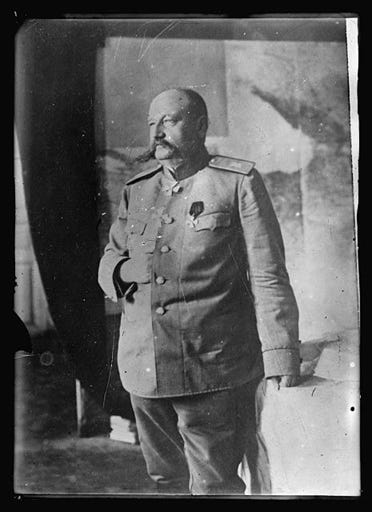
One of the prominent Ottoman-Armenian representatives at the Erzurum Congress, Garegin Pastermadjian (Armen Garo), had signed-up with the Russians by mid-September 1914. Pastermadjian, a Dashnak terrorist at the Ottoman Bank in 1896 and a deputy in the Ottoman Parliament during the reconciliation period with the CUP, would command of one of the Armenian volunteer units that invaded the Ottoman Empire as part of the Russian army six weeks later.71 The commander of another of these units arrived about the same time, Arshak Gavafian (Keri), a roving Ottoman-Armenian insurgent, who had inter alia fled Sasun in 1904 and engaged in the Iranian “Constitutional Revolution” the next year.72 The dazzling Ottoman-Armenian Dashnak General Andranik, another unit leader, whose most recent round with the Porte was fighting alongside the Bulgarian rebels, arrived in Tiflis much earlier, on 2 August 1914, and was soon joined by Garegin Nzhdeh, another participant in the Balkan Wars, and Hampartsum Arakelyan, editor of Mshak, the leading Armenian-language newspaper in the Caucasus.73 Another of the unit commander’s present from early on, Drastamat Kanayan (Dro), had a very similar life trajectory to Nzhdeh: both were technically Russian-born but spent most of their lives involved in Ottoman affairs and lived long enough to collaborate with the Nazis in the next war.
The prestige of these men and many others proved magnetic in bringing Armenians, Ottoman or otherwise, into Russian ranks.74 By the end of August 1914, the Russian train-and-equip program for Armenian volunteers was so swamped Yudenich had to ask the Stavka for 25,000 more rifles. “The Russian army, then, actively sought to arm Ottoman Armenians [inside the Ottoman Empire] even before Turkey entered the war, with the full cooperation of the Dashnaks, General Andranik, and Armenian leaders in Tiflis. So, too, was the Russian Foreign Office involved, and at the very highest level.”75 We will come to this dimension of the Russian operation in more detail momentarily.
As participants in the enterprise make clear, the organisation of the Armenian volunteers into formal units was complete by mid-September 1914, and these units were attached to Russian army all along the line in the Caucasus. Other Armenians were trained by Russian intelligence for reconnaissance and sabotage missions.76 The Russian army had five Dashnak Armenian volunteer druzhinas when it invaded the Ottoman Empire in November 1914 and a sixth legion led by Hunchaks was soon added. There were also multiple smaller irregular volunteer detachments.77
The number of Armenian volunteers is, as with so many historical numbers, highly politicised and fundamentally unknowable. There were not less than 6,000 spread through the six druzhinas, and that increased considerably in short order. One of the Russians’ key Dashnak collaborators reported that “20,000 Armenian volunteers … responded to the call” to “take up arms against the Turks”.78 The British estimated the Russians had nearly 45,000 Armenian volunteers by the end of October 1914.79 Another Armenian volunteer said their number was 20,000 just “at the front” in Van by mid-1915.80 Armenian political leader Boghos Nubar puts the figure around 50,000,81 and Russian historians give the same figure, estimating that 11,500 of them were Ottoman-Armenians spread across twenty-three Russian units.82
Taner Akçam, a leading historian arguing the Ottomans committed genocide in 1915-16, has claimed that the Russians’ Armenian volunteers had a “far greater” psychological than military importance, in their impact on the “imagination” of the Ottoman leaders towards their Armenian subjects.83 Contemporary Ottoman, Armenian, and Russian sources all disagree with this, describing the Armenian volunteers as highly-motivated and proficient, playing a significant role in the initial military disasters for the Ottoman army in eastern Anatolia.84 It was in recognition of this Armenian contribution to Russian arms that Tsar Nicholas II made a personal visit to the Armenian Cathedral in Tiflis on 13 December 1914, where he was publicly hailed by Alexander Khatisian, the president of the Armenian National Bureau, who made a speech saying: “Armenians from all countries are hurrying to enter the ranks of the glorious Russian Army, and with their blood, to serve the victory of the Russian Army … Let the Russian flag wave freely over the Dardanelles and the Bosporus. … Let the Armenian people of Turkey, who have suffered for the faith of Christ, receive resurrection for a new, free life under the protection of Russia.”85 If there was “imagination” in the Ottoman government’s view of Armenian dynamics, it seems to have been shared by some significant portion of the Armenians themselves and the Russian Emperor.
The Armenian Rebellion
The Ottoman government’s sense that an Armenian rebellion was in the works had been building over about a year by the summer of 1914, and not without reason.
Some consular reports suggest the Ottoman State’s crackdown on the Kurds in mid-1913 worked for a time to increase public security in the east.86 Other foreign dispatches in the same period suggest the lawlessness was worse than it had been for years. Regardless, the Ottoman government did not believe the ongoing stockpiling of weapons by the Armenian committees was for “self-defence”, not least because the government itself was increasing the amount of arms given to Armenians for that purpose.87 The Ottomans believed the committees’ strategy remained one of preparing for a rebellion in tandem with Russian intervention, which had been delayed by the diplomatic contingencies of mid-1913. It was a view not without foundation.
In mid-1913, the Armenian committees—the Dashnaks, the Hunchaks, and the Armenakan Party—had met in Van and agreed to form a united front, coordinating their revolutionary activity. As so often in insurgent alliances, the most ideologically radical and operationally violent element dominated, namely the Dashnaks (though the Hunchaks had been radicalising on their own). Similarly commonplace was the Dashnaks’ utilisation of this alliance to extend a shadow governance capacity—“taxing” Armenians in Van, for example—which normalised the population cooperating with the insurgents and gave the insurgents access to increasing resources that were used to provide goods and services, a feedback loop that progressively solidified the insurgents’ de facto control and legitimacy.88 Captain Molyneux-Seel, a British official at the Consulate in Van, argued in May 1913 that the committees’ alliance resulted from a meeting Van Dashnak leader Arshak Vramian had “with the Russian authorities” in Tiflis, and a month earlier Molyneux-Seel had reported to London: “[The Armenians have] thrown off any pretence of loyalty they may once have shown, and openly welcome the prospect of a Russian occupation of the Armenian Vilayets.”89
In January 1914, the British Vice-Consul in Van, Ian M. Smith, reported that the Armenian revolutionaries’ “secret importation of arms”, mostly from Russia, was on such a vast scale it was ceasing to be secret: “I have seen Armenians openly carrying these arms in the country districts … In Van it is said that the Armenians are now better armed than the Kurds”. Smith also noted the political dynamics pushing towards confrontation: within the alliance of Armenian committees, the Dashnaks were unquestionably supreme “owing to the more active and extreme policy it pursues”. This included the Dashnaks imposing themselves—and purging Armenian moderates—throughout Van province.90 Van would prove the seismic hinge point, but not yet.
In March 1914, a month after the Ottomans had signed the reform treaty with Russia, a rebellion erupted in Bitlis, just west of Van. It was led by Kurds, specifically a mullah named Selim Efendi al-Hizani. Mullah Selim and the 300 Kurdish chieftains who joined him nominally wanted the restoration of the shari’a and considered the CUP impious, but the Christian economic predominance in the east and the CUP disarming the Kurds had at least as much to do with it. The rebellion was put down by 2 April. The CUP regime at one level breathed a sigh of relief that the Kurds had targeted the government, rather than the Armenians, which would have created dire consequences for relations with the Great Powers at that moment. The warning was taken, though, with measures put in place such as “granting the local governors wider latitude to declare martial law and request military reinforcements, [and] Minister of the Interior Talat ordered that special attention be paid to protecting Christians from future attacks”.91
On the other hand, the Ottoman government was alarmed by the clear Russian fingerprints on the Bitlis uprising, despite ostensibly-friendlier diplomatic relations of late. Mullah Selim was defeated so rapidly because he had jumped the gun: if he had waited, several Kurdish powerbrokers who were actually in Russia would have returned with the weapons transfers they had been arranging. As it was, all the Kurdish chiefs could do was offer words of support, but it showed that Russia had not given up on its Kurdish assets, the disappointing realisation a year earlier that the Kurds could not be brought under a collective Russian-directed leadership structure notwithstanding.92 Ensuring nobody missed what had happened, Selim took shelter in the Russian Consulate and Petersburg refused to hand him over (he was still there when open war began in November). The Porte, therefore, tried to win the Kurds over by granting “financial subsidies, making leading Kurds senators, and pressing the Kurds of Istanbul to use their influence over their brethren in Anatolia”. It was yet another treatment that made the illness worse—and complicated the policy of protecting Christians—but the Ottomans were short of options, unlike the Russians, who could play the Kurdish and Armenian cards simultaneously in “eroding Ottoman control of Eastern Anatolia”, and it was working.93
Just over two weeks later, on 19 April 1914, Talat warned the provincial authorities in Adana and Aleppo that the Armenians in Zeytun and the region around Alexandretta (İskenderun) were smuggling in weapons and preparing for a rebellion. Then there was a lull and some in the Ottoman government began to think—or to hope—that their fears had been misplaced.94 In July, worrying signs reappeared, such as shipments of Russian weapons into the heavily-Armenian Eleşkirt Valley,95 and in the shadow of the Great War commencing the direst Ottoman fears started to manifest.
* * * *
There is a tendency, acknowledged even by those who strongly support recognising the 1915 events as genocide, for scholars to ignore the wartime Armenian rebellion in the Ottoman Empire because to mention it is perceived as giving ammunition to the “Turkish” argument that the deportations were just that, a security measure against a rebellious population with incidental, not intentional, fatalities.96 The unspoken issue is that any claim of genocide is inherently to make an analogy with the Nazi Holocaust of European Jewry, and the Armenian rebellion greatly complicates such a parallel. It is a fact nonetheless.
The real debate is to some extent about the scale of the Armenian rebellion and most fundamentally about the connection between the Armenian volunteers and the Ottoman-Armenian insurgencies. One side sees a firm dividing line between the Russian-controlled “external” volunteers and “internal” rebel activity that was geographically local and had an indigenous impetus. The other side sees two prongs of a holistic Russian strategy. Armenian leaders contemporaneously largely took the latter view, as can be seen from Kajaznuni and Papazian above. Another example is Boghos Nubar, who said the invasion of the volunteers with the Russians was supposed to be the mechanism for igniting Ottoman-Armenian rebellion, that the volunteers would provide an example to their Ottoman “compatriots … in a common action to acquire the rights of autonomy”, as he put it.97 Russian officials said the same thing.98
From early August 1914, Armenian draft resistance was widespread in Zeytun, a city where Armenian nationalist unrest went all the way back to 1862, with recent rounds in 1895-96 and 1909. The committees soon appeared to organise Armenian demands that they be excused service in the Ottoman army and allowed to set up their own volunteer unit that would “defend” the city, i.e., administer it autonomously. This would have been refused at any time, but the language of “volunteers” at that moment, with what the Russians were doing in the Caucasus, naturally spooked the Ottoman government. The committees exacerbated Ottoman dread by reacting to the refusal with an armed revolt in Zeytun on 30 August 1914. The court house was attacked, Ottoman officers (and some of their families) were killed, and telegraph lines brought down. The guerrillas were scattered quickly, but not crushed. A low-level insurgency persisted in Zeytun up to December.99
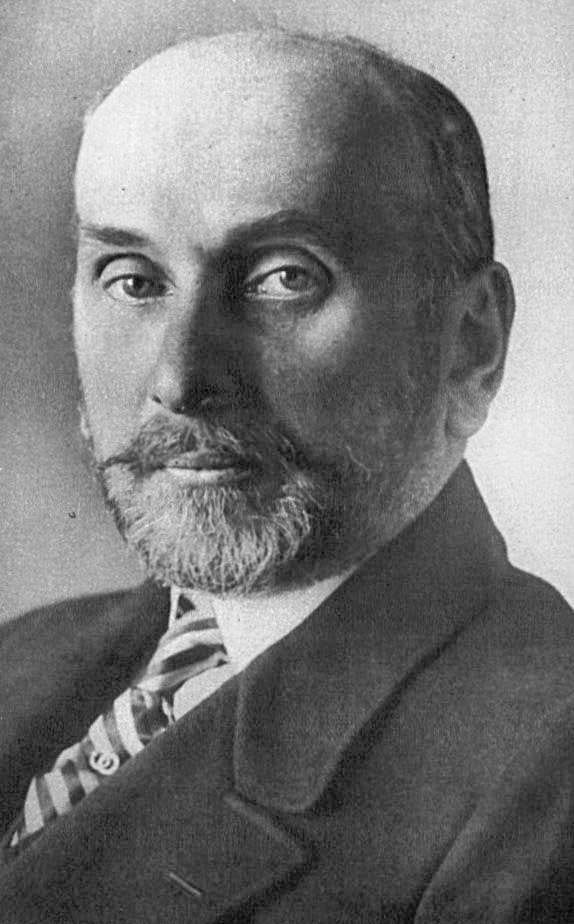
The archives show that it was right around this time the Russian Foreign Minister Sazonov told the Tiflis command to begin arming “Armenians and Assyrian Christians” inside the Ottoman Empire so that they could act behind the lines for Russia as soon as war began, and Sazonov was insistent that the Armenians be ordered not to “undertake anything without our instructions”. General Yudenich, the man on the spot, more familiar with eastern Anatolia and aware of Russian limitations, wrote back on 29 August, in a memo entitled, “On the Arming of Ottoman Armenians”, that, if Russia embarked on this course of pushing the Armenians into rebellion without much greater resources devoted to it, it would leave the Armenians “to defend themselves exclusively under their own power” and in all likelihood this would result in the Ottomans “annihilating the Armenians”. Yet Yudenich then recommended smuggling “at least 20,000 rifles and accompanying ammunition” to Ottoman-Armenians, ostensibly so they could defend themselves. Interpretations differ on whether this is proof of Yudenich’s prescience about the Ottomans’ genocidal ambitions, or proof of Russian-instigated Armenian treachery that made the deportations inevitable.100
The Armenian committees at the time had no illusions about what a dangerous game they were playing with the lives of Ottoman-Armenians by allying with the Russians and plotting to rebel against the Ottoman government once war broke out, but after two decades of their provocation strategy this was more of an inducement than a deterrent. Aram Turabian, one of the Dashnaks’ chief propagandist-recruiters abroad (based in Paris), stated bluntly that the Armenian revolutionaries “knew very well to what they were exposing the innocent inhabitants of the regions of Armenia under Turkish rule; but in the history of a people there are moments when … it becomes necessary to sacrifice … a part of the present generation to safeguard the future”.101
The Russian plans to stoke internal Ottoman disorder via the Armenians were theoretically covert, but it was more of an open secret, given the integral connection with the overt Armenian volunteers program and the scale of what Saint Petersburg was up to.
In the first week of September 1914, the Ottoman ambassador in Tehran reported that the Russians were arming Armenians in Iran and the Caucasus, and the Russian Consul in Tabriz was recruiting more Armenians by promising to reward those who supported the Russian war effort with an Armenian State on conquered Ottoman land. Around the same time, Ottoman spies in Petersburg reported: “The Russian Government aims to win the support of the Armenians so as to provoke a revolt in Eastern Anatolia any time it chooses.” Ottoman military, police, and intelligence sources in eastern Anatolia all converged on the view that an Armenian rebellion awaiting the green light from Russia was being prepared. On 16 September, the Tsar issued a statement telling Armenians that “the hour of liberty” had “finally sounded”. The next day, the commander of the all-important Ottoman Third Army in eastern Anatolia notified his troops, “Russians, with the assistance of Armenians from Caucasia, have incited our Armenians with promises of independence”, and called for vigilance and counter-measures to interdict the flow of Russian weaponry to Armenian rebels.102
A military report on 24 September, after clashes between Third Army troops and Armenian rebels in Van city, once again took note of Russian weapons and ammunition pouring over the border.103 In Hopa, on 5 October 1914, the Ottomans confronted Armenian guerrillas estimated to number 800, all armed with Russian weapons. To the south, at Erzurum, Ottoman troops fought Armenian çete (armed bands).104 In early October, the Third Army informed the Ottoman General Staff that Russian-born Armenians who had experience in the Russian army were infiltrating the Empire with maps, money, weapons. On 20 October, a counter-insurgency raid in Hasankale (Pasinler) discovered Russian rifles in Armenian homes. Three days later, the Third Army reported the movement of large numbers of Armenian armed guerrillas in Muş, Bitlis, Van, and Erivan.105
What the Russians were doing with the Armenians was not unique. Foreign powers using disaffected nations within multinational Empires had been standard practice in European statecraft since Napoleon unleashed nationalism on the Continent a century earlier, and the Ottomans had learned to play this game, too. The pointed omission of Russia’s subversive activities from the Ottoman war declaration in November 1914 was a tacit acknowledgement the Porte did not have a leg to stand on with such complaints: since August, it had been enlisting Russian deserters in its army, and instrumentalising Russian Muslims through the Special Organisation (S.O., Teşkilat-ı Mahsusa) to instigate revolt in the Caucasus.106
This was not, as is sometimes claimed, because the CUP had pan-Turanist and/or pan-Islamic goals.107 Those elements of the Party had been repressed by 1913, and the Ottomans entered the war with rather modest aims: restoring sovereignty, specifically by ending the Capitulations; securing territorial integrity on the 1914 borders, with the only exception being the goal to recover Batumi, Kars, and Ardahan lost to Russia in 1878; and more generally weakening Russia as far as possible.108 The S.O. was deployed to stir-up trouble behind the Russian lines in pursuit of these objectives, not without success.109 (Within this framework, there is some truth to the argument—often made simultaneous with the pan-Islamism/Turanism one, bizarrely—that the CUP was pushing towards the creation of a demographically contiguous nation-State in Anatolia to present the world a fait accompli in the aftermath of the doomed Empire, though how consciously is unclear.110)
The bottom line is that the Ottomans and Russia were in all serious senses at war from September 1914 through their various agents and proxies.111 As part of this undeclared Russo-Ottoman war, eastern Anatolia was engulfed by violence for two months before the Russian invasion. The Russians were not the puppet-masters of every insurgent action in eastern Anatolia in September-October 1914, nor did they try to be. The Russians provided the support system to the principle elements of the violence, the communal civil war and the Armenian “national liberation struggle”, as they had for years, and were content for it to cascade into a downward spiral. In the chaos, many residents reasonably concluded that remaining unarmed bordered on suicidal, and, humans being what they are, many militias formed initially for local self-defence swelled to a point where they were capable of predating on their neighbours and did just that.112 With Russian weapons available to all, Armenian guerrillas attacked the State and looted and massacred Muslim villages, and Kurdish irregulars nominally loyal to the State, Turkish and Kurdish gangs, and Muslim villagers raided and massacred Armenian settlements.113 The blurring of motives and allegiances, offense and defence, hardly mattered to the Russians. What counted was that this all amounted to “a catastrophe of unimaginable proportions” for the Ottoman Third Army, which was waiting to meet the Russian invaders while barely holding on to its fragile supply-lines.114
The Formal Outbreak of the Russian-Ottoman War
The Russian invasion of the Ottoman Empire on 1-2 November 1914, the Bergmann Offensive,115 targeted the Erzurum-Sarikamish Road, with a strong supporting attack towards Oltu and supplementary assaults on Karakose and Dogubayazit. The Armenian volunteer formations fighting with the Russian Army were particularly visible in the brief seizure of Dogubayazit. Ottoman losses were moderate and by the end of November, the front stabilised with Russia occupying a strip fifteen miles deep in the Ottoman Empire.116 Internally, however, the “situation went from bad to worse”.117
Leaving his post on the night hostilities began, Aleksandr Adamov, the Russian Consul in Erzurum, where the Ottoman Third Army was headquartered, sent a final dispatch to Petersburg saying that the Ottoman-Armenians of Erzurum and “all cities surrounding it, including Erzincan, Sivas, Mana Hatun, and Kayseri, not to mention in the villages and rural areas, … are awaiting with impatience the arrival of Russian troops who will free them from the Turkish yoke”. The Dashnaks in Erzurum, once close to the German Consul, had “turned fully Russophile” and “hidden their weapons in secret storage caches”, wrote Adamov: when “the Russians are right on their doorstep” they will rise in rebellion. Perhaps Adamov’s expansive vision of the assets Russia had inside a country it was about to invade were mistaken—the phenomenon is not unknown Russian history—but Sazonov took it seriously enough to send Adamov’s memo straight to the Stavka.118 And there were indications Adamov had not been wholly delusional.
While Zeytun was more-or-less brought under Ottoman government control in the first week of December 1914, by then Armenian guerrilla activity had become commonplace all over eastern Anatolia, from sabotage operations, notably cutting telegraph wires, to (attempted) assassinations of Ottoman officials, the bombing of police stations, and brigandage on the roads. Most of this was concentrated near the front, in Erzurum, Bitlis, and Van, where two Armenian districts, Karçekan and Gevaş, were reported as being in full-fledged revolt on 21 December.119 But there were armed Armenian attacks on infrastructure, services like mail delivery, and Ottoman gendarmes and troops as far behind the lines as Muş, Suşehri, Aleppo, and Dörtyol,120 and, in January-February 1915, Armenian guerrilla warfare would spread west and escalate, to Erzincan, Sivas, and Cilicia, among other places.121
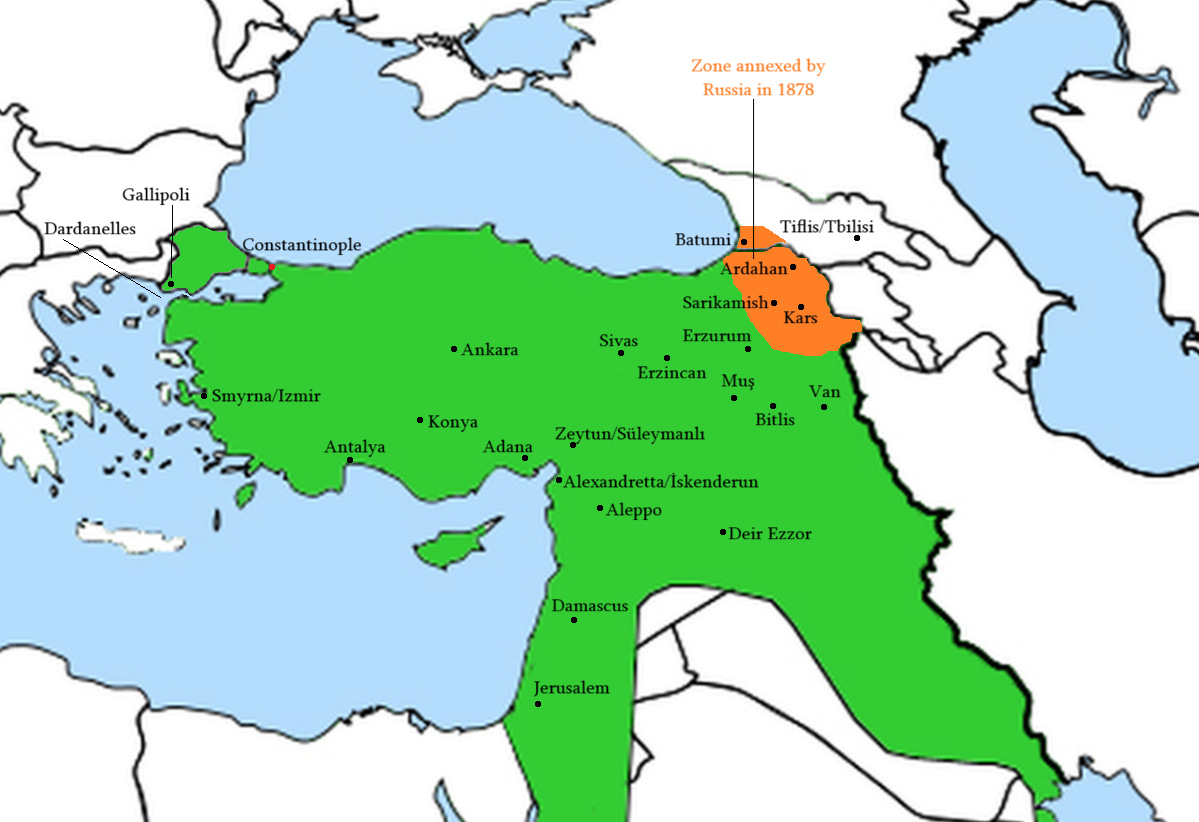
The gathering momentum of the Armenian insurgency in early 1915 was especially alarming because the military picture had drastically turned against the Ottomans. Enver had ordered a major push against the Russians on 22 December, which had started well, with the Ottomans invading Iran up to Qotur and troops (led by a German officer) re-taking Ardahan on 27 December, but the detachment was too small to hold it.122 Russian reports praise the Armenian volunteers’ contribution to stemming the Ottoman offensive at this point.123 By the first days of the New Year, the Ottoman army had been surrounded and defeated at Sarikamish, and in the retreat over the next ten days probably 50,000 Ottoman soldiers were killed, half in combat and the rest frozen to death and struck down by disease in the mountain passes. Many of the 20,000 or so wounded died of typhus in the hospitals and thousands were taken captive. The Ottomans lost about two-thirds of the 120,000 troops Enver sent into battle.
The Ottomans absorbed this calamity with the additional misery that once the snows faded the Russians would begin a new offensive. What the Ottomans did not and could not know was that the Sarikamish offensive had achieved one vital thing: it derailed Sazonov’s plans to initiate a general Ottoman-Armenian uprising. Sazonov’s deputy cabled Tiflis on 17 December 1914, reminding Yudenich that “any order for an Armenian uprising must only be given after receiving prior agreement with the Foreign Ministry”, and subsequent cable traffic was finalising arrangements for such an order. Then came the Ottoman onslaught, in the wake of which the Russians somewhat got cold feet about an Armenian rebellion. Again, the Ottomans could not know this, nor the Armenians for that matter,124 and the signals from Russia seemed designed to actively mislead about their intentions.
Russkoe Slovo, one of the largest mass-circulation Russian newspapers, published a letter from an Armenian lawyer named Calkus on 24 January 1915 reading: “In Turkey’s eyes, … we were guilty of treason. Armenians confess to this treason without any further ado. … The Armenian is a traitor to Turkey because Turkey is not his mother but his stepmother. A growing number of Armenians are volunteering in the ranks of the Russian army. They are streaming toward Russia from the far corners of the world … They believe in Russia and Russia’s mission.” An Armenian deputy, the Kadet Mikayel Papadjanian, stated in the Russian Duma on 28 January 1915: “The Armenian population of Turkish Armenia joyously greeted our victorious [Russian] army. Armenians helped wherever and however they could, and prepared a hearty welcome for the Russians.”125
In mid-February 1915, a delegation of Ottoman-Armenian revolutionaries from Zeytun arrived in Tiflis saying they had 15,000 men ready to “pounce on Turkish [army] communications” if the Russians gave them arms and ammunition. Count Illarion Vorontsov-Dashkov, the formal overall commander of the forces that had beaten the Ottomans at Sarikamish, met the Armenian rebel leaders personally. Vorontsov-Dashkov disclaimed any ability to help—Zeytun was too far from Russian positions, he said—but offered to put the Zeytun rebels in touch with Britain and France. One can say that Ottoman government fears about this—and they did very quickly learn about it—were to that extent overblown. However, the Armenians merely getting from Cilicia to Tiflis must have required significant Russian logistical support. Moreover, “Simply by meeting with the Zeytun Armenians[,] … Vorontsov-Dashkov had committed a deeply provocative act.” And it was no idle thing to connect Ottoman-Armenian rebels with the Anglo-French Allies.126
Back in November 1914, Boghos Nubar had offered Britain and France support in the Zeytun area: “Armenians in Cilicia are ready to enlist as volunteers to support a landing in Iskenderun, Mersin, or Adana. … [T]hey will rebel against the Turks if they are supplied with arms and ammunition.”127 By February 1915, the British and French were bombarding the Dardanelles, in visible preparation for an assault on the Ottoman capital, and after ditching their own plan to open a second front around Alexandretta—they settled for some British shelling of the coast—were engaged in a conspiracy with Ottoman-Armenian rebels to do it for them. Britain had made contact with Armenians in Cilicia, whom it planned to arm as “part of a scheme for the occupation of Alexandretta”, as a War Office cable of 4 March 1915 records. By that time, Britain had already arranged via Mikayel Varandian for the Armenian committees abroad to send 20,000 of their men—half from America, half in the Balkans—to Cyprus to be organised into an invading force to join the internal rising in Cilicia.128 Around this time, Armenians were seen coming ashore at Dörtyol, in Cilicia, from a British warship.129
In the event, the First Lord of the Admiralty, Winston Churchill, convinced the British Cabinet to abandon the plans for a southern front using the Armenians to focus on a knock-out blow in Constantinople, but the Armenians in Cilicia had already gone ahead with their rebellion, quite possibly with Russian encouragement—it was a Russian request to London for a diversionary operation on 1 January, when the fighting at Sarikamish appeared to be going the Ottomans’ way, which set the British and French on the fateful road that ended at Gallipoli,130 and during the preparations the Russians had remained engaged in the Anglo-Armenian discussions through their London Embassy.131 Led by the Hunchaks, the armoury of the gendarmes in Zeytun was raided on 24 February 1915, and, in the emerging pattern of these revolts, numerous gendarmes were killed and the telegraph poles were destroyed.132 In early March, armed Armenian deserters tried to take over Zeytun and throughout the month armed combat continued, at one point with the rebels occupying an Armenian monastery for five days and killing ten soldiers from inside.133
In early April 1915, with the Ottomans having lost hundreds of soldiers in Zeytun and still struggling to pacify it,134 the commander of the Fourth Army took the decision to deport the Armenians to Konya, nearly 350 miles northwest, to eliminate the social basis for rebellion on this crucial military supply route. Despite stern instructions for the protection of Armenians and swift punishment of Muslims who violated these orders, the process was badly organised and Armenian deportees suffered: they lacked provisions and the soldiers reacted with inadequate vigour when Muslims attacked the convoy in various locations. This was the first instance of Armenian deportation and the lack of preparation testifies to its contingent and reactive nature. Of note, too, though Talat formally signed-off on it, the initiative came from the local military authorities; it remained an isolated case for some time; and the Armenians were relocated further into Anatolia.135 It is not the fact pattern one would expect if the CUP went into the war with a premeditated plan for the genocidal clearance of Armenians from Anatolia.
The Van Rebellion
Throughout the spring of 1915, as the attritional grind set in in the east, “Russian soldiers, guided by Armenians, raided Muslim villages in the Caucasus, Van, and Bitlis. Louis Mosel, a German officer, reported that in the Caucasus, ‘a large part of the population is fleeing death at the hands of Russians and their Armenian collaborators’.” The Germans tried asking the Armenian Patriarch to restrain his flock, but he said there was no point in him trying and Armenian historians agree he had been overshadowed by the Dashnaks in Constantinople “secretly encouraging the volunteer movement in the Caucasus”.136 Even in retrospect, Armenians present could be remarkably blasé about the anti-Muslim atrocities, for instance writing in passing that the rebels “disposed of about sixty Turks” living in one village.137 Inevitably, Muslims who survived the outrages of the Russians and the Armenians, whether volunteers or rebels, and were displaced into the interior, then revenged themselves on innocent Armenians.
Throughout the Ottoman east in early 1915, an especially inflamed form of the situation in preceding years played out as “national liberation” warfare and foreign invasion mingled with sectarian-communal violence, and the ever-marauding Kurdish tribes were under less State oversight than ever. Such was the situation around Van,138 close the Russian border and so long the centre of gravity for Armenian nationalism in the Ottoman Empire, where the Armenian revolutionary movement would fatefully reach the height of its success.
There is no doubt there had been massacres of Armenians in Van province in the early months of 1915, and this has led to a narrative wherein the Armenian rebellion that seized Van city in April 1915 was “a kind of preventive ‘Warsaw Uprising’.”139 The evidence adduced for this comes from some Central Powers officials, specifically Joseph Pomiankowski, the military attaché at Austrian Embassy, who described the Van uprising in precisely such terms, as “a desperate effort by Armenians, who witnessed the beginning of the murders and understood that their turn would come”, and German liaison officer, General Friedrich Posselt (“Posselt Pascha”), as well as some missionaries, notably two American Protestants, Clarence Ussher and Stanley E. Kerr, who claimed that 55,000 Armenians had been massacred by the time the Armenians in Van rose.140
The evidence is highly problematic. Pomiankowski, for example, was based in Constantinople and speaking years later. Posselt was stationed in Erzurum, and his testimony from that narrow vantage point differs sharply from the conclusion of General Otto Liman von Sanders, the overall head of the German military mission attached to the Ottoman Army from 1913 to 1918, who had access to all reports—German and Ottoman—from all over the Empire.141 The missionary testimony is self-evidently parti pris and formulaic. Nobody can take Kerr’s fatality figure seriously and in the case of Ussher, a British official had remarked as long before as 1905, “I myself know by experience that Dr. Ussher’s statements are unreliable”. An American diplomat added that Ussher was “most unreliable, and given to gross exaggeration owing to his innate dislike of Turks and his inordinate fanaticism”.142
The “Defence of Van” narrative does not just struggle for evidence on its own account: it is contradicted by the evidence of the local context, the actual course of the rebellion, and the broader context of the First World War.
Even without the admission of one of the Dashnaks on the council that administered Van under rebel rule that activity began in October 1914,143 the protracted build-up of arms by the Armenian committees in Van would cast doubt on the claims of a spontaneous “defensive” rising. The reality is that the military picture was the other way around by the end of February 1915: the Ottoman administration in Van was losing in the contest with the Armenian guerrillas. Across Van province, government buildings were being occupied and Muslim villages attacked and sometimes massacred. Quite a number of what the missionaries describe as Armenian massacres were Ottoman soldiers fighting rebels in areas like Havasor, Timar, and Başkale, where indiscriminate attacks and horrific excesses against Armenian civilians did indeed take place, and even more so Muslim villagers exacting “revenge”. But this was in a situation not of the Ottoman government’s making, where an escalating Armenian rebellion in Van was sufficient to tie down an Ottoman division by March-April that was intended for Iran (the Ottoman foothold in Iran grabbed in December was lost in April because of this) and in the districts of Çatak and Saray the State did not regain control until the autumn.144
Four of the Russians’ Armenian volunteer legions had been quickly grouped into the “Van detachment”, so named since it drew significantly on Ottoman-Armenians from that region, and focused its attention there.145 The Russians army had gotten bogged down before it could reach Van, though, so resorted to infiltrating armed Armenian bands trained in Tiflis—before war officially broke out and on a larger scale afterwards. As mentioned above, Ottoman intelligence had detected these movements, and the communications between the Armenians and Russians requesting weapons and supplies was rough enough that the Ottomans intercepted much of it.146 As the Armenian rebellion in Van crested and closed in on the provincial capital, the Ottomans tried to abort it via a decapitation strike: they succeeded in killing Arshak Vramian on 17 April, but the most important leader, Aram Manukian, an experienced Dashnak terrorist leader and one of the founders of the Armenian Republic in 1918, escaped. Manukian was able to impose a unified command over the insurgency and bring it into Van city, which fell to the rebellion on 20 April.147
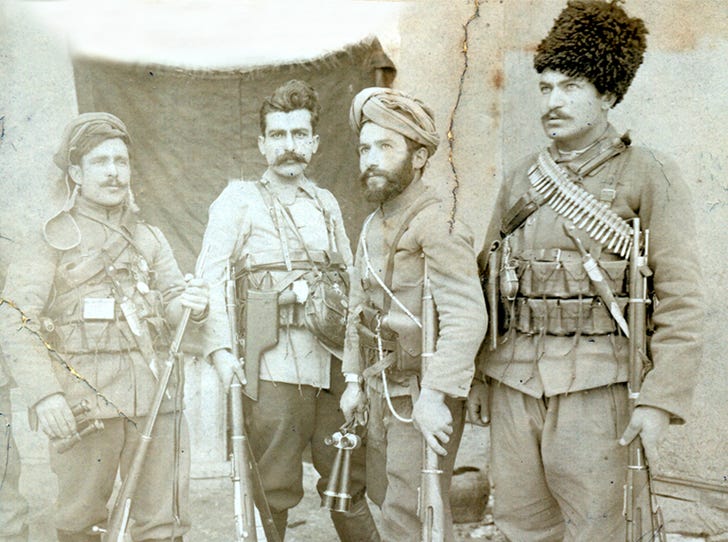
The Armenian rebels were well-armed, able to draw on caches stored over eighteen months and more, and disciplined and organised enough, reinforced with rebels who flooded in from elsewhere in the province, to hold off three Ottoman police divisions, the First Expeditionary Force, and the Kurdish militiamen wielding heavy weapons, including cannons, for a month. The Armenian rebels in control of Van swiftly dispatched runners to the Russians, whose cause they believed their actions were helping.148 One of the letters approved by Manukian for Yudenich said that the Armenians of Van were “expecting Russian help every day”. The Russians were so proud of the letter they sent it to the Allies—though eliminated the word “Russian”, downplaying any sense of political coordination and portraying the Armenian appeal as a humanitarian one to the Entente generally. The Russians reached Van on 17 May in the form of a Cossack contingent guided by thousands of Ottoman-Armenian deserters, forcing the Ottoman garrison to retreat.149
On 20 May, the Russians’ Armenian volunteers, led by Sargis Mehrabyan, arrived in Van, followed shortly by the regular Russian army, who were greeted by cheering Armenian crowds. The commanding Russian General was given the keys to the city, and the Russian occupiers appointed Manukian head of the defence council administering the city.150 For the Armenians, this was deliverance: there was a joyous “night of orgy, a saturnalia”, sacking, looting, and burning Ottoman buildings.151 For the Muslims, the slaughter was unmerciful.152
While interpretation of the Van events has become the epicentre of controversy over 1915, this was not really so at the time. The Ottoman government, of course, saw this as the Armenian rebels acting as a fifth column in a premeditated operation to enable the advance of their Russian masters by seizing and handing over a city. German officials, some friendly to the Armenians, saw it the same way,153 as did the Armenians’ great champion, U.S. Ambassador Henry Morgenthau, who wrote to Washington of “an Armenian insurrection to help the Russians [that] had broken out at Van”.154 And the Armenians themselves agreed. The “idea that Van had been delivered to the Russians by the Armenian rebels” was not regarded contemporaneously as an accusation: “Armenian newspapers in the Caucasus boasted openly about this throughout 1915”.155
* * * *
When the camera is pulled back to survey the whole picture, one can understand why the Ottomans saw this as their nightmares becoming a reality. So soon after the insurrection in Zeytun, Van seemed to ratify the Ottoman perception that a generalised Russian-orchestrated Armenian rebellion was underway.156 In combination with the almost-exactly-simultaneous landing of Allied troops at Gallipoli on 25 April, how could there be any doubt Van’s fall was the first domino in a pre-planned Entente operation? The stated British and French intent was to conquer Constantinople, and thereby the Ottoman Empire, to open up a direct supply line to Russia—which was closing in, with its Armenian collaborators, from the east.157
It was while being attacked on two fronts, with the fate of the Empire at stake and the invaders having recruited an enemy within so far as the Ottoman government was concerned, that the arrest of the Armenian leadership in Constantinople was ordered on 24 April 1915, the event Armenians mark as the beginning of the genocide. The Tehcir (Relocation) Law, passed by the Ottoman Parliament on 27 May and publicly published on 1 June, ordered the deportation of the Armenian population from the militarily sensitive areas, starting with the Six Provinces in the east. The ferocious debate that continues more than a century later about whether this was a desperate exigency measure in the midst of an existential security crisis, with inherently tragic human consequences, or official cover for a long-planned policy of annihilation, will be taken up in a subsequent post.
FOOTNOTES
Andrekos Varnava (2014), ‘French and British Post-War Imperial Agendas and Forging An Armenian Homeland After the Genocide: The Formation of the Légion D’Orient in October 1916’, The Historical Journal. Available here.
Onur Isci (2023), ‘Turkey at a Crossroads: The Soviet Threat and Postwar Realignment, 1945-1946’, Diplomatic History. Available here. See also: Bernard Lewis (2012), Notes on a Century: Reflections of a Middle East Historian, pp. 286-287.
The Justice Commandos of the Armenian Genocide (JCAG), later rebranded the Armenian Revolutionary Army (ARA), the “deniable” terrorist wing of the Dashnaks, was the first of these organisations, and the longer-lasting was the Soviet-dependent Armenian Secret Army for the Liberation of Armenia (ASALA), which lasted beyond the Soviet collapse, as so many Communist toxins have.
A prominent early example is Abraham Hartunian, whose 1968 memoir documented his role, as a Protestant pastor in Maras, in collaborating with the Armenian rebels and extolling their cause to his congregation. See: Gwynne Dyer (1976), ‘Turkish “Falsifiers” and Armenian “Deceivers”: Historiography and the Armenian Massacres’, Middle Eastern Studies. Available here.
Maxime Gauin (2015), ‘Review Essay: “Proving” a “Crime against Humanity”?’, Journal of Muslim Minority Affairs. Available here.
The initial Christian rebellion in Bosnia-Hercegovina spread to Bulgaria, Montenegro, and Serbia, with Romania joining in after the Russian intervention. This episode is remembered as the Great Eastern Crisis. It concluded with Bosnia being occupied by Austria-Hungary, while remaining de jure part of the Ottoman Empire until 1908, when Vienna proclaimed its annexation, creating a diplomatic crisis that shaped the dynamics heading into the First World War. Bulgaria, too, remained a formal Ottoman province until 1908, though was de facto independent and under Russian influence. Montenegro was handed back, under British pressure, to direct Ottoman rule. Serbia and Romania, meanwhile, gained formal independence.
In return, Britain signed a secret agreement with the Ottomans to acquire administrative control of Cyprus. British holdings on Cyprus are an important strategic asset to this day.
The numbers game is, as ever, highly politicised, but the common reference to the Six Provinces as the “Armenian Provinces” was misleading: neither Armenians nor Christians generally were a majority in any of them. The Ottoman census recorded about 600,000 Armenians in the Six Vilayets in 1914, while the Armenian Patriarchate said it was about one million. The total population of the Six Provinces was 2.5 to 3 million, thus by the Turkish estimate the Armenian population was a fifth or a quarter, and by the Armenian estimate it was between one-third and 40%.
The Armenian Patriarchate claimed there were between 1.9 and 2.1 million Armenians in the whole Empire in 1914, with those outside the Six Provinces concentrated in two other main areas: 400,000 Armenians in Cilicia (along the Mediterranean coast in the southeast) and 530,000 in western Anatolia and European Turkey. The Ottoman census records the Empire-wide Armenian population in 1914 at about 1.2 million.
The contest over these numbers is because there is (with innumerable caveats) a rough agreement that 600,000 to 700,000 Ottoman-Armenians were alive at the end of the war, the implication being that the Turks claim 500,000 or 600,000 Armenians perished in 1915-16, and the Armenians claim the fatalities amounted to 1.2 to 1.5 million.
See: Arthur Grenke (2005), God, Greed, and Genocide: The Holocaust Through the Centuries, pp. 55-56; and, Dawn Chatty (2010), Displacement and Dispossession in the Modern Middle East, pp. 153-154.
Gerard Libaridia (2004), Modern Armenia: People, Nation, State, pp. 91-92.
The Ottomans had previously taken domestic measures under external pressure, notably (nominally) abolishing the jizya in 1856 as payment for British and French support in the Crimean War against Russia, but that had not involved Christian States asserting rights to monitor and implement policies within the boundaries of the Empire.
Bernard Lewis (1961), The Emergence of Modern Turkey, pp. 61-64.
Or “loyal millet” (millet-i sadıka). See: Lewis, The Emergence of Modern Turkey, p. 356.
Richard G. Hovannisian, ‘The Armenian Question in the Ottoman Empire, 1876–1914’, in Richard G. Hovannisian [ed.] (1997), The Armenian People from Ancient to Modern Times, vol. 2: Foreign Dominion to Statehood: The Fifteenth Century to the Twentieth Century, pp. 203-238.
Michael A. Reynolds (2011), Shattering Empires: The Clash and Collapse of the Ottoman and Russian Empires, 1908-1918, p. 53.
Sean McMeekin (2011), The Russian Origins of the First World War, pp. 144-145.
Mekertich Portukalian was in Marseille.
The Hunchaks were formally named the Social Democratic Hunchakian Party. The Dashnaks were properly the Armenian Revolutionary Federation or ARF (Hay Heghapokhakan Dashnaktsutyun).
Louise Nalbandian (1963), The Armenian Revolutionary Movement: The Development of Armenian Political Parties through the Nineteenth Century, pp. 113-114.
The Hunchaks, in particular, were marked by this phenomenon. By the first decade of the twentieth century, the Hunchaks were devoting nearly as much of their terrorist resources to assassinating their own dissidents in Europe as they were to targeting Ottoman officials.
Nalbandian, The Armenian Revolutionary Movement, pp. 109-114.
Nalbandian, The Armenian Revolutionary Movement, pp. 156-157.
Guenter Lewy (2005), The Armenian Massacres in Ottoman Turkey: A Disputed Genocide, pp. 22-23. Available here.
Lewis, The Emergence of Modern Turkey, pp. 62-63.
Varak Ketsemanian (2018), ‘The Hunchakian Revolutionary Party and the Assassination Attempts Against Patriarch Khoren Ashekian and Maksudzade Simon Bey in 1894’, International Journal of Middle East Studies. Available here.
Letter from Cyrus Hamlin to the Boston Congregationalist, 23 December 1893, held by the U.S. Department of State foreign relations archives, cited in: Lewy, The Armenian Massacres in Ottoman Turkey, p. 22.
Lewy, The Armenian Massacres in Ottoman Turkey, p. 17.
Maxime Gauin, ‘Uneven Repression: The Ottoman State and its Armenians’, in: Edward J. Erickson [ed.] (2020), A Global History of Relocation in Counterinsurgency Warfare, p. 117.
Nalbandian, The Armenian Revolutionary Movement, pp. 127-128.
13,000 Armenians were killed according to the official Ottoman tally. European estimates ranged between 50,000 and 80,000 deaths. See: McMeekin, The Russian Origins of the First World War, p. 144.
An objective observer would have to say that of the two calculations in 1895—the Armenian rebels intensifying their military efforts in the belief a larger war would secure greater external intervention and the Sultan escalating repression in the belief that a military solution would obviate his paper promises—the Sultan had the better grasp of reality. The remarkable thing is that this basic paradigm would repeat time and after time, up to and including 1914-15, with the same outcome, and yet the Armenian revolutionary strategy was unwavering. See: Nalbandian, The Armenian Revolutionary Movement, pp. 127-128.
McMeekin, The Russian Origins of the First World War, p. 143.
Lewy, The Armenian Massacres in Ottoman Turkey, pp. 32-33.
Justin McCarthy, Esat Arslan, Cemalettin Taşkıran, and Ömer Turan (2006), The Armenian Rebellion at Van, pp. 101-102.
Lewy, The Armenian Massacres in Ottoman Turkey, pp. 32-33.
Lewy, The Armenian Massacres in Ottoman Turkey, p. 33.
Reynolds, Shattering Empires, p. 62.
Gauin, ‘Uneven Repression’, in: A Global History of Relocation in Counterinsurgency Warfare, p. 118.
Variations of this description were used to describe elements of the political elite in Northern Ireland during “The Troubles” and in post-Saddam Iraq.
Reynolds, Shattering Empires, pp. 62-63.
Anthonie Holslag (2018), The Transgenerational Consequences of the Armenian Genocide, p. 102. See also: Bedross Der Matossian (2011), ‘From Bloodless Revolution to Bloody Counterrevolution: The Adana Massacres of 1909’, Genocide Studies and Prevention. Available here.
Reynolds, Shattering Empires, p. 63.
McMeekin, The Russian Origins of the First World War, pp. 146-148.
McMeekin, The Russian Origins of the First World War, p. 142.
This practice was continued by the Soviet Union and continues still with the current Russian government.
McMeekin, The Russian Origins of the First World War, pp. 147-149.
The tight relationship that would form between the Armenian revolutionary committees and Imperial Russia looked forward to the Soviet instrumentalization of the “national liberation movements”.
McMeekin, The Russian Origins of the First World War, pp. 145-146.
Lewis, The Emergence of Modern Turkey, p. 357.
The role of Russia’s pan-Slavist ambassador to Serbia, Nikolai Hartwig, in orchestrating the 1912 Balkan coalition’s attack on the Ottoman Empire is often overstated, but there is little doubt he personally was enthusiastic about the enterprise, even if Petersburg “proper” was hesitant because of the internal problems after the 1905-07 terrorist rebellion, the aftershocks of which had then-recently murdered Prime Minister Pyotr Stolypin.
There was a lot of improvisation in the Ottoman resettlement policy for the refugees. As the Muhacir—the Muslims displaced from the Balkans, Black Sea region, and the Caucasus as the Empire contracted—were one-quarter or more of the Anatolian Muslim population after 1913 there was no way to avoid some of them being housed in Christian areas. See: Erik J. Zürcher (1993), Turkey: A Modern History, p. 117.
However, there was also a fateful decision to attempt demographic engineering by deliberately settling Muhacir in Christian-heavy areas to dilute the power of a community whose loyalty was suspected. These mixed zones were tense if not turbulent at the best of times. Once there was a breakdown of norms and order during the war, there was bound to be violence against Christians, and the presence on the sectarian faultline of so many Muhacir, the most radicalised and revenge-hungry section of the Muslim population, ensured the scale and cruelty of this violence would be terrible when it came.
McMeekin, The Russian Origins of the First World War, p. 148.
Gauin, ‘Uneven Repression’, in: A Global History of Relocation in Counterinsurgency Warfare, p. 119.
Aram Manukian, the future leader of the Van rebellion and a founder of the First Armenian Republic, was likely behind the assassination of Mayor Kapamajian of Van, who was widely respected in Europe and by the Ottoman leadership for his efforts to improve the lot of the Armenians without inflaming Muslim-Christian relations, whether inside the Empire or between the Porte and the Great Powers. See: Hasan Oktay (2002), ‘The Assassination of Mayor of Van Kapamaciyan by the Tashnak Committee’, Review of Armenian Studies. Available here. See also: David Earl Nunn (1984), Great Britain and the Armenian Crisis, 1912-1914, p. 58
Taner Akçam (1999), A Shameful Act: The Armenian Genocide and the Question of Turkish Responsibility, p. 99.
McMeekin, The Russian Origins of the First World War, pp. 149-150.
McMeekin, The Russian Origins of the First World War, pp. 150-151.
During the Great War, the Ottoman government withdrew from the Yeniköy Treaty of February 1914, and then from the 1878 Treaty of Berlin, as well as the more fundamental “international law” conventions, the 1871 London Declaration and the 1856 Paris Treaty, which had provided the basis for foreign States to intervene in Ottoman internal affairs in the name of the Armenian Question. It is sometimes argued that freeing the Ottoman Empire of these restraints on its sovereignty was a cause of the CUP regime entering the First World War, not merely an outcome, and that this constitutes evidence of a premeditated plan to annihilate the Armenians. This is superficially plausible since invalidating the Yeniköy Treaty in December 1914 was one of the first actions by the Ottoman government after entering the war. But this was a treaty only recently signed and de facto not yet entered into force. The argument simply does not meet the test of the timeline for the three effectual treaties, which were repudiated simultaneously in September 1916, after the main phase Armenian deportations and attendant deaths. See: Akçam, A Shameful Act, pp. 122, 248.
McMeekin, The Russian Origins of the First World War, p. 152.
Sean McMeekin (2010), The Berlin-Baghdad Express: The Ottoman Empire and Germany’s Bid for World Power, pp. 11-16.
Jonathan Conlin (2022), ‘“Our Dear Reşadiye”: The Legend and the Loans behind Ottoman Naval Rearmament, 1908-1914’, The International History Review. Available here.
Ulrich Trumpener (1968), Germany and the Ottoman Empire, 1914-1918, p. 24.
Robert Johnson, ‘Contested Historiography: Allied Perspectives on the Gallipoli Campaign’, in: Metin Gürcan and Robert Johnson [eds.] (2016), The Gallipoli Campaign: The Turkish Perspective, p. 23.
McMeekin, The Berlin-Baghdad Express, pp. 123-129.
Asquith, responding to militantly religious terms of the Ottoman war declaration, made a point of stressing that Britain’s war was not with Islam or Muslims, saying: “Nothing is further from our thoughts or intentions than to initiate or encourage a Crusade against their creed”, and noted that there were millions of Muslims among “the most loyal of [the King’s] subjects”. (The Kaiser, by contrast, hoped precisely for the reverse: that the Ottoman entry into the war would “incite the entire Islamic world to a savage revolt”, especially the Muslims in British India and Russia.) Asquith also distinguished between “the Turkish people” (blameless in frustrating Britain’s “hopes and efforts” to avoid war) and the Ottoman government, the latter having “drawn the sword, and which, I do not hesitate to predict, will perish by the sword.” See: Jim Grundy (2024), Alive with Death: August 1914 – April 1915, p. 155.
Erzurum was taken by Russia in 1878 and returned to the Ottomans later that year at the Congress of Berlin.
The Armenians also believe there was a ruse at this point: they argue that the CUP offer was inauthentic because the only reason for that delegation attending the Congress at all was as cover for the CUP to travel to Erzurum to oversee the creation of the Special Organisation gangs in the area that would wage irregular warfare in Russia and, when that flopped, turn to playing a central role in the genocide. See: Akçam, A Shameful Act, pp. 143-144.
Hovhannes Kajaznuni (1923, July), ‘Manifesto: The Armenian Revolutionary Federation (Dashnagtzoutiun) Has Nothing to Do Any More’. Available here.
Kapriel S. Papazian (1934), Patriotism Perverted: A Discussion of the Deeds and the Misdeeds of the Armenian Revolutionary Federation, the so-called Dashnagtzoutune, p. 38. Available here.
Richard G. Hovannisian (1967), Armenia on the Road to Independence, 1918, p. 42.
McMeekin, The Russian Origins of the First World War, p. 154.
Garegin Pastermadjian (1918), Why Armenia Should Be Free: Armenia’s Role in the Present War, p. 9. Available here.
Candan Badem (2025), Kars Province under Russian Rule: Imperial Rivalry and Nation-Building in the Periphery, 1878-1918, chapter four.
McMeekin, The Russian Origins of the First World War, p. 154.
Papazian, Patriotism Perverted, p. 38.
McMeekin, The Russian Origins of the First World War, pp. 154-156.
Gavriil Korganov (1927), La participation des Arméniens à la guerre mondiale sur le front du Caucase (1914-1918) avec 19 schémas, p. 10. Available here.
The First Armenian Volunteer Battalion was commanded by Andranik (Ottoman-Armenian).
The Second Armenian Volunteer Battalion was jointly commanded by Drastamat Kanayan or “Dro” (Russian-Armenian) and Garegin Pastermadjian or “Armen Garo” (Ottoman-Armenian).
The Third Armenian Volunteer Battalion was commanded by Hamazasp Srvandztyan (Ottoman-Armenian).
The Fourth Armenian Volunteer Battalion was commanded by Arshak Gavafian or “Keri” (Ottoman-Armenian).
The Fifth Armenian Volunteer Battalion was commanded by Sargis Mehrabyan or “Commander Vartan” (Russian-Armenian).
The Sixth Armenian Volunteer Battalion was commanded by Grigor Avsharian (Ottoman-Armenian).
One of the smaller Russian volunteer units was led by the Dashnak fedayi Mikael Seryan or “Pandukht”.
See: Edward J. Erickson (2013), Ottomans and Armenians: A Study in Counterinsurgency, p. 145.
Pastermadjian, Why Armenia Should Be Free, pp. 19-20.
Gauin, ‘Uneven Repression’, in: A Global History of Relocation in Counterinsurgency Warfare, p. 120.
‘Letter from Mr. E. Vartanian, an Armenian-American Volunteer in the Russian Service’, 22 July 1915, published in the Armenian Journal Houssaper in Cairo. Available here.
Joan George (2002), Merchants in Exile: The Armenians of Manchester, England, 1835-1935, pp. 184-185.
Kemal Çiçek (2020), Studies on the Armenian Question, p. 68.
Akçam, A Shameful Act, p. 215.
While the Ottoman archives are filled with expressions of concern about the extent of the damage done to the Empire by the Armenian volunteers in late 1914, perhaps most interesting is the eyewitness testimony of Rafael de Nogales, a Venezuelan adventurer in the Ottoman army, a Christian at some remove from official perceptions, who nonetheless saw the Armenian “auxiliaries” making the Russians “quite formidable”, and pointed to Armenian desertion, rebellion, and atrocities against Muslim civilians as important both in the military outcome at Sarikamish and Van, in particular, and the measures taken by the Ottoman government that gave rise to such “terrible consequences”. See: Rafael de Nogales (1926), Four Years Beneath the Crescent, pp. 45, 99.
Dashnak sources say the Armenians played “a great role” in the Ottoman defeats in late 1914 (Pastermadjian, Why Armenia Should Be Free, p. 20), and record that it was the significance of the Armenian role in “many severe engagements” with the Ottomans which inspired the great devotion the Russians came to have for the volunteers, who were referred to in Russian communiques as “our Armenian detachments”. See: Avetoon Pesak Hacobian (1917), Armenia and the War. An Armenian’s Point of View with an Appeal to Britain and the Coming Peace Conference, p. 86
Non-Dashnak Armenian leaders likewise record: “The Armenian volunteer regiments rendered valuable services to the Russian Army” from 1914 to 1916. See: Papazian, Patriotism Perverted, p. 38.
The “increasing importance [the Russians are giving] to the part the Armenians are playing in the Russian-Turkish war” was visible in the international press less than a fortnight after the Russo-Ottoman war began in November 1914, and the personal visit Tsar Nicholas II paid to the Armenian Cathedral in Tiflis a month later—making a public statement about how much the Armenians had sacrificed on behalf of the mission to fly the Russian flag over the Dardanelles—speaks for itself.
During the Battle of Sarikamish (mid-December 1914 to mid-January 1915), an utter calamity for the Ottomans, the Armenian volunteers provided “excellent and useful services” to the Russian army, according to General Pyotr Kalitin, the commander of one of the Russian Caucasian Army Corps. Kalitin said the Armenians “offered stubborn resistance … until the arrival of [Russian] reinforcements, in whose company they inflicted a cruel defeat upon the [Ottomans]”. General Grigory Chernozubov, who led another of the Russian Caucasian Corps during the Sarikamish battle, remarked that “the legion of Armenian volunteers of Andranik showed much bravery and self-sacrifice”. See: Korganov, La participation des Arméniens à la guerre mondiale …, pp. 19-20.
On it went. The American Ambassador, Henry Morgenthau, a theoretical neutral but recognised by all sides as a great friend of the Armenians, said the Armenian volunteers (and internal revolutionaries) were “helpful to [the] Russians in their invasion of Van” in May 1915.
Farid Shafiyev (2018), Resettling the Borderlands: State Relocations and Ethnic Conflict in the South Caucasus, pp. 83-84. And see: Stanford J. Shaw and Ezel Kural Shaw (1977), History of the Ottoman Empire and Modern Turkey, Volume II: Reform, Revolution, and Republic: The Rise of Modern Turkey, 1808-1975, pp. 314-315.
Gauin, ‘Uneven Repression’, in: A Global History of Relocation in Counterinsurgency Warfare, p. 119.
Lewy, The Armenian Massacres in Ottoman Turkey, p. 84.
Stathis N. Kalyvas (2006), The Logic of Violence in Civil War, p. 113.
McCarthy et al., The Armenian Rebellion at Van, p. 182.
McCarthy et al., The Armenian Rebellion at Van, p. 184.
Reynolds, Shattering Empires, pp. 78-81.
Yektan Türkyılmaz (2011), ‘Rethinking Genocide: Violence and Victimhood in Eastern Anatolia, 1913–1915’, PhD Dissertation at Duke University. Available here.
Foreign diplomats in eastern Anatolia from the spring of 1913 were detecting a surge of Muslim opinion, in the bazaars and elsewhere, that looked forward to a Russian takeover of the area, simply as a way to end the chaos. “Turkish rule in Kurdistan is without soldiers and without money, and lacks all prestige and influence”, a British consular official in Bitlis wrote in April 1913, citing a local consensus that the Russians could take the whole area with 5,000 men. The Ottoman government basically agreed, the inspector general of the Third Army in Erzincan having reported three months earlier that “Russia will be able to operate as it wants and invade as deep as it wants [in eastern Anatolia] . . . If there is a war on this front resistance will not be possible.” See: Reynolds, Shattering Empires, pp. 78-81.
Hilmar Kaiser (2010), ‘Regional Resistance to Central Government Policies: Ahmed Djemal Pasha, the Governors of Aleppo, and Armenian Deportees in the Spring and Summer of 1915’, Journal of Genocide Research. Available here.
Erickson, Ordered to Die, p. 97.
Akçam, A Shameful Act, p. 214.
Donald Bloxham (2005), The Great Game of Genocide: Imperialism, Nationalism, and the Destruction of the Ottoman Armenians, p. 73.
McMeekin, The Russian Origins of the First World War, p. 164.
Salahi Ramadan Sonyel (2000), The Great War and the Tragedy of Anatolia: Turks and Armenians in the Maelstrom of Major Powers, p. 91.
McMeekin, The Russian Origins of the First World War, pp. 156-158.
Aram Turabian (1917), Les Volontaires Arméniens sous les Drapeaux Français (“The Armenian Volunteers Under the French Flag”), p. 42. Available here.
McCarthy et al., The Armenian Rebellion at Van, p. 185.
Sean McMeekin (2015), The Ottoman Endgame: War, Revolution, and the Making of the Modern Middle East, 1908-1923, p. 229.
Erickson, Ottomans and Armenians, p. 148.
Erickson, Ottomans and Armenians, p. 146.
McMeekin, The Russian Origins of the First World War, p. 159. See also: Reynolds, Shattering Empires, pp. 103-106.
Feroz Ahmad (1970), ‘Reviewed Work: Germany and the Ottoman Empire, 1914-1918 by Ulrich Trumpener’, Middle East Studies. Available here.
Gauin, ‘Uneven Repression’, in: A Global History of Relocation in Counterinsurgency Warfare, pp. 119-120.
Edward J. Erickson (2006), ‘Armenian Massacres: New Records Undercut Old Blame’, Middle East Quarterly. Available here.
Reynolds, Shattering Empires, pp. 149-154.
Erickson, Ottomans and Armenians, p. 147.
Reynolds, Shattering Empires, pp. 146-147.
Türkyılmaz, ‘Rethinking Genocide: Violence and Victimhood in Eastern Anatolia, 1913–1915’.
Edward J. Erickson (2001), Ordered to Die: A History of the Ottoman Army in the First World, p. 98.
So named for Georgy Bergmann, the infantry General who organised it.
Erickson, Ordered to Die, p. 54.
Erickson, Ordered to Die, p. 98.
McMeekin, The Russian Origins of the First World War, p. 164.
McMeekin, The Ottoman Endgame, p. 229.
Justin McCarthy (1995), Death and Exile: The Ethnic Cleansing of Ottoman Muslims, 1821-1922, p. 185.
McMeekin, The Ottoman Endgame, p. 229.
Erickson, Ordered to Die, pp. 64-65.
Korganov, La participation des Arméniens à la guerre mondiale …, p. 16.
McMeekin, The Russian Origins of the First World War, p. 165.
Ernest Jackh (1916), The Rising Crescent: Turkey Yesterday, Today and Tomorrow, p. 43. Available here.
McMeekin, The Russian Origins of the First World War, pp. 165-166.
Maxime Gauin (2011), ‘Aram Andonian’s “Memoirs of Naim Bey” and the Contemporary Attempts to Defend their “Authenticity”,’ Review of Armenian Studies. Available here.
Akçam, A Shameful Act, pp. 155-156.
McMeekin, The Berlin-Baghdad Express, p. 250.
The communications limitations of the era, among other things, made the “fog of war” especially dense in the mountain struggle at Sarikamish. By the afternoon of 1 January 1915, when Grand Duke Nicholas Nikolayevich, the cousin of the Tsar and commander-in-chief of the Russian Imperial Army, asked Britain’s military attaché at the Stavka, Major General Sir John Hanbury-Williams, to do something to draw away the Ottomans—he never actually mentioned the Dardanelles or the Straits—and avert the collapse of the Russian Caucasus Army, the moment of danger had in fact already passed. The encirclement of Russian troops had been broken and the Ottomans were falling back, their drive into Russian-held territory shattered and their hopes for a Muslim rebellion in Kars and Ardahan dashed. See: McMeekin, The Ottoman Endgame, pp. 152-153.
Gwynne Dyer and Christopher J. Walker (1973), ‘Correspondence’, Middle Eastern Studies. Available here.
Maxime Gauin, ‘From Terrorism to Insurgencies: The Armenian Revolutionary Nationalists Against the Ottoman State, 1912–1915’, in: Hakan Yavuz and Feroz Ahmad [eds.] (2016), War and Collapse: World War I and the Ottoman State, pp. 348-349.
Kaiser, ‘Regional Resistance to Central Government Policies’.
Gwynne Dyer, ‘Correspondence’.
Kaiser, ‘Regional Resistance to Central Government Policies’.
Akçam, A Shameful Act, pp. 215-216.
Abraham H. Hartunian (1968), Neither to Laugh Nor to Weep: A Memoir of the Armenian Genocide, p. 58. Available here.
McCarthy et al., The Armenian Rebellion at Van, p. 235-236.
McMeekin, The Berlin-Baghdad Express, p. 246.
Akçam, A Shameful Act, pp. 220-221.
“Cause for expulsion was frequently furnished by the Armenians joining the Russians, and by the many cruelties against the Mohammedan population proven against them. In the execution of the expulsions many of the terrible and damnable cases of ruthlessness may unquestionably be ascribed to the minor officials whose personal hatred and rapacity gave to the measures ordered from above an enhancement of harshness that was not intended.” See: Otto Liman von Sanders (1927), Five Years in Turkey, p. 157.
McCarthy et al., The Armenian Rebellion at Van, p. 253.
Haig Gossoian (1967), The Epic Story of the Self Defense of Armenians in the Historic City of Van, p. 13.
McCarthy et al., The Armenian Rebellion at Van, p. 234-235.
Korganov, La participation des Arméniens à la guerre mondiale …, p. 21.
McMeekin, The Berlin-Baghdad Express, pp. 245-246.
McCarthy et al., The Armenian Rebellion at Van, pp. 200-201.
McMeekin, The Russian Origins of the First World War, p. 169.
McMeekin, The Berlin-Baghdad Express, pp. 246-247.
Lewy, The Armenian Massacres in Ottoman Turkey, p. 85.
Gossoian, The Epic Story of the Self Defense of Armenians in the Historic City of Van, p. 58.
Lewy, The Armenian Massacres in Ottoman Turkey, pp. 85-86.
Lewy, The Armenian Massacres in Ottoman Turkey, p. 87.
Erickson, Ottomans and Armenians, p. 166.
McMeekin, The Berlin-Baghdad Express, p. 247.
Gwynne Dyer, ‘Correspondence’.
In the event, the British, most famously the Australian and New Zealand Army Corps (ANZACs), and the French, found themselves at Gallipoli in an eerily similar position to the Armenians at the exact same moment: paying a price in blood for acting to assist the Russians based on promises of support from Saint Petersburg that never materialised. See: McMeekin, The Russian Origins of the First World War, pp. 138-140, 168-171.
You forgot to mention how the circassian connection. Due to the russian conquest/genocide many circassians fled to the ottoman empire, who they regarded as a protector. Many were resettled in Bulgaria which lead to conflict with the christian natives. After the bulgarian wars of independence many of those circassian, joined by other muslims (turks, rroma, etc.) were than resettled in inner Anatolia. This article also seems to follow the usual late ottoman-nationalities story: a ethno-religious group in the empire wants to separate themselves (violently) from the empire (since it was an extractive institutions, & an oppresive one for the balkan christians) so the ottomans respond with massacres, deportation of disloyal population & resettling with loyal ones (the same thing that happened with greeks, serbs, assyrians). The idea that ottoman policy wasn't genocidal simply because the would be genocided group was a threat to empire also is a non-starter for me. The same argument could be made with the soviets genociding their minorities in the 30's & 40's