

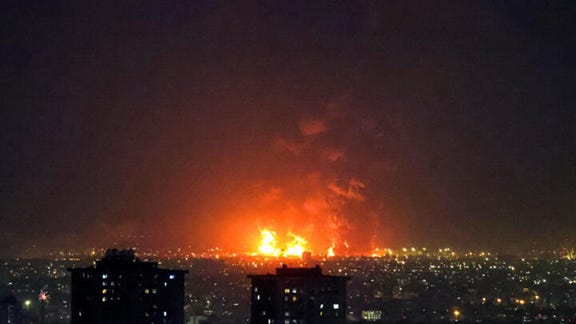
Since the United States, supported by Israel, launched the military operation—or “limited combat operation” or intervention or war, as you prefer—against the Islamic Revolution that rules Iran on 28 February, the intended purpose has been rather difficult to pin down.
THE U.S. MESSAGING
President Donald Trump, in his first remarks hours after Operation EPIC FURY began, said the mullahs had “attempted to rebuild their nuclear program [after the June 2025 American-Israeli operation] and continue developing long-range missiles” that threaten Europe, American troops around the world, and “could soon reach the American homeland”. The U.S. would, therefore, “destroy their missiles”, “raze” Tehran’s missile program “to the ground”, and enforce the U.S. policy that Iran “not obtain a nuclear weapon”, as well as “annihilate” the Iranian Navy and ensure the Islamic Revolutionary Guards Corps (IRGC) could “no longer destabilise the region”.
While Trump did not exactly say regime change was a war aim, he concluded his speech by telling the IRGC, the regular army (Artesh), and the Iranian police, “lay down your weapons” or face “certain death”, and told the Iranian people, “The hour of your freedom is at hand. … When we are finished, take over your government. … This is the moment for action; do not let it pass.”
To give a flavour of U.S. messaging since then:
Trump on 1 March, speaking after it was confirmed Iranian Supreme Leader Ali Khamenei (“a wretched and vile man”) and most of his military commanders were dead, said the U.S. had “very strong objectives”, but decided not to bore us with what they are. The nearest Trump came to defining objectives was saying that the “massive operation” was to “ensure security”, and alluding to the “dire threat” posed by a regime that raises “terrorist armies” possessing nuclear weapons and long-range missiles, which the U.S. is not going to permit.
Defence Secretary Pete Hegseth said on 2 March: “This is not a so-called regime-change war … This is not Iraq. This is not endless. … This operation [has] a clear, devastating, decisive mission: destroy the missile threat, destroy the navy, no nukes. … [There will be] no nation-building quagmire, no democracy building exercise”.
Trump on 2 March said, “I don’t have the yips with respect to boots on the ground”, though the U.S. “probably” would not need them for this mission, whatever that is. Trump at least offered the assurance: “We’re right on schedule”.
Secretary of State Marco Rubio on 2 March professed himself baffled by “what the confusion is” over the administration’s “very clear goal”: “The United States is conducting an operation to eliminate the threat of Iran’s short-range ballistic missiles and the threat posed by their navy”. In terms of the timing, Rubio said, “We knew that there was going to be an Israeli action”, which “would precipitate an attack against American forces”, so Trump “made the very wise decision” to go in “pre-emptively” to avoid casualties. Rubio also said “orders had been delegated down to the field commanders” because of the imminence of an Iranian attack, so the operation began “automatically”.
Trump on 3 March said he had reached the conclusion after negotiating with the “lunatics” that rule Iran that “they were going to attack first”, so he gave the order to initiate hostilities and called on the Israelis to join in, indeed, “I might have forced their hand.”
Rubio on 3 March said: “Iran is run by lunatics, religious fanatic lunatics … The President made the decision to … take away their missiles, take away their navy, take away their drones … so that they can never have a nuclear weapon.”
Hegseth on 4 March said, “America is winning decisively, devastatingly and without mercy”, and General Dan Caine, the chairman of the Joint Chiefs of Staff, clarified that this meant destruction of nuclear-weapons sites, missiles, and the IRGC Navy.
Hegseth on 5 March said there had been “no expansion in our objectives” and that they were “actually simplifying”. There were references to “these objectives” and “clear objectives”: it remained hazy what they are. The targeting of the IRGC Navy and Iranian officials responsible for ordering attacks on civilian demonstrators were mentioned.
Trump on 6 March said “unconditional surrender” was the only acceptable outcome.
WHAT TO MAKE OF ALL THIS
Rubio’s 2 March remark about Israel’s role will be taken by those prone to seeing tentacular Jewish influence behind world events as vindication, and Trump’s direct contradiction of Rubio the next day will hardly matter to those who believe the Zionist Elders are capable of plotting global domination and then losing the blueprint. On planet earth, the importance of this episode was underlining the administration’s flailing public diplomacy: it tried a talking point and swiftly withdrew it when the negative feedback poured in.
If one exercises the “heroic flexibility” the late Khamenei recommended in another context, it is just about possible to synthesise the administration’s messaging into a half-way coherent story of military action triggered by ominous developments in the Iranian nuclear-weapons and ballistic missile programs, and some kind of imminent attack being planned, with the consequent mission being the destruction of both programs, necessitating the suppression of air defences and the eradication of the IRGC Navy to protect American forces and prevent moves to close the Strait of Hormuz that would damage the world economy. Confining the Islamic Revolution within Iran’s borders or eliminating it entirely appear to be what one might call Schrödinger’s objectives, or aspirations.
To start with the narrative about why now. Trump’s claim that Clerical Iran has “attempted to rebuild their nuclear program” since Operation MIDNIGHT HAMMER—a maidenly codename next to the Team America designation of the current round—is narrowly true. The Islamic Revolution will never cease its ambition to acquire at least a latent nuclear-weapons capacity,1 and these intentions are very important. With such regimes, the only ultimate solution is their removal. The question before us, however, is whether, eight months on from the last intervention, the Iranian regime had reconstituted its atomic resources and gotten so close to the nuclear-weapons threshold that another intervention was immediately necessary? All available evidence is that the answer is “no”.
David Albright, one of the few nuclear-weapons experts to avoid compromising his analytical integrity for the sake of politics in the Obama years, emphasises, because of his experience, Tehran’s intentions as a permanent threat, but the evidence of the Islamic Republic’s activities since June 2025 does not point to an imminent threat. There have been “salvaging operations and potentially rebuilding” on the weaponisation side since MIDNIGHT HAMMER, but it is “minimal”, says Albright. The devastation to the centrifuges means “you have a program that no longer really exists”, Albright continues, and while there are “remnants”, especially uncertainty over the quantity of enriched uranium, plus presumable hidden sites, the primary danger from them at the present time comes if security at (what’s left of) Iran’s nuclear facilities evaporates amid a regime collapse.
Notably, too, there have not yet been any airstrikes on Iranian nuclear-weapons sites. As a general military proposition, that is not necessarily surprising: those targets are more complicated and time is needed for intelligence-gathering to ensure no fallout and so on. The anti-nuclear strikes are likely to come in a later phase of the operation and some sites are probably off-limits altogether, like the Bushehr reactor, which was untouched last time in conformity with U.S. and Israeli assurances to Russia. If the clerical regime was on a crash course to build “The Bomb”, though, one can imagine a campaign that handled that emergency first.
The rebuilding of Iran’s missile program does seem to have been faster. In the first days of the war, Tehran hit nine countries with missiles—Israel, all six Gulf States, Jordan, Cyprus—and fired at Turkey. The ostensible target in most cases was a U.S. base and six American servicemen have been killed, with eighteen wounded. That said, this has now virtually stopped, a result certainly of the U.S. and Israel quickly destroying the launchers, but also it seems because of depleted Iranian missile stockpiles. At a minimum, it should induce some scepticism about the higher (generally Israeli-sourced) estimates in circulation of the Islamic Republic’s current missile arsenal and potential production capacity. The notion of Iranian missiles threatening the U.S. “homeland” any time soon is fanciful.
As to the idea of an imminent Iranian attack on the U.S. forces in the Middle East, there is simply no evidence for this, and the Pentagon reportedly acknowledged as much to Congress in a closed-door briefing after the operation began.
* * * *
What, then, motivated Trump to do this? It is all speculation until we get the memoirs, or a press leak, but the political situation Trump got himself into after telling Iranians on 13 January to continue protesting because “HELP IS ON ITS WAY” [all-caps original] seems likely to be part of it. This was days after the clerical regime slaughtered Iranians en masse.2 That Trump then entered into nuclear negotiations with the Iranian regime—which “executed” prisoners Trump claimed to have saved—disheartened Iranians and fuelled media criticism on the “TACO” (“Trump Always Chickens Out”) theme that is known to enrage him. There are few principles Trump is wedded to in any reliable sense, but saving his personal face is one of them.
Trump once spoke of a two- or three-day operation; his most recent comments indicated more like four weeks. There is nothing inherently wrong with this: it is a sign of the silliness of the times that the phrase “endless war” exists as a criticism. If a State has objectives it is worth going to war over, achieving them takes as long as it takes, and the enemy gets a vote. The problem, of course, is when the political leadership has chosen war as a messaging strategy, with objectives that are, if not quite non-existent, ill-defined and/or unstable, and there is every reason to believe that has happened here.
To give an example. Earlier this week, after reports that the CIA was arming Iranian Kurdish militants based in Iraqi Kurdistan,3 and that they were preparing to invade Iran, Trump declared: “I think it’s wonderful that they want to do that, I’d be all for it.” The support of Iranians for the U.S.-Israeli operation so far, even from those personally impacted by the bombing, is remarkable among such a deeply patriotic population. Trump’s embrace of actors Iranians see as separatists was, therefore, quite shocking. If there was anything that could change Iranian opinion it would be a perception that the Islamic Republic is defending the country’s territorial integrity and the U.S.-Israeli operation threatens it. Someone seems to have gotten in Trump’s ear about this and yesterday he said, “I don’t want the Kurds to go into Iran.” Israeli Prime Minister Benjamin Netanyahu made a still more pointed and detailed statement last night publicly repudiating any intentions to divide Iran.
It was the right outcome in the end, but it is an alarming indicator all the same. It is not as if, after all, the Kurdish groups could have made much difference to the military balance inside Iran, but their deployment backed by the U.S. and Israel would have had devastating political consequences. It should not have taken several days for a point as basic as this to be understood. It suggests there has been insufficient planning, and that the source of the problem is confused directives from the political leadership that is casting around for tactical options without the constraint of any overarching strategic framework.
A similar indication is given in the reporting that Trump is considering sending “a small contingent” of U.S. ground troops into Iran. What for is, once again, opaque, but securing uranium stockpiles would seem to be one purpose. It is not encouraging that this decision is being made midstream in a war where concerns about the nuclear-weapons program are the most consistent element of the messaging.
A terrorist wearing clothes with an Islamic Republic flag shot up a bar in Texas hours after the EPIC FURY operation began, a criminal gang which is a known cut-out for the IRGC has thrown an IED at the U.S. Embassy in Norway, and IRGC spy-terrorists have been arrested in Britain, Azerbaijan, and Qatar this week while planning attacks, against Jews in the former two. It is unclear how much preparation Trump made for the Islamic Revolution retaliating like this, and if any consequences will be visited on the regime for this behaviour.
Meanwhile, the surprise about the efficacy of the Iranian Shahed drones, after seeing them in action for four years as part of Russia’s war on Ukraine, is perhaps the strangest element so far. On the plus side, it has publicised how extensively Ukraine is already contributing to NATO and the security of other Western friends. It makes it ever-more absurd to deny Ukraine formal membership in the Alliance.
* * * *
From a public-relations or propaganda perspective, avoiding unequivocal objectives is highly advantageous for the Trump administration: critics cannot call the Iran operation a failure because there are no agreed metrics by which that judgment can be made, and supporters can ascribe to it vast and subtle strategic designs. Of most immediate relevance to Trump, this ambiguity is helpful in managing the vexing question of whether this is one of those “regime change wars” he and his (strangely absent) Vice President, J.D. Vance, have spent years denouncing. While the Iranian regime still stands, the MAGA base is assured the war is not about toppling it; should it fall, the Leader can be credited with being “a fighter” who drew a line “after 47 years of Iranian belligerence” and American timidity, as Hegseth put it the other day.
Whether as a direct war aim, or a wished-for by-product, there can be little doubt regime change has been on Trump’s mind. Some of the targets struck, starting with the Rahbar, make no sense unless the intention is to at least test the possibility of destroying the regime, and Trump has said as much. In an interview on 1 March, Trump said: “What we did in Venezuela, I think, is the perfect, the perfect scenario.” Just today, as Iran was selecting its new Supreme Leader,4 Trump said the new man is “going to have to get approval from us” and is “not going to last long” if he does not. It is open to doubt whether what has happened in Venezuela—removing the top personnel, yet leaving the system in place—qualifies as regime change, but the transformation of the country into an indirect American colony is a change. The plans for replicating the Venezuela scenario in Iran have apparently hit a snag as “most of the people we had in mind [to be the new ruler] are dead”, according to Trump. But that is the least of it.
A Venezuela scenario in Iran relies on the idea that the U.S. can keep killing the current leadership cadre until it reaches down to a layer of people, especially in the military, who are willing to come to terms with the U.S. and rule according to its key interests. The problem with this is that the Islamic Revolution is an ideological movement which from inception had hostility to the United States and the broader West as core elements. UANI’s Kasra Aarabi put it well: “The IRGC is a highly radicalised and indoctrinated force. So the idea of them switching sides … is unlikely.” The scale of what is required to neutralise the Revolution as a factor in Iranian life, and get to a point where people amenable to the U.S. are able to take power stably, given the vitality of the Revolution’s votaries and the depth of its ruling structure, amounts to a thoroughgoing regime change. In short, the Venezuela option does not exist in Iran, and the implications for the possibility of regime change are not positive.
The Islamic Revolution has only ruled in Yemen for a little over a decade and it has shown itself to be immensely durable, able to withstand internal challenges on multiple fronts and sustained external intervention. The Revolution has had nearly half-a-century to entrench in Iran, to infiltrate every sector of the society, raise three generations in its ideology, and recruit hundreds of thousands of armed men who believe God wants them to protect the rule of His viceregent on earth. It is not absolutely impossible that regime decapitation, damage to IRGC security nodes, the activities of Israel’s ground assets and agents, and internal Iranian rebellion combine just right to unravel the clerical regime.5 But, absent that black swan, it is most unlikely Trump can overthrow the Revolution in Iran with a month-long air campaign.
* * * *
Many have a normative opposition to interventions in the Middle East and/or to Trump, and in the circumstances it is understandable that many more will conclude this is a war launched on false premises, without any serious plan, and therefore cannot be supported. For Americans, there is the additional concern about what Trump will do with the additional powers and prestige that accrue to a President in wartime. These arguments might well persuade even Iran hawks, especially since the Islamic Republic is likely to survive this, and Trump could well botch things from the other direction by calling the operation off too soon, before Israel—which has some semblance of a plan—can work through all of its strike packages, as he did last June.
My own view is that one need not deny any of the problems with Trump’s Iran operation, nor try to rationalise this as being about more than it is—a thesis currently getting a workout is that this is a grand strategy move in the competition with Red China—to believe that what Trump has done is beneficial for the Western Alliance in three important ways.
First, Trump made a promise in the name of the United States to the people of Iran and, whether it was wise or not to have done so, once made it was morally and strategically vital for all of us that it was upheld. Now it has been. A lot of the people who ordered the massacres of Iranians, many of them long owed retribution for their crimes against us, have had their accounts settled.
Second, the clerical regime has been seriously degraded, and any steps towards weakening it should be welcomed. The physical disarmament and State debilitation has downsized Tehran’s ability to threaten the West and its regional allies for some time, and when the Islamic Republic restores its threat capacity to an unacceptable level the precedent is in place to deal with it. Which is the final and most important gain.
Third, Trump has decisively broken the taboo on using force against the Islamic Revolution inside Iran. In prior dealings with the regime—especially over the nuclear-weapons program—the threat of Western military action was mostly felt as a constraint on the West, enabling Tehran to control the diplomacy by threatening to walk away. In the future, that will not be the case.
It is somewhere between amusing and infuriating to see Trump and his supporters, conspiratorial anti-warriors on the Iran Question until so recently, justifying this operation by saying it is in effect self-defence because the Islamic Revolution has been at war with the civilised world for forty-seven years and is steeped in the blood of our people. It happens to be true, though. The Islamists swept to power in Iran in 1979 declaring war against the West and the State system safeguarded by the United States, manifested in the seizure of the U.S. Embassy in Tehran and the keeping of its staff as hostages for 444 days. The failures of Western policy towards Iran from that time onwards have always been the result of an excessive willingness for accommodation. That time has now surely passed. “This deal or war” is a much less persuasive sales pitch for accommodationism now Trump has exposed the Islamic Revolution as a ramshackle despotism that can do very little if the U.S. chooses the latter option.
NOTES
The question of Clerical Iran’s access to nuclear weapons is greatly complicated by the “known unknown” of arrangements with North Korea.
The numbers of Iranians murdered by the clerical regime on 8-9 January are very uncertain: one estimate sourced from within the regime says 30,000 people; other estimates are even higher.
Six Iranian Kurdish groups in the Iraqi Kurdistan Regional Government (KRG) area recently formed a joint platform. The groups involved include the Democratic Party of Iranian Kurdistan (KDPI), the Kurdistan Freedom Party (PAK), and the Kurdistan Free Life Party (PJAK), the Iranian department of the Kurdistan Workers’ Party (PKK), the terrorist-revolutionary outfit originating in Turkey that has historic links with the Islamic Republic.
Interestingly, the Agency program to arm the KRG-based Iranian Kurdish groups “began several months before the war”, which means the U.S. was either running an operation to destabilise the Islamic Republic via the Iranian Kurdish insurgents even if there was no overt U.S.-Iran war, or this was a contingency option that somebody remembered the U.S. had and suggested using this week.
It turned out to be Mojtaba Khamenei, the son of the last Supreme Leader.
What comes after a collapse of the clerical regime is, as they say, beyond the scope of this article.