


A previous article looked at the terrorist infrastructure, sustained by Palestinians and centred on Lebanon, which formed the crucial external support system for the 1978-79 Islamic Revolution in Iran that brought down the Shah and ushered Ayatollah Ruhollah Khomeini into power. There was, however, a parallel network supporting the Iranian Revolution in Lebanon. In Distant Relations: Iran and Lebanon in the Last 500 Years (2006), Houchang E. Chehabi and Hassan I. Mneimneh give a survey of this other network (pp. 182-214), primarily through the life of one of its key operatives, Mostafa Chamran.
EARLY LIFE
Born in Tehran in 1932, Chamran joined the Liberation Movement of Iran (LMI) soon after it emerged as a religious splinter from the Mossadeqist nationalist National Front in 1961. The Iranians in LMI were the core of the other network in Lebanon that helped Khomeini to power, While LMI ended up having a generally confrontational relationship with the Palestine Liberation Organisation (PLO), there was an ambivalence in that they were not wholly separate from the Palestinian-reliant network. This was baked-in from the start. For instance, the LMI, while supposedly “moderate” or “modernist” with a certain aversion to the traditional Shi’a clergy, had among their founders “the Red Mullah” Ayatollah Mahmoud Taleghani, who was also the spiritual leader of the Mojahedeen-e-Khalq (MEK). MEK was a close collaborator with the PLO and under an alliance formed with Khomeini in the early 1970s acted as the terrorist wing of his Revolution in 1978.1
That there was always an international dimension to the Iranian opposition to the Imperial Government can be seen in Chamran’s story. As Chehabi and Mneimneh explain, Chamran lived in the United States from the late 1950s—he would obtain a PhD in engineering and physics from Berkley—and he was no rank-and-file member of LMI. Chamran was among the founders of “LMI Abroad”, an interconnected LMI contingent operating in the West.
With Chamran in the U.S. were Ebrahim Yazdi and Sadeq Ghotbzadeh, later two of the three leaders of Khomeini’s PR shop in Paris at the height of the Revolution and officials in the first post-revolutionary government. In France, there was Sadeq Tabataba’i, whose sister was married to Ahmad Khomeini, the Imam’s son, and he was a nephew of Musa al-Sadr (about whom more soon). Tabataba’i, another propagandist for Khomeini in Paris in late 1978, was (appropriately enough) Deputy Prime Minister for Public Relations after the Revolution. And perhaps most importantly there was Ali Shariati in Germany, the key ideologist in bridging the Black and the Red, the Islamists and Communists, who led the Revolution. A religious fanatic who had differences with Khomeini only over the exact power of the clergy in an ideal State and a sociologist steeped in the nascent “post-colonial” theology, Shariati was an ardent admirer of the nationalist socialists who drowned Algeria in blood and the main populariser of Frantz Fanon among the Iranian opposition.
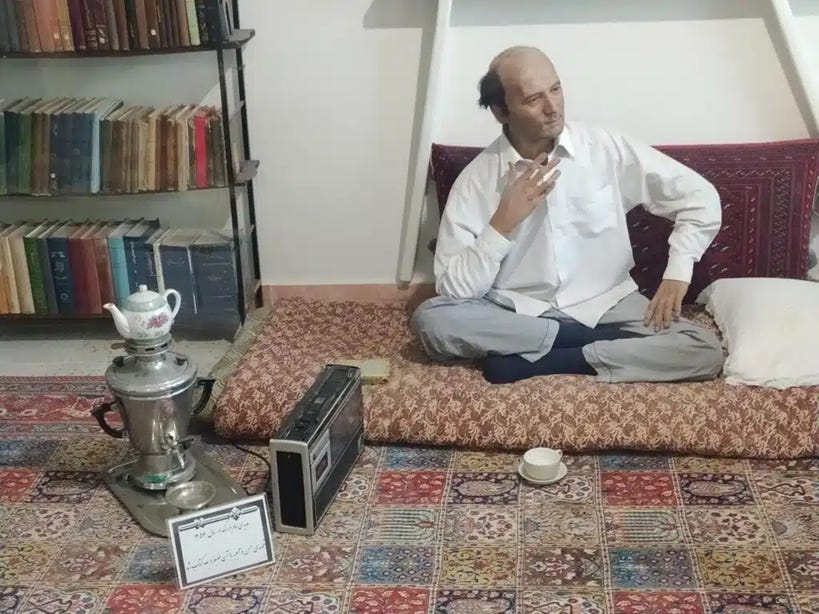
The Persian translation of Fanon’s The Wretched of the Earth that Shariati spread was created c. 1966 by Abolhassan Banisadr, never an official LMI member but always close to it and very much in the Red Islamist current. It goes without saying, Banisadr was a resident of Paris, and he was the third key official in managing Khomeini’s propaganda image and message after the Imam arrived in the city in October 1978. While Shariati died six months before the Islamic Revolution began, Banisadr accompanied Khomeini back to Iran in 1979 and became the first president of the Islamic Republic in 1980.
Chehabi and Mneimneh refer to LMI Abroad as the “radical” wing of the party, but if so it was only briefly: it was their doctrines and practices that came to define the LMI. Mehdi Bazargan, the founding leader of LMI who stayed in Iran, was crucial in misleading the American Embassy on Khomeini’s behalf during the 1978-79 crisis,2 and Bazargan was the first Prime Minister of the Islamic Republic.
After the defeat of Khomeini’s first rebellion in 1963, triggered by the Shah’s modernising “White Revolution” (specifically the provision of education to girls), and the Imam’s deportation—he went to Iraq in 1965 and stayed there for thirteen years—the Shah entered the decade where he was at the zenith of his power, memorably securing for Iran an unprecedented transfer of wealth from the West in the “oil shock”. Most of the opposition inside Iran, certainly the constitutional elements, went into abeyance. Chamran and LMI Abroad, by contrast, had been drawn to violence and set about enacting it, the authors note. Algeria had mesmerised them and this was the era when the Soviet “Third World Strategy” was thickening into a global campaign of subversion. Chamran and his set were hardly alone in feeling the allure of Cuba becoming a Soviet colony under the charismatic Fidel Castro, and attention was turning to Vietnam as American involvement deepened to hold back the Soviet onslaught fronted by Ho Chi Minh.
BEGINNING A TERRORIST CAREER
In “late 1963”, Distant Relations records, Chamran, Yazdi, and Ghotbzadeh negotiated with Egypt’s Gamal Abdel Nasser, the Soviet-aligned leader of the radical camp in the Middle East, to set up an anti-Shah formation in Cairo, the Special Organization for Unity and Action (SAMA). Chamran was “chosen to supervise the military training of its members”, the beginning of a long career as a roving terrorist trainer. Iranian militants were trained at the SAMA camp for two years, but relations with the Egyptian despotism broke down. Nasser, a pan-Arabist, began to agitate against Iran in ways SAMA’s leaders felt threatened the nation, not the Shah. Nasser had taken to referring to “the Arabian Gulf” and labelled the Arab-majority Khuzestan province of Iran “Arabistan”, even supporting secessionists there.
By 1966, Yazdi had moved SAMA’s headquarters to Lebanon, a weak State home to camps run by the PLO, which would in time make it weaker still. Other SAMA operatives went to Iraq and set up camps in Baghdad and Basra. “Chamran was left in Cairo to wrap up operations there and joined Yazdi in Beirut a few months later”, Chehabi and Mneimneh write. “But in the spring of 1967, relations between Iran and Lebanon deteriorated and the resulting pressure of the Lebanese government forced first Chamran and then Yazdi to return to the United States.” SAMA was dissolved at this point.
The Chamran clique had in any case “concluded that the time was not ripe for armed struggle against the Shah and that therefore the fight against his regime had to take the form of inculcating students with a revolutionary Islamic consciousness, for which purpose Islamic Student Associations were created in the United States and Europe.” This mission was to prove highly successful. Among the Shah’s reforms was increasing access to education for the poor, including enabling them to be educated abroad. There were about 100,000 Iranian students in Europe and America in 1978 and instead of feeling grateful to the Shah for their opportunities, they became, in the main, a force-multiplying cadre of activists for the Islamic Revolution. Chamran himself did not remain in the U.S. for long.
KHOMEINI’S PALESTINIAN-BASED NETWORK IN LEBANON
As the Palestinian-centric network for Khomeini’s Revolution has been covered in-depth already, that story will not be reiterated here, but it is important to have an outline of that infrastructure in mind to understand the other network, and Chehabi and Mneimneh confirm and add some interesting details.
When the attempt of Yasser Arafat’s PLO to take over Jordan in September 1970 ended in defeat and expulsion to Lebanon, the link between the Palestinians and the Iranian opposition was already in place. Senior MEK leaders were in the PLO’s Jordanian camps and followed Arafat to Lebanon. The attempt of a separate MEK cadre in Dubai to get to Beirut created a major diplomatic incident and brought Lebanon’s status as an incubator of Iranian radicals to wider attention. From Chehabi and Mneimneh:
The … [MEK] Dubai group was arrested before getting to Lebanon and the Dubai police put them on an aeroplane to Iran. Their extradition was thwarted, however, when their comrades hijacked the aircraft and took it to Baghdad, where Iraqi authorities [the Ba’th Party by this point] arrested the militants. When Ayatollah Khomeini refused to intervene with the Iraqi government on their behalf [for fear of compromising his sanctuary], Abu Nidal [real name: Sabri al-Banna], then-PLO representative in Baghdad, came to the rescue by arranging for them to be taken to Damascus after 40 days in gaol. In late January 1971, they arrived in Beirut with identity cards provided by [Arafat’s FATAH faction of the PLO] that pretended they were Palestinians. They spent about a fortnight at Shaykh Zinad camp near Tripoli [in northern Lebanon] before being taken to a camp near Tartus in Syria. In April [1971, FATAH] evacuated that camp, whereupon the Iranian guerrillas in training went to Beirut.
In Lebanon, MEK studied “ideology, sabotage operations, forging documents, and producing explosives”, Chehabi and Mneimneh continue. “Having undergone their training, individual Iranians would return to Iran carrying weapons concealed on their bodies and in their luggage. In Lebanon, they posed as Palestinians and, having received identity papers from [FATAH] that gave them new names, they enjoyed a certain amount of immunity on account of the ‘Cairo Agreement’ the Lebanese government had been constrained to sign with the PLO in 1969. To account for their faulty Arabic and Persian accents, they pretended they had been brought up in Afghanistan.”
MEK’s first attempt at terrorism within Iran, to disrupt the celebrations of 2,500 years of Monarchy in October 1971, was thwarted by SAVAK, the Shah’s political police, and most of its leadership inside Iran was arrested. MEK’s first official communique was published in Beirut on 9 February 1972. One of its leaders at that time, Mohsen Nejat Hoseini, says MEK’s “external branch … was active” in Lebanon, Syria, Aden, Baghdad, Paris, London, and Tripoli (Libya), with members “constantly travelling between these areas”. Hosseini adds:
Lebanon was, because of the relative freedoms it afforded, the most appropriate country for semi-clandestine activity in the Middle Bast, and so we chose Lebanon to be the centre of our international contacts and communications. Many of our initial contacts with militant and revolutionary organizations in other countries took place in Lebanon. Moreover, our comrades and sympathizers in Iran always came to Lebanon if they wanted to get in touch with the external organization. …
[Acquiring weapons was easy because i]n the south of Beirut there were brokers for arms deals. To gain access to the busy world of arms dealers, all one had to do was to gain the confidence of a short fat man who sat on a stool in a tea store and played with his worry beads. … He could deliver any weapons and equipment that were not too bulky at a prearranged place in Beirut. If no deal was possible with this man, there was always the barbershop … and if one ran into a problem there one could go to the grocery store[.]
Later in 1972, as MEK rebuilt, it reached a tactical alliance with Khomeini: MEK got greater religious legitimacy and the Imam got reach into Iran, as well as an indirect relationship with the PLO. In 1973, Khomeini established a direct relationship with the PLO. Khomeinist militants began to receive training soon afterwards from the PLO’s Force 17, an “elite” unit that evolved out of Arafat’s Praetorian Guard. The arrangement raised Arafat’s stature by making him a player in the Shah’s Iran, the most powerful and influential regional State at the time, and gave Khomeini greater freedom of action.3 Instead of relying on requests to MEK for actions inside Iran, Khomeini had his own soldiers trained in terrorism and intelligence by the Palestinians in Lebanon.
The other main Iranian terrorist group, the Communist Fedayeen, was already receiving training at the PLO bases in Lebanon. The Fedayeen ostensibly eschewed relations with either of the two big Communist powers, the Soviet Union and Red China, and in Lebanon rejected the “mainstream” Communists scene because it was connected to the Iranian Tudeh (Communist) Party, a KGB creature like all the other “fraternal” Parties. The Fedayeen enmeshed with the more marginal Lebanese Communist forces, like the Communist Action Organization in Lebanon, who opposed to the presence in the country of Syria, the Soviets’ great Arab ally. In practice, however, the Fedayeen was close to the Soviets, in its internal ideology and structure, and in its relations, receiving vast amounts of money and weapons via Moscow.
The PLO itself was deepening its relations with Moscow at this time, and MEK and the Fedayeen were particularly close to the Popular Front for the Liberation of Palestine (PFLP), a contingent of the PLO operationally controlled by the Soviet KGB. The two groups also utilised PFLP training camps in South Yemen and Colonel Muammar al-Qaddafi’s Libya, the one a Soviet colony and the other as good as. Qaddafi provided MEK and the Fedayeen—and Khomeini directly—with money, as he did many Lebanese factions. The unity of the external milieu that sought Revolution in Iran—Khomeini, the PLO, and Qaddafi, with the Soviets in the background—would be matched by internal unity in mid-1977 when the Mojahedeen and Fedayeen came into alliance.4
CHAMRAN AND KHOMEINI’S OTHER NETWORK IN LEBANON
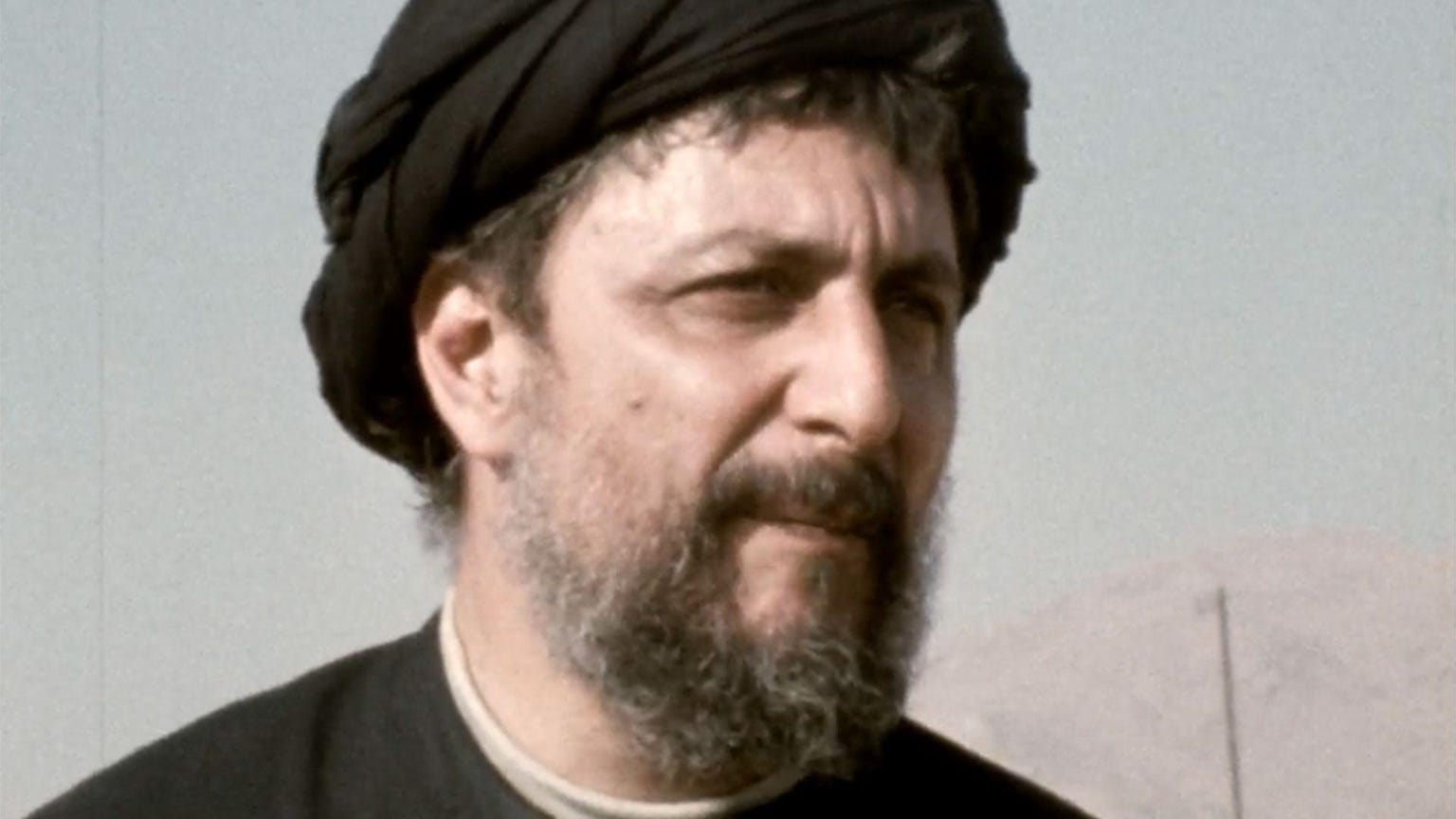
Yazdi had been travelling back and forth to Lebanon even when he was based in Cairo, and developed relations with Musa al-Sadr, the effective leader of Lebanon’s Shi’is, whom he had known from their student days in Tehran. Al-Sadr, an Iranian by birth, was a traditionalist insofar as he had conventional clerical qualifications, did not subscribe to Khomeini’s revolutionary program for clerical rule (velayat-e faqih), and retained the patronage of the Shah of Iran, but he was “modern” in the sense of being more involved in politics and more brazenly so than was usual for the Shi’a ulema. During one of Yazdi’s trips to Lebanon, Al-Sadr “told him that he was looking for a director for the technical school he had established in Tyre and Yazdi suggested Mostafa Chamran”, according to Chehabi and Mneimneh. Chamran moved to Lebanon in 1971 to take the job.
Chehabi and Mneimneh record Chamran’s later explanation of what he did after arriving in Lebanon:
As soon as I settled in southern Lebanon in 1971, I started classes in Islamic ideology in the style of the Islamic Student Associations. From each village I chose one or two believing and Muslim teachers, totalling about 150. These would visit the school once a week and conduct sessions at which Sadr, Shaykh [Muhammad] Mahdi Shamseddin and Sayyid Muhammad Husayn Fadlallah gave talks as well. There were discussions and criticism and little by little I joined the discussions and gave a series of ideological lessons. About half of these people left, the other remained and became the first core group of the Movement of the Deprived (Harakat al-Mahrumin). In Beirut we did the same, although there the difficulties were greater. … Thus we trained the best Shi’i youth, and it was these young believers who later became the cadres of the Movement of the Deprived and of Amal.
(There is a lot of foreshadowing there, especially the mention of Ayatollah Fadlallah, the spiritual guide of what became known as Hizballah, the Lebanon-based unit of the Guardians of the Islamic Revolution (IRGC) formed in 1979 to protect Khomeinism in Iran and export it beyond.5)
This was the beginning of a situation where, in broad strokes, Khomeini operated a direct apparatus in Lebanon that revolved around the PLO, comprising his own cadres and at various levels of remove the Mojahedeen and Fedayeen, while working—primarily through Chamran and the LMI—to cultivate loyalists within Al-Sadr’s infrastructure, which was separate and quite hostile to the PLO, yet intersected with it to some degree all the same. It led to a complex, lethal game where who was doing what for whom and why was murky, in real-time and to the participants themselves. Even in hindsight, unpicking it and explicating the alignments neatly is not always easy.
Khomeini had lieutenants in Lebanon before he began impacting the politics of that country, most importantly Jalaleddin Farsi and Mohammad Montazeri, and they reported back very negatively about Al-Sadr, shaping the Imam’s view. The crux was relations with the PLO. It is jumping ahead, but Farsi and Montazeri became lynchpins of the Khomeinist-PLO alliance during the Revolution and were prime movers in that alliance forging the IRGC afterwards. Farsi arrived in Lebanon in 1970 and rapidly took against Al-Sadr. He also was not impressed with Al-Sadr’s seminaries, did not take kindly to Al-Sadr’s indifference to the Maronite-dominated “Lebanese” Army watching over the Amal camp with its guns directed at Palestinian positions, and was outraged to find Al-Sadr passing intelligence to SAVAK on anti-Iranian activities in Lebanon. Montazeri, a young cleric, son of Ayatollah Hussein-Ali Montazeri, was “one of Khomeini’s most prominent disciples”, the authors note, and while his connection to Lebanon was fainter—he spent most of his time travelling the world, proselytising for Khomeinism with the goal of creating an “Islamist International”—he had firm relations with the PLO and “was particularly close” to Colonel Qaddafi, a detail to keep in mind.
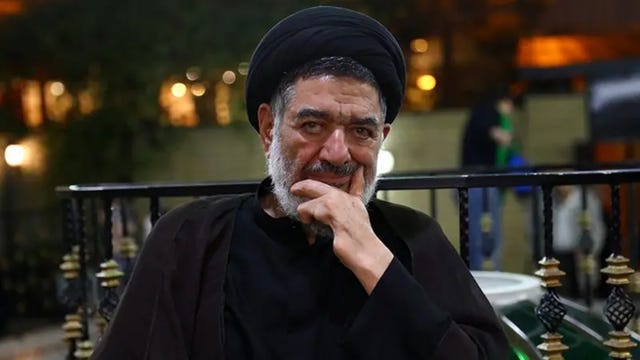
Solidifying Khomeini’s animus to Al-Sadr was his vital aide, Ali Akbar Mohtashamipur, who was sent to Beirut in 1973 to arrange the details of the Imam’s personal line to Arafat. Mohtashamipur also knew Lebanon well already, Chehabi and Mneimneh note, having travelled there for military training soon after Khomeini went to Iraq in 1965 and Mohtashamipur continued travelling in and out of the country. Al-Sadr had sinned ideologically in a way Mohtashamipur could not forgive in June 1970, Chehabi and Mneimneh explain. That was when Grand Ayatollah Muhsin al-Hakim died in Najaf, and Al-Sadr directed the Shi’a clerical council in Lebanon to recognise another of the Najafi hawza, Abu al-Qasim al-Kho’i, as the new marja (source of emulation), rather than Khomeini. Then there were Al-Sadr’s practical sins. When Mohtashamipur visited Al-Sadr’s learning establishments in the south, he judged the quality of education low and the discipline even worse, with the Lebanese and particularly African foreign students spending more time swimming in the sea and visiting bars at night than reading. “The seminary was more like a sanatorium than a centre of knowledge and learning”, Mohtashamipur fumed. Above all of this was the Lebanese Shi’a-Palestinian tension.
The PLO’s disregard for Lebanese sovereignty after its arrival in 1970—the sense of Sunni Palestinians trying to take over a second country and turning Lebanon into a nest of international terrorists—destabilised Lebanon’s delicate sectarian balance. It angered the Christian-led government, and the clashes between the PLO and the Christian militias were what mushroomed into all-out civil war in early 1975. It was in the south, however, where the PLO was most intrusive, its bullying gangs roaming the Shi’a-majority zone, resented all the more for being foreign and Sunni. And alongside building a State-within-the-State that eroded what little power the Shi’is had, the PLO’s cross-border terrorism provoked Israeli incursions from as early as 1968. Mohtashamipur recognised early, Chehabi and Mneimneh document, that the Shi’is, including the ulema, were blaming the PLO for the consequences of Israel’s actions in southern Lebanon.
This put Khomeini in a bind. On the one hand, even if the Imam had not needed the PLO to build his revolutionary cadre, Khomeini was already attuned to the Palestine Cause as a useful mechanism for mass-mobilisation and genuinely desirous of Israel’s destruction. On the other hand, Khomeini worried that an open breach between the Lebanese Shi’is and the Palestinians would make the Shi’a stepchildren, in the phrase of the late Fouad Ajami, look bad in front of Islam’s Sunni majority, and if Khomeini publicly turned on Al-Sadr it would cut off his points of entry into the Lebanese Shi’a population and especially its clerical hierarchy, which were important to his plans. In the event, the turmoil of the Lebanese civil war was to be Khomeini’s salvation, the beginning of a pattern that still holds, wherein Khomeinism thrives on chaos and violence, no matter how much people delude themselves that the Islamic Revolution values “stability”.
Al-Sadr, after long resistance, bowed to the inevitable and took the plunge into the world of militias, creating the Amal Movement in 1974, with Chamran as its military leader, ostensibly against the threat from Israel, but Al-Sadr’s eyes were on the Palestinians.6 In the short-term, this ambiguity worked. Internally, it allowed Al-Sadr’s followers to elide, in their own minds and in their presentation to others, the question of whether they regarded the Palestinians as more menacing than the Israelis, an ideological Rubicon few wanted to cross. Chamran’s own “attitude to Palestinians was marked by ambiguity”, Chehabi and Mneimneh write. “He supported them wholeheartedly in their struggle against Israel, but at the same time witnessed the nefarious effects of their tactics for Shi’i villagers living near the Israeli border”. Chamran was particularly incensed that the PLO, while “compensating” the families of its PLO “martyrs” made no such payments to the families of the Shi’a villagers the PLO got killed.
Al-Sadr’s stance was political shrewd enough that even the PLO accepted it for a time—a crucial time, when Amal was in formation. Arafat lent Chamran FATAH “instructors” to train recruits at the Amal camp near the Syrian border. Indeed, Arafat personally “visited the camp a number of times”, according to Chehabi and Mneimneh. While Chamran’s mission was primarily to train Lebanese Shi’is, he would claim that “hundreds of Iranians were also trained at this camp”. Given that the authors document—even if they minimise—Chamran’s connection with MEK, saying they were “on friendly terms” and Chamran helped the Mojahedeen with the logistics of smuggling weapons into Iran, it is strange that there is no consideration of whether the Fedayeen and Mojahedeen were among these “hundreds”. In either event, this overlap was enough to worry the Shah’s government. The Iranian ambassador in Beirut complained about the Amal camp in 1974 and the same year the Shah severed relations with Al-Sadr because of the association with Chamran.7
Reality was destined to overtake Al-Sadr, though. War is a great clarifier and Al-Sadr’s equivocations over ideology and affiliation rather quickly came to seem less convincing and adroit, and more incoherent. It gave Khomeini an opening to offer a clearer doctrine to Al-Sadr’s followers, and Al-Sadr himself would fall victim to the tangled web he tried to navigate.
THE LEBANESE CIVIL WAR AND THE IRANIAN REVOLUTION
Once the Lebanese Civil War erupted in 1975, the Shi’is suffered terribly. Al-Sadr looked to Yazdi for advice on publicising the Shi’is plight in the West, and Chamran used his teaching position to recruit for the Amal militia. It was in these early months that the division with the PLO sharpened, though interestingly Chamran was less inclined to blame Arafat. “As Chamran tells the story,” Chehabi and Mneimneh record, “Arafat was favourably disposed to Amal but the Communists who infiltrated the PLO and its member organizations begrudged Musa Sadr his support among the poor and did their best to harm Amal in the field. They did so by deserting their Amal allies at crucial moments exposing them to enemy fire or provoking the [Phalangist] Kataeb to attack Amal positions. … When hungry Shi’is turned to the better-off Palestinians for assistance, they were told to ask Musa Sadr to help them.”
The LMI’s Sadeq Ghotbzadeh, by now based in France, was another frequent visitor to Lebanon. Ghotbzadeh tried to reconcile the PLO and Amal, meeting Nabih Berri (the Amal leader since 1980). Here one can see the messy matrix in Lebanon, where the war of all against all was so total—between and within all communities and political persuasions—that describing “sides” cleanly is often very difficult. Chehabi and Mneimneh write: “[Ghotbzadeh] was of course close to Musa Sadr and Chamran, but he also maintained close ties with the PLO; in fact he briefly manned its Paris office after the assassination [in January 1973] of the PLO representative in Paris, Mahmud Hamshari, until a replacement was sent”.8
There were some signs of progress: “when LMI [and Amal] activists organized a memorial service for Ali Shariati in [June] 1977, Yassir Arafat attended and gave a speech.” It was a mistake to read too much into this, though. As Chehabi and Mneimneh amusingly note: “Arafat’s close relations with various Iranian opposition groups did not prevent him from periodically approaching the Shah through intermediaries to ask for money.” A more telling straw in the wind was that “[Jalaleddin] Farsi was the only major Iranian oppositionist not to attend Shariati’s memorial service in Beirut, implying that by organizing it under the auspices of the LMI and Amal, Yazdi and [Ghotbzadeh] wanted to profit from Shariati’s popularity.” The upshot was that Ghotbzadeh’s “efforts [to reconcile Amal and the PLO] came to naught, for Arafat had a low opinion of the LMI’s tactics for overthrowing the Shah and worked more closely with Jalaleddin Farsi and the Mojahedin [MEK]”. As the Islamic Revolution loomed, lines were being drawn and they would harden as it unfolded.
When the Islamic Revolution stirred in January 1978, Lebanon became the nerve-centre, feeding PLO-trained militants into Iran and the Soviet-oriented Palestinians themselves joined in force before the end. As Khomeini escalated into the endgame in late summer of 1978, he moved to clear the board. The Qom hawza that could have given the Shah an ideological counterweight was neutralised, its younger clergy suborned by Khomeini with Qaddafi’s money and its elders intimidated from inhibiting the Revolution by Khomeinist militiamen, rendering Grand Ayatollah Mohammad Kazem Shariatmadari a virtual prisoner in his house.9 As the Shah looked to repair relations with Al-Sadr as an alternative, Khomeini, Arafat, and Qaddafi conspired to lure Al-Sadr into a trip to Libya; he was last seen in Tripoli on 31 August 1978, his exact fate a mystery from that day to this. The Imam moved to Paris in October 1978. Yazdi joined him; Ghotbzadeh and Banisadr were already there. Together they would lead a campaign of political warfare, with the complicity of the Western media, that combined with the mayhem Khomeini orchestrated inside Iran to destroy the Shah by January 1979.
ISLAMIC REVOLUTION IN IRAN
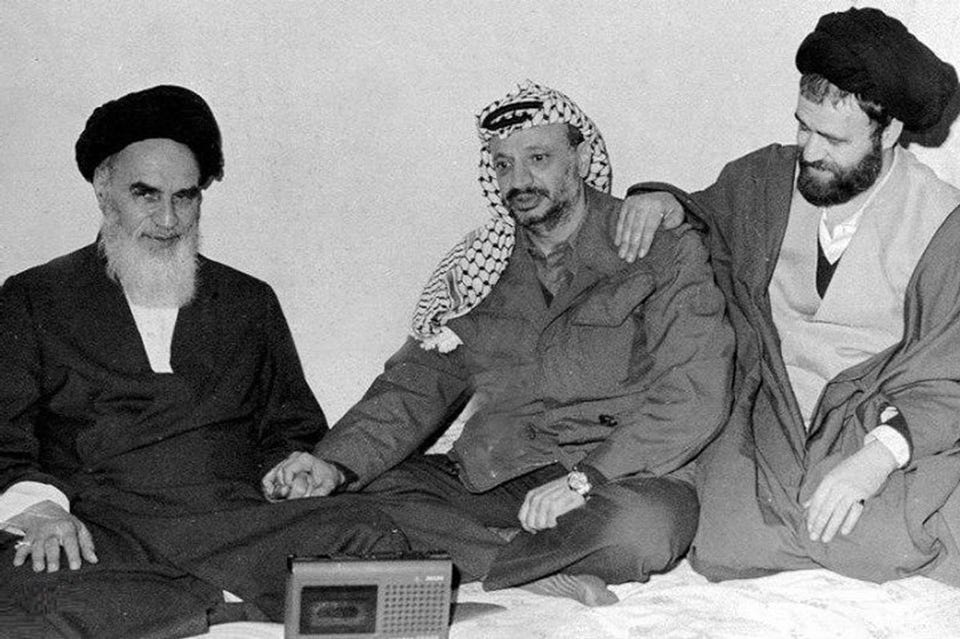
On 17 February 1979, six days after the Islamist-Marxist coup against the Interim Government, Arafat was received in Tehran. It was billed as the first visit by a “Head of State” after Khomeini’s triumph was complete, a marker of how important the PLO had been to the Islamic Revolution. Just as symbolic, Chamran returned to Iran the same day, after two decades away, merging Khomeini’s two Lebanese networks within Iran. Overall, there can be no doubt the PLO-centric network was the more important to the Islamic Revolution, in the struggle with the Shah and in the regime created afterwards. However, this does not mean the other network did not have some momentous impacts, one of which was being significantly responsible for preventing the PLO itself gaining influence in post-revolutionary Iran.
Chamran “took a leading role in the formation of the Revolutionary Guards”, Chehabi and Mneimneh note, and the PLO may well have come up with the idea. The PLO had some military forces in Iran—they had helped with the terrorism during the Revolution—and Montazeri asked Arafat to bring in more FATAH troops to train the new IRGC. The proposal was blocked and the PLO’s military role inside Iran after the Revolution would transpire to be brief and limited, in no small part because of Chamran, according to Chehabi and Mneimneh. Chamran was able to exert influence in part through his LMI allies who had been appointed by Khomeini to front the provisional government. Chamran’s motives were strategic in part, but at root he was bitter about the PLO’s behaviour towards Amal and suspected Arafat’s role in Al-Sadr’s “disappearance”. It was inconceivable to Revolutionaries at this time that the Imam was behind it.
The PLO’s diminution in Iran after the Revolution was not solely due to Chamran and the LMI faction. Iran’s revolutionary clergy in general were wary of the Palestinian militants’ lack of devotion to the shari’a, in particular a “perceived loose sexual morality” within FATAH.10 Whether they knew about Arafat is unclear. And what did for Arafat ultimately was his usual antics in trying to play all sides off each to his own advantage. It worked in the Arab states; it cut no ice with Khomeini. Arafat was swiftly put in his place, which did not involve influence over Iranian internal affairs, and once Arafat sided with Saddam Husayn’s Iraq in the war against Clerical Iran he was cut adrift until the early 2000s.
A similar experience awaited Khomeini’s other erstwhile allies, many of whom thought they could ride the wave the Imam had called up to power and then send the old man to a seminary. Their discovery of who was using whom was swift and brutal.
Chehabi and Mneimneh document that all of Qaddafi’s contributions to the Islamic Revolution—the money and weapons, sullying what was left of his public image by so blatantly murdering Al-Sadr for Khomeini at the crucial moment, publicly celebrating the fall of the Shah, and granting immediate political recognition to the Imam’s regime—did not even buy Qaddafi the right to a State visit, despite a direct request. When a lower Libyan official was finally allowed into Iran in late April 1979, Khomeini ostentatiously demanded that he ask Qaddafi to locate Musa al-Sadr, while reassuring his guest he was not accusing the Maximum Leader of anything. Qaddafi’s Libya and Khomeini’s Iran would retain the solidarity so common among anti-Western rogue States—its like an axis or something—but there was a certain frostiness between the rulers.
Of Khomeini’s Iranian allies, such liberals and democrats as there were in the Revolution went first, the symbol of their destruction being the banning of the National Democratic Front in August 1979. LMI was next, its role in prettifying the Imam for Western audiences and the Iranian middle-class having ended. Bazargan’s government was felled three months later. Bazargan and Yazdi were consigned to irrelevance, with occasional official harassment. Ghotbzadeh was not so lucky: he ended up before a firing squad. MEK had read the situation and tried to fight, but its closeness to Khomeini’s infrastructure was its downfall: despite some terrorist spectaculars against the Khomeinist leadership, half of MEK’s troops had defected to the IRGC almost immediately after the Revolution,11 and it was simply too weak to resist. By mid-1981, MEK’s leader, Masud Rajavi, had fled for his life. Then came the turn of the Left, which had abandoned its principles to ally with the Islamists when it seemed to promise a road to power. At least they got to go last. The Fedayeen and Tudeh were taken apart in 1982-83, their lack of vision holding to the end. Factions of each sided with Khomeini in eradicating the others: the hope was to save themselves; the result was to leave them defenceless when the Imam came for them.
Having prevailed over Montazeri’s proposal that the PLO should be involved in the IRGC in an ongoing capacity, Chamran led the Guardians to war against the Iranian Kurdish rebels in the summer of 1979 and batted the hornet’s nest by saying “he detected the same tactics [from the Kurds] as in the anti-Amal operations of the Lebanese and Palestinian Left”, Chehabi and Mneimneh report. Montazeri’s wing of the Islamists and the Left accused Chamran of being a MOSSAD and CIA agent, a potentially lethal charge at the time. He survived it, partly because Montazeri fell from favour. Montazeri defied Khomeini by going to Libya for the celebration of Qaddafi’s decade in power on 1 September 1979 and Montazeri then started calling Foreign Minister Yazdi and Prime Minister Bazargan “Zionist” agents, jumping the gun on the Imam’s move against the LMI. Because of these political missteps, Montazeri was sidelined and the cooling of Iran’s relations with Libya confirmed, both sources of immense satisfaction to Chamran, who blamed Qaddafi (reasonably) for Al-Sadr’s presumed murder, with (again) no inkling of Khomeini’s role.
Chamran was named Minister of Defence in late September 1979 and was the only official to keep his position when Bazargan’s LMI-led government fell in November after the seizure of the U.S. Embassy. Chamran’s position as defence supremo would bed down and once Saddam invaded Iran in September 1980 his stature rose further. Chamran was killed at the front in Khuzestan on 21 June 1981. His great antagonist Montazeri would not long outlive him: Montazeri was killed exactly a week later in the massive bombing in Tehran that wiped out much of the leadership of Khomeini’s Islamic Republican Party (IRP). The bombing was the last gasp of MEK by the Islamic Republic’s account. Rajavi went in exile a month later alongside Banisadr, the last man standing of the LMI-associated faction. Banisadr had been president from February 1980 until the day before Chamran died, when he was removed by the Imam for making the mistake of thinking being head of government entitled him to independent views on policy. Interestingly, in the impeachment “process” by which Khomeini deposed Banisadr, the only person to defend Banisadr was Montazeri’s father, a premonition of where his relationship with the Imam would end up.
ISLAMIC REVOLUTION IN LEBANON
The slightly odd circumstances surrounding Chamran’s death, and the fact it occurred simultaneous with both the final sweep of the LMI-linked cadre in the Revolution and the Khomeinist offensive against Amal manifesting, have led some to wonder if those who eliminated Chamran’s old friend Al-Sadr had a hand in it. Such theories hinge on the idea that Chamran was a “pro-Amal” holdout in the Iranian revolutionary regime, thus would have been despondent that “the consolidation of hardliner rule in [Iran in] the summer of 1981 cut [Amal] off from conceivable sources of Iranian patronage”, as Chehabi and Mneimneh write (p. 269), which in turn restricted Amal’s reach and left elements of the Shi’i population, notably in Dahiya, looking for new protectors. The dynamics and causality appear to have been quite otherwise, though.
The question about Chamran’s life to which nobody seems to have an answer—Chehabi and Mneimneh do not even attempt one—is when Chamran went over to Khomeini, but he clearly did go over to Khomeini. Thus, when the authors note that Chamran was elected to Amal’s leadership council in April 1980, at which time he was also serving as Defence Minister of Iran, he was Khomeini’s man in Amal, rather than Amal’s man in Tehran. There is every appearance that Chamran used his position in Amal, as an ideological-military instructor while in Lebanon and then as patron in Iran, to consciously spread Khomeinism within Amal’s ranks, which was the key to Amal’s diminishment at the Khomeinists’ hands.
The tactic of crippling former allies from the inside out was not new. As mentioned, shortly after the Revolution, the IRGC—that part of the PLO-trained Khomeinist apparatus that moved to Iran—had, under Chamran’s rather close administration, annexed the chunk of MEK that had covertly turned to Khomeinism. The stay-behind part of the Khomeinist apparatus in Lebanon, which would overtly declare its existence in 1985 as “Hizballah”,12 repeated the same trick, consuming parts of its former PLO host, including from Force 17,13 and assimilating elements of the other network from Amal.
The groundwork for the move against Amal was quite extensive. There were those in Amal won for Khomeinism by Chamran’s ideological instruction. The late March/early April 1980 dissolution of the “Iraqi” Khomeinist Dawa Party and Amal’s apparent absorption of the Dawa cadres was really more like mass-infiltration.14 Then there was the onset of the inevitable direct clashes between Amal and the PLO in the spring of 1981, which weakened Amal militarily and, crucially, politically. Fighting the Palestinians was deeply unpopular and could so easily be cast as making Amal “Israeli agents”—even to its own members. In these ways, the Khomeinist foothold in Amal was reinforced and expanded. The June 1982 Israeli invasion of Lebanon and Berri joining the national “Salvation Council” furnished the pretext for open schism. Later that month, a protégé of Chamran’s, Husayn al-Musawi, denounced Berri as a traitor and led a mass defection to create “the Islamic Amal”, a splinter duly folded into Hizballah. By the late 1980s, the Amal remnant would also be effectively subordinated to Hizballah.15
FOOTNOTES
Andrew Scott Cooper (2016), The Fall of Heaven: The Pahlavis and the Final Days of Imperial Iran, p. 251.
Cooper, The Fall of Heaven, pp. 341-343, 451-453, 466.
Ronen Bergman (2018), Rise and Kill First: The Secret History of Israel’s Targeted Assassinations, pp. 368-369.
Cooper, The Fall of Heaven, pp. 248-249.
Oved Lobel (2022, Winter), ‘Tehran’s Russian Connection: Whither Iran?’, Middle East Forum. Available here.
Fouad Ajami (1986), The Vanished Imam: Musa al-Sadr and the Shia of Lebanon, pp. 194-195.
Cooper, The Fall of Heaven, p. 296.
MOSSAD eliminated Mahmud Hamshari as part of Operation WRATH OF GOD, the settling of accounts over the 1972 Munich Olympics. Hamshari was judged to be the deputy in Black September, the “deniable” unit of the PLO responsible for torturing and murdering the Israeli athletes. MOSSAD also connected Hamshari to an assassination attempt against Prime Minister David Ben-Gurion in Denmark in May 1969. See: Bergman, Rise and Kill First, pp. 158-160.
Cooper, The Fall of Heaven, pp. 252, 364, 455.
Afshon Ostovar (2016), Vanguard of the Imam: Religion, Politics, and Iran's Revolutionary Guards, p. 114.
CIA Intelligence Assessment, ‘Iran: The Mujahedin’, August 1981. Available here.
The official self-presentation of Hizballah is as a “Lebanese” actor established in 1982 to lead the “resistance” to Israel’s occupation of southern Lebanon. In reality, it was already operational by the spring of 1979, a fact publicly admitted by none other than the current Hizballah General-Secretary Naim Qassem. See: Naim Qassem (2002), Hizbullah: The Story from Within, translated by Dalia Khalil (2005), pp. 65-66.
The timeline—and the essential falsity of the linguistic distinction between “the IRGC” and “Hizballah”—is important because it goes to the heart of the Islamic Revolution model, which implants itself in countries by adopting a pseudo-nationalist sheen and claiming to be the champion of oppressed Shi’is. To admit “Hizballah” was already there in 1979 as an organic component of the IRGC is to admit that it is an instrument of Iranian colonialism; the claim to be formed in 1982 has given it a nationalist carapace that has helped entrench Tehran’s domination of Lebanon.
The name “Hizballah” itself is a giveaway, however: it was a self-description used by Khomeinists across the region since the early 1970s. When the IRGC was being stabilised inside Iran, it drew together those Khomeinists returned (or returning) from Lebanon, and the Imam’s loyalists who had been on the ground throughout 1978-79. The latter elements all called themselves “Hizballah”. The Khomeinists who provided the muscle for the Islamic Revolution tend to be divided by analysts into the hizballahi, the mosque-oriented Islamist street gangs, and the militiamen the revolutionary committees or komiteh-ha-ye enghelab (think Paris sections), but in practice and personnel the distinctions are hazy, reflected in the komitehs also referring to themselves either as “Ansar-e Hizballah” (Partisans of the Party of God) or simply “Hizballah”. When Khomeini issued the order publicly announcing the existence of the IRGC in May 1979, an important specific component of it was bringing the komitehs’ militiamen—and by extension the hizballahi—under the IRGC banner, legitimising these armed formations as the security forces of the Revolution. See: Lobel, ‘Tehran’s Russian Connection’; Afshon, Vanguard of the Imam, p. 42; and, Steven R. Ward (2009), Immortal: A Military History of Iran and Its Armed Forces, p. 226.
The hizballahi-infused IRGC was managed by clerics associated with Khomeini’s IRP, which triumphed in the internal struggle in Iran in 1981, creating a one-party Islamist regime that described itself as “the hizballahi government”. The “Hizballah” monicker was also used by Khomeinists outside Iran before the Lebanon-based Khomeinists started using it on official documentation in 1984, notably in Afghanistan. See: Lobel, ‘Tehran’s Russian Connection’.
The most prominent Force 17 defector to IRGC/Hizballah was Imad Mughniyeh, a fully commissioned IRGC officer who served as Hizballah’s military leader until MOSSAD and the CIA killed him in 2008. Mughniyeh was, before 9/11, the most infamous global terrorist, responsible for such “spectaculars” as the Marine barracks bombing in Beirut in 1983. See: Matthew Levitt (2013), Hezbollah: The Global Footprint of Lebanon’s Party of God, pp. 28-31.
Lobel, ‘Tehran’s Russian Connection’.
In April 1988, Hizballah and Amal began to clash in what became the “War of Brothers” (Harb al-Ikhwa): the main phase of the fighting was ended in early 1989, but did not end completely until the conclusion of the Lebanese Civil War itself in late 1990. Some estimates are that 2,500 Shi’is were killed, and it is clear the majority were Amal militants and civilians. The outcome of the war was to enduringly weaken Amal physically, and to politically render Amal—despite its obvious lingering resentment—effectively an extension of Hizballah. Amal’s operations in Dahiyeh and the south exist on Hizballah’s sufferance, and Amal’s positions in the government—including Berri’s position as Speaker of Parliament—are held with Hizballah’s approval and on condition those positions are used to advance Iran’s agenda in Lebanon. See: Hanin Ghaddar (2016), Hezbollahland: Mapping Dahiya and Lebanon’s Shia Community, pp. 36-37.
Great article. One minor comment: looks like Montazeri the Elder wasn’t Deputy Supreme Leader until 1985?