

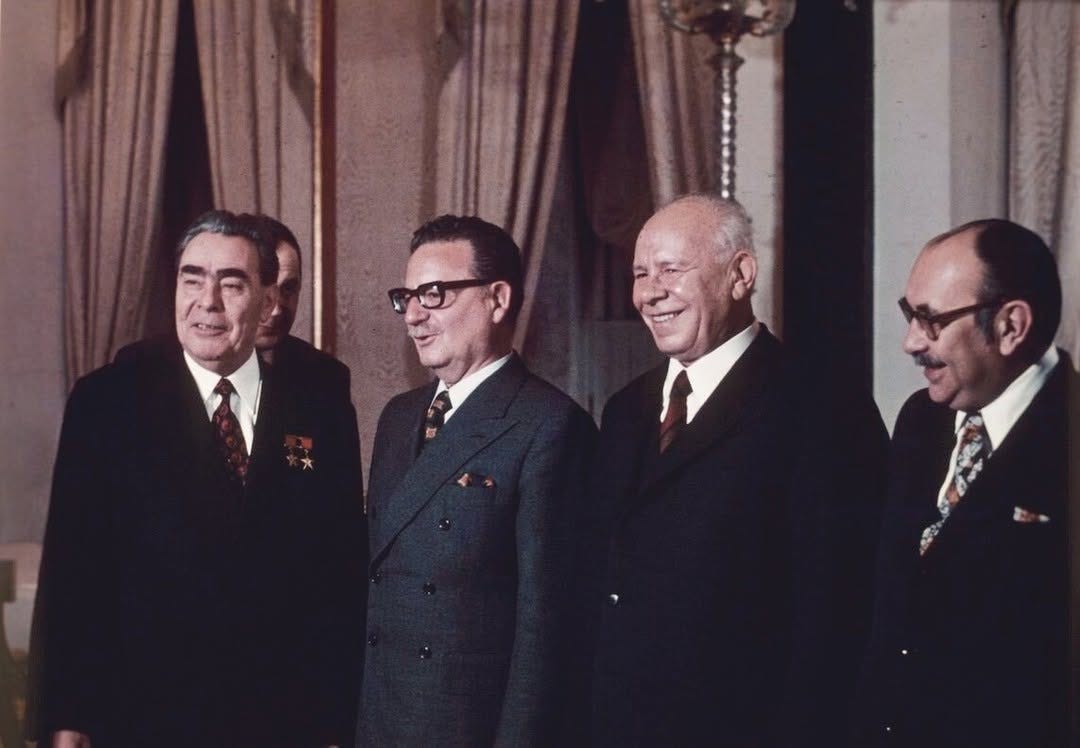
In late 2023, I wrote about the downfall of Chile’s president Salvador Allende in September 1973. My intent was to convey that the big picture understanding many people have of that event—a democratic Left-wing government overthrown in a military coup backed by the United States Central Intelligence Agency (CIA)—is a myth.
To reassure readers I was not pulling a fast one in making this argument, I presented what happened in some detail. To recapitulate briefly:
Allende came to power in an election in 1970 where Soviet interference in his favour was heavy and perhaps decisive. The same cannot be said of the CIA, whose much more limited activities during the election and attempt to prevent Allende taking office afterwards went about as well as Agency operations usually do. Allende in power systematically demolished Chile’s democracy, fashioning a Marxist regime that was well on the way to becoming a Soviet outpost, propped up by KGB “advisors” and troops from the Soviet colony on Cuba administered by Fidel Castro.
By the summer of 1973, Allende’s attempt to impose Communism had ruined the economy and taken Chilean politics to a point where there were no constitutional mechanisms left to restrain the government. The other two branches of the Chilean State, the Supreme Court and the Parliament, had publicly declared Allende to be an outlaw, and all-but-openly pleaded with the army to step in to rescue the country not only from despotism, but from what everyone believed was an imminent civil war.
Chileans were shocked by some aspects of the military coup, its laggardness above all. But nobody was surprised and the majority were relieved.1 In terms of U.S. involvement, Chile in 1973 is not even at the level of Guatemala in 1954, which is to say complicated and exaggerated. The U.S. simply had no role in the Chilean coup. American officials, working from the same rumours known to any child in Santiago, were aware a coup was likely and knew no more than that.
Essentially a sainthood cult around Allende began on the international Left very soon after the coup, which the Soviets encouraged and exploited for political warfare against the United States. It is to Moscow Centre that most of the credit must go for the enduring myths about the Chilean events, though the leader of the post-Allende junta, General Augusto Pinochet, deserves some acknowledgement in this regard: disinformation works best when it incorporates elements of truth and Pinochet gave the Soviets lots to work with.
What I want to do today is set out some additional sources on this topic I have come across in the last two years. As such, this will be less an article than a series of fragments.2
SOVIET STRATEGY AND CHILE
Brian Crozier was a historian focused on intelligence and international terrorism, an excellent background for assessing Soviet foreign policy, which was, from the 1960s onwards, dominated and then controlled by the KGB, with its vision of winning the Cold War via a Third World Strategy.3 Operationally, this strategy primarily involved creating and instrumentalising “deniable” terrorist-revolutionary instruments, from “urban guerrillas” to “national liberation movements”, and coordinating them in a global ecosystem—prominent nodes of which were in Lebanon and Angola—to subvert and where possible destroy Western influence.
In 1999, Crozier wrote about the Chile situation in The Rise and Fall of the Soviet Empire (pp. 346-349).
Allende took office at the head of “Popular Unity” (Unidad Popular), an old “popular front” mechanism, containing, of course, the Soviets’ “fraternal” Communist Party of Chile (PCC or PCCh), led by Luis Corvalán, and Moscow reaped the rewards of this: “By the end of 1972”, writes Crozier, the PCC’s “membership … had increased from 150,000 to 200,000”, making it, by the numbers, “probably the largest Communist Party in Latin America, including Cuba’s”. (Indeed it was, and the third largest in the Western World: only the Communist Parties in France and Italy were larger.)
However, “[i]n ideological terms”, says Crozier, the PCC “was less revolutionary than” Allende’s Socialist Party (PS), whose formal General-Secretary, Carlos Altamirano, was also a Senator, “and still less [extreme] than the Miristas, so-called from the initials in Spanish: MIR, for Movimiento de la Izquierda Revolucionaria, or Movement of the Revolutionary Left”.
Allende’s apologists make much of MIR not formally being a member of the Popular Unity, but this is sophistry. For one thing (not mentioned by Crozier), MIR, a Marxist-Leninist faction founded as a straightforward terrorist (“urban guerrilla”) organisation in October 1965, had Allende’s nephew, Andrés Pascal Allende, as one of its founding leaders.4 MIR acted in concert with the Allende government from the first to the last.
In “the division of spoils after the 1970 election, the Communists were allotted the Ministries of Labor and Finance, while the Ministry of Economics went to Pedro Vuslovic, who worked closely with the Party’s Central Committee, although he styled himself an ‘independent Marxist’,” writes Crozier. This apportionment was crucial.
“The Communist strategy for Chile, known as ‘the Santiago model’, was aimed at driving the private sector out of business”, Crozier explains. The legal pretext was “reviving a dormant 1933 law that provided for the appointment of an official administrator—styled an interventor—to oversee businesses shown to be running at a loss”. In practice, this was done by having mobs of “workers”, led by the trades unions, seize businesses, which would then be declared as “in recess”, and “an interventor would be appointed”:
The new circumstances made this easy, since the Communists controlled not only the Ministry of Labor but about 80 percent of organized labor through the key trade union organization, the Central Única de Trabajadores. Simultaneously, President Allende encouraged large-scale seizures of land by militant peasants. Dispossessed farmers organized a resistance movement. The outcome was a confrontational situation that pointed the way to a probable civil war.
Allende was aware that a civil war was being stoked by his actions. In a radio broadcast on 13 August 1973, Allende said plainly that Chile was “on the brink of civil war”, Crozier documents. But Allende did not try to stop this slide. On the contrary:
[Allende] encouraged a breakdown of law and order by forbidding the security services to use force, dissolving the riot police (known as the Grupo Móvil), and releasing the Mirista terrorists who had been jailed under the previous government. To prevent the Miristas from threatening his personal power, Allende went on to transform those he had released into a palace guard. [italics original]
(The revolutionaries in the government of the Spanish Republic in the 1930s believed that “a successful revolution always involved at least a brief civil war”,5 a view inherited from Vladimir Lenin, who wanted and orchestrated an apocalyptic civil war to destroy the old world in Russia, leaving a blank canvas to implant Communism. Allende and those around him were strongly influenced by the Spanish example.)
The Communists pushed this disintegratory process from the other Chilean ministry they controlled, Crozier notes:
Another effective technique was exercised through the finance ministry, which would order firms to grant instant wage increases that were equivalent to the previous year’s inflationary rise in the cost-of-living index.
The economic effect of this was catastrophic: “By the time Allende was overthrown in September 1973, the yearly rate of inflation had reached 1,000 per cent: a sign of a collapsed economy.”
Chile had closed Cuba’s Embassy after the Communist takeover of the island; it was re-opened within days of Allende being sworn in in November 1970. The Cuban Embassy “expanded rapidly when a new brand of ‘diplomats’ moved in: they belonged either to the Soviet-controlled General Directorate of Intelligence (DGI) or to Fidel Castro’s nominally independent Directorate of National Liberation (DLN).” The DGI was the KGB clone in Cuba, and the set-up with the DLN was part of the outcome as “the Soviets completed their satellization of Cuba”, writes Crozier.
As Crozier sums up:
Allende transformed his country, in effect, into a satellite of Cuba, and hence into an incipient addition to the Soviet Empire. … By [mid-1973], Chile could be truthfully described as a Marxist state in ideological and economic terms. If that had been all, Chile would not necessarily have threatened its neighbors. From a strategic viewpoint, however, it had been turned into a major base for Soviet and Cuban subversive operations, including terrorism, throughout Latin America. …
[T]he Soviet KGB was recruiting Mirista members for training courses in terrorism. In other camps, North Korean specialists were training young members of Allende’s Socialist Party, following a visit to the North Korean capital, Pyongyang, by Senator Altamirano, who had flown there from Havana in a presidential plane provided by the North Korean dictator Kim Il Sung.
Another book published the same year as Crozier’s makes the same point. Jorge Masetti inherited his name from his father, who was better known as “Commander Segundo”, a Communist from Argentina, participant in the Sovietization of Cuba, and prominent “journalist” on the island afterwards. Masetti Senior then became close to Castro’s murderous Argentine deputy, Ernesto “Che” Guevara, and disappeared in 1964 while collaborating with Guevara in trying to bring violent Revolution to their homeland. Masetti Junior, born in Argentina in 1955 but raised on Cuba and entering into Castro’s service as a spy and roving revolutionary, later in life regretted what he had done and wrote a memoir, El Furor y el Delirio (“Fury and Delirium”), where he said of Chile:
Today I can tell you how lucky we are that we were not victorious. Given our formation and our heavy dependence on Cuba, we would have sunk the continent in general barbarism. One of our watchwords was to turn the Andes into the Sierra Maestra of Latin America. First we would have shot the soldiers, then the opposition, and then any of our comrades who opposed our authoritarianism.
It was from the Sierra Maestra mountain range in eastern Cuba that Castro, Guevara, Camilo Cienfuegos, and the rest of them waged their ultimately successful war against the government of Fulgencio Batista. In the Communist myth of the Cuban Revolution, the Sierra Maestra was not just the physical base for a “tiny” rebel band, but a potent vindication of what could be achieved by ideological purity—by vanguardism. As Masetti explains, the contemporary U.S. fears that Chile would become “a second Cuba”, only worse because it was on the mainland, were justified. The Soviet-loyal Communists spoke of their intention to use Chile itself as the base from which to export Revolution across Latin America in terms of creating “multiple Vietnams”.
Two final facts of note are included in Crozier’s account. First, though it would become widely believed on the Left—largely thanks to Castro—that Allende was murdered by Pinochet’s troops, it was Allende’s wife, Hortensia, who confirmed, on 17 September 1973, less than a week after the coup, that Allende had committed suicide using a rifle given to him by Castro. Second, of the 3,000 people killed or “disappeared” during Pinochet’s seventeen years in power, “Around 1,000 had died during the first four months of military rule, when Chile was in effect a combat zone.”
THE VIEWS OF THE PARTICIPANTS
In 2005, José Piñera, a Chilean libertarian economist, wrote a paper, “How Salvador Allende Destroyed Democracy in Chile”, making that argument in possibly the strongest and most concise form available. Some will be tempted to dismiss Piñera since he served for a couple of years as a technocratic minister when Pinochet was in power, but Piñera’s credibility has little bearing on his paper, which is so persuasive because he largely allows Allende and those around him to speak for themselves, and similarly he presents the responses of Allende’s opponents who could see in real-time what was happening.
“[A]ll the principal worker parties preached and practiced violence, whereas the parties of the Right, whatever their long-term goals, pursued legal tactics.”6 This was written about Spain in the 1930s, but it applies equally to Chile in the 1970s. In both cases, the Left introduced political violence, and did so intentionally and on a wide scale, as the means to achieve a totalitarian end. This commits one to no particular political or moral opinion of these situations or how they unfolded, but it is ahistorical to write about either without keeping this fundamental fact in view because it shaped the perceptions and consequent behaviour of actors on all sides.
In Chile, as Piñera documents, the turn of Allende’s Socialist Party (PS) away from constitutionalism and towards revolutionary violence was “made publicly clear in two official resolutions … adopted unanimously in its annual Congresses of 1965 and 1967”.
In July 1965, PS, at its Annual Meeting in the city of Linares, declared:
Our strategy in fact rejects the electoral route as a way to achieve our goal of seizing power. … The party has one objective: in order to obtain power, the party must use all the methods and means that the revolutionary struggle requires.
In late November 1967, by which time PS was overtly self-defined as “Marxist-Leninist”, at the Annual Meeting in Chillán, the party passed a resolution that Piñera notes “was equivalent to a declaration of war on democracy”. The resolution read:
Revolutionary violence is inevitable and legitimate. … It constitutes the only route to political and economic power. … Only by destroying the democratic–military apparatus of the bourgeois State can the socialist revolution take root. … The peaceful or legal expressions of struggle do not, in themselves, lead to power. The Socialist Party considers them to be instruments of limited action, part of a political process that leads us to armed struggle.
A few days before the 1967 meeting, Clodomiro Almeyda, a PS ideologist and Allende’s Foreign Minister, explained his vision of how the party would bring socialism to Chile:
It is impossible to say in absolute terms what fundamental form the final phase of political struggle will assume in a country like Chile, when the current process gives way and the order of the day is the problem of power. I am inclined to believe that it will most probably take the form of a revolutionary civil war, Spanish-style, with foreign intervention, but much more rapidly and decisively.
As Piñera says, “The casual reference to a ‘Spanish-style’ civil war is striking considering the atrocities and the death toll of that conflict.”
The incorporation of the Soviets’ local Communist Party into Allende’s “popular front” was neither happenstance, nor a surprise. “Allende’s alliance with Communism was nothing new”, writes Piñera:
In 1953, a week after the death of Joseph Stalin, Allende was one of the principal speakers at a ceremony to honour the Soviet dictator. He declared that “Stalin was to the Russian people a banner of revolution, of creative execution, of human sentiment; a symbol of edifying peace and unbounded heroism … but above all this is his enormous faith in Marx and Lenin doctrine and his unyielding Marxist behaviour” (El Siglo, March 16, 1953).
During the decade of the 1960s, Allende agreed to serve as president of the Latin American Organization of Solidarity, a pro-Castro organisation designed to export Communist Revolution to the continent. The organisation had publicly declared, “Armed revolution is the only solution for the social and economic ills of Latin America.”
As president of the Senate in the 1960s, Allende on various occasions expressed his support for the Leftist Revolutionary Movement (MIR), the group that initiated guerrilla violence in Chile. Since the Cuban Revolution, the Leftist leaders of Chile and the rest of the continent had idealised violence.
The Chilean Supreme Court had written to Allende as president, on 26 May 1973, protesting his lawless refusal to comply with judicial rulings—in some cases by supporting the illegal seizure of property, and in other cases by preventing the police arresting criminals close to the regime. Allende responded in a public speech a few days later:
In a time of revolution, political power has the right to decide, at the end of the day, whether or not judicial decisions correspond with the higher goals and historical necessities of social transformation, which should take absolute precedence over any other consideration; consequently, the Executive has the right to decide whether or not to carry out the verdicts of the Judicial Branch.
Shortly after the coup, Oscar Waiss, “director of the government gazette, Diario Oficial, and an intimate friend of Allende”, bluntly confessed the thinking behind the Allende government’s conduct in the months before its demise:
The moment had come to throw away all legalistic fetishism, to sack the military conspirators, to remove the Comptroller General, to intervene in the Supreme Court and the Judiciary, to confiscate the El Mercurio newspaper and the whole pack of counterrevolutionary journalistic hounds. We must hit first, since he who hits first hits twice.
Fidel Castro was a major influence over Allende long before 1970. Piñera records the view of Claudio Véliz, a Chilean historian and personal friend of Allende, that Allende’s trips to Cuba had “a fundamental impact on his plans for Chile”:
After seeing Cuba, Allende thought that he could take a short cut. But the truth is that he went against Chilean tradition … there is no doubt that the Unidad Popular government was a disaster and one which led us into civil war.
Castro’s last letter to his “Dear Salvador”, on 29 July 1973, was advice on mobilising “the formidable strength of the Chilean working class” to win the imminent civil war. When the moment came, the Chilean working class was in no mood to risk itself on Allende’s behalf, but it is nonetheless to Allende’s great credit that he refused to try to implement Castro’s advice.
The day Allende arrived in Moscow, 7 December 1972, he gave a speech to the Kremlin in which he said the Soviet Union was the “Big Brother” of Chile. “Afterwards, having met with Soviet leaders [General-Secretary] Leonid Brezhnev, [Premier] Alexei Kosygin, and [Chairman of the Presidium of the Supreme Soviet] Nikolai Podgorny, Allende said that he had reached an ‘identical point of view’ with the Communist leaders. A little later, he received the ‘Lenin Peace Prize’.”
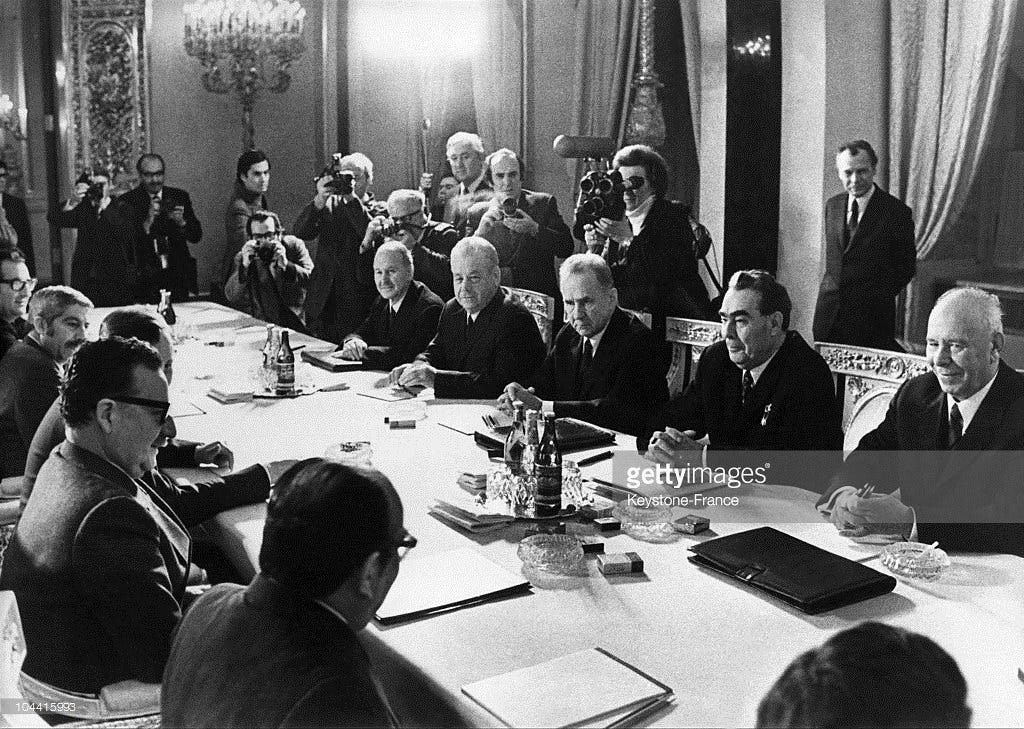
Allende was approaching one thousand days in power on 22 August 1973 when the Chamber of Deputies (the lower House of Parliament) passed the Resolution that joined the Supreme Court and the Senate in declaring Allende an outlaw. The Resolution is known to all Chileans because, as Piñera says, in addition to itemising Allende’s trampling of the legal order, it concluded in that “indirect language that is traditional of Latin American politics” with a call for the military to put an end to the Marxist government before the country collapsed into civil war.
Claudio Orrego, an intellectual and “highly respected member of the centrist Christian Democrat Party”, which had done the unthinkable in forming a coalition with the Right-wing National Party to oppose Allende, spoke these words in favour of the passage of the Resolution:
The country is in a crisis that has no parallel in our 163 years of national history since independence. The current state of illegality includes repeated outrages of the Administration against the resolutions of Congress, against the Judiciary, against the Comptroller General, against the rights of citizens, and even, in some cases, against personal liberties. … When the country is disintegrating, there is no room for gimmicks or superficial politics. In this case we must resolve the problem by going to its roots.
Orrego was close to Eduardo Frei, the Chilean President before Allende, who as Piñera explains became the most extraordinary figure in the Chilean drama. Frei was a determined democrat and a pillar of the centre-Left, but in that pattern that is so familiar he had always avoided confrontation with the radical Left. Nobody could call Frei an anti-Communist. Once Allende came to power, Frei might have been expected to follow the Leftward drift of his Christian Democratic Party, and turn this bulwark of the opposition into a ballast for the Allende regime. Or to retire from public life and perhaps leave the country, especially once he realised the danger constitutional politicians were in. Among those assassinated by Allende’s allies was Frei’s political heir, Edmundo Pérez, in June 1971.
Instead, Frei, inter alia burdened by the thought he would be remembered as the “Chilean Kerensky”, rose to the occasion of resisting the Communist takeover of his country. Frei stayed in Chile and became Allende’s primary political opponent. Frei was appointed President of the Chilean Senate in late May 1973, and Piñera’s argument that “it was the posture assumed by Eduardo Frei that tipped the balance among the military commanders” is plausible.
The “Rivera Minutes” document a meeting Frei had on 6 July 1973 with the leadership of the Industrialists Association, the largest trade association of Chilean industrialists, who told Frei that “the country was disintegrating and that if urgent measures were not taken, Chile would fall under a bloody Cuban-style Marxist dictatorship.” Frei responded:
There is nothing that can be done by myself, by the Congress, or by any civilian. Unfortunately, this problem can only be solved with guns. … I fully share your apprehensions, and I advise you to express them plainly to the commanders-in-chief of the Armed Forces, hopefully today.
Speaking to a journalist from the Spanish newspaper ABC on 10 October 1973, Frei expressed his full support for the military intervention that toppled Allende:
The Armed Forces were called, and they complied with a legal obligation, because the legislative and judiciary, the Congress and the Supreme Court, had all publicly denounced the presidency and its regime for destroying the Constitution.
Frei’s most extensive testimony was in a letter he sent on 8 November 1973 to the President of the International Christian Democrat Party, the Italian politician Mariano Rumor:
[Allende and his supporters] were implacable in their efforts to impose a social model clearly inspired in Marxism-Leninism. In order to achieve their ends they twisted the laws or openly trampled them, ignoring the Judicial Branch. In their attempt at domination, they even tried to substitute a Popular Assembly in the place of the Congress as well as trying to create a system of Popular Tribunals, some of which actually began to operate. This was denounced publicly.
They also attempted to transform the entire educational system, based on a process of Marxist indoctrination. These attempts were vigorously rejected, not only by the democratic political parties, but by unions and organizations of every kind, and with regard to education that meant the protests of the Catholic Church and of all of the Protestant faiths, who all made their opposition public.
Importantly, in the letter to Rumor, Frei, as well-placed an eyewitness as it is possible to get, expressed the view later echoed by Crozier and Masetti, that the whole of Latin America would have been endangered if Allende was permitted to complete his Revolution in Chile, and that it was the thwarting of this Soviet design that explained the hysterical response to the coup:
[T]he fall of Allende has been a setback for world Communism. The combination of Cuba with Chile, with its 4,500 kilometres of Pacific coast, and its intellectual and political influence in Latin America, was to have been a decisive step in the attempt to control the hemisphere. This ambition explains the violent and exaggerated reaction to its demise. Chile was going to be a base of operations for the whole continent.
Piñera sums up: “These … testimonies … are fully consistent among themselves, and with the Chamber of Deputies Resolution. They prove that former President Frei supported and defended the removal of the Allende government. He did it not against his democratic values, but precisely because of the need to uphold them”.
ALLENDE AS AUTHOR OF HIS OWN DEMISE
At this point, half-a-century later, the (largely Soviet-derived) mythology of Allende-the-democrat liquidated by CIA hirelings is repeated baldly in Western media coverage and even academic works, often without even the pretence of a citation, so ingrained has this narrative become as something “everyone knows”. But it was not like this uniformly at the time. There were Westerners who could see what Chileans did.
The Economist, a British liberal outlet, described the state of play in Chile on 15 September 1973, four days after the coup, this way:
President Allende did not become a martyr … [I]f a bloody civil war does ensue, or if the generals who have now seized power decide not to hold new elections, there must be no confusion about where the responsibility for Chile’s tragedy lies. It lies with Dr. Allende and those in the Marxist parties who pursued a strategy for the seizure of total power to the point at which the opposition despaired of being able to restrain them by constitutional means.
What happened in Santiago is not an everyday Latin American coup. The armed forces had tolerated Dr. Allende for nearly three years. … [T]he Allende government did more than wreck the economy. It violated both the letter and the spirit of the constitution. The way it rode roughshod over Congress and the courts eroded faith in the country’s democratic institutions. … The feeling that Parliament had been made irrelevant was increased by violence in the streets (almost on a Belfast scale) and by the way the government tolerated the growth of armed groups on the far-Left that were openly preparing for civil war.
The armed forces moved only when it had long been clear that there was a popular mandate for military intervention. They had to move in the end because all constitutional means had failed to restrain a government that was behaving unconstitutionally. …
General Pinochet and his fellow officers are no one’s pawns. Their coup was home-grown, and attempts to make out that the Americans were involved are absurd to those who know how wary they have been in their recent dealings with Chile. … [The coup] will mean the temporary death of democracy in Chile, and that is to be deplored. But it must not be forgotten who made it inevitable.
SOVIET INTERVENTION IN CHILE
Christopher Andrew, perhaps the greatest living intelligence historian, has written of the way American covert actions, through the CIA or otherwise, are invariably recorded in histories of the Cold War, while KGB activities frequently get left out—as in, entirely—of even major academic studies, whether the focus is on Soviet foreign policy or a particular Third World country. Since “the role of the KGB in Soviet policy”—especially towards the Third World that the Centre saw as “the arena in which it could win the Cold War”—was “even more important than that of the CIA in U.S. policy”, the effect “has been a curiously lopsided history of the secret Cold War … the intelligence equivalent of the sound of one hand clapping”.7
In 2017, Andrew wrote a paper with Kristian Gustafson, “The Other Hidden Hand: Soviet and Cuban Intelligence in Allende’s Chile”, which reiterates the point: While the role of U.S. intelligence in Chile was made public by the vindictive Church Committee in the mid-1970s and has been part of the popular and scholarly understanding ever since,8 “What has been largely unstudied is the role of Cuban and Soviet intelligence operations throughout this critical period of the Cold War in Latin America.”
It should be noted here that, though the Andrew-Gustafson paper is adamant, “We cannot simultaneously dismiss the influence of Soviet Bloc intelligence whilst highlighting the role of American intelligence”, the argumentation does trend towards a minimisation of the Soviet intelligence role in Chile. For instance, the authors note even-handedly that “covert political action is rarely likely to contain enough motive force to alter significantly a country’s internal political environment. At best they can only ‘nudge’ or amplify existing trends.” In my view, applying this truth about conventional covert influence operations, undertaken from outside a country, to the KGB’s activities in exporting Revolution—especially once the KGB was embedded in a State and working to impose its Revolutionary template—is to make a category error. More importantly, the impact of tactical divisions between the Soviet KGB and Cuban DGI are overstressed by the authors, in my judgment.9 But for our purposes the thing to be kept in mind is that it makes the authors’ findings on the “extensive intelligence operations in Chile during the Allende years” by the Soviet Union and its Cuban satellite all the more notable.
The authors note that Soviets were relatively slow in trying to export Communist Revolution to Latin America: there was still some ideological hesitancy from Moscow during the Guatemalan crisis in 1954, and a systematic regional policy only took shape after the establishment of the Cuban “bridgehead” in 1959. That being said:
Funding for the PCCh [Chilean Communist Party] from the COMINTERN had begun as early as the 1920s, but the party’s potential was underestimated by its Soviet supporters … More permanent funding for the PCCh began in the 1950s. By the following decade the funding had doubled, putting the PCCh 14th on the list of beneficiaries of Soviet financial assistance for overseas Communist parties. By 1970—the year of Allende’s election as President—the funding had almost doubled again to about $400,000, a sum that placed Chile fourth of the list of Communist Parties funded by the Soviets[.]
Meanwhile:
Svyatoslav Fyodorovich Kuznetsov (code name LEONID), a KGB political intelligence (‘Line PR’ in KGB parlance) officer from Buenos Aires, made the KGB’s first contact with Allende in 1953. Kuznetsov’s meetings with Allende were helped by his cover as a reporter for the Novosti news agency … The KGB assigned the code name LEADER to Allende … [and] he worked wittingly as a ‘confidential contact’ … Systematic contact between Allende and the KGB was established in 1961, when diplomatic relations between Chile and the USSR were restored and the KGB set up a residency in a new trade mission. To the KGB Allende “stated his willingness to cooperate on a confidential basis and provide any necessary assistance, since he considered himself a friend of the Soviet Union. He willingly shared political information”. [emphasis added]
The KGB briefly thought Allende was “dangerously Maoist” and, amusingly, too bourgeois because he was a Freemason, an association considered evidence of his radicalism by Catholic conservatives. This was not unusual. For context, the Centre—twice—got so lost in its own conspiracy theories that it concluded its most successful ever agents, the “Magnificent Five” (Cambridge spies), were dangles fed to them by the British and cut contact.10
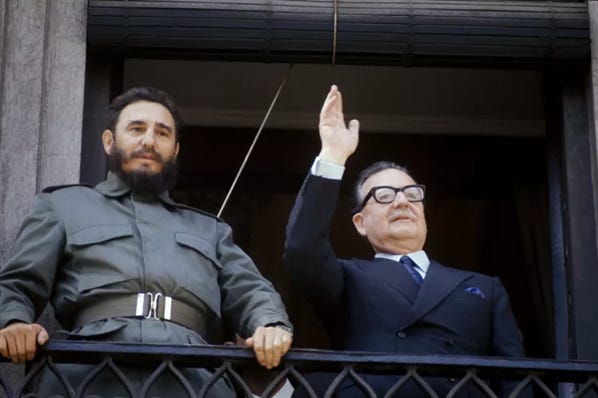
“Allende and Castro had met initially in 1959, shortly after the victory of the revolution, and shared very similar views”, Andrew and Gustafson write. “Their seemingly genuine personal friendship was affirmed over many visits of Allende to Cuba.” Further:
Castro and the Cuban party were a source (both directly and through returning Chilean supporters of the revolution in Cuba) and inspiration to ideas of revolution in Chile from the early 1960s, and this strong influence continued through the Allende administration to urge armed “people’s revolution” against the “illegal state structure”.
This overt connection Allende and his supporters had with Havana was perhaps the single most visibly alarming factor to many Chileans in the run-up to the 1970 election.
The Soviets might well have had quite limited expectations for communizing Latin American States before Allende was elected in 1970, but they ensured they were well-placed to capitalise should the opportunity arise:
The Czechoslovak rezidentura in Chile was established on the request of the Soviet Union in 1961. The Czech Security Services Archives show the mission of the security staff there to be an echo of the Soviet aims: “to follow the activities of the United States and undermine the U.S. influence in Chile through disinformation and confrontation campaigns”.
And the Soviets did not passively wait for opportunity. Having established, directly and through Castro, interlocking channels of influence over the Chilean Left in the 1960s, and seen the Left Bloc rise in the elections that decade to secure a floor of about 39%, the Soviets had a clear strategy for 1970:
The KGB’s actions were aimed at getting the Socialists and Communists to cooperate, keeping the centre and Right divided, and at bringing about some degree of cooperation between the Christian Democrats and the UP [Popular Unity]. …
[B]oth Soviet and Cuban intelligence (and Castro personally) immediately put full effort into helping [Allende]. Perhaps most importantly, both the Soviets and the Cubans urged their favoured parties (the PCCh and the PS, respectively) to support the single candidacy of Salvador Allende, leading a united coalition. Other concrete help was provided as well.
Allende’s original case officer, Kuznetsov, was sent from Mexico to Santiago to maintain direct liaison, to assist him when needed, and to co-ordinate those specific KGB operations designed to support his electoral success—the movement of funds, the provision of intelligence support, and the like. In 1970, the Soviets contributed $400,000, to the PCCh with a further “personal subsidy” of $50,000 to Allende, as well as $18,000 to keep a Left-wing senator from running against Allende.
Other aid to the PCCh included the establishment of the Soviet state-run news agency Novosti in Santiago, providing a contribution of foreign currency to certain Chileans, but more importantly providing another legitimate media outlet to the Chilean Communist press. … With a further $100,000 from the Chilean Communist Party paid directly into Allende’s campaign fund (and which seems to have been given to them by the Soviet Communist Party Central Committee, via the KGB, for just this purpose), nearly a million U.S. dollars (if the figures are correct) poured into UP election coffers, a substantial sum in the Chilean economy of the time.
When one takes into account the additional and significant support by Castro, we can see how Socialist Bloc aid in Chile was applied in a concerted way behind a winning formula. The PCCh achieved the goal of a UP coalition behind Salvador Allende. More importantly, the PCCh manoeuvres vis-à-vis the Christian Democrats achieved some success—in the lead up to the election the Christian Democrats, for internal reasons, was moving to the Left and even sought cooperation with the UP. This kept the anti-Marxist opposition divided.
The authors are hyper-cautious in assessing the effect of this: “At the very least, like all effective covert action, it encouraged an existing trend and worked to offset any advantage U.S. funding had provided to their opponents.”
This is all the more remarkable because Andrew himself has previously argued that it is plausible the Soviet interference in the election was decisive, specifically the KGB bribing the Left-wing Chilean Senator to stay within the UP and not stand against Allende:
Given the closeness of the result, even the small vote which [the Senator] might have attracted, could have tipped the balance against Allende. … In its report to the Central Committee, the KGB claimed some of the credit for Allende’s victory. … [T]he closeness of the result suggests that the KGB may indeed have played a significant part in preventing Allende being narrowly beaten into second place.11
Once Allende was in power, the Soviets were central to keeping him there. Kuznetsov, his old KGB handler, continued on his role, and fiercely resisted efforts from Soviet Ambassador Aleksandr V. Basov to “normalise” relations by dealing with the Chilean Head of State through the Embassy. At one point, Kuznetsov administered basically an ideological questionnaire to Allende:
[Allende’s] answers so impressed the Soviet Politburo that they awarded a payment of $30,000 “in order to solidify the trusted relations” with Allende. Further funds valued over $130,000 were also authorized by the Politburo to assist certain Communist publications, and to help Allende bribe various Chilean political actors, though no record is available of what was actually disbursed or the effect achieved.
The Soviets’ Cuban department, with its linguistic capabilities, apart from anything else, and some familial connections to Allende, was foregrounded:
While the Soviets had an embassy in Santiago since diplomatic relations were restored in 1964, the Cubans had to wait until Allende restored relations in November 1970 before they had a legal basis within Chile. From that point onwards, Cuban assistance to Allende was robust. The Ambassador was Mario Garcίa Enchaustegui, who had previously been expelled from Uruguay for subversive activities. Fernandez Oña of the DGI was his Minister Counsellor and noted that the DGI was “enormously active,” and in light of being his son-in-law he “had a very close relationship with the president”.
The station chief for the DGI was the Embassy’s Counsellor, Juan Carretero Ibáñez, codenamed “Ariel”. The DGI Station helped to coordinate the movement of Marxist activists and militants into Chile from around the Communist bloc. They would stockpile arms in Santiago, and also arm and train a number of militant groups. The most significant of these was the MIR, whose training for armed insurgency was viewed by Cuba as an important measure to defend Allende against coup attempts.
“By March 1972”, the authors note, there were “clandestine MIR paramilitary camps at several locations around” Chile.
Ernesto Guevara had been leading the “National Liberation Army” (ELN) in a rampage through Bolivia when he was killed in October 1967. The ELN’s most prominent member in the early 1970s was the daughter of a Nazi fugitive: she had assassinated one of the soldiers who eliminated Guevara. In “one particularly successful operation”, Andrew and Gustafson record, the Soviets and Cubans moved the “ELN into safe-havens in Chile with the knowledge of Allende”.
Already by 1971, “so numerous were the foreign militants, activists, and agents in Chile … that ‘a special team of CIA clerks was dispatched to Chile to start indexing thousands of cards on their activities’.”
When it came to the official State,
both Cuba and the Soviet Union undertook to train and reequip Allende’s intelligence and security branches. … [S]ignificant Cuban assistance was directed at the Grupo des Amigos Personales (Group of Personal Friends, GAP), Allende’s private bodyguard force. The GAP underwent lengthy security and weapons training in Cuba and undertook security tasks for the UP. The Cuban training cadre brought in to form the GAP remained with MIR and were called the Fuerza Central. A CIA cable from their Santiago station sent in November 1971 [testified to this] and identifies GAP’s second section, Informacion y Chequeo [Information and Verification], as being heavily supported and well-armed by the Cubans. [emphasis added]
In February 1973, as the death spiral set in for Allende, he told his KGB handler of plans to reform the security system, and in the report back to Moscow it was noted: “Allende is very much counting on Soviet assistance in this matter.”
Allende’s secret police force, the Servicio de Investigaciones (Investigations Service), charged with counter-intelligence above all, was a creature of his foreign patrons, and was capable of detecting and torturing Allende’s critics,12 though, in a tradition of the far-Left that remains with us, the Investigaciones was debilitated in pursuing its actual stated mission by faction fighting. The cadres of the Investigaciones were largely drawn from the PS and PCC/PCCh, and they never managed to get on the same page.13
Soviet-Cuban intelligence, directly and through the Investigaciones, was unable to uncover and neutralise the critical threat to Allende: “the socially insular and firmly middle-class Chilean military officer corps” remained more or less a closed book to them, despite the fact the “Investigaciones were, by mid-1972, maintaining round-the-clock surveillance of the Chilean General Staff”. But this did not mean the Soviets or their Investigaciones were without successes: they beat the CIA all ends up.
The KGB might have been somewhat out of their element operating in Latin America, but “their aim … of thwarting American interests and actions” was achieved. “[T]he combined efforts of Soviet and Cuban security operatives had significant success against the CIA”. In Allende’s first year in power, the CIA began to speak of Chile as “almost a denied-area environment”. The surveillance of the Chilean officer corps discouraged U.S. contacts; the fear of embarrassing revelations, such as had happened in 1970, saw to that. This was why the U.S. had little warning about the 1973 coup and “no influence over it”, Andrew and Gustafson write. The extent of the CIA’s abilities in Allende’s Chile was directing some money to the opposition parties and independent media, most importantly (in the Agency’s view) the daily newspaper El Mercurio, which had nearly alone resisted Allende’s censorship and outright seizure.14
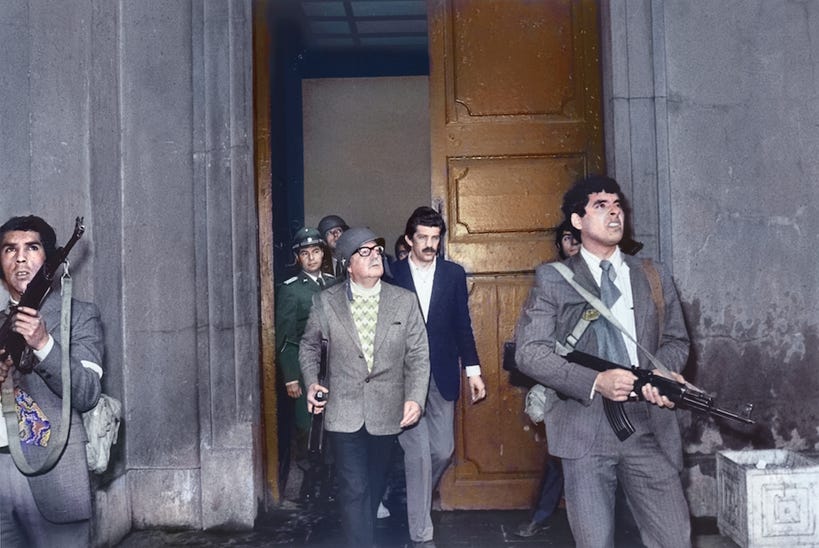
Vía Chilena (the Chilean path [or way]) ended in defeat, of course, and on 23 September 1973 “the embassies of the USSR, Cuba, and all other Socialist States had left Chile, and with them the intelligence stations which had given covert foreign support for the Allende regime. The only remaining Soviet Bloc rezidentura left in Chile was that of the German Democratic Republic” (GDR/DDR). The reason for this exception is not entirely clear, but it might have been because of “the marriage of GDR President Erich Honecker’s daughter Sonia to a Chilean man, Leandro Yañéz, a senior activist in the Chilean Socialist party.”
Regardless, the Soviets had begun their massive active measures campaign to make Allende into “the most potent cult figure since his old friend, Che Guevara”—a recovery of popularity in death he had lost in life—and the DDR outpost in Santiago was the practical foundation of the Soviet efforts to re-enter Chilean affairs. The Stasi officers at the East German Embassy were deputised “to assist the now underground Marxist parties to keep in touch with Moscow”. This was not much of a strain for the Stasi, which acted as the cut-out in Moscow’s relations with many terrorist groups the world over. In the diplomatic realm, at the United Nations, it was the Czechs that the Soviets sent out to make the speeches and call for resolutions condemning those who had ousted Allende, on the grounds of “human rights”, of all things.
The reason for this “deniable” approach was that the Soviets were in a slight bind: they wanted to make the most of the anti-American political warfare opportunities presented by Allende’s demise, but they did not want the loss of prestige that too closely associating themselves with Allende would imply. If Pinochet, the “fascist” and American puppet per the Soviet narrative, had defeated Moscow’s man then the verdict in Santiago was something of a Soviet embarrassment, plus it created propaganda problems—there would be much less sympathy for a Soviet-backed Communist. Safer and more effective to say Pinochet had overthrown Allende as a “democrat” rather than a servant of History.
The Soviet offensive against Pinochet’s Chile gradually scaled up:
In 1976, the Communist Party of the Soviet Union (CPSU) requested to admit “twelve Chilean Communists for training by the Committee for State Security (KGB) in secret and illegal work”. Former CPC [or PCC] leader Luis Corvalán was exchanged out of detention by the Soviets in 1976, and quickly received Soviet support, fiscal and training, to help rebuild the CPC clandestine leadership structures in Chile. By the 1980s the CPSU was admitting Chilean Socialist and Communist Party activists for military training by the Soviet military and security services, and “party activists for training in the methods of conspiratorial work”.
There is a final paper that has many interesting insights about the Soviet campaign against Chile in the Pinochet years, but since this has already gone considerably longer than intended, I will handle that in a separate post tomorrow.
Post has been corrected about the profile of Jorge Masetti. Thanks to Laurent Defours in the comments for pointing out the error.
FOOTNOTES
Chilean historian Joaquín Fermandois has put it this way: “When the hour of armed confrontation arrived, the military coup had massive support (precisely how massive will always be a matter of speculation), both on the part of the population and the majority of organized political forces. The violence itself was less than some feared but, arguably, was greater than necessary.”
The format is partly inspired A Middle East Mosaic: Fragments of Life, Letters and History (2000), by Bernard Lewis.
Christopher Andrew and Vasili Mitrokhin (2005), The World Was Going Our Way: The KGB and the Battle for Third World, pp. 9-12, 488-489.
MIR’s nominal supreme leader was Miguel Enríquez, until he was killed resisting arrest in Santiago in October 1974. Andrés Allende officially took over as MIR leader after that, surrendering the position in 1986 when the party was essentially dissolved. (MIR was revived in a fashion after the return to democracy in 1990.)
Stanley G. Payne (2011), Spain: A Unique History, p. 174.
Payne, Spain, p. 204.
The World Was Going Our Way, p. xxv.
It is notable that the Church Committee, despite its efforts to interpret all CIA actions in the darkest way possible, was forced to flatly concede: “CIA did not instigate the coup that ended Allende’s government”.
The authors themselves partly supply evidence that KGB-DGI divergence over Chile was not very meaningful. For instance, it is noted that the Centre’s documents “always portray the DGI as only barely cooperative”, but this is contradicted by the available evidence, which shows deep and persistent coordination. Even on this account, “closer alignment … was forced by the Soviets in February 1969”. Later it is pointed out that “in 1970, certain anti-Soviet officers in the DGI were removed and replaced with more cooperative officers who had Moscow’s trust.”
The authors explain a lot of this “inconsistency” between the documents and the reality, without seeming to realise it, in their discussion of KGB chief Yuri Andropov and his underlings writing reports to justify, to themselves and the Politburo, their inability to save Allende. The Centre partly blames Allende himself and by implication the Cubans, who were the bulk of the force on the ground, for not implementing totalitarianism fast enough, and uses this insufficient fealty to the Moscow Line—they had told Allende repeatedly to use more repression than he actually did—as evidence to “distance” the Soviets from the Allende regime, the notion being it was not really one of their colonies, so there was no obligation (and no loss of face in refusing) to shoulder the risk and cost of stepping in.
This tactical divergence argument is tied to a broader thesis in which the authors portray the Soviet Union pursuing a cautious line of wanting a “peaceful path” to socialism in South America to avoid antagonising the Americans and damaging détente, while Castro, who had some degree of genuine autonomy, was more inclined to violent radicalism. I simply dissent from the framing in toto. In the eighteen months after Allende fell, the Soviets colonised Mozambique, Angola, and Ethiopia, deploying Cuban troops in the latter two, and conquered South Vietnam. In Latin America, Grenada and Nicaragua would be brought under Soviet control in 1979. All of this was in the détente era. Détente was in practice a unilateral restraint on the West and an encouragement to Soviet aggression. Castro undoubtedly did have ideas of his own, most notoriously calling for a Soviet nuclear first-strike on America in 1962, but as that case showed: Moscow did as it wished and Castro did as he was told.
Christopher Andrew and Vasili Mitrokhin (1999), The Sword and the Shield: The Mitrokhin Archive and the Secret History of the KGB, pp. 84-85, 90-91, 118-125.
The World Was Going Our Way, p. 72.
The World Was Going Our Way, p. 82.
As mentioned (footnote 9), Andrew and Gustafson often argue in the abstract that the Soviets and Cubans were working to some extent at cross purposes in Chile because of their slightly variant strategic theology. It is, therefore, instructive that they conclude in this concrete instance where a possible divergence might be expected—the PS being more favoured by the Cubans and the PCC more by the Soviets—that the dysfunction in the Investigaciones occurred “in spite of Soviet-Cuban cooperation”.
A claim recurs that the CIA was behind the truckers’ strike in Chile in 1972, one of the first major signs that the Allende government was not long for this world. It is possible that some Agency money went to some of the strikers, but there is simply no evidence showing that this happened—even the Church Committee admitted that—and it is absurd, CIA funds or not, to place the driving force for the strike anywhere except on the Chileans involved. It was too large an event and its causes too deep to have been created from outside.
Very interesting as alway but I’m a bit confused with the paragraph related to Jorge Masetti.
The reference of the quote (“where he said of Chile”) actually links to José Piñera’s article and a search about Jorge Masetti gives confusing results :
- According to Wikipedia’s entry, his nickname was indeed “Segundo”, he was a close friend of Che Guevara and the founder of Prensa Latina, but he disappeared in Argentina in 1964 during a guerilla action, never to be seen again. His body was never found. “El Furor y el Delirio” is not mentioned and he has no bibliography at all.
- A book with this title is however found on Amazon spain. It’s author, Jorge Masetti, is the son of Ricardo Masetti, a close friend of Che Guevara and the founder of Prensa Latina. He was a cuban spy who defected and took refuge in France in 1990, where he published “El Furor y el Delirio" in 1993. He also published in english “In the Pirates Den: My Life as a Secret Agent”, maybe the real translation of “Fury and Delirium” but who knows?
https://www.amazon.es/El-furor-delirio-Volumen-independiente/dp/8483100886
https://www.amazon.com/Pirates-Den-Life-Secret-Agent/dp/1594030480
- You can find in France the war memories of Jorge Ricardo Masetti, “Ceux qui luttent et ceux qui pleurent” - Those who Fight and Those who Cry. He was a close friend of Che Guevara, went with the nickname “comandante segundo”, the book has the same number of pages as “In the Pirates Den”, he could be the perfect synthesis but “patatras !” he disappeared in 1964 and his body was never found.
https://www.amazon.fr/Avec-Fidel-Che-luttent-pleurent/dp/2251447210
I love the borgesian idea of a man named “Segundo” living two lives, one in which he dies in the jungle and one in which he lives in Paris, having two œuvres, one in which he is a devoted propagandist of the cuban revolution published in Paris, one in which he recounts the disillusions of a master spy for a south american audience.
I really love this idea, but I fear the son and the father where somehow mixed up, or the other way around.