

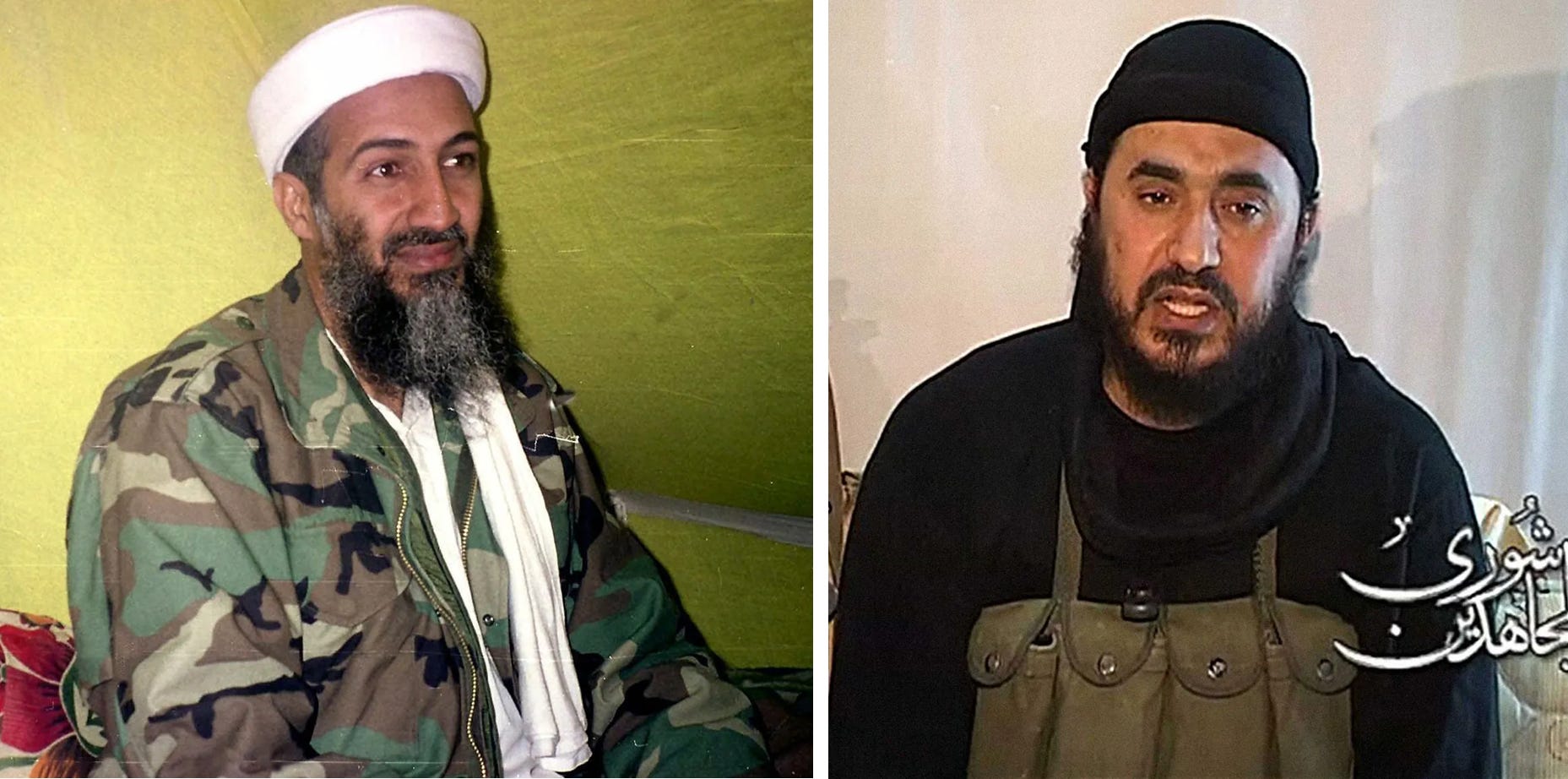
Almost twenty years ago, on 30 June 2006, Usama bin Laden released a eulogy for Ahmad al-Khalayleh, the Jordanian jihadist universally known as Abu Musab al-Zarqawi, the founder of the Islamic State movement. A translation of the eulogy is given below.
Zarqawi had established the nucleus of IS with Bin Laden’s seed funding in Taliban Afghanistan in late 1999 and moved to Iraq with his cadres in early 2002, linking up with the well-developed and increasingly emboldened jihadist underground, a year before the Anglo-American invasion that felled Saddam Husayn. In October 2004, after eighteen months of combat with the Coalition where it was quite clear the Zarqawists had some connection to Al-Qaeda, Zarqawi resolved all doubt by publicly swearing an oath of allegiance to Bin Laden and renaming his organisation Al-Qaeda in Mesopotamia (AQM). It was as emir of AQM that Zarqawi perished on 7 June 2006 and as such that Bin Laden eulogised him three weeks later.
The alliance forged by Bin Laden and Zarqawi between their jihadist currents would, a lot of murk and ambiguity notwithstanding, outlast both of them, but ultimately the theological and strategic tensions that had been visible at their first meeting just before the turn of the millennium proved too much of a strain. The relationship collapsed in 2014 and in many ways the story of the jihadist movement since then has been the struggle for supremacy between two poles that have steadily widened as they defined themselves against one another.
Eulogy for the Martyr of the Umma and the Emir of the Martyrdom-Seekers: Abu Musab al-Zarqawi1
Praise be to God, then praise be to God, praise be to God who said: “Think not that those killed in the path of God [sabil Allah] are dead. Rather, they live with their Lord, being provided for, rejoicing in what God has given them from His bounty, and receiving glad tidings about those who have not yet joined them but have been left behind: no fear shall be upon them, nor shall they grieve” [Qur’an 3:169-170].
Prayers and peace be upon our Prophet Muhammad, who said: “By the One in whose hand is the soul of Muhammad, I would love to raid in the path of God and be killed, then raid and be killed, then raid and be killed” [hadith, Sahih al-Bukhari].
As for what follows:
Our Islamic umma [community] has been struck with crushing grief by the loss of its fearless knight [or “bold horseman” (farisuha al-miqdam)], the lion of jihad, and the man of resolve and sound judgement: Abu Musab al-Zarqawi, Ahmad al-Khalayleh, following his killing in a sinful [or “wicked” (atheema)] American airstrike. To God we belong and to Him we return. We ask God to honour him with what he wished for, thus accepting him among the martyrs, granting him abundant reward and recompense, and beautifying consolation for his family and relatives.
O Muslims, indeed the grief is immense, and the situation is grave. We urge you toward what is beautiful, namely patience, and we encourage you toward what is abundant, namely reward [al-ajr].
[Arabic poetry, indicated henceforth by italics]
Thus let the calamity be immense and the matter grievous [/] for there is no excuse for an eye whose tears have not flowed
A youth who died amid striking and stabbing [/] a death that stands in place of victory since victory escaped him
Our precious Islamic umma: although the separation from the beloved ones, Abu Musab and his companions, has saddened us, it has gladdened us that their souls were poured out in these tremendous epics [al-malahim] while they were defending the shari’a of Islam. And although we have been afflicted by the loss of a knight [fursan] from among our greatest knights and an emir from among our greatest emirs, it has gladdened us that we have found in him a symbol and everlasting example for the generations of our glorious umma [to come]. The mujahideen shall remember him, supplicate for him, and praise him in poetry and prose, secretly and openly. We shall praise him according to what we knew.
For he was easy in companionship so long as he was not wronged [/] and if he sensed fear among the people, he charged forth without reproach
Abu Musab departed with his head held high, mighty of soul, free and proud, noble and loyal. He would never accept humiliation in his deen [lifeway, i.e., Islam], nor would he ever sleep upon oppression, nor would he flatter anyone or compromise regarding the truth. Stern against the disbelievers [or “infidels” (kafireen)], merciful toward the believers, inciting toward fighting, and waging jihad in the path of the deen.
Among his statements, may God have mercy on him, was: “There is no good in a life where our honour is violated, the dignity of our sisters is trampled, and the slaves of the Cross rule over us.”
Another of his statements: “We fight in Iraq and our eyes are upon Jerusalem, which shall not be regained except through a Qur’an that guides and a sword that grants victory.”2
He, may God have mercy on him, was the focus [or “object” (mahall)] of the love of his friends and the esteem of his enemies, the fair-minded among them, who testified for him and praised him, and there is no wonder in that.
He departed pure of garments; there did not remain a garden [/] on the morning he was laid to rest that did not wish to be his grave
Upon you be the peace of God always, for indeed I [/] have seen that the noble, free man has no lifespan [i.e., limit to his legacy]
Abu Musab followed the example of our Prophet Muhammad, and took as his example others who passed before him from among our leaders: Musab [ibn Umayr], Umar [ibn al-Khattab], Ali [ibn Abi Talib or Imam Ali], and Ja’far [ibn Abi Talib], may God be pleased with them all. Thus he plunged into the depths of war with a smile, so God raised his rank, elevated his remembrance, and he became an example for those after him.
The coward’s love of self led him survival [/] and the brave man’s love of war led him to war
And what difference is there between mankind [i.e., other men] and him [/] when he feared what is fearful and regards what is difficult as difficult?
Abu Musab, may the mercy of God be upon him, departed after God had granted fath [opening, conquest]. He established a base for defending the deen and for recovering Palestine, by God’s permission, and exacted revenge there on behalf of the oppressed [mustad’afeen], inflicting heavy losses upon the Americans, the allies of the Jews. He confounded them, killed their men, shattered their edifice [lit. “structure” (bunyanahum)], exhausted their wealth, disrupted their unity, and humiliated their arrogance, until those both near and far, the obedient and the disobedient, dared to challenge them. So it was that he entered history through its widest gates and ennobled it, and took the world by the hand toward the path of honour and made it known to it, through determination, decisiveness, and a proud refusal [to submit]. As a result, his biography was immortalised alongside the biographies of the eminent nobles.3
Do not weep except for a lion who has departed [/] bravely in the raging wars
Leave me in the wars that I may die honourably [/] for an honourable death is better than my life
Abu Musab taught humanity practical lessons in how freedom is seized. For freedom is not granted to the submissive beneath the domes of democracy. He taught humanity rebellion against idolatrous rulers [tamarud ala al-tughat], in an age in which the greatest taghut, the Pharaoh of the age, Bush and his companions, hold sway, trampling upon all values and covenants. In the invasion of Iraq and the prison of Guantanamo, you have a lesson. They terrorised the people, humiliated them with fire and iron, and treated presidents as though they were slaves.4
The Pharaoh of the age came to Iraq not caring about the objections and demonstrations of mankind, who said to him: “No to the shedding of red blood for the sake of black oil”. But he was contemptuous of the entire world and advanced into Iraq arrogantly, swaggering on account of his troops and equipment, imagining that the lions of the wilds [asad al-shara] had been transformed [into something weak], and that the men of Islam had receded after the Arab rulers, the kings and presidents, had given him every sign of obedience and loyalty, humiliation and submission. Each one of them was placing his hand upon his head, wondering when his turn would come to be placed in his grave.
The enemy attacked Iraq, then began oppressing the people mercilessly and demolishing villages utterly. The roar of aircraft filled the horizons and deafened the ears, while the explosions of gunpowder spread death and offended the nostrils. The mountains were shaking and swaying from the intensity of the bombardment, until hearts were in throats. Those possessing courage and understanding sought refuge in their homes; they were not stirred by words, and their feet would not carry them because of the severity of the terror. Falsehood raised its head high, the munafiqeen [hypocrites] broke their covenants and stood in the trench of the Christians and Jews. The Muslims became like scattered sheep on a rainy night in a land filled with predators.
It was under the shadow of that gloomy atmosphere—where you saw the semblances of leaders but no leaders, the semblances of ulema but no ulema, and the semblances of men but no men, except those upon whom God had mercy—in those difficult, earth-shaking circumstances, that there appeared the knight of Islam, Abu Musab al-Zarqawi.
Like a lion stretching out upon its forelegs [/] bold-hearted, a lion of great stature and power
He appeared with a small band of believers. They were seventeen men, not seventeen armies.5 They bound themselves together, pledged themselves to one another, and made a covenant with God Most High that they would support His deen or perish in its defence, [as] men, and [real] men are few.
The people are a thousand, of whom [only] one is like a man [/] while one man may equal a thousand when a matter becomes serious
Whom were they going to fight? Those equal to them in number, or twice their number?! Never [or “by no means” (kalla)]. Or even ten times their number?! Never. Rather, they [the enemy] were waves like the sea, waves of equipment and soldiers of evil. But whoever magnifies God’s right in his heart and is granted tawhid [monotheism], the firm mountains will sway while he does not sway. So our knight dismounted, carrying the banner [or “standard” or “flag” (al-raya)], and resolved upon fighting until the end: either he would taste what Ja’far tasted, or he would taste victory.6
He planted his foot firmly in the swamp of death [/] and said to it: “Beneath your sole is al-hashr [“the gathering” (of mankind on Judgment Day)].”
So they plunged into the depths of war and began striking, with a small number of Kalashnikovs, a small number of anti-tank mines, and a small number of bazooka launchers. Abu Musab had previously come with some of his brothers to the jihad against the Russians [i.e., Soviets, in Afghanistan in the 1980s7], so he competed with his brothers [in racing to the battlefield] until he overtook those who had gone before him, and when he spoke he excelled over the other speakers. Through his coming, and that of his brothers, to the land of Afghanistan, they gained experience [lit. “inoculation” (ta’tim)] in battling a superpower, and the myth of the [invincibility of] great powers vanished from their minds. They transferred the great, surging boldness and the immense morale from Afghanistan to Baghdad, igniting the fuse of jihad. The energies of the youth erupted in every place, from the Upper Euphrates to its lower reaches, and to God belongs all praise and favour.
This is our knight about whom we are speaking. He accomplished all of that, after God granted him success, with his own modest means alone. There was not behind him an international alliance, nor a regional coalition, nor a global organisation. That is the bounty of God; He gives it to whom He wills, and God is All-Encompassing, All-Knowing.
The soul of Isam made Isam a leader [/] and taught him to charge into battle and boldly advance
Yes, this is the knight of Islam about whom we speak, who stood in the face of the Pharaoh of the age, in the face of American imperialism [al-imbiriyaliyya al-amrikiyya], after the international organisations failed, after the regional groupings failed, after the entire world failed to stop that brutal, exceedingly unjust aggression.8
A striker of heads, striking heads in the heat of battle [/] agile when the heavily-armoured horse becomes burdened
Perceptive in obtaining praise from every place [/] even if the lions concealed it between their fangs
Here we ask God to grant the best reward to our bold knight, and to bestow the best reward upon everyone who offered us condolences and comfort regarding our great knight, may God have mercy on him. We mention specifically al-Emir al-Mu’mineen [“the Commander of the Faithful” or “the Prince of the Believers”], [Taliban leader] Mullah Muhammad Umar, and we ask God Most High to grant him and his mujahid brothers victory over the infidels.9
Then I say to whoever accuses the knight of our umma of killing some segments of the Iraqi population: if someone comes to you claiming that a man gouged out his eye, wait until you see the accused, for perhaps the claimant himself gouged out his own eye!
In recent weeks, there has been increased clarity on this matter. The [Iraqi Sunni Arab parliamentary] deputy Mohammed al-Dayni has spoken about the scale of the oppression and torture being practised against the Muslims in Iraqi prisons. Likewise, leaders of the Association of Muslim Scholars [Hay’at Ulema al-Muslimeen] has previously spoken about the war of extermination to which the sons of Islam in Iraq are being subjected.
Abu Musab, may the mercy of God be upon him, had clear instructions: that he should concentrate his fighting upon the invading occupiers, primarily the Americans, and that he should leave alone anyone who desired neutrality. As for whoever insisted on standing and fighting in the trench of the Crusaders against the Muslims, he was to kill them, whoever they may be, regardless of their madhhab [school of Islamic jurisprudence] or tribe, because supporting infidels against Muslims is a nullifier from among the Ten Nullifiers of Islam [Nawaqid al-Islam], as is established among the people of knowledge [ahl al-ilm, i.e., the consensus of the ulema].
Next, I say to Bush: you must hand over the body of the hero to his family. Do not be excessive in your rejoicing, for the banner has not fallen, praise be to God. Rather, it has passed from one lion to another lion from among the lions of Islam, and we shall continue, by God’s permission, fighting you and your allies in every place—in Iraq and Afghanistan, in Somalia and Sudan—until we drain your wealth, kill your men, and you return defeated to your own lands, just as we defeated you before, by God’s grace, in Somalia.10
Likewise, I say to your proxy [or “agent” (wakil)] in Jordan: enough of your despotism [or “arbitrary rule” (istibdad)]. You prevented Abu Musab from entering his homeland alive, so do not now stand between him and that. The one most deserving of leaving Jordan is you, to the Hijaz, for that is your land and the land of your forefathers before Britain installed your grandfather, Abdullah the First, as its agent [amila] over Jordan. What frightens you about Al-Zarqawi, may God have mercy upon him, even from beyond the grave, is that you know that if the Muslims are left to their own devices concerning his funeral, then, by God’s permission, it will be a great funeral, a demonstration of the extent of the Muslims’ sympathy with their mujahideen sons.11
In conclusion, I say: Abu Musab, may God have mercy upon him, brings honour not only to his tribe, his homeland, and his umma, but humanity as a whole, because he embodied for it the meanings of honour and proud refusal [of surrender], sacrifice and self-ransom [al-tadhiya wal-fed’a12]. Indeed, his life story is valuable material for [use as] a contemporary model. If the world were to study his fragrant biography, its sons would learn how faith in God [iman bi Allah] makes men, so that they resist the people of injustice and misguidance [or “oppression and error” (al-zulm wal-dalal)].
It is incumbent on every educator, writer, and novelist worthy of the name to draw from his biography that which may give sustenance to the rising generation and the next generations. Similarly, it is incumbent on every free poet to compose poetry regarding this falcon. If I were among the knights of poetry, I would greatly multiply the rhymes in lamenting him, and thereby compete with Tamadur [bint Amr, a.k.a. Al-Khansa] in lamenting Sakhr. But there is no harm in my borrowing verses from the poetry of the poet of the contemporary Islamic da’wa [proselytism], [the Islamist propagandist on Al-Jazeera satellite channel] Shaykh Yusuf Abu Hilala:
The earth choked with the blood of the sacrifices, and the fields of struggle blazed,
And from the barren desolate wastelands there springs forth the source of pure water,
Shining proudly with the banners of al-aqeeda [the creed] and true acts of heroism,
Declaring: if giving becomes scarce, then we are the sacrifices for the deen.
***
Victory belongs to those dyeing their bodies with the blood of wounds,
Who refuse to sell away their lands in willing surrender,
And those who disdain the life of humiliation and violation.
***
A few moments whose terror would overwhelm the raging winds,
Hamdan plunges down through them like a falcon with clipped wings,
After he had stormed into death while bombardment had engulfed the surrounding regions.
***
I bent over kissing his bleeding wound, and my own wounds reopened,
Tears flowed upon my cheek, so I said: “O my soul and my comfort,
Would that you had mercy upon our hearts and turned away from this departing.”
***
Then the shrouded hero answered me, mocking my suggestion:
“Wipe away your tears; there is no comfort for me in your noble tears.
This is the path if your love is sincere, so carry my weapon.”
May God have mercy on Abu Musab, and may God have mercy on everyone who carried weapons for jihad in the path of God. The last of our supplications is that all praise belongs to Allah, Lord of the worlds, and prayers and peace be upon our Prophet Muhammad and upon his family and all his companions.
Shaykh Usama bin Muhammad bin Laden
4 Jumada al-Thani 1427 AH
30 June/Haziran 2006 AD
FOOTNOTES
“Eulogy” is translated from Ritha (رثاء), which could also be translated as “Elegy”. “Umma” means the worldwide Islamic community. “Emir” means commander and also translates as “Prince”. “Martyrdom-Seekers” is from Al-Istishhadiyeen (الاستشهاديين), the term used for suicide bombers. So the title could be given as: “Elegy for the Martyr of the Islamic Community and the Prince of the Suicide Bombers: Abu Musab al-Zarqawi”.
The quote is from the 25 April 2006 video where Zarqawi first revealed his face to the world. The phrase nuqatil fi al-Iraq wa ‘uyununa ‘ala Bayt al-Maqdis (نقاتل في العراق وعيوننا على بيت المقدس)—variously translated as, “We fight in Iraq, while our eyes are upon Jerusalem” or “We are fighting in Iraq, but our eyes are fixed on Jerusalem”—was used by Zarqawi as early as August 2004, shortly after he made his presence in Iraq public, and has cropped up from time to time in official Islamic State propaganda since his death, often in the context of countering the (rather unfair) charge from other jihadists and Islamists that the Zarqawists are insufficiently attentive to the war against Israel.
The phrase used for “biographies of the eminent nobles” is siyar a’lam al-nubala. It is probably an allusion to the twenty-eight-volume compilation of biographies of prominent figures in Islamic history, which starts with Muhammad and the Rashidun Caliphs, and ends in the fourteenth century.
The author of that work is Al-Dhahabi (1274-1348), a Syrian historian and hadith scholar working under the aegis nominally of the Abbasid Caliphate and in reality the Mamluk Sultanate that had transferred power to Cairo after the Mongols sacked Baghdad in 1258.
This is an interesting indirect protest by Bin Laden on behalf of Saddam Husayn, who was famously and ignominiously dragged out of what is invariably called a “spider hole” in Al-Dawr in December 2003, whereupon he declared, “I am the president of Iraq and I want to negotiate.”
This was not the first time Bin Laden had publicly, if back-handedly, expressed support for Saddam. In February 2003, on the eve of the invasion, Bin Laden released an audio statement saying: “There is no harm, in these circumstances, if the interests of the Muslims intersect with the interests of the socialists [i.e., Ba’thists] in fighting the Crusaders, even as we believe and openly declare that the socialists are disbelievers.” The jihadists who soon publicly identified themselves as Al-Qaeda in Mesopotamia were already in Iraq at this time: they fought the Coalition as it drove up to Baghdad, and after the regime came down they combined with the Saddamist remnants in the insurgency. The question of how far back this relationship went, and how deep it was, remains contentious all this time later.
This narrative of Zarqawi having about him less than two-dozen operatives at the onset of his activities in Iraq has been told many times, though the number can vary slightly depending on the account. There is, for example, a list in circulation of the eighteen men around Zarqawi at the foundation of Jamaat al-Tawhid wal-Jihad, as the Islamic State movement was known before 2004 (see footnote 3 here). The listed men, many of them foreign, were indeed among the prominent early leaders of the IS movement inside Iraq, but the idea they were the only men loyal to Zarqawi in Iraq is silly: he was received in Kurdistan in April 2002 by Al-Qaeda-linked forces that had set up a quasi-emirate and from the moment he landed in Baghdad in May 2002 he was plugged into the powerful Salafi militant underground.
The facts were beside the point for Bin Laden, of course: the purpose of the story was propagandistic, to portray Zarqawi and the cause of jihad rapidly and spectacularly reaching the heights they had by 2006 from the most inauspicious starting point. It is not such a good story if it is acknowledged that Iraq was rather fertile ground for Islamic militancy by 2002-03.
Islam’s sacred history tells of Ja’far perishing at the Battle of Mu’tah, in what is now Jordan, in late 629 AD, after riding into a crowd of Byzantine soldiers and their Ghassanid Arab vassals, killing hundreds of them. According to the Muslim sources, though Muhammad’s armies were defeated in this confrontation, they were saved from a rout by Khalid ibn al-Walid, “the Unsheathed Sword of God” (Sayf Allah al-Maslul), and several months later Muhammad conquered Mecca.
The problem for a non-Muslim in treating any of this as history is that the Tradition recording these details appears two centuries later in the context of an exegetical project to consolidate what was by then an Imperial creed in contradistinction to its Jewish and Christian progenitors.
In point of fact, Zarqawi did not fight in the anti-Soviet jihad: he arrived in Afghanistan too late in 1989.
“Exceedingly unjust” is from zalum (ظلوم). Its root word, zulm (injustice), is the one widely applied to a bad government—the counterpoint to adl (justice), classically meaning a government that upholds Islamic law (and usually infers that the ruler obtained power legitimately, though it was theoretically possible to be a usurper who ruled justly). This dichotomy of “justice” and “injustice” functions in the political lexicography of Islamdom in the way “freedom” and “tyranny” (or “slavery”) does in Christendom/the West.
Bin Laden was technically subordinate to the Taliban leader, having sworn a bay’a (oath of allegiance) to the emir of “the Islamic Emirate of Afghanistan”. In 2014, one of Al-Qaeda’s immediate reactions to IS’s caliphate declaration was to transmute this heretofore ambiguous status Mullah Umar had as “Commander of the Faithful” into something more concrete—to present Umar, in Cole Bunzel’s words, as a “counter-caliph of sorts”. Old footage of Bin Laden’s “supreme bay’a” to Umar was wheeled out and a messaging campaign was launched for Al-Qaeda’s loyalists to “renew” their bay’a to Umar, starting with Bin Laden’s successor, Ayman al-Zawahiri. This was not a particularly effective method of blunting the ideological challenge from the Zarqawists and it unravelled completely in the summer of 2015 when the Taliban publicly admitted Mullah Umar had been dead since April 2013.
The situation at the present time is very murky. The embarrassment of encouraging a “renewed” bay’a to a dead man notwithstanding, Al-Zawahiri retained the same set-up with the Taliban, but Dr. Z was killed in July 2022 and, while it is widely believed that the Iran-based Muhammad Saladin Zaydan (Sayf al-Adl) currently leads Al-Qaeda, there has been no formal announcement and therefore no clarification about the relationship with Taliban emir Hibatullah Akhundzada, assuming he is still alive.
This is a reference to the “black hawk down” episode. In Bin Laden’s writings and speeches by the mid-1990s, he had consolidated a narrative that the jihadists had defeated the more ruthless and dangerous of the two infidel superpowers, the Soviet Union, driving it out of Afghanistan to ruin and collapse. Dealing with America would be comparatively easy, Bin Laden believed: it was soft and effeminate, run by Jews and corrupted by homosexuality; a paper tiger incapable of sustaining a fight involving casualties. Hit them and they will run, Bin Laden intoned to his followers, always giving the same litany of examples: Vietnam in the 1970s, the Marines in Lebanon in 1983 (an event that was inspirational in more ways than one for Bin Laden), and Somalia in 1993. By the end of turn of the millennium, Bin Laden added to the list the East African Embassy bombings in 1998 and the attack on the U.S.S. Cole, which occasioned “only angry but empty words and, at most, a few misdirected missiles” from the United States, emboldening him on the road to 9/11.
Zarqawi had ordered the massive suicide bombings of three hotels in Amman in November 2005, which slaughtered sixty people (among them, incidentally, the Syrian-American producer of the Halloween films, Moustapha Akkad, and his daughter). This had slightly dented Zarqawi’s image in Jordan, but not by all that much in the regional State where overt sympathy for the Baathi-jihadist insurgency in Iraq probably ran highest. The atmosphere was such that not only Zarqawi’s family, but Jordanian parliamentarians felt safe to publicly demand Zarqawi’s body be returned to Jordan, with the advertised intention of staging a lavish celebratory funeral and then turning his burial place into a shrine. The Jordanian monarchy wisely blocked this, and Zarqawi was buried in an unmarked grave in Iraq, but the need to block Zarqawi’s posthumous return was an admission that Bin Laden was quite correct in his assessment of the situation in the Kingdom.
By coincidence, the Islamic State made much of these two words in its most recent editorial in Al-Naba.