

A few days ago, I published a long article about what Azerbaijan calls “the Khojaly genocide” as an exemplar of a false genocide claim that is generated for political reasons. The genocide claim, made in the immediate context of Azerbaijan’s war with Armenia over the Nagorno-Karabakh amid the Soviet Empire’s collapse, became a crucial pillar of Azeri nationalism, binding the population of the new State in a collective sense of victimhood and hostility towards a foreign neighbour that plots their destruction—and always has. For in Baku’s telling, Khojaly is only the most-recent of multiple genocides perpetrated by the Armenians against Azeris stretching back to the first decade of the twentieth century.
The Armenian response is that it is they who have suffered an interminable campaign of genocides by Turkic enemies, from the terrible massacres during the deportations in the Ottoman Empire in 1915 through to the pogroms against the Armenian minority in Azerbaijan, at Sumgait and Baku, in 1988 and 1990. This competitive victimhood has entrenched “divergent national narratives”, each denying the suffering of the other, which sustains the conflict by preventing the two sides finding even the minimal common ground that would be needed to begin working towards peace and reconciliation.
As discussed in the article, part of what makes the Khojaly case interesting is that, despite a general trend in academia since the 1980s—reflected in the media and popular understanding—to dissociate the word “genocide” from the Holocaust and apply it ever-more widely, the academic consensus rejects the Khojaly genocide claim. An important reason for this is the recognition that Khojaly is part of a broader phenomenon in the post-Soviet space, where “genocide” is widely used in official political discourse “with barely any reference to the international legal understanding of the term”.
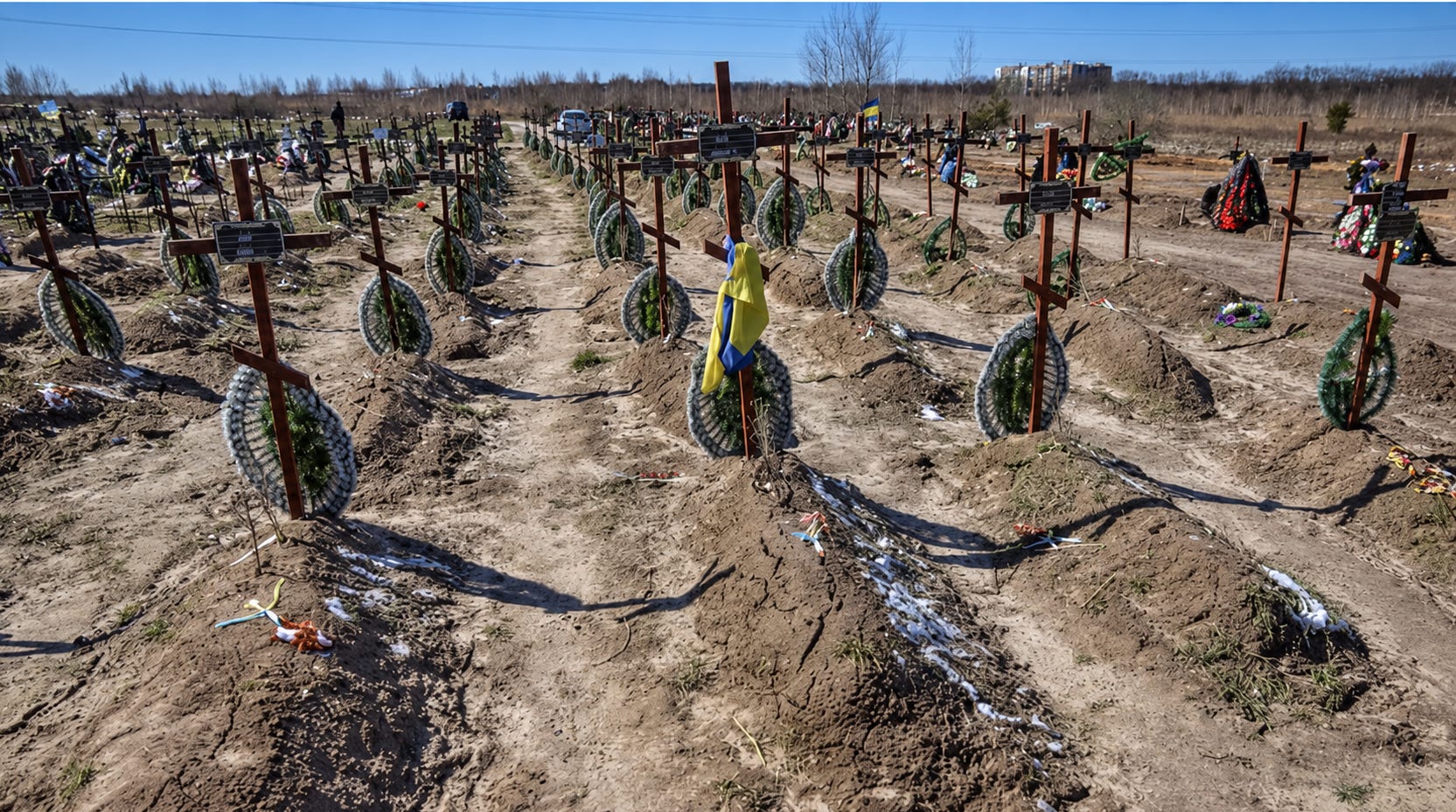
An example of this tendency was furnished yesterday by Ukrainian President Volodymyr Zelensky, who tweeted: “Bucha. It was a genocide, recognized by everyone.”1 Bucha refers to a small town, less than twenty miles from Kyiv, which the Russian army entered on 27 February 2022, during the first days of the full-scale invasion meant to destroy the Ukrainian State and incorporate the country into Russia. Bucha’s liberation a month later, as the invaders were driven back from the Ukrainian capital, disclosed a hideous scene. The occupiers, including some of Russia’s elite troops, had raped, tortured, and massacred the civilian population, leaving bodies in the streets.2
In the regional context, Zelensky is doing nothing unusual in choosing to call the Bucha slaughter, or indeed the entire Russian war, genocide. The Azeris frame Khojaly as one episode in an Armenian war in the Karabakh that was genocidal tout court. Even before that, right at the beginning of the post-Soviet world in 1989, Romania’s revolutionaries had put Nicolae Ceaușescu and his grisly wife, Elena, to death after a show trial that declared them guilty of genocide.3 Russia, meanwhile, claimed it invaded Georgia in 2008 to stop a genocide in Abkhazia and South Ossetia, and Tbilisi counter-claimed that Russian and its separatists were the perpetrators of genocide.
Alongside contemporary genocide claims, numerous post-Soviet States have raised such claims about the past. This often happened in the early phase of independence and was geared towards reinforcing the dual processes of nation-building, namely anathematising the Communist period as an alien imposition and forging a new national history, whether remembered, recovered, or invented. Estonia, Latvia, and Lithuania all commemorate Soviet genocides against them. Poland has Katyn. Mutatis mutandis, Russia claims it, as successor State to the Soviet Union, embodies the victims of the Nazi “genocide of the Soviet people”.
At a sub-State level, the Crimean Tatars and Chechens have appealed for their deportations by Stalin to be recognised as genocide, and the Circassians have made the same appeal about their deportation by Imperial Russia in the 1860s.
What does make the Bucha genocide claim slightly unusual is that it comes from Ukraine. Ukrainian émigrés first seriously mobilised to campaign for recognition of the terror-famine during Soviet collectivisation in 1983, on the fiftieth anniversary, and the Holodomor was legislatively enshrined by independent Ukraine as the national genocide in the 2000s. Ukraine thereafter avoided making supplementary genocide claims for itself, even under the extreme provocation of Russia’s initial invasion in 2014, which (one may detect a pattern here) was justified by Moscow as protecting people in the Donbas from a “genocide” by “the Kiev junta”. The Ukrainians understood—as the Azeris and Armenians seem not to—that proliferation erodes, rather than enhances, the legitimacy of genocide claims.
There is an irony in the attempt to use politicised genocide claims as a mechanism to escape the Soviet legacy because there can be no surer testament to it. In 1946, before the United Nations General Assembly adopted a resolution declaring genocide a crime under “international law”, the Soviets had already used the Nuremberg “trials” as a stage to blame the Germans for Katyn. The 1948 Genocide Convention had barely entered into force in 1951 when the Soviets started accusing the United States of genocide for its treatment of the Native Indians and African Americans at home, and for repelling Soviet aggression in Korea. It was in this era that the Armenian genocide-recognition campaign originated as a Soviet active measure to prevent and then punish Turkey for joining NATO. And the Soviet capture of the U.N. General Assembly in the 1960s, creating an in-built anti-Western majority via the amusingly named Non-Aligned Movement, made the U.N. the key theatre for launching an endless series of KGB global influencing campaigns based on fabricated genocide charges.4 The most intense and enduring such campaign was against Israel.5
I got a bit of blowback for saying Zelensky was not quite correct that “everyone” agreed Bucha was a genocide. The basic objection was that this was in some way downplaying the seriousness of the atrocity. In a strict sense, this is unfair: to argue that an event does not meet the technical definition set out in the Genocide Convention is to say no more than that. It does not necessarily involve contesting the facts of the case nor their criminality; the issue is why the crime happened, and whether the perpetrators had the “special intent” for genocide. Emotionally, of course, the objection lands because those making a genocide claim do so precisely because genocide is viewed as the top of a hierarchy of atrocity—“the crime of crimes”—and events so recognised thereby enter the same category as the Holocaust; to refuse this will incur resentment. The only way through is to reiterate that the Convention definition is what it is; “genocide” is not a synonym for “a bad thing”. And a crime does not have to be genocide to deserve attention, condemnation, and retribution.
FOOTNOTES
President Zelensky was quoting from a podcast interview (1:15:45).
The death toll at Bucha is, as these things always are, highly contested.
The accused combatant in such circumstances always tries to minimise the total. Slightly unusually, Russia denies there were any casualties at all, claiming that while Bucha was “under the control of the Russian armed forces, not a single local resident has suffered from any violent action”. Moscow’s contemporary reaction was to declare the scene attended by journalists upon Bucha’s liberation a “monstrous forgery”. The Russian position has since become somewhat ambiguous about whether anyone was killed in Bucha, simultaneously maintaining that it was a “fabricated story”, “provocation”, and “put-up job”—and that “the Zelensky regime and its Western handlers staged a bloody mass murder of the people”. These are transparent, contradictory lies, but so it goes with the current Russian government.
Ukraine reported “official statistics” in August 2022 of “458 bodies found [in Bucha] (366 men, 86 women, 5 unidentified, 1 bag containing body parts that cannot be identified as a body). Of these, 419 people were killed.” President Zelensky said yesterday “around 500 people” were killed in Bucha. That number was circulated by Ukrainian officials immediately after the atrocity, and by mid-April 2022 Zelensky was already referring to the Bucha massacre as “genocide”.
The United Nations, for what little it is worth, reported in December 2022 that it had “documented the killings of 73 civilians (54 men, 16 women, 2 boys and 1 girl) in Bucha between 4 and 30 March 2022 … [and] was in the process of corroborating 105 additional alleged killings of civilians (85 men, 11 women and 9 adults whose sex is yet unknown) in the town.” The U.N. cited, without stated reservation, the 13 September 2022 announcement of the Main Department of the National Police in Kyiv region that 422 bodies of civilians had been discovered by then.
The new Romanian government upheld the genocide verdict against the Ceaușescus, making it officially the first genocide conviction in Europe since the Genocide Convention entered into force in 1951. Bucharest has even utilised genocide charges in subsequent cases against former Communist officials.
The Soviets initiated propaganda campaigns based on fake genocide claims against, inter alia, France (for resisting the terrorist rebellion in Algeria), Rhodesia (for existing), South Africa (nominally for its apartheid system), Chile (in revenge for General Pinochet aborting a Communist Revolution), Britain (for combatting IRA terrorism in Northern Ireland), and El Salvador (for resisting the Soviet-run Communist revolt).
Moscow Centre always believed—and still believes—a vast proportion of its own propaganda, and it got so lost in its conspiracy theories during the antizionist campaign that even the decrepit Leonid Brezhnev lamented: “Zionism is making us stupid”.