

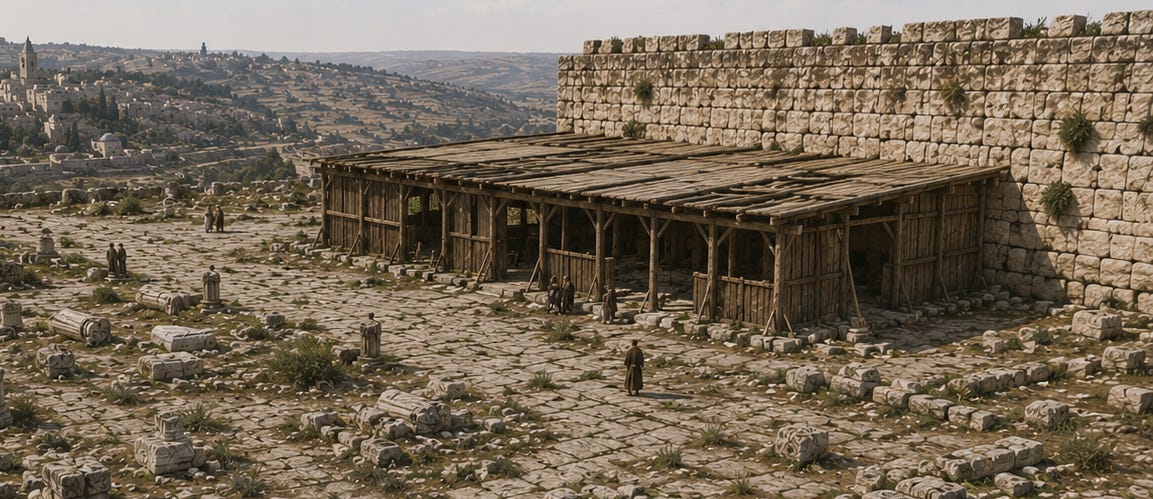
Roughly between 679 and 682 AD, Arculf, a Frankish bishop,1 undertook a journey in the Near East, through Egypt, the Land of Israel, and Syria—the ancient Christian territories conquered by the Arabs a few decades earlier. The most intriguing aspect of Arculf’s testimony relates to the nine months he spent in Jerusalem at the beginning of his trip.2
Christian pilgrimage to the Holy City went back to the fourth century, after the Emperor Constantine and his mother Helena “discovered” the sites related to Jesus’s life and ministry, but the practice had been disrupted by the Arab conquests of the 630s and the relentless subsequent expansion. In 678-679, however, there had been a thaw between the Romans/Byzantines and the Arabs that permitted freer movement.3 That Arculf’s journey was possible, and the fact he saw “a huge concourse of people from various nations … come together in Jerusalem”,4 helps date his journey to after this Byzantine-Arab treaty.5
Islamic Tradition tells of the Muslim conquerors, soon after their occupation of Jerusalem in 637-638, beginning to refashion the architecture of the city. Arculf records little evidence of this. Arculf also found little evidence of the claims in earlier Frankish chronicles that it was the “habit” of the “Saracens” to “lay waste the provinces of the Empire that had fallen to them”.6 The churches and Christian sites were as his ancestors would have known them, and their upkeep was remarkable. Arculf’s travel documents were in Greek and the coinage he used was not only weighted according to metrics set in Constantinople; many of the coins had Christian crosses on them.7
A specific claim in the Tradition is that Umar, allegedly the second Rashidun (Rightly-Guided) Caliph, began to put Islam’s stamp on the site where Solomon’s Temple and the Second Jewish Temple had stood until the Romans demolished it in 70 AD. What Arculf found was:
In that famous place, where once stood the magnificently constructed Temple, near the eastern wall, the Saracens now frequent a quadrangular house of prayer, which they have built in a crude manner, constructing it from raised planks and large beams over some remains of ruins. This house can, it is said, accommodate three thousand people at once.8
It seems unlikely that such an improvised “place of prostration” or masjid (mosque) would still be in place if construction had begun three decades earlier. On the other hand, there is a claim in a ninth-century Byzantine chronicle that the Umar-era houses of worship “kept falling down”,9 which may explain its condition when Arculf saw it, and in either case such a large structure on the Temple Mount attests to the Arab rulers’ viewing the site and thus the city as significant.
Finally, Arculf relates a story, “which all the people of Jerusalem assert to be true”, of a dispute between Jews and Christians over the shroud placed over Christ’s head in the tomb:
The rivalry … divided the people of Jerusalem into two factions, the faithful believers, that is, against the infidel unbelievers. Upon this the King of the Saracens, Mavias [i.e., Muawiya] by name, when invoked by both sides, in judgment between them said to the infidel Jews (who stubbornly held on to the Lord’s shroud) in presence of the Christian Jews [i.e., Christian converts]: “Give into my hand the sacred cloth that you have.” …
The King took it with great reverence, and bade a pyre be prepared in the court before all the people. When it was burning with great intensity, he got up, went right up to the pyre, and said in a loud voice to the dissident parties: “Now let Christ the saviour of the world, who suffered for the human race, who had this shroud (which I now hold in my arms) placed on his head in the sepulchre, judge by the flame of the fire between you who contend for this cloth, that we may know on which of these two contending bands he will deign to bestow such a gift.” And so saying he cast the Lord’s sacred shroud into the flames.
But the fire was completely unable to touch it. Whole and unimpaired it arose from the pyre, and began to flutter on high … then gradually coming down it swerved by God’s guidance towards the Christian party, who meantime kept beseeching Christ the judge, and it settled in their midst.10
The story, obviously, has a mythic quality, but the core of it—that Muawiya was concerned with arbitrating Jewish-Christian disputes, and they both regarded him as the proper authority in such matters—is something to keep in mind.
Arculf transmitted his account in 683 or 684 to Adomnan, the abbot on Iona,11 an island off western Scotland, and Adomnan recorded it in De Locis Sanctis (“Concerning the Sacred Places”), which was completed around 686 AD.12
Arculf’s testimony is important because it provides a precious point of light in what is otherwise a dark age in the Near East. The term “dark age” is often used morally-polemically,13 but there are legitimate technical-descriptive uses for it in history. One such case is the Near East from the 630s to about 800 AD, the period of the Arab conquests and the advent of the Arab Empire. (Another famous case is Britain, where from 410 to 597 AD—between the collapse of Imperial Roman administration and the arrival of the Papal Roman mission—the sources are so threadbare that all attempts at reconstruction are necessarily probabilistic and provisional. There is an interesting parallel in both beginning with the collapse of part of the Roman Empire and lasting about two centuries.)
The only narrative account of how the Arabs captured and colonised the Roman and Persian zones is contained in the Islamic Tradition: the biographies of the Prophet Muhammad (Sira) and accounts of the military campaigns (Maghazi) especially, as well as in the Hadith, the legal literature of the shari’a, and Qur’anic exegesis. For a long time, this source deficiency led to a deference towards Islam’s sacred history, even in Western critical scholarship. The enormous problem is that the Islamic Tradition postdates 800 AD almost in its entirety and, as is well-known in general, “Tradition does not merely transmit the past: it creates it”.14
A proper reckoning with this situation began in the 1970s with the emergence of a “Revisionist” trend in Islamic Studies, exemplified by John Wansbrough and Patricia Crone. Half-a-century later, the Revisionists have not prevailed, exactly, and almost definitionally could not—there is no single Revisionist view.15 However, the collective evidence and arguments of the Revisionists have significantly eroded the Tradition-reliant consensus, and the methodology that underwrote it. The primary approach of recent decades has been to situate the Arab conquests in their Late Antique context and that has produced some convergence, if not quite consensus.
An area where the debate in Islamic Studies has been substantially rewritten is that many secular academic specialists now, even former stern critics of the Revisionists, accept that Islam is a product of the Arab Empire, not a cause of its creation. The obvious corollary question is: What was the nature of the Arab creed before that?
The Revisionist answer—taking together the totality of the available evidence, including from the Qur’an, which unlike the Tradition is (probably) authentically Late Antique—is an indeterminate Biblical monotheism, a blending of Jewish and Christian elements, some of them already ancient “heresies” by the seventh century. This doctrine, which the Qur’an calls Millat Ibrahim (the Way of Abraham), was not a new revelation but a primordial call for Jews and Christians to “return” to the “proper” faith. The non-Arabs who encountered it at the time knew its followers “Hagarenes” or “Ishmaelites”, the reference being to Hagar, the concubine of Abraham, and their son, Ishmael, from whom the Arabs descend, according to Biblical exegetes on all sides.
This kind of creed is very recognisable from the Late Antique “sectarian milieu” in and around the Roman Levant, where renegades from the orthodoxy of Constantinople and the rabbis gathered and mingled—and where Arabs had been employed as foederati and settled in ever-expanding numbers in the centuries before the 630s. The implication from this, reinforced by multiple lines of evidence, is that when the Arab armies very pointedly made the Jerusalemite Holy Land the first target of their conquests, they did not arrive from the Hijaz a thousand miles away, but took advantage of a situation on their doorstep, with Roman power in the Near East hollowed out after a generation-long war with the Persians.
All indications are that the Ishmaelites emerged from the more Jewish end of the spectrum in the sectarian milieu, adhering to a revivalist doctrine focused on the Promised Land to which they had a blood right, and were quite possibly assisted by Jews during the take-over of the Syro-Palaestina provinces, partly in reaction to the then-recent severe Byzantine antisemitic persecution and partly due to the stimulation of eschatological hopes that the Temple would be rebuilt. Which it might have been if the Arabs had stopped there, and the spectacle of a restored Temple combined with the weight of the Jewish inheritance might have absorbed the inchoate Ishmaelism. But with the devastation of Rome and Persia, a dominion more vast than they could ever have dreamed of fell into Ishmaelite hands. The creed adapted to the new horizons, taking on a more Christian universalist character, though the particularism was never wholly set aside.
There is no reason to doubt that Muhammad existed—contemporary evidence suggests he led the invasion of the Jerusalemite zone16—but he died soon afterwards and then disappears from the records for about sixty years. It is the Arab Empire beginning to officially invoke Muhammad in the 690s that marks the turn towards a more exclusivist creed, with the Prophet and the Qur’an as its pillars, and the evolution of an identity where, so to speak, muslim (“submitter to God”) becomes a proper noun, separate from the Jews and Christians, particularly in its explicit hostility to the Trinity.17 Ultimately, once the Tradition stabilises in the ninth century AD, Islam will cast the two prior monotheisms as corrupted and superseded revelations.18
The importance of Arculf is that he is an eyewitness and an outsider, free of the pressures that shaped the Tradition. What Arculf provides to historians is a piece of concrete evidence—an immovable data point in a landscape where inference and probability do so much work in constructing the historical picture.19 In other words, while the substantive weight of Arculf’s testimony is relatively slight—a few brush strokes on the canvas—it is an important controlling element because Revisionist interpretations that are contradicted by Arculf must be discounted.
On the core Revisionist argument of Islam emerging from the Empire, rather than before it, Arculf’s account offers no contradiction. There is no hint of “final-form” Islam: the word is absent; there is no mention of Muhammad or the Qur’an, neither by Arculf’s interlocuters or on inscriptions; “Muslim” does not appear as an identity category; and there is no Islamic architecture. On the visual evidence of the unmolested churches and shrines, and what we might call the logistical evidence provided by Arculf (his travel papers and money), it might easily be concluded the Christian Byzantines had never left Jerusalem.20 This is what would be expected if the Arab Imperial ideology had not detached itself from its Judeo-Christian seedbed at this stage.
The makeshift “house of prayer” (orationis domus) Arculf sees offers more substantive evidence for the Judeo-Christian creedal fluidity of the Arab rulers in Jerusalem around 680 AD, though it is more in the nature of a tantalising clue than a definitive answer. It shows that the Temple Mount had a sacral significance to the Ishmaelites, implying that the Jewish dimension within Ishmaelism remained alive. From other sources, it is believed that relations between the Ishmaelites and the Israelites themselves had cooled by this time, and Arculf’s story of Muawiya siding with the Christians over Jesus’s shroud hints at this. Arculf’s testimony is also consistent with the explanation the earlier evidence gives for the tension in Jewish-Ishmaelite relations, namely the Ishmaelites’ moves to appropriate the Temple site into their dispensation, not merely the Jews’ disappointment at their perceived allies and new overlords preventing them rebuilding the Temple.21 The construction c. 692 of the Dome of the Rock might be regarded as the completion of this process of appropriation, but it is difficult to be sure what this curious structure originally was: it is certainly not a mosque—the Aqsa Mosque was created more than a decade later—and the rites it hosted in the first phase of its existence call into question the appellation of “the first great Islamic building”.22
In a similar vein, Arculf does not contradict the thesis that Muawiya was not a Muslim in the modern sense, and to an extent contributes directional evidence for this, but once again Arculf gives a sense of something in outline that remains out of reach in the specifics.
What we know of Muawiya is that he came to power in 661 AD, displacing the Rashidun with the Umayyad dynasty, and this reignited Jewish hopes, which had first arisen a quarter-century earlier in the immediate aftermath of the Arab occupation of Jerusalem, that the Ishmaelites would be the vehicle for restoring the Temple.23 One can understand why. Muawiya was crowned on the Temple Mount, declaring that the spot was “dearer to God than the rest of the earth” and the surrounding land would be the place “of ingathering and resurrection on Judgement Day”.24 Muawiya even ostentatiously considered making Jerusalem his capital, before settling in Damascus.25 However, from the beginning it was not only Jews who detected a Redeemer.
After Muawiya was crowned, he prayed at Gethsemane, Golgotha, and the tomb of the Virgin Mary. Subsequently, contemporary chroniclers would tell of Jacobites (Syriac Orthodox) and Maronites calling in Muawiya to settle their differences.26 This adds to the credibility of Arculf’s account that Ahl al-Kitab (People of the Book) looked to Muawiya as an arbitrator and that Christians in Jerusalem in 680 believed the Arab ruler capable of invoking “Christ the saviour of the world”. What connection this has to the real Muawiya is, of course, distinctly opaque, but the Christians can be forgiven for thinking their favourable view of Muawiya was requited, and struggling at times—as Arculf did—to understand he was not one of them.27 After the pro-Christian display at Muawiya’s coronation ceremony, he had married a Christian and married his son to a Christian Princess, the daughter of the last King of the Ghassanids, the devoutly Christian Arab shield of Byzantium for two centuries and more. Throughout his reign, the gestures continued, such as repairing the church of Hagia Sophia in Edessa when it was damaged in an earthquake,28 in-keeping with the maintenance of the churches in Jerusalem that Arculf witnessed.
The ambiguity surrounding Muawiya starts with the very title of his office. The Qur’anic term “Caliph” (Khalifa),29 “Deputy (of God)” or “Successor (to His Prophet)”, would not be used by Arab rulers until the 690s. Muawiya was “Commander of the Believers” (Emir al-Mu’mineen), a non-Qur’anic and seemingly wilfully more equivocal title.30 None of Muawiya’s surviving inscriptions, coins, or documents mention the Prophet Muhammad, nor are there any extant Qur’ans securely datable to Muawiya’s reign, if it comes to that.31 But there is an inscription at Hamat Gader, near the Sea of Galilee, which is preceded by a Cross and reads, in Greek, “Muawiya, the Commander of the Believers”.32 Which believers remains an open question.
As intriguing is what is not in Arculf’s account: Mecca. Arculf records no sign that those at prayer face it. On its own, this is an argument from silence that does not amount to much. But it becomes more important in combination with the writings from a couple of years later of Jacob of Edessa, a Syriac bishop, who precisely locates the Arab qibla (direction of prayer): “the Jews and the muhajirun” pray “toward Jerusalem and toward the ka’ba, these ancestral places of their peoples”.33 Modern archaeology tells the same story of the qibla in this period being in the vicinity of Jerusalem, not the Hijaz.34 Arculf is, therefore, consistent with the evidence that the qibla reorientation from around Jerusalem to the Hijazi Mecca was a byproduct of the reforms by Abd al-Malik (r. 685-705) in the 690s, and the Tradition placing this change before the conquests is a theologically-inspired back-projection.
One might perhaps see it as an effect of the creedal changes that Willibald, an English monk and later bishop in Bavaria who tried to follow in Arculf’s footsteps in the 720s, found a much less hospitable environment for Christian pilgrims in the Jerusalemite zone.35 But the ramifications only became fully apparent after the Umayyads had been overthrown in 750 AD.
The new Arab rulers, the Abbasids, moved the Imperial capital to Baghdad, away from the former Roman Levant and into Persianate Mesopotamia. It was in this environment that the great exegetical project took place that codified the Tradition, forging Islam as we know it.36 As so often in the ancient world, this revolution was presented as a return to a forgotten authentic past. The Abbasids, naturally, blamed their Umayyad predecessors for this recovery being necessary, embedding an anti-Umayyad bias in Islamic historiography, which presents the Umayyads as impious, presiding over a worldly Caesarist system rather than upholding the Holy Law of God, and spiritually marginalises the geographic heartland of the Umayyads.37 The Abbasid-era Tradition that underlies classical Islam “aggressively seeks to conceal” the “special sanctity of Jerusalem and Palestine … [to] the early Believers”—damning the belief that Jerusalem is a Holy City as a superstition of superseded creeds, while locating the Muslim Holy Land firmly in the Hijaz—and attributes any confusion on the point to the Umayyads’ “un-Islamic” deviance.38
FOOTNOTES
The Frankish Kingdom was ruled by the greatest of the post-Roman Barbarian dynasties in the West, the Merovingians. After a laborious struggle, by the dawn of the sixth century the Franks had effectively stitched back together what had been Roman Gaul (roughly France), and from there begun expanding over the Rhine. The Franks would in time carve out territories that would evolve into the Holy Roman Empire and ultimately Germany (and northern Italy).
Denis Meehan [ed.] (1958), Adamnan’s De Locis Sanctis, p. 37.
It is clear that Byzantine military advances in the late 670s forced the Arabs into friendlier relations, but there is good reason to believe that the narrative of the culminating victory being the Byzantines breaking a four-year Arab siege of Constantinople (674-678) with Greek fire is a myth—more precisely, a back-projection of events that really did occur in 717-718. See: James Howard-Johnston (2010), Witnesses To A World Crisis: Historians and Histories of the Middle East in the Seventh Century, pp. 303-304.
Meehan, Adamnan’s De Locis Sanctis, p. 41.
Meehan, Adamnan’s De Locis Sanctis, p. 9.
Quote is from Fredegar, writing c. 650s, cited in: Robert G. Hoyland (1997), Seeing Islam as Others Saw It: A Survey and Evaluation of Christian, Jewish and Zoroastrian Writings on Early Islam, p. 219.
Tom Holland (2012), In the Shadow of the Sword: The Battle for Global Empire and the End of the Ancient World, pp. 366-367.
Even in the Islamic account, the Arab Empire continued to use Roman coinage—and governing structures—up to the 690s, when an “organisation and adjustment” process was instituted that saw the Arabs begin to mint their own coins and impose Arabic as the language of government. See: Bernard Lewis (1995), The Middle East: A Brief History of the Last 2,000 Years, pp. 67-68.
Translation taken from: Meehan, Adamnan’s De Locis Sanctis, p. 43; and, Hoyland, Seeing Islam as Others Saw It, p. 221. Original Latin available here.
The Chronicle of Theophanes (c. 815). Available here.
Meehan, Adamnan’s De Locis Sanctis, p. 53-54.
Iona at the time was part of the Dalriada, a small Gaelic Kingdom spanning the North Channel, encompassing the western seaboard of Scotland and the north-east of the island of Ireland (roughly Ulster), where Adomnan had been born c. 625. Adomnan was an active missionary, and it was the Christianity spread by men like Adomnan in the early Middle Ages that provided the basis in due course for unity in the British Isles, starting with the forging of England 250 years later. Adomnan was also a great scholar, one of the most learned men of his age, and his achievements as a man of letters and man of action in God’s cause had him recognised as a Saint soon after he died in 704. Adomnan’s death date, 23 September, remains a Christian feast day to the present.
It is not only among Christians that recognition of Adomnan remains, though. Adomnan’s most famous work, written shortly before his death, Vita Columbae (“The Life of Columba”), was a biography of another Irish monk and Saint, the founder of Iona Abbey in 563. Saint Columba had used this foothold to proselytise Christianity to the Picts, a mysterious people who left no writing of their own and disappeared after their polity was folded into the proto-Scottish Kingdom of Alba in the tenth century. Adomnan, inter alia, used the monastery’s missionary records from Columba’s time in his hagiography and thus provides a rare contemporary source about the Pictish world. This is an invaluable resource for historians, and it is interesting that Adomnan provides evidence for the two great medieval mysteries at either end of the old Roman Empire.
This being early medieval history, there is naturally some dispute about the dates. Older analysis tends to place Arculf’s journey somewhere between 670 and 674, and there are even arguments the journey was nearer 660. These dates are almost certainly much too early.
Arculf met Adomnan after the latter had become abbot, i.e., 679. Even taking into Arculf’s travails—according to the Venerable Bede, Arculf was shipwrecked on the way home—it is absurd to propose it took Arculf five years, let alone fifteen, to get from the Middle East to Scotland. Likewise, Adomnan presented a completed copy of De Locis Sanctis to the King of Northumbria, Aldfrith (r. 685-704), very likely in 686 and at the latest 688. It is improbable the book took seven to nine years to complete, suggesting a meeting date in the early 680s.
The internal evidence of the manuscript points to Arculf being in Alexandria before 680, then spending a year or so in the Holy Land and Syria, with his period in Jerusalem definitely occurring before 683 because he heard a story about the Caliph Muawiya from “three years earlier”, and Muawiya died in 680. Arculf’s arrival in Constantinople at Easter very likely coincided with the General Council, which means it was spring 680 or 681. And Arculf saw Sicily it seems in the spring of 682.
Putting it all together, it is highly probable Arculf’s Near East sojourn was 679 to 682, and Adomnan wrote De Locis Sanctis from 683/684 to 686.
See: Meehan, Adamnan’s De Locis Sanctis, pp. 3-5.
The polemical “Dark Age” concept originates with the Protestants, who cast it as the period between the Church’s alliance with the Roman State and their own day—the Middle Age. The Protestant Reformers’ belief was that they were recovering the enlightenment of the pristine, primordial Church before it was corrupted by its compromises with power.
The concept of “Dark Age” as used at the present time has been mediated through the French Revolution and the radical movements that have followed it which are hostile to Christianity wholesale. The updated narrative has a Classical world of tolerance and wisdom blotted out by Christian repression and superstition, and the recovery of the ancient verities beginning with the Enlightenment philosophe.
Without even dwelling on this being empirically wrong from just about every conceivable angle, in an ideal world the fact it is polemical to use “Dark Age” in this way would deter historians from doing so, but we do not live in an ideal world.
Paul Irwin (1981), Liptako Speaks: History from Oral Tradition in Africa, p. 163.
The Revisionists agreed that scholarship on Islam’s origins had to step outside the Tradition and not on much else. This led to divergent approaches. Wansbrough, for instance, examined Islam’s sacred texts as a literary canon—dates and locations of composition, sources of inspiration, etc.—but was dubious that the early history could be recovered at all. Crone did attempt to reconstruct the early history in Hagarism, but the book was famously controversial, and she and her co-author revised parts of it themselves later on. The inherent problem is that once the Tradition is abandoned, the sources are so scanty that there are essentially as many versions of the early history as there are historians.
The source is the Doctrina Jacobi. Like all ancient sources, there are “problematic” aspects, but no decisive reason to distrust it, which would make Islam the only creed that can claim to have contemporary evidence for its founder. The difficulty for Muslims is that the Tradition says Muhammad died in 632 and the invasion of the Holy Land took place in 634. The likely explanation is that Muhammad’s primary prophetic model was Moses and he does not enter the Promised Land. The Mosaic aspect of Muhammad’s ministry was occluded after the Ishmaelites conquered half the known world, but the narrative of Muhammad dying before the invasion stuck.
Fred Donner (2010), Muhammad and the Believers: At the Origins of Islam, pp. 205-211.
Gerald Hawting (1999), The Idea of Idolatry and the Emergence of Islam: From Polemic to History, pp. 8-9, 14-15.
There are historians—Lawrence Nees is a prominent recent example—who argue that Arculf did not exist and is a literary construct of Adomnan’s. This argument is very weak and, frankly, shows every sign of resulting from motivated reasoning. See: David Woods, (2016), ‘Adomnán, Arculf, and the Mosque on the Temple Mount’, Royal Irish Academy. Available here.
It is notable, too, that one of the arguments for viewing Arculf as fictitious used to be that nobody he encountered in Constantinople mentioned the then-recent gruelling siege of the city by the Arabs, which had lasted in various ways for seven years. It is now clear that this narrative is at best grossly overstated and there is reason to doubt there was an Arab siege of Constantinople in the 670s at all. That is to say, Arculf was vindicated: what is recorded of his testimony is what would be expected from an eyewitness; the discrepancy was because subsequent historians had made an error.
Peter Brown (2013), The Rise of Western Christendom: Triumph and Diversity, A.D. 200-1000, p. 319.
Sebeos (661), Armenian History, chapter 31. Available here.
Stephen Shoemaker (2018), The Apocalypse of Empire: Imperial Eschatology in Late Antiquity and Early Islam, pp. 165-166.
It is telling that in the eighth-century Jewish manuscript attributed to Simon ben Yohai, which is a difficult source since there are such clear signs of interpolation, the extant version calls Umar I—the Ishmaelite leader during the conquest of Jerusalem—“a lover of Israel”, but Umar’s biography has clearly been blurred with that of Muawiya. See: Hoyland, Seeing Islam As Others Saw It, pp. 311-312.
Andrew Marsham, ‘The Architecture of Allegiance in Early Islamic Late Antiquity: The Accession of Mu’awiya in Jerusalem, ca. 661 CE’, in: Alexander Beihammer, Stavroula Constantinou, and Maria Parani [eds.] (2013), Court Ceremonies and Rituals of Power in Byzantium and the Medieval Mediterranean: Comparative Perspectives, pp. 87-89, 101.
The Maronite Chronicle (664), quoted in: Hoyland, Seeing Islam As Others Saw It, p. 136.
The Maronite Chronicle (664), quoted in: Hoyland, Seeing Islam As Others Saw It, p. 135.
Thomas O’Loughlin (2000), ‘Palestine in the Aftermath of the Arab Conquest: The Earliest Latin Account’, Studies in Church History. Available here.
Richard North (2026), ‘Cædmon and Muhammad Revisited’, Early Medieval England and its Neighbours. Available here.
Qur’an 2:30.
Donner, Muhammad and the Believers, p. 211.
Holland, In the Shadow of the Sword, p. 365.
North, ‘Cædmon and Muhammad Revisited’.
Stephen Shoemaker (2021), A Prophet Has Appeared: The Rise of Islam through Christian and Jewish Eyes: A Sourcebook, p. 203.
Suliman Bashear (1989), ‘Qur’an 2:114 and Jerusalem’, Bulletin of the School of Oriental and African Studies (University of London). Available here. See also: Aziz Azmah (2014), The Emergence of Islam in Late Antiquity: Allah and His People, p. 419-420.
Hoyland, Seeing Islam As Others Saw It, pp. 225-226.
John Wansbrough (1978), The Sectarian Milieu: Content and Composition of Islamic Salvation History, p. 49.
Garth Fowden (2004), Qusayr ‘Amra: Art and the Umayyad Elite in Late Antique Syria, p. xxiii.
Shoemaker, The Apocalypse of Empire, pp. 164-165.
“...the qibla reorientation from around Jerusalem to the Hijazi Mecca was a byproduct of the reforms by Abd al-Malik (r. 685-705)..” would ignore 2:144 — unless we have reasons to argue that Abd al-Malik has inserted this (and possibly other verses) to Quran. Do we have such reasons?
How does revisionist history of Islam affect our understanding of the genesis of Shi'ism?