

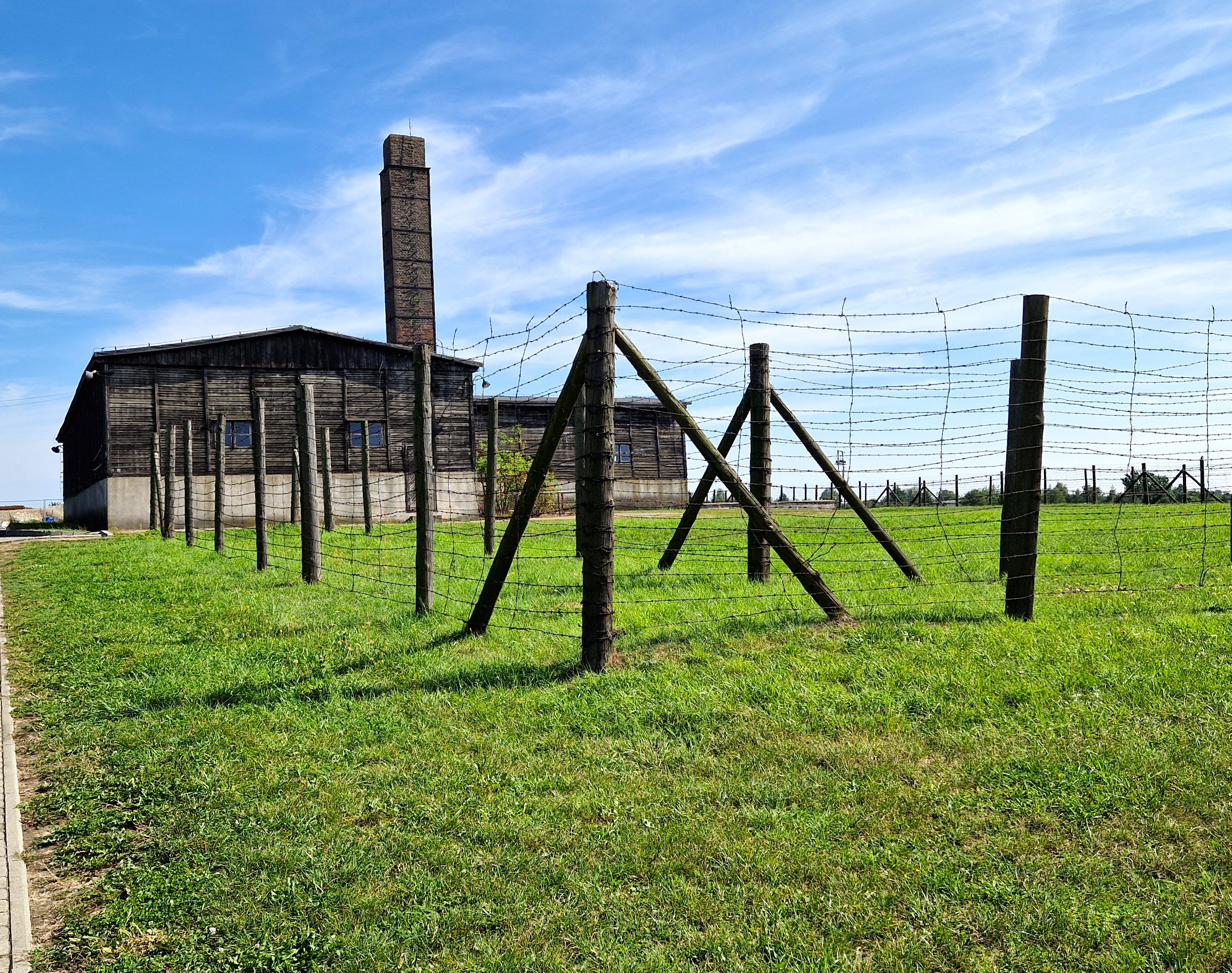
Fifteen senior Nazis gathered in Berlin on 20 January 1942, at a villa in Wannsee, to discuss the “Final Solution of the Jewish Question”. Some early post-war historiography presented the Wannsee Conference as the decision-point for the Holocaust, but in reality it was a coordination meeting about a decision already taken. While the structure and conduct of the Nazi regime is unimaginable without Adolf Hitler, the regime was not the orderly totalitarian system of popular imagination, and Wannsee was necessary to bring together its fragmented and overlapping power centres to implement a single policy. Examining the participants at Wannsee provides a window onto the structure of the Nazi regime, the process of perpetually escalating radicalism this structure sustained, and how the Holocaust decision was produced from these dynamics.
THE NATURE OF THE NAZI REGIME
The Third Reich was, above all else, a Führer cult: the premise of power in Nazi Germany was the Führerprinzip, that what the Leader wanted took precedence over all else, including written law and the bureaucratic procedure of formal State institutions. The Nazi system, however, never approached the kind of unitary, totalitarian rule seen in the Soviet Union. This was for three interlinked reasons.
First, where Communism imposed itself on Russia via a violent coup and apocalyptic destruction, giving Vladimir Lenin tabula rasa, the Nazi Revolution was democratic, and Hitler’s “charismatic authority” was grafted onto the sophisticated modern bureaucracy of the German State, creating an inherent duality in power from which further splits cascaded.1
Second, Hitler, unlike Lenin or Joseph Stalin, was a highly non-interventionist ruler, who had no interest in grand designs to “rationalise” the State structure and did not involve himself in disputes among underlings until the Darwinian wrangling had produced a clear winner. This was not just about Hitler’s personality—waking near midday, watching movies late into the night, being uninterested in complex detail, averse to dealing with paperwork, detesting chairing meetings—let alone a conscious divide-and-rule strategy. It was an inescapable and indispensable element of Hitler’s charismatic authority: the Führer post having been deified, Hitler needed to maintain the personal prestige, specifically the reputation of infallibility, to match it. He could not be lowering himself into grubby faction fights and he certainly could not be getting onto the losing side of one.2
Third, ideologically, the Nazis, unlike the Communists, were very sensitive to the charge their rule was lawless—and, in practice, Nazi Germany, even its army at the height of the savage war in the East, could be bizarrely legalistic.3 The crux was the interpretation of law. The Nazis despised strict adherence to detailed written law, but only because, apart from seeing it as a deadening rabbinic innovation, they saw it as a dangerous impediment to true law. That is to say the primordial law of nature, felt as a living essence in the blood and soul: ensuring the survival of the race and serving the Führer, the two things synonymous in the Nazi mind.4
The upshot was a system where power was both institutional-legal and personal, and the latter was always decisive. The fundamental fact of the landscape was the incomplete integration of Party and State, meaning the two retained separate and often competing interests. There were then factions within the Party and the growth of an autonomous SS-police complex as a subdivision of the “Nazi bloc” in the ruling coalition, while each of the State ministries had their own priorities. Added to that, the various regime entities had formally overlapping lines of authority and there were special Führer projects—the Four Year Plan is a classic case—that cut across Party-State lines and created yet further power-bases. It was a chaotic milieu of venomous rivalries where the only semblance of order was imposed by Hitler, or more precisely the image of Hitler, whose will these Party offices, State agencies, and hybrid institutions all claimed to be carrying out.5
As even senior ministers struggled to actually meet or communicate with Hitler, the handful of people who did—and those who controlled access to the Führer—became immensely powerful, effectively the barons at Hitler’s court. It was these baronial networks, especially as the war went on, with the growing institutional decay and collapse of any coherent policy-making process, that defined the power centres in the Reich.6 The day-to-day experience of most people in the Nazi regime was acting on their own initiative, in conformity with their own racialist beliefs and emphases, to realise the broad vision and goals Hitler embodied and propagated, such as “remove the Jews”. The combination of the fractured governmental landscape (“polycratic” is the technical term) and Hitler issuing only infrequent, “delphic” orders,7 fostered a mentality of “working towards the Führer”, where the networks and individuals within them continually fought for Hitler’s approval by trying to out-bid each other in providing the most extreme solutions, correctly judging these were the solutions Hitler wanted to the problems he had defined.8
The result was a restless dynamism wherein the most radical element of the “power cartel”, the Nazi bloc (the Party organisation proper and the SS), gained increasing influence, and its growing influence drove the system into ever greater extremism, locking in a cycle of cumulative radicalisation in regime behaviour.9 Wannsee was on the one hand a reflection of this trendline, and on the other a unique exception to the general pattern of Nazi governance, since its primary purpose—which succeeded—was to unite the entire regime coalition around one policy under the agreed leadership of one faction.
THE WANNSEE CONSPIRATORS
Those present at Wannsee were:
Reinhard Heydrich: Chief of the Reich Security Main Office (RSHA) and Deputy of the Protectorate of Bohemia and Moravia.
Dr. Gerhard Klopfer: Ministerial Director in the Party Chancellery.
Erich Neumann: State Secretary in the Office of the Four Year Plan.
Friedrich Wilhelm Kritzinger: Ministerial Director in the Reich Chancellery.
Heinrich Müller: Chief of the Gestapo.
Dr. Josef Bühler: State Secretary and Deputy Governor-General in the General Government.
Dr. Wilhelm Stuckart: State Secretary in the Interior Ministry.
Otto Hofmann: Chief of the SS Race and Settlement Main Office.
Martin Luther: Undersecretary of State in the Foreign Ministry and principal liaison with the Party and SS.
Dr. Alfred Meyer: State Secretary and Deputy Reich Minister in the Ministry for the Occupied Eastern Territories.
Dr. Roland Freisler: State Secretary in the Justice Ministry.
Dr. Georg Leibbrandt: Head of the Political Department in the Ministry for the Occupied Eastern Territories.
Dr. Karl Eberhard Schöngarth: Commander of the Security Police (SiPo) and the Security Service (SD) in the General Government.
Dr. Rudolf Lange: Commander of the SiPo and SD in Latvia.
Adolf Eichmann: Head of the Jewish Affairs and Evacuation Section of the RSHA.
Some of these participants were individually prestigious and/or powerful, most obviously Heydrich, one of the most senior SS officials, who had convened and chaired the Wannsee meeting. The purpose of the conference did not require the presence of top officials, though. Most of the invitees were second-level officials, deputies to Party barons or State Secretaries at the principal ministries, and Heydrich’s aim was to have them, as representatives of their institutions, assent to participation in implementing the Final Solution and accept their roles in it as directed by the SS. Wannsee was a coordination meeting to identify and resolve legal and administrative problems, particularly conflicting bureaucratic jurisdictions, which, bluntly, meant the representatives surrendering any prerogatives that would impede the SS’s program. As such, it makes most sense to examine the participants in the context of the five broad sectors of the Nazi regime represented at Wannsee.
THE SS-POLICE COMPLEX
The baron of the SS sector was Heinrich Himmler. The Wannsee Protocol bloodlessly records Heydrich, in his opening statement at the Conference, invoking Himmler’s authority as Reichsführer-SS with “lead responsibility for conducting the process of the Final Solution”. It gives little sense of the burning ideological commitment that propelled Himmler to that point, or the scale of his demonic achievement in knitting together a bureaucratic empire—containing the Nazis’ ideological vanguard, the race policy administrators, police, intelligence services, kommissars of the occupied territories, and concentration camps—that was already putting the other regime sectors in its shadow and made Himmler effectively the third man in the Third Reich.
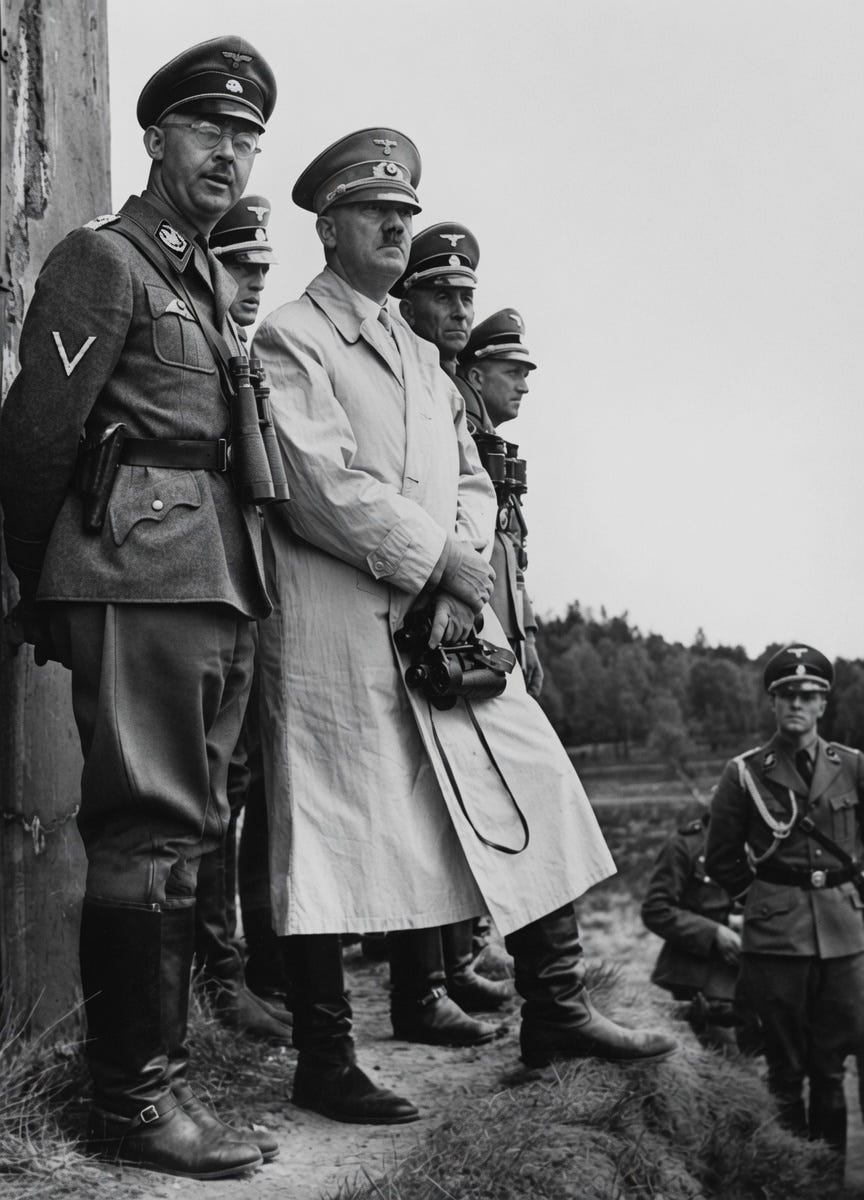
Himmler, a member of the National Socialist German Workers’ Party (NSDAP) since its re-founding in 1925, was an intellectual and impatient revolutionary. Himmler was determined to “re-awaken” Germans to the worldview of their pagan ancestors, where humans understood they were separate races in an eternal struggle and the strong unsentimentally trampled down the weak.10 To get there, to secure a thousand-year Reich, a Nordic racial elite, such as the Romans had (in the Nazi imagination), would have to be forged to guide the restoration of “the Germanic familial order” in a reordered Europe,11 and the greatest obstacle to this new world, Christianity, would have to be torn up by the roots,12 meaning the Jews who had incubated one Saint Paul—with his “Bolshevik” doctrine that laid the Roman Empire low by inciting racially inferior masses to rebel against their natural masters—would have to be destroyed, lest they produce another.13
Himmler’s January 1929 appointment as head of the Schutzstaffel (SS, “Protection Squad”), the personal bodyguard for the leader of a fringe (if growing) political party, hardly seemed the ideal starting point for turning his dreamworld into a reality. But Himmler trusted in history—and the German people—to deliver power to the Nazis, and he was an exceptional player in the bureaucratic-political game. Industrious, meticulous, and ruthless, Himmler combined ideological utopianism with a cold understanding of power politics, above all the need for unfailing loyalty to Hitler, whose favour time and again removed obstacles in Himmler’s way.14 It was this personality and political skill that enabled Himmler to transform control of a squad of 280 bouncers into the first step on the road to, within a decade, embedding his ideological mission in the most powerful European State and taking into his hands an apparatus of terror that would impose it on nearly the whole Continent.15
Himmler began by remaking the SS internally into a disciplined Nazi intellectual elite, the nucleus of his new racial aristocracy. Fostering an elitist ethos was abetted by defining the SS against the Party militia, the Stormtroopers (Sturmabteilung or SA), to which the SS was officially subordinate. The SA was a chaotic mass movement, having 60,000 members at the end of 1929,16 focused on spectacle and “action” (political street fighting), and its internal culture was marked by proletarianism and populism,17 especially after coming under the leadership of Ernst Röhm, from the socialist wing of the Party, in November 1930.18 The educated idealists drawn to the Nazi Movement as Hitler’s political fortunes rose in 1929-30—university professors, scientists, doctors, civil servants, military professionals, and elements of the lower nobility—were attracted to the SS, where Himmler made racialism a matter of academic seminars and scientific inquiry, casting the violence inherent to Nazism as reasonable and defensive in a world of racial “struggle”. Wannsee was in effect one of these seminars, heavy in SS discourse defining “Jew” and framed around the necessity of “struggle … against this opponent” to protect the German people.
Back in 1931, with Röhm constraining the SS to 10% the size of the SA and the seizure of power (Machtergreifung) two years away, Himmler organising a “Final Solution of the Jewish Question” seemed a remote possibility, but he was already laying the foundations. That year, what became the SS Race and Settlement Main Office (RuSHA) was established, simultaneous with Himmler’s Marriage Order. Initially a genealogical race vetting mechanism for SS recruits—guiding the selective breeding of this prospective elite of the German volk—the RuSHA got seriously involved in settlement, i.e., Germanising conquered zones, in Austria in 1938.19 At Wannsee, RuSHA chief Otto Hofmann reinforced the ideological framework of the meeting and promised to press the point on unconquered countries like Hungary by sending racial “orientation” officials to prepare the ground for the Final Solution. By then, the RuSHA had already coordinated with other elements of the SS to design the racial screening programs underpinning the expulsions and colonisation of Poland,20 and contributed to the General Plan East (Generalplan Ost), the Nazi blueprint for restructuring Eastern Europe after the Soviet Revolution and the Jews were gone, which entailed destroying tens of millions of Slavs.21
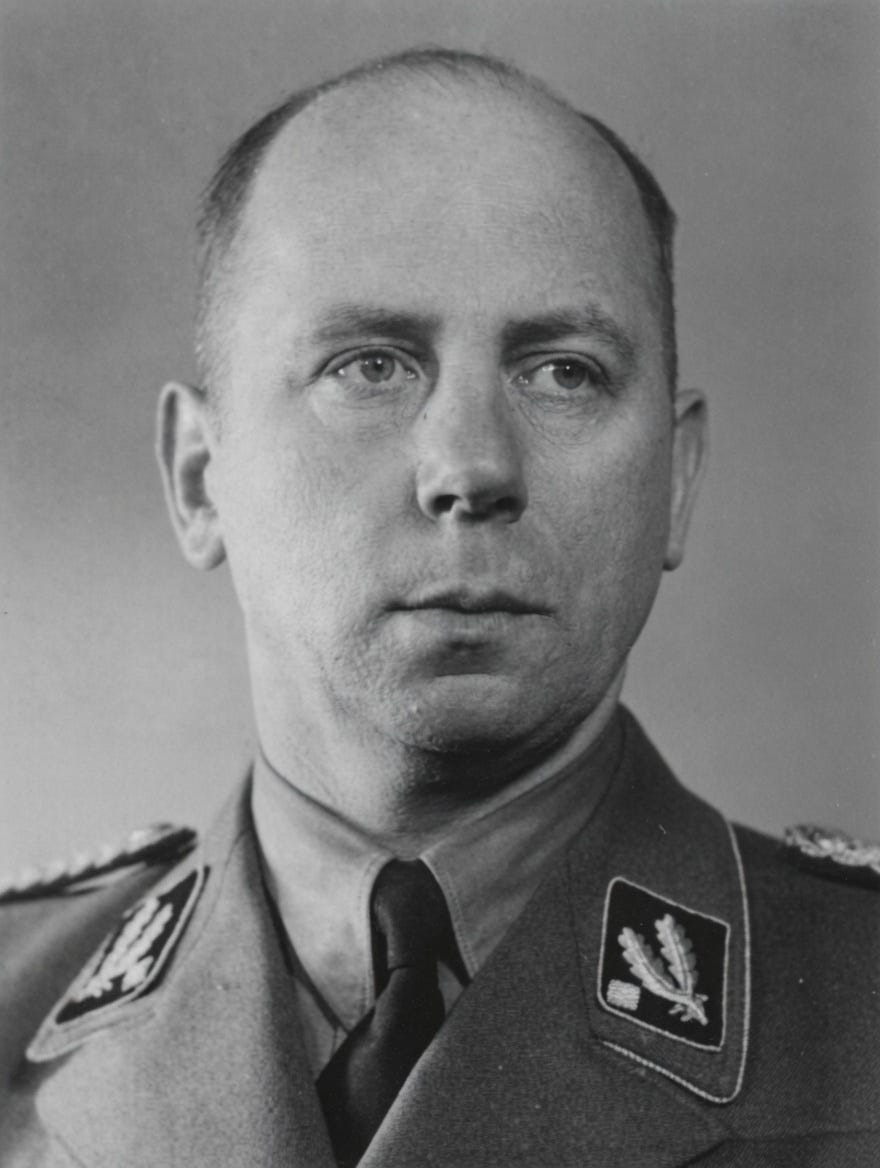
Also in 1931, Himmler created an SS intelligence service, the Security Service (Sicherheitsdienst or SD), appointing as leader a recently-cashiered Naval intelligence officer, Reinhard Heydrich, a protégé, ideologically and administratively, obsessed with the purity of German blood and so hostile to Christianity that in 1941 he would even oppose “hearts and minds” propaganda showing the invading Germans re-opening churches closed by the militant godless in the Soviet Union.22 In the summer of 1932, in an important harbinger of what was coming, the SS outmanoeuvred its rivals to secure for the SD monopoly powers over Party intelligence activities—internal security, intelligence, and surveillance.
After the Machtergreifung in January 1933, Hitler moved rapidly to refashion Germany as a centralised Führer State by Nazifying or eliminating every public and private institution (the process known as Gleichschaltung, lit. “Coordination”). Dismantling Germany’s federal structure (Länder) was an immediate necessity, and key to that was gaining control of the police. It was by no means obvious that Himmler, merely head of the Criminal Police (Kriminalpolizei or Kripo) in the single city of Munich as of 9 March 1933, would be the man to do it. But within days, Himmler was on the move, assuming command of the Bavarian political police, which was swiftly SS-ified and used to sideline the Kripo in the rest of Bavaria by the end of the month, giving Himmler free rein to repress anti-Nazi forces in the State.
March 1933 was also the fateful moment when Himmler was vested with authority over the Weimar-era “protective custody” (Schutzhaft) system, which was used as legal cover for his capacity to arbitrarily imprison and administer the Nazi concentration camps, the first opened in Dachau in Upper Bavaria on 22 March 1933,23 by which time the murders in SS custody had already begun.24 Himmler spent the next year capturing the State political police forces seriatim and increasingly synchronised them, laying the foundations of a centralised national police force such as Germany had never had. Most momentously to this end, Prussia, containing two-thirds of Germany’s 65 million people, transferred its political police, the Secret State Police (Die Geheime Staatspolizei or Gestapo), to Himmler in April 1934.25
The SS had vastly expanded,26 and Himmler freed himself from SA oversight by proving his loyalty once and for all to Hitler on the Night of the Long Knives, providing the muscle to eliminate Röhm and neutralise the SA.27 The SS was declared an independent organisation answering to Hitler alone, and the SD was made the sole Party intelligence service, its rivals absorbed or dissolved. Himmler, now supreme over Party security and entrenched in the State police, was able to significantly shift policing in practice to preventive repression of political dissent, especially the Jewish “wire-pullers”, and policing in concept towards protecting the “Aryan” race from biological defects.28 But Himmler’s vision of the Party subsuming the State was now impeded by the police remaining part of the Interior Ministry.
Interior Minister Wilhelm Frick, an ardent Nazi but a lawyer and career civil servant, envisioned a system not of State over Party, exactly, but an integration of the two where the institutional scaffolding of the State was reinforced and the Party exercised power through the State, rather than alongside it or above it.29 Frick held his ground for two years before he was defeated in the way so many others would be in the Nazi regime: Hitler bestowing personal favour on one of his underlings. In June 1936, Himmler was made “Chief of the German Police in the Reich Ministry of the Interior”, i.e., de jure still under Frick, controlling a unified national Security Police (Sicherheitspolizei or SiPo)—containing the Kripo and political police—which nominally remained a State institution. However, Himmler had de facto detached the police from the Interior Ministry and merged the police into the SS.
From now on, Himmler was at baronial level, answering solely and directly to the Führer. There were some efforts to demarcate the State-Party division in Himmler’s empire, notably between the Gestapo—a name now applied to the entirety of the State political police—and the Party’s intelligence service, Heydrich’s SD. They failed. For example, Heydrich set up an SD Jewish department in 1937 run by a coterie of young intellectuals, among them Adolf Eichmann, to develop a comprehensive Jewish policy, but the department soon became involved in persecution, a Gestapo function.30 Heydrich’s role at Wannsee, acting at Himmler’s behest and with Eichmann at his side, was an extension of the process that centralised Jewish policy in Heydrich’s office through the 1930s.
The announcement of the RSHA (Reichssicherheitshauptamt) in late September 1939, formally bringing the SiPo and SD under one roof, exemplified another feature of the Nazi system: the awarding of formal titles after Hitler’s personal favour had already created a power centre in practice. (In August 1943, the bureaucratic tangle was fully resolved by Himmler overtly supplanting Frick as Interior Minister.31) In accordance with the Führerprinzip that ran through the regime, Himmler set the “visionary” guidelines for the RSHA, while Heydrich, whose rise and protection within the Nazi system relied significantly on his personal relationship with Himmler, was its operational leader, albeit Himmler—like Hitler—intervened in the details when he wished.32 Similarly, Heinrich Müller, a professional policeman with an anti-Nazi record before the Machtergreifung, was appointed Chief of the Gestapo upon the RSHA’s foundation because he had Heydrich’s patronage.
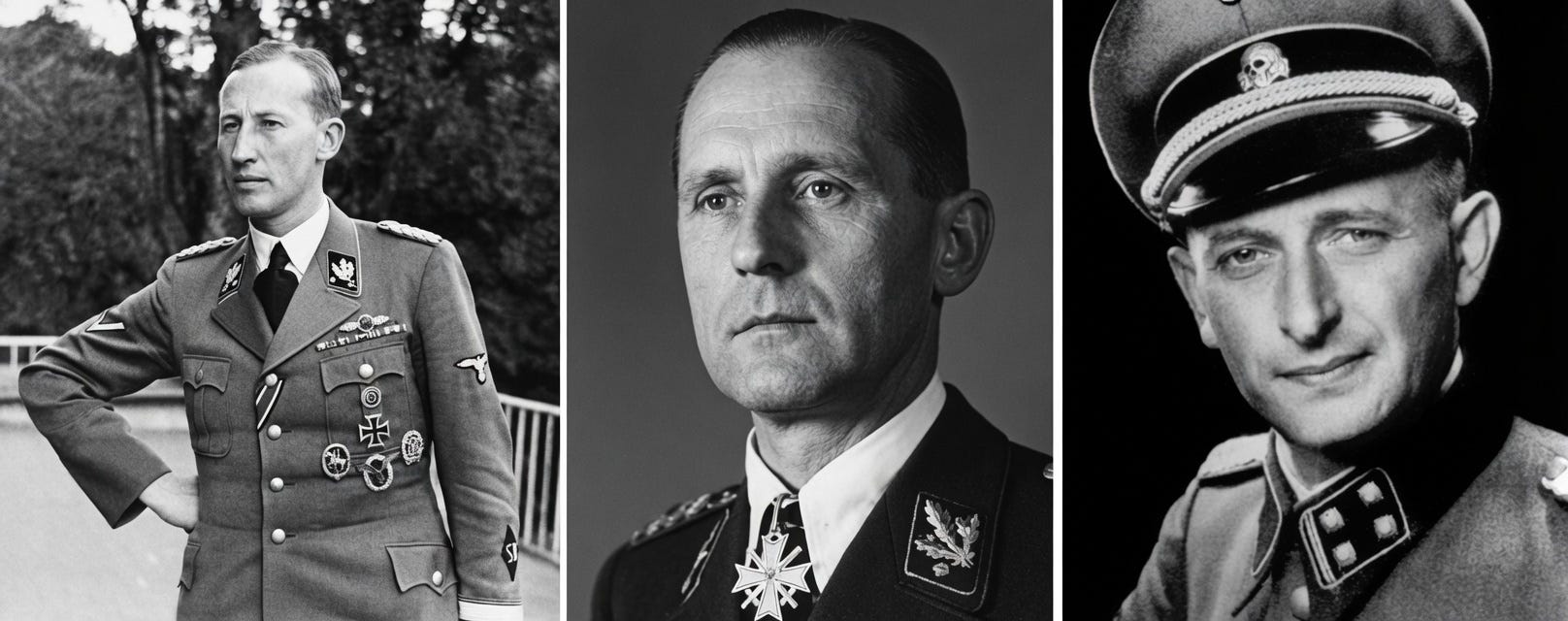
There was nobody else who would have, and probably nobody else who could have, “brought together the police, the camp system, racial selection, settlement policy, [and] forced-labour programmes” in the way Himmler did, as Peter Longerich writes. Himmler’s ideology gave him the ambition to accumulate so many powers and provided the controlling principle to organise them into a coherent bureaucratic empire that restlessly pursued Nazi goals.33 The war in the East brought Himmler new power and prestige—it was his SS officers like Karl Schöngarth and Rudolf Lange who dominated in the occupied territories—and all it did was inspire him to press for more, sensing that the Nazi Utopia was within reach.34
To us, the Wannsee Conference represents the culminating horror of the Nazi regime, the systematisation of the program to destroy the Jewish people. For Himmler, however, it was conceived of as merely the beginning. Himmler’s dream of a Europe reordered as a Greater Germanic Reich necessitated the extermination of many other peoples, and seizing the opportunity opened up in the East required more power than the SS had at Wannsee to direct other regime sectors.35 In the event, the SS-police complex would continue to be empowered. SS control of slave labour, for instance, at the factories and elsewhere, became a lever for gaining influence over the economy. Albert Speer’s “armaments miracle” in 1944 relied directly on SS terror.36 Through the war economy, the SS spread into the connected policy areas, i.e., nearly of them, and Himmler steadily reaped official duties from others.37 But even as Reichsführer-SS’s power grew, his dream was being consumed in fire and ruin.
THE PARTY
A case in point of the ambiguities of status in Nazi Germany is Gerhard Klopfer, who was a member of the SS (an Oberführer) yet represented the Party—a rival power centre to Himmler’s, however often they ideologically agreed—and who was personally in no sense a top-tier figure, but who represented Martin Bormann, the most shadowy of the barons.
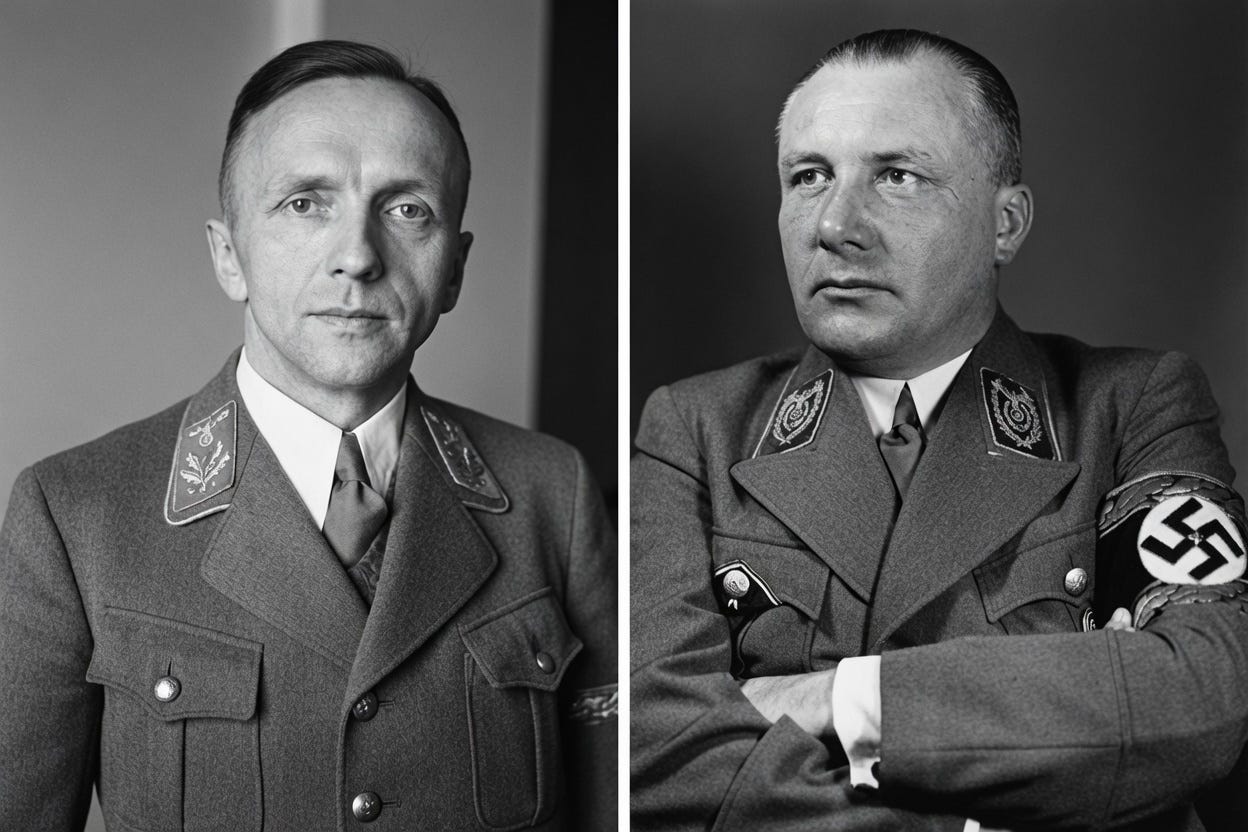
Bormann’s involvement in violent antisemitic politics went back to 1919, and he briefly joined the SA in 1925, before joining the NSDAP in 1927 and transitioning from a street fighter to a bureaucratic warrior.38 Serving at first in propaganda and finance roles, Bormann became chief of staff to Deputy Führer Rudolf Hess a few months after the Machtergreifung. Getting involved in as much of the business of Hess’s office as he could, mediating Party factionalism and Party-State issues, and using the Party apparatus to drive escalating cycles of antisemitic “action”,39 Bormann was soon in Hitler’s orbit, becoming a regular at the Führer’s dining table,40 in many ways the centre of gravity in Nazi policy-making. Bormann, immensely loyal and capable, became an all-purpose fixer for Hitler, and had a status far beyond his official rank by 1935 when he started handling the Führer’s personal finances,41 and organised the construction of Hitler’s Berghof residence on the Obersalzberg. Bormann built a home for himself within the same compound in the Bavarian Alps, a physical manifestation of his proximity to power.42
In 1938, Bormann ceased to be a “guest” at Hitler’s table: he now “belonged to the inner group of courtiers”,43 and those present recognised “Bormann’s dominant position in the Court”.44 When Hess flew to Britain in May 1941, Hitler immediately abolished Hess’s post, renamed his office the Party Chancellery, and put Bormann in charge of it. Thereafter, Bormann swiftly acquired more power than Hess ever had.45 The Party Chancellery gave Bormann institutional power, overseeing the NSDAP—by then one of the two most dominant elements of the regime—and specifically directing the Party regional offices with their SS-provided apparatuses of surveillance and repression. But it was the simultaneous appointment as Secretary of the Führer, a position formalised in April 1943, which truly distinguished Bormann.
Bormann spent more time with Hitler than anybody else after 1941. A near-constant presence at the Führer’s side, including in the bunker at the last, Bormann gained Hitler’s trust in a way few others did,46 while controlling the flow of paper information and in-person access of others to Hitler, ensuring the Führer rarely heard views Bormann opposed.47 Since Hitler did not operate a decision-making process in any conventional sense, but had a “tendency to seize impulsively upon random strands of information or half-baked judgements from cronies and court favourites” that were then issued as Führer Orders,48 Bormann had the opportunity to exert enormous sway over policy, such as it was. And Bormann took the opportunity to invariably advocate the most extreme course to Hitler, often exceeding the suggestions of the Party radicals that dominated the regime at the local level.49
Bormann’s concentration of power allowed him to uncompromisingly enforce his version of Nazi orthodoxy through the Party apparatus. Fear of incurring Bormann’s disapproval for insufficient radicalism spread throughout the bureaucracy and afflicted even a figure so close to Hitler as Propaganda Minister Joseph Goebbels.50 Right down to the end, Bormann was devising anti-Jewish measures,51 and trying to eradicate Christianity.52 Bormann was certainly ultimately working towards the Führer with this latter fixation,53 though there was a tactical ambiguity. Hitler initially favoured having “the showdown” with Christianity after the war,54 but as the war went on Hitler moved closer to Bormann’s position, increasingly blaming Christian morality for Germany’s declining fortunes and seeing even short-term accommodation as dangerous.55
Bormann’s relentless persecution of the churches was a source of common ground with Himmler,56 and in general the two, being from the same ultra-radical wing of the Party, saw eye to eye.57 This was crucially true in the conquered zones, which were under Party jurisdiction and practical SS control. Bormann fought all efforts for a more “moderate”—and militarily sensible—policy towards populations in the East, backing Himmler’s insistence on sticking to the letter of Nazi ideology in dealing with “subhumans” (Untermenschen), and providing the SS with logistical and administrative muscle in places to enable the campaign of enslavement and extermination.58 Klopfer, therefore, attended Wannsee as active supporter of Heydrich’s.
THE FOUR YEAR PLAN
Erich Neumann was similar to Klopfer in not having much personal prestige, but he represented Hermann Göring, an individual for whom the word “baron” might have been invented, the avaricious and flamboyant designated successor to Hitler. This status was instantiated in a law of 30 August 1939 that also made Göring head of the six-man Ministerial Council for the Defence of the Reich (MCDR).59 When the war began days later, “Hitler basically ceased to be Reich Chancellor”: Nazi interaction with the State apparatus was largely delegated to the MCDR, and Hitler became physically distant from the Reich government, regularly leaving Berlin and permanently departing in 1941.60 Göring, President of the Reichstag from before the Machtergreifung and Minister-President of the all-important State of Prussia from soon afterwards, was made head of the Air Force (Luftwaffe) in 1935 and would become Reichsmarschall, the highest-ranking military officer, in July 1940.
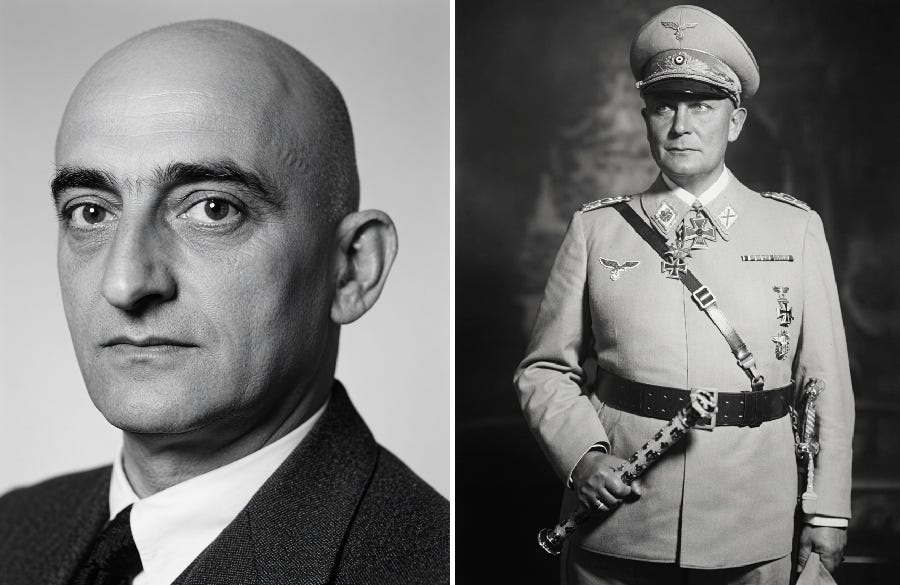
Unsurprisingly, these formal positions derived from Göring’s personal relationship with Hitler, which went beyond the usual brotherhood of the Front Generation. Göring, often remembered justifiably as a ludicrous figure, bulging out of an all-white suit and surrounded by stolen art, had not always been so. When Göring joined the Nazi Party in 1922, he was the most famous living flying ace of the Great War, having led “the Flying Circus” after the death of “the Red Baron” Manfred von Richthofen. Göring’s membership single-handedly elevated the NSDAP’s national visibility and credibility. In 1923, after bringing some discipline to the Stormtroopers,61 Göring was a (wounded) participant in the Beer Hall Putsch, an accolade among the Nazis to rank alongside fighting in the First World War. Göring held to the NSDAP when the cause seemed hopeless in the wilderness years, then helped guide the Nazi Machtergreifung, founded the Gestapo, and was a pivotal actor on the Night of the Long Knives. The bond held to the end—Hitler would not formally dismiss Göring from anything and sentimentally insisted on his “indispensable” leadership, despite his manifest incompetence—and, indeed, it held beyond the end. At Nuremberg, Göring refused to utter a word of criticism against the Führer and as far as possible he prevented others doing so.62
It was against this background Göring was appointed Plenipotentiary for the Four Year Plan by Hitler in August-September 1936, tasked with accelerating rearmament and autarky. That this was to prepare for aggressive war by 1940 was the most open of secrets and the German public reacted with rapturous enthusiasm.63 It is at this moment in 1936 when the Marxist idea of the Nazi regime serving the interests of “big business” becomes untenably absurd: the “primacy of politics” was asserted, State planning prevailed, and the autonomy of the “economic establishment” as an influence on policy was sharply curtailed and ultimately terminated. The creation of the Four Year Plan complex was in essence Gleichschaltung for industry, erasing another line between State and society by bringing vital corporations into conformity with the ideological-strategic vision of National Socialism.64
Göring’s Four Year Plan Office (Vierjahresplanbehörde) spread its tendrils through the State, annexing vast swathes. Economics Minister Hjalmar Schacht—one of three men acquitted at Nuremberg—had been a powerful figure steering the Nazi economy in line with international financial markets, and he was now removed. Göring briefly headed the Economics Ministry himself, before formally handing it over to the journalist Walther Funk, while Göring—following Hitler’s example and foreshadowing his own fate—ran the Ministry through favourites among Funk’s subordinates. Similarly, Göring colonised the Agriculture, Labour, and Transport Ministries from the inside out by recruiting the State Secretaries to the Four Year Plan Office. In the private sector, the pattern repeated, most prominently with Carl Krauch, a board member at the chemical giant I.G. Farben, who provided “informal” employees to Göring’s empire: their expertise and efficiency assisted Göring and Krauch’s association with Göring made him the strongman of the company.65
Göring’s operational deputy at the Four Year Plan Office was Paul Körner and Neumann was Körner’s deputy from mid-1938. Hitler, obviously, did not wait four years to begin the war, but the Office, name and all, remained as the coordinating authority for the war economy—and, as the war was the primary “policy” Hitler took an interest in, this was a very powerful institution. By the time of Wannsee, however, Göring’s prestige was seriously slipping. Hitler had been reasonably forgiving when Göring’s extravagant promises for his Luftwaffe’s offensive and defensive capabilities were falsified against Britain in late 1940. But a line was drawn when Göring overpromised and underdelivered again in late 1941 for Operation BARBAROSSA.66
Göring’s diminished status with Hitler crippled him in the unfolding power-struggle as Himmler capitalised on the SS’s new military and economic functions in the occupied East to encroach on Göring’s territory. Göring recognised the centrality of controlling slave labour to his position, both as an indicator of his standing against Himmler, and as the mechanism for recovering favour with Hitler by using it to increase military-industrial output and construct the wonder weapons Hitler placed his hopes in until nearly the end.67 Neumann’s primary intervention at Wannsee reflected Göring’s resistance in this area. Neumann insisted that Jews “presently employed in … war-essential enterprises” could not be “evacuated”—the Wannsee euphemism for annihilation—“so long as no replacement labour was available”. Heydrich granted the exemption, but it did little to alter the trajectory of events.
By the spring of 1942, the Göring-led MCDR had been sidelined, many of its responsibilities syphoned off by Bormann, and Albert Speer, another permanent fixture at Hitler’s dining table, had been appointed Armaments Minister.68 Speer was ostensibly within the Four Year Plan network under Göring’s authority, but the shift in Hitler’s favour precipitately reduced Göring’s war economy prerogatives immediately, and most of the rest drained away over the next eighteen months.69 Göring was never completely disempowered—and officially, as mentioned, not at all—but there was a steady downward spiral. Hitler’s disfavour incentivised factional attacks, and Göring increasingly spent his time fending off these attacks, which prevented him accomplishing the tasks that would restore Hitler’s favour. Demoralised by this, and by realising relatively early the cause was lost, Göring retreated into self-indulgence and reminiscences with his remaining loyalists.70
THE STATE
Friedrich Kritzinger represented the Chief of the Reich Chancellery, Hans Lammers, at Wannsee.71 Lammers was different to the other barons because his proximity to Hitler was more a consequence than a cause of his institutional weight, and his scope for independent action and dispensing patronage was far more restricted.
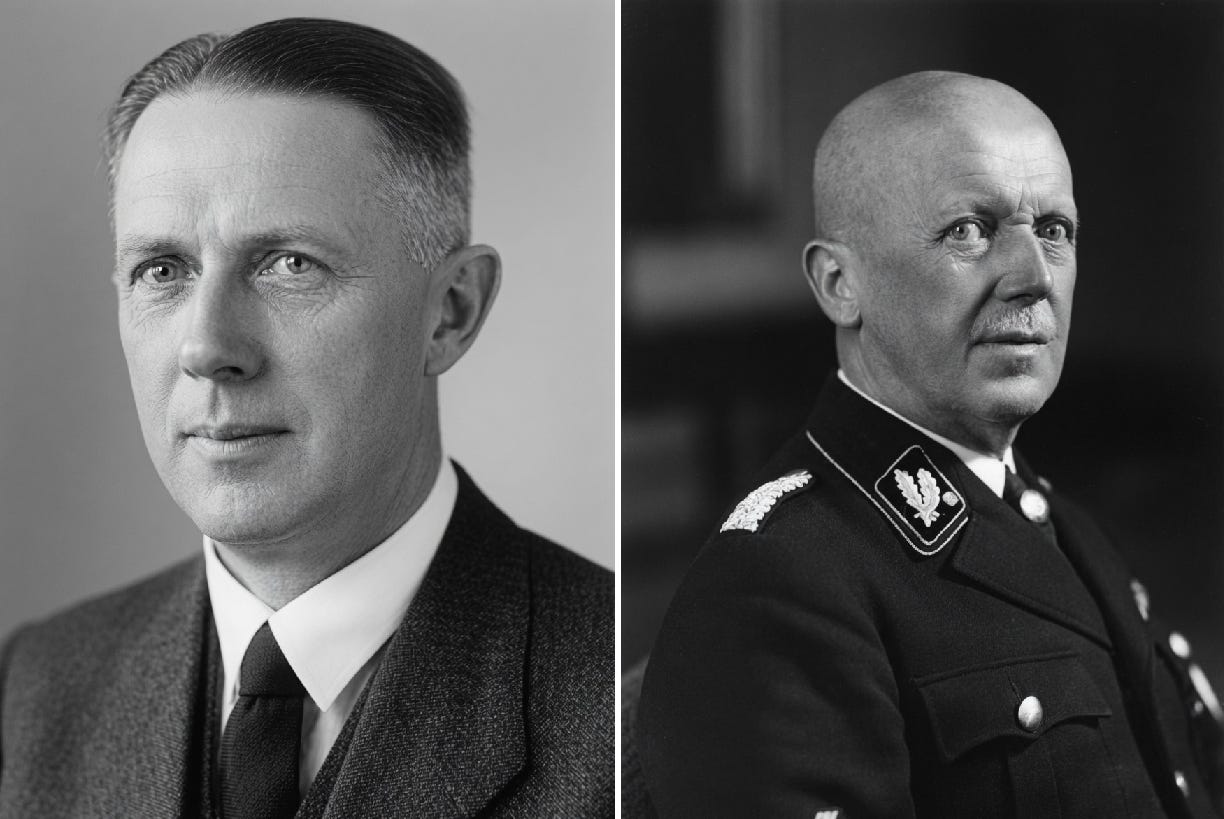
The Reich Chancellery was the central administrative office of the German State, coordinating the work of the ministries, and handling communication between the ministries and Hitler. Lammers’ power at its height should not be underestimated. Sitting at the nexus of the pre-existing civilian State bureaucracy and the Führer, and acting as the bridge between the two, Lammers enjoyed unusually frequent access to Hitler, regulated the access of others, and was instrumental in the most high-functioning State in Europe serving Nazi goals. Without the capacity of the German State, and its ingrained ethos of apolitical State service as an end in itself,72 the Holocaust could not have taken place on the scale it did in so short a time. That being said, Lammers’ role was procedural, facilitating and administering for others, thus it was always narrower and more passive than the bureaucratic entrepreneurialism of the other barons. Lammers’ levers were managing the flow of business to Hitler, a margin for interpretation in translating Hitler’s will into policy, enabling or obstructing the implementation of administrative decisions, and influencing appointments in the Reich Chancellery. And over time, Lammers would lose even these.
Lammers came from within the civil service—he was a lawyer in the Interior Ministry in the interwar years—but he also had the prestige of being a veteran of the Great War (he lost his left eye on the Western Front) and joining the NSDAP (just about) before the Machtergreifung.73 Lammers was recommended to head the Reich Chancellery by Interior Minister Frick, and served in the post from the first day to the last of the Third Reich.74 Lammers’ promotion to Reichsminister in November 1937 symbolised his overtaking of Frick, whose authority had been radically diminished a year earlier when Himmler removed the police from his ministry.
As of 1938, Lammers was in a category with maybe half-a-dozen others in terms of his power, but by January 1942 this had changed. The Party was overshadowing the State: the SS had made inroads in many of the ministries Lammers coordinated and there was no individual from whom Bormann would usurp more power than Lammers. Lammers understood that Bormann’s rise—intentionally on Bormann’s part—would render him “superfluous”,75 a dynamic visible by the time of Wannsee, well-advanced by mid-1943 when Bormann formally became Hitler’s private secretary (as usual, the title following the practicality of the Führer’s favour), and completed by mid-1944. By then, Lammers’ office was “little more than a postbox and distribution agency for orders laid down by Bormann”.76
Still, at Wannsee, Lammers remained around the top tier, the primary conduit of Hitler’s orders—almost invariably given verbally—to the civilian government,77 and Kritzinger sat at the table as primus inter pares among the ministry representatives. Kritzinger later said he thought the “Jewish policy” set at Wannsee was shameful; he gave no contemporary indication of this view.78
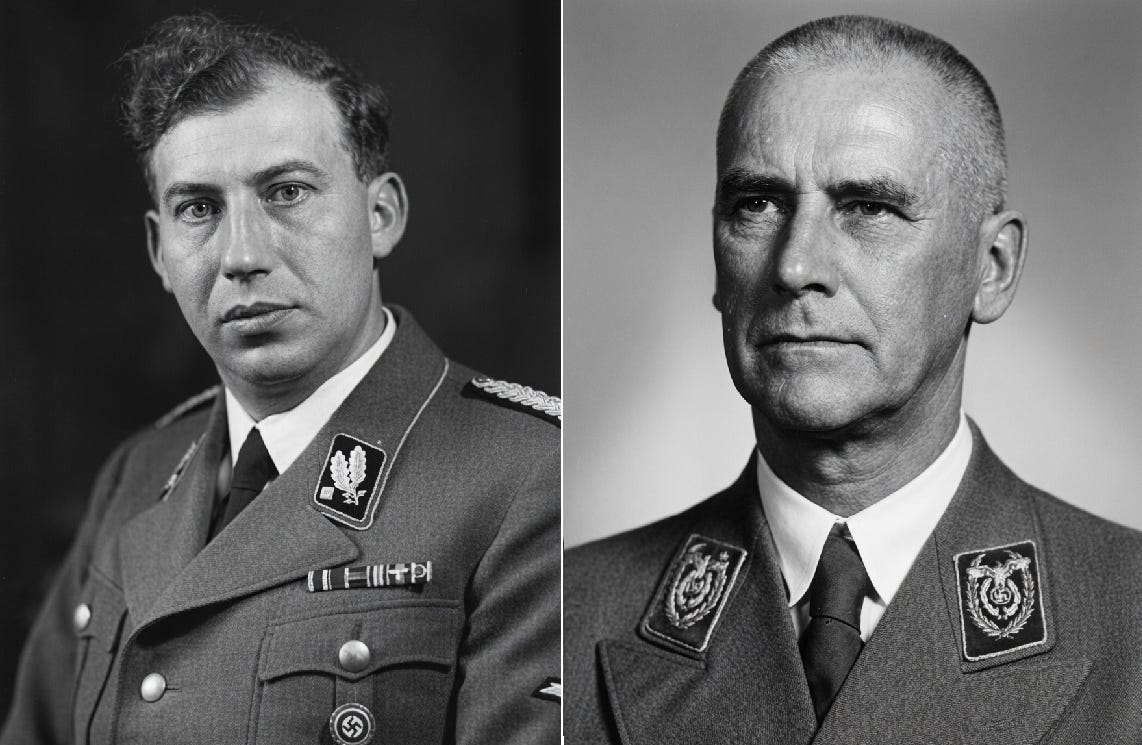
Dr. Wilhelm Stuckart, a lawyer at the Interior Ministry, represented Interior Minister Wilhelm Frick at Wannsee. Frick, a member of the Front Generation imprisoned after the Munich Putsch, was key to the Nazi consolidation of power, one of the principal architects of the legislation that dismantled the Weimar Constitution and, his own misgivings notwithstanding, the lead administrator in superimposing the Party upon the State.79 Though Frick’s ministry lost power to Himmler’s SS after 1936, it did not become irrelevant. As already mentioned, the Nazis—individually and collectively—were genuinely concerned to act legally. This gave Stuckart, not only as the embodiment of his ministry but having the personal prestige of co-authoring of the foundational 1935 Nuremberg Race Laws,80 something of a special role at Wannsee: his approval tacitly reassured the other participants that genocide was legitimate within the Nazi legal order.
It is, therefore, strange that Stuckart is sometimes presented as a dissenter at Wannsee. The basis of this is the Protocol recording Stuckart’s objections during a key section of the discussion, over what to do about “mixed” (Jewish and “Aryan”) marriages, and their Mischling (“hybrid”) offspring, a category Stuckart led in creating.81 What the Protocol actually says, though, is that Stuckart was concerned about the “practical implications” for the bureaucracy, specifically the “endless … administrative work” if the “Mischling” were to be assessed for “evacuation” according to Heydrich’s exemptions, which included some subjective considerations like “racial appearance”. Stuckart raised no objection to the principle of murdering “Mischling”—and no objection whatever to murdering “full Jews”. Stuckart merely “proposed proceeding to compulsory sterilisation” as a blanket measure for part-Jews, thus simplifying the administration and annihilating all of their bloodlines within a generation.
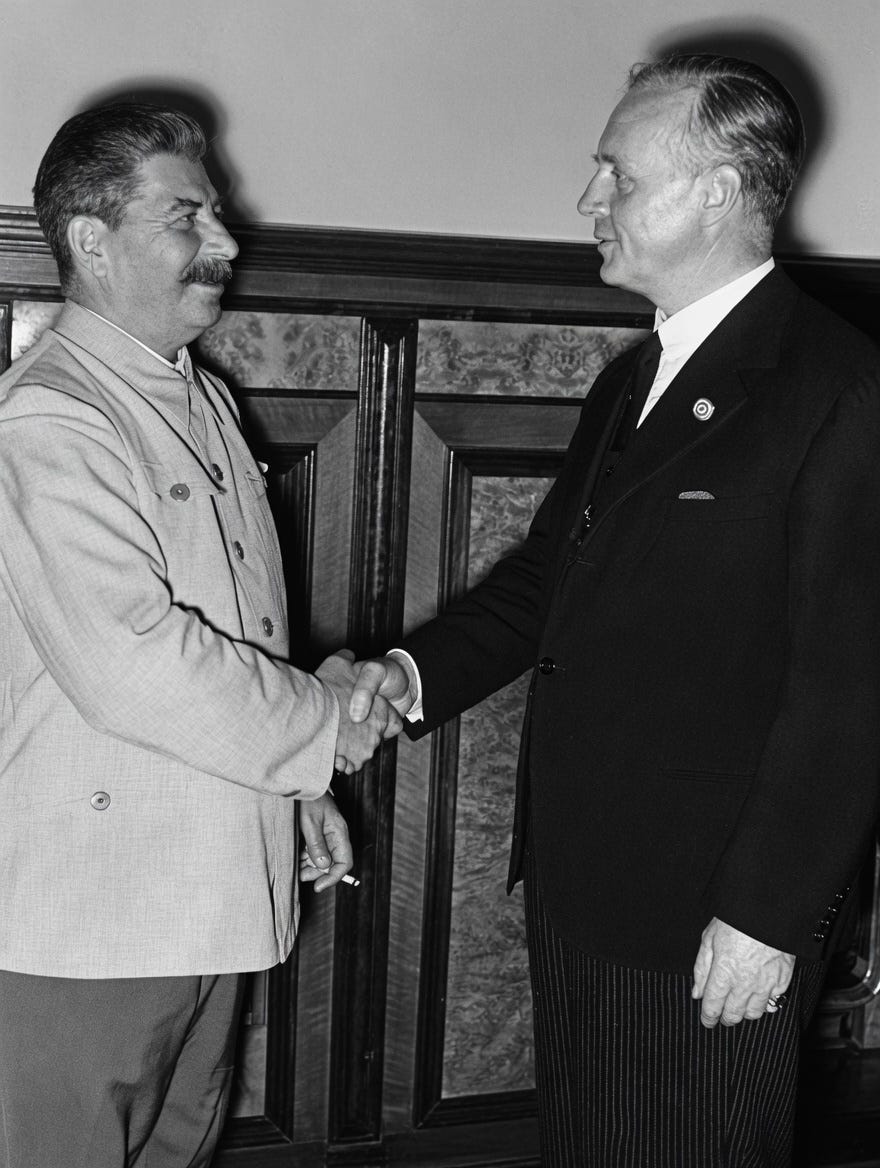
Martin Luther represented the Foreign Ministry of Joachim von Ribbentrop, a former star player within the regime and its international face, who was by the time of Wannsee a victim of his own success. Ribbentrop had steered the Nazi State into war, right up to personally signing the Pact with the Soviets in 1939 that ignited it. But war diminished the need for diplomacy, and the Foreign Ministry lost a lot of ground to the SS. Wannsee was an example of that, with the Foreign Ministry being given a task within an SS operation, namely to coordinate the cooperation of other States under varying degrees of German influence—Scandinavia, the Low Countries, Vichy France, Croatia, Slovakia, Romania, Hungary, and Bulgaria—in the Final Solution. It was an important task in enabling the Holocaust, and it makes nonsense of the Foreign Ministry’s post-war claims of institutional innocence. Luther’s actual input at Wannsee, though, amounted to voicing a prudential concern, namely that the pace of the Final Solution be tailored to local levels of antisemitism. Ribbentrop’s once mighty ministry counted for less than the administrators of the conquered zones where the killing took place.
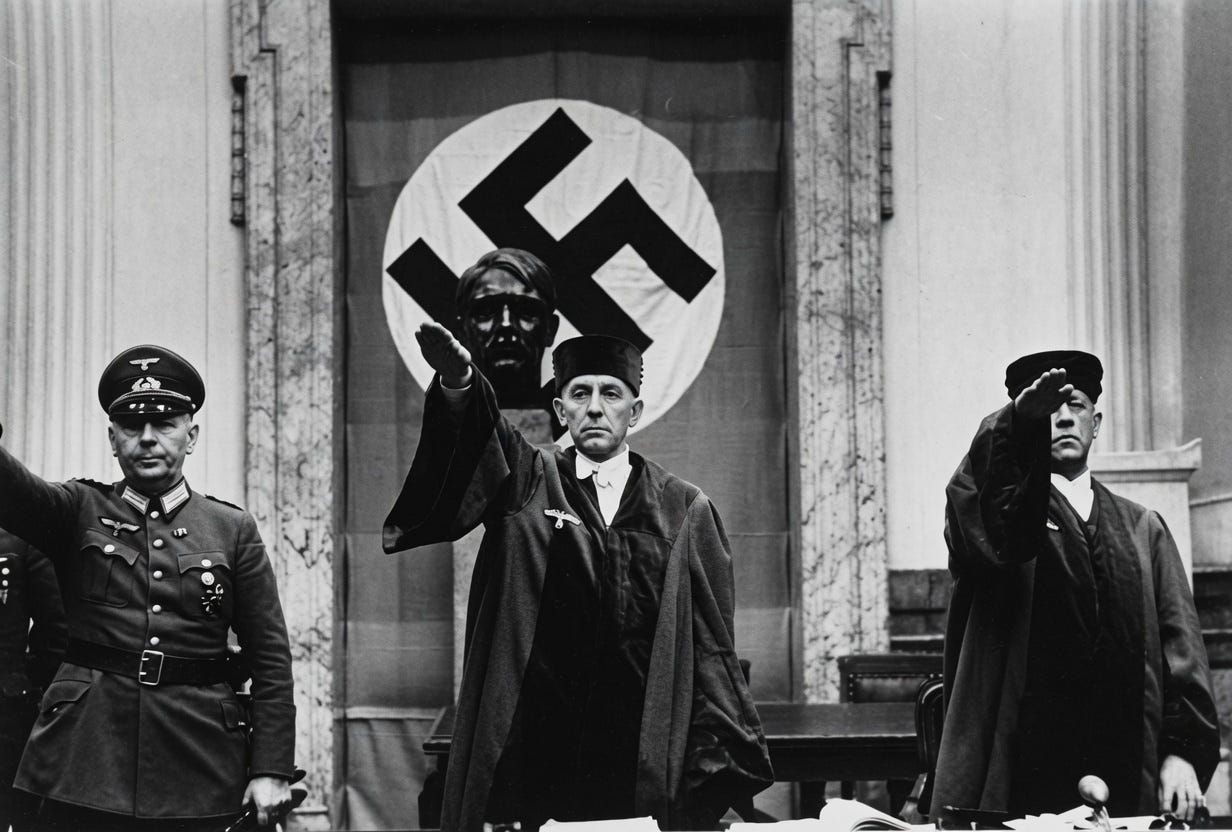
Roland Freisler was one of the best-known legal theorists of the Third Reich (and went on to infamy as head the People’s Court82). The Justice Minister that Freisler represented at Wannsee, Dr. Franz Schlegelberger, by contrast, was not a long-standing Nazi revolutionary, but a highly distinguished academic and practicing jurist of the old world, who only joined the Nazi Party in 1938 and had been in his job merely a year (technically as acting Minister). The Justice Ministry was responsible for applying the racial laws devised by the Interior Ministry, meaning at Wannsee there was a certain overlap of institutional interests between Freisler and Stuckart, notably on the implications of the Final Solution for “mixed” marriages. But, in contrast to Stuckart, Freisler was a passive participant at Wannsee. This was less to do with the Justice Ministry being much less powerful than even the emasculated Interior Ministry, or Freisler lacking the personal prestige of Stuckart, and more to do with Freisler being a Party radical whose eagerness to assist the SS extermination program outweighed any concern for bureaucratic turf or administrative difficulties.
OCCUPATION ADMINISTRATIONS
The final category of officials present at Wannsee were those administering the conquered areas in the East where the killing had begun and the Final Solution under discussion would be implemented.
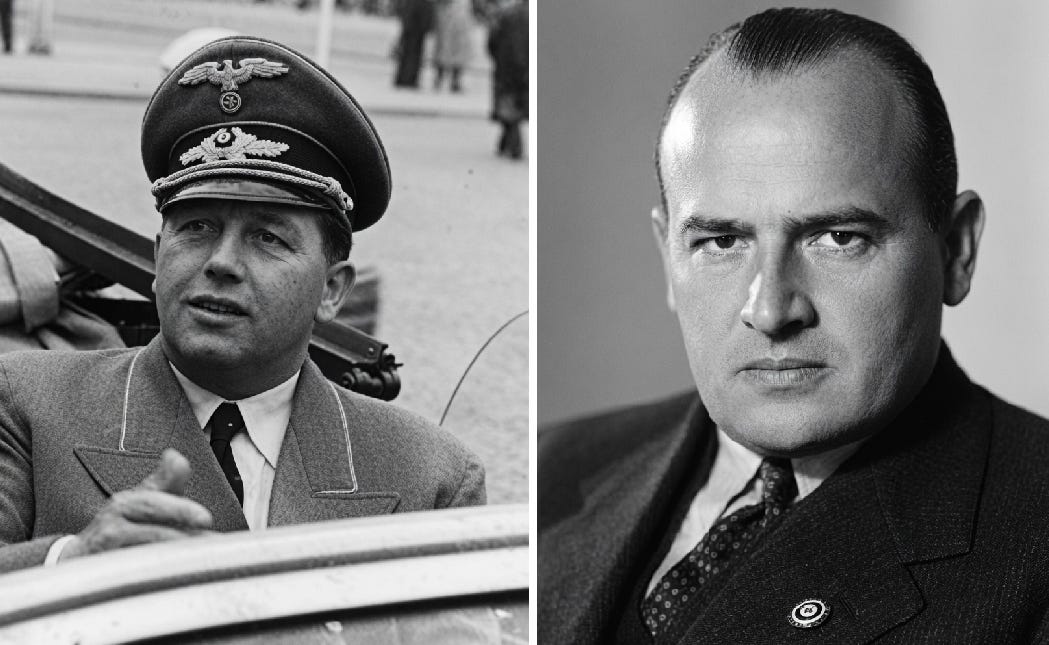
Dr. Joseph Bühler, a lawyer, joined the German Academy of Law run by Dr. Hans Frank in 1933.83 Bühler remained in Frank’s orbit ever-afterwards. Frank, a Front Generation Nazi and putschist in 1923, was Hitler’s personal lawyer and the Party lawyer, before becoming the chief legal ideologist of the Nazis in power. In the early phase, Frank held senior official posts and was a trusted Hitler intimate, but by 1936 it was clear his theorised vision of the Nazi regime had been defeated, and legal theory was much less relevant as the Führer prepared for war.84 Once the war began, Frank was sent to govern part of obliterated Poland, the General Government (Generalgouvernement). For Frank, becoming Governor-General was an ambivalent appointment, being both a promotion and removing Frank from proximity to Hitler, the fundamental source of Nazi power. Bühler went with Frank to Warsaw, and in 1940 he became State Secretary for the General Government and Deputy Governor-General.
After the joint Nazi-Soviet attack on Poland that initiated the Second World War, the Soviets annexed the eastern half. The Nazi half was roughly halved again,85 with the westernmost sector annexed and the eastern portion turned into a colony, the General Government, which was inevitably closely tied into the Reich proper.86 The Nazi-annexed sector was divided into four. Three of the pieces were added to pre-existing German provinces,87 and one wholly new province was created, the Warthegau.88 All the annexed territories were subject to vicious “Germanising” policies, but the Warthegau became exceptional, with more to do and subject to a particularly cruel Gauleiter (regional Party leader) and Reich Governor (a State office), Arthur Greiser, who planned to physically “cleanse” the four million Poles and 400,000 Jews in the Warthegau to make space for German settlement. The General Government was the designated dumping ground for “undesirables”.89 In pursuing this mission, the Warthegau emerged as an epicentre of radical innovations in racial policy that helped pave the way to the Holocaust, but it was ultimately in the General Government, which was unable to play the receptacle role envisioned for it, where the Holocaust itself mostly took place.90
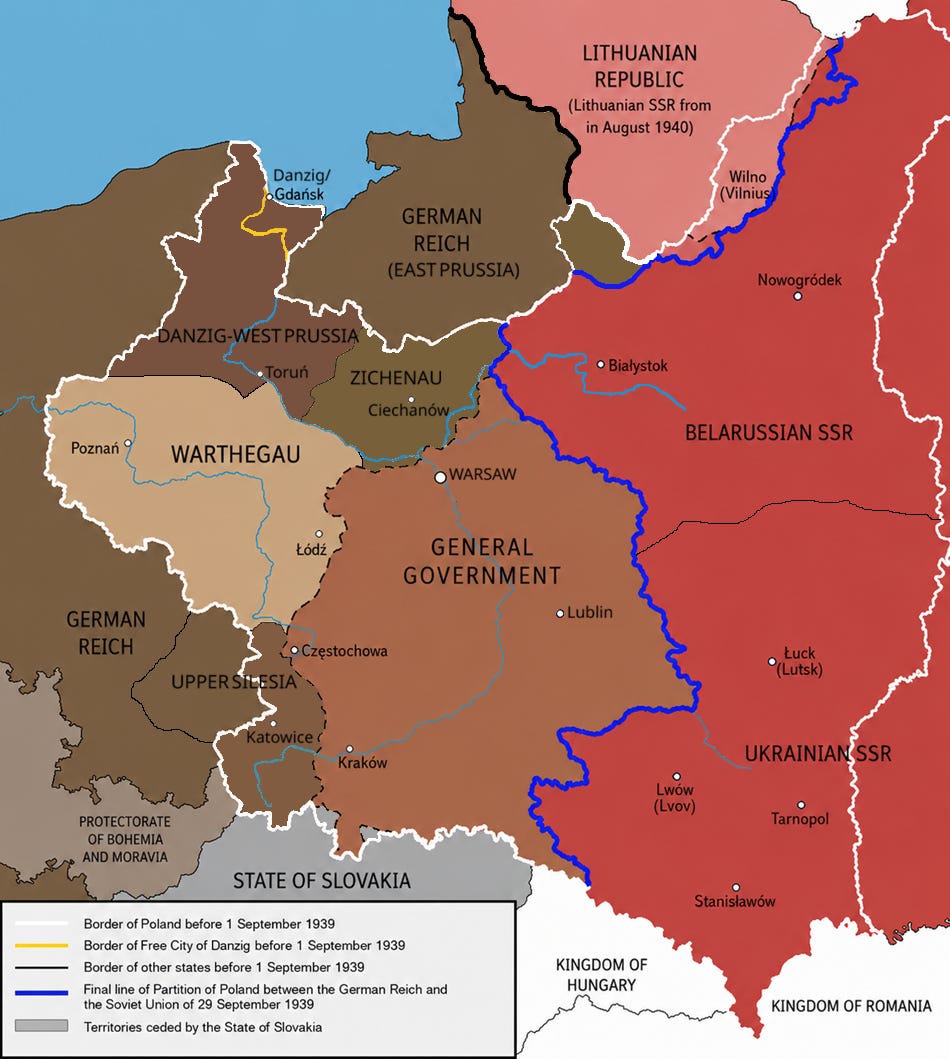

The Nazi-conquered districts of former Poland were placed under Party rule. Radicals hand-picked by Hitler operated out of sight of the constraint of public opinion and free of any modulating influence from the State ministries. Not that the resolution of the Party-State conflict in the incorporated and occupied territories reduced governmental anarchy. The Gauleiters had an institutional rival, the SS; the Gauleiters vied with each other to fulfil the broad “Germanising” mandate Hitler had given them; and the provinces were racked internally by the customary clashes of personality and personal power—with the overall effect of contributing to the escalating radicalism as they all competed for Hitler’s favour. In addition, the Nazis in Poland were dealing with “Eastern Jews” (Ostjuden), the most supremely dehumanised population in Nazi theology and propaganda.91
Levels of antisemitic barbarity hitherto unseen swiftly took hold in Nazi-ruled former Poland. Jews were forced, including via pogroms, into ghettos, the first in Łódź (Warthegau) in December 1939,92 and compulsory labour for Jews was introduced a month later. These two measures raised the ideological baseline of radicalism to new heights and crossed a line in moving genocide from the realm of abstract ideal to concrete policy.93 The large-scale Jewish mortality intrinsic to the ghettos and helotage was consciously understood and welcomed by the Nazis.94 In parallel, an infrastructure of registration and confinement was being constructed to make all-out genocide possible. Perhaps most fatefully, the measures, from the perspective of their envisaged outcome, created “problems”—of “unproductive” Jews who could not work, housing shortages and overcrowding, disease outbreaks, and perennial difficulties providing food—for which mass-murder became a “solution”.95
Nazi policy towards Jews at this time “officially” remained “emigration” (expulsion). That policy had been set in place by Göring, who was formally tasked with coordinating a “resolution” to the Jewish Question after Kristallnacht, and he deputised Heydrich, on 24 January 1939, to lead the new Reich Central Office for Jewish Emigration, where Eichmann would become a prominent official.96 While the office would fail in its stated mission of “emigration”, it was important in solidifying Heydrich’s administrative hold over Jewish policy. The office becoming a nerve-centre of the Holocaust was downstream of the commission Heydrich now had through lines of authority from Himmler and Göring, as Heydrich emphasised at Wannsee.
The bureaucracy did continue exploring “emigration” options into 1941.97 But the war in the West had largely foreclosed external migration, and the “internal” deportation plans—to empty the Warthegau into the General Government—collapsed in March 1940 when Frank said he could not handle any more and Göring backed him. Step by step, in the Nazi perception, policy was being driven into a cul-de-sac where options other than outright genocide were dwindling.98 War in the East, the planning for which began in December 1940, seemed, briefly, to offer an alternative.99 The vastness of Russia, expected to soon be in Nazi hands,100 could provide the “territorial solution” Heydrich had been advocating since June 1940.101 In itself, this was a marked change: the transfer of Jews to the arctic wastes of Russia was an implicitly genocidal scheme to neglect and work the Jews to death.102 And in the event, the invasion of the Soviet Union would prove to be a “quantum jump” on the road to anti-Jewish genocide.103
Why the Holocaust happened is not in question: because Adolf Hitler wished it to. As his biographer, Sir Ian Kershaw has put it, “No Hitler, no Holocaust”.104 How and when the decision to exterminate Europe’s Jews was made remains debated. One view is that Hitler had formulated the Holocaust plan by the time he published Mein Kampf in 1925-26, if not before, and implemented it as soon as he could.105 While Hitler’s remarkably consistent worldview was always latently genocidal, and a strong link clearly formed early in his mind between another war and murdering the Jews,106 few historians, even in the “intentionalist” camp, any longer believe there was a straight line from Mein Kampf to Auschwitz.107
Even if one does believe Hitler came to power with a developed plan for anti-Jewish genocide, however, the Holocaust did not begin in 1933, so there must have been a later moment when the order was given, and no written Führer Order for the Shoah has been discovered. It was either destroyed by the Nazis in the final months of the war, along with so much of the Third Reich’s documentation, or, more likely, there never was one to begin with in a system where high-level orders were routinely conveyed verbally. Reconstructing the circumstances and timing of a Führer Order for the Holocaust, therefore, relies on interpreting the surviving records, which is made more difficult by the euphemistic terminology used in the Nazi documents,108 and Hitler’s strenuous efforts—following in the footsteps of Lenin, the originator of the one-party State model Hitler emulated—to avoid personal association with his regime’s most heinous crimes.109
Some argue Hitler gave the Holocaust Order in July-August, in the period of German “euphoria” at the apparently-imminent Soviet collapse, as the apotheosis of his dream of “removing” the Jews. Others contend the order was given in or after September 1941, once the difficulties with the Nazis’ Eastern Blitzkrieg were visible, as a sort of vengeful consolation prize,110 and because of an increasingly firm ideological conviction that the war could not be won unless the Final Solution was completed first, reversing the original plan for victory in the war to create the conditions for the Final Solution.111
Still others doubt Hitler gave an order, verbal or otherwise.112 Requests and rationalisations for genocide had been sent to Berlin over the summer of 1941 by officials in destroyed Poland whose administrations were foundering, ravaged by disease and beset with shortages. The requests were early and unusually candid from the Warthegau.113 The General Government was more circumspect, with the Frank-Bühler administration initially pressing to deport Jews “further East”—to zones everyone knew were killing fields—until, in October 1941, accepting they would be responsible for murdering the Jews in place and initiating mass-shootings.114 The implication from the “structuralists” or “functionalists”, who locate the crystallisation of the Holocaust in the iterative interaction between Hitler at the centre and local initiatives from the periphery, is that there was no “moment” of decision.
The structuralist analysis is not necessarily contradicted by the research showing—after peeling back the layers of Nazi public propaganda and internal regime messaging “leading away from the Führer” on the Jewish Question—how intimately Hitler was involved in the details of anti-Jewish “action” up to the outbreak of war.115 But it does lead some historians to consider it inherently implausible that Hitler played an endorsing, rather than originating, role at the culmination point.
Similarly, it is noteworthy that SS operatives involved in implementing the Final Solution—including Eichmann, its primary logistical coordinator—have uniformly testified that their orders came directly from Hitler. There is no reason to doubt the SS men were substantially correct, that Hitler stood behind the fundamental decision for the Holocaust and every decision of significance as it escalated. But it does not settle the question of a Führer Order because none of the SS officials heard Hitler’s verbal instruction(s) personally; they all heard of Hitler’s will through Himmler. And Himmler did not specify to his subordinates whether, during his increasingly frequent face-to-face meetings with Hitler from the summer of 1941 onwards, the Führer had approved or initiated genocidal measures.116
It is uncontested that the decisive phase of the process leading to Europe-wide extermination of Jews in gas chambers began no later than 31 July 1941, with Göring’s letter to Heydrich giving him official powers over the ministries to devise a “complete solution” to the Jewish Question.117 What is contested is whether this was the written expression of a verbal Führer Order for genocide. Heydrich opening the Wannsee Conference with an invocation of the authorities bestowed by this letter, and saying the meeting was “to create clarity on fundamental questions” raised therein, can be argued to point in that direction. However, it is possible the meaning evolved over time, not unlike the way Heydrich’s Jewish emigration office morphed into part of the administrative apparatus for Jewish annihilation. Suggestive in this regard is that the letter was prepared in Heydrich’s office (probably written by Eichmann). All Göring did was sign it. It is at least possible that Göring saw this merely as confirming de facto authorities Heydrich had had since January 1939 and their extension into the soon-to-be created “reservation” for Jews beyond the Urals. Likewise, it is plausible Heydrich’s purpose was simply locking down bureaucratic turf for the still-envisioned “Russian General Government”.118
This does not, however, rule out the possibility of a Führer Order for the Holocaust at some point after July 1941: Heydrich also said at Wannsee that Jewish policy had switched from “emigration” to “evacuation” “following the appropriate prior approval by the Führer” [emphasis added], which appears to mean the change originated with Hitler, though “approval” leaves open the possibility Hitler consented to a proposal brought to him by Himmler.
By the time of Göring’s letter, the SS Einsatzgruppen units that accompanied the regular army (Wehrmacht) into the Soviet Union had been massacring Jews for six weeks under “general orders” from Berlin. In mid-August 1941, the relatively small-scale Einsatzgruppen killing operations against mostly male Jews escalated into wholesale slaughter: genocide was definitively underway, the so-called Holocaust by Bullets, and it was only possible with the Führer’s approval.119 Simultaneously in mid-August, Goebbels secured Hitler’s assent to make Jews wear the “Yellow Star”, a policy long desired by Party radicals. At that meeting, Hitler referred to the “prophecy” in his 30 January 1939 Reichstag speech—that another world war would result in “the annihilation of the Jewish race in Europe”—and said it was coming true “with an almost uncanny certainty”.120 The “prophecy” and its message that Jews would pay the price for forcing war upon Germany, a Führer theme before BARBAROSSA,121 now became a total fixation for Hitler, repeated constantly to Nazi leaders in private, as well as in the Führer’s public speeches and official Nazi propaganda.122 For example:123
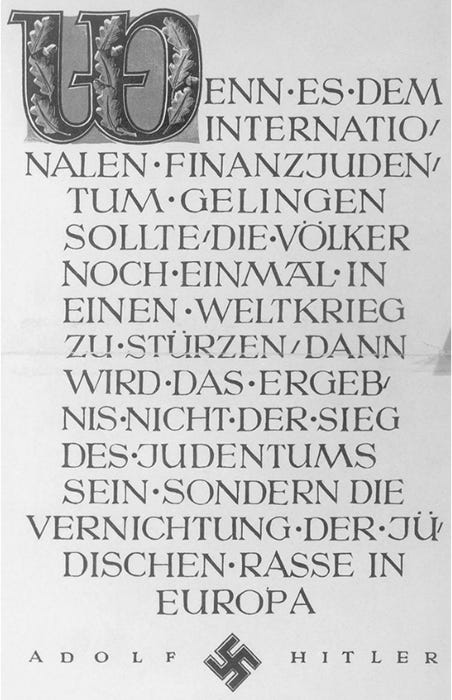
In September 1941, Hitler ordered the deportation of Jews in Germany proper, Austria, and the Czech Protectorate to the East. Hitler had heretofore resisted this policy, another idée fixe of Party activists, arguing the Jews were useful as “hostages” against the Allies, especially if the U.S. should enter the war. Hitler’s abrupt reversal signalled that Hitler was no longer willing to wait until the war was over for the final confrontation with the Jews. It was a momentous conceptual shift and by October 1941 it had effected a policy shift, whether as a result of a Führer Order or a Führer signal spurring radical initiatives from below. The deportations began on 15 October and in all of the destinations—Lodz, Riga, and Minsk—either the Jewish deportees were massacred on arrival or Jews in local ghettos were massacred to make space for the new arrivals.124
In parallel, the General Government, while being spared a new influx of German and Czech Jews, had it made plain by the centre that “their” Jews were never going to be sent “further East”,125 and began implementing their own “solution”. Genocide-scale shootings of Jews commenced in the east of the General Government,126 and authorisation was received from Himmler on 13 October to build an extermination camp, what became Belzec, in the adjacent Lublin District.127 Construction of Belzec was underway as of early November 1941, utilising equipment from Germany proper and officials (notably Christian Wirth) reassigned from the paused euthanasia program.128 The same month, gas vans began to be used to murder Jews—experimentally in the Warthegau, on a large scale in Ukraine, and on a lesser scale in Latvia.129 Chelmno death camp, purpose-built to liquidate the Jews in the Lodz ghetto using carbon monoxide and like Belzec relying on technology and personnel assigned to it from the centre,130 became operational in the Warthegau in December 1941, three days before Germany declared war on the United States.131
For our purposes, there are two takeaways from all this. First, the threads within the Nazi matrix—ideology, i.e., the guiding antisemitic obsession of the Führer cult, the self-created logistical problems in Poland, and the new opportunities opened up, psychologically and practically, by the invasion of the Soviet Union—had very likely coalesced into a decision to annihilate European Jewry before the Wannsee Conference,132 probably by the time Heydrich sent out the first invitations to Wannsee on 29 November 1941.133 Frank certainly seemed to be under the impression a decision had already been made after visiting Berlin two weeks later.134 Which leads to the second point: Bühler was not “coming in blind” to Wannsee. Bühler not only knew the agenda; the Nazi entity he served had helped condition it and was already implementing it. Wannsee was about the mechanics of generalising the Final Solution and Bühler’s personal contribution at the Conference itself, forcefully advocating this course and that the SS’s new “efficient” methods be deployed in his province first, makes him a more consequential participant than some others, including those below, who outrank him on various metrics.
Dr. Alfred Meyer, academically trained in law and political science, joined the NSDAP in 1928 as it was expanding into the Protestant north. Meyer became Gauleiter for Westphalia-North in 1931, answering directly to Hitler, and the High President (Oberpräsident) of the Prussian Province of Westphalia from 1938. Meyer was not in Hitler’s inner-circle, but he was not actively marginalised. For example, Meyer was one of the Gauleiters consulted by Goebbels in the summer of 1941 when the Roman Catholic Church ignited the massive anti-Nazi protest movement that halted the euthanasia program.135 A month after Operation BARBAROSSA began, Meyer was appointed Deputy and operational leader of the new Ministry for the Occupied Eastern Territories (Ostministerium), the body (nominally) responsible for the civilian administration of the Nazi-occupied areas of the Soviet Union, which was headed by Alfred Rosenberg, whom Meyer represented at Wannsee.
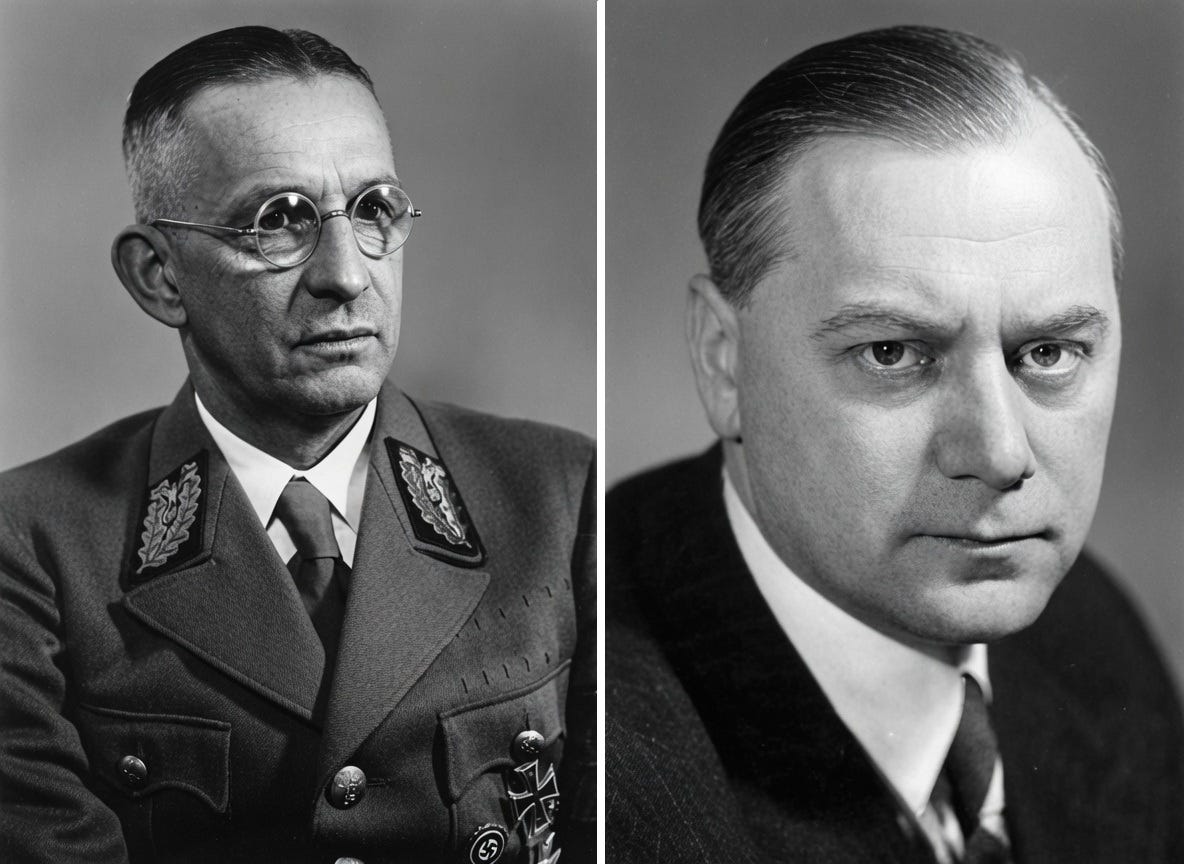
Meyer was undoubtedly a significant second-tier Nazi official—one of the crucial “middle managers” that keep so many organisations going—but he was not quite as important as he might appear given the foregoing for three reasons. First and most obviously, Bormann’s tightening of the reins over the Party made Gauleiters much less independent figures as time went by.
Second, Rosenberg was not at the baronial level, his self-perception and reputation as a Nazi ideologist second only to Hitler notwithstanding. Rosenberg had the prestige of being an early Nazi Party member even by the standards of the Front Generation. An ethnic German born in Tsarist Estonia, Rosenberg was part of that cadre of ethno-separatist “Russian” collaborators pulled out with the German army in 1918 who played such an outsize role in the early phase of the post-war Völkisch movement in Germany. Where most faded away after 1923, Rosenberg joined the first incarnation of the NSDAP in 1919 and saw it through to the gallows at Nuremberg. This gave him the standing to be persuasive to Hitler on occasion, including possibly about the deportation of Germany proper’s Jews in late 1941.136 But Rosenberg was never entrusted with serious power. Even in the propaganda realm where Rosenberg ostensibly had authority,137 Hitler imposed rather stringent limits on Rosenberg’s hobbyhorses, finding his flamboyant assaults on Christianity tactically irksome and his paganism substantively contemptible.138 It is notable that Rosenberg’s The Myth of the Twentieth Century (1930), a tract often ranked with Mein Kampf as encapsulating Nazi ideology, had to be published as a private work and never received official blessing from the NSDAP.139
Third, the Ostministerium, based in Berlin, had little practical reach into the East. This was a problem internally, with Rosenberg and Meyer struggling to get the Ostministerium’s own officials to obey orders. Notoriously, the Ostministerium’s Reichskommissar for Ukraine, Erich Koch, appointed by Hitler on Göring’s recommendation, openly defied Rosenberg’s instructions to try to win over Ukrainians, brutally exploiting a population he regarded as subhuman and challenging Rosenberg’s ideological bona fides into the bargain. It was even more of a problem in dealing with the SS, which had an officially overlapping competency for Eastern policy, especially towards Soviet Jews, and held power on the ground. Inflaming the institutional rivalry, Himmler found dealing with Rosenberg personally exasperating, and unlike the Wehrmacht that Himmler also found vexing, Rosenberg had no legions to compel an accommodation.140 Meanwhile, the Ostministerium had to compete with Göring’s Four Year Office on economic “policy”—the cataloguing and distribution of material, agricultural, and human plunder—and in time Rosenberg’s network was eclipsed by Speer’s apparatus on this front.
All that said, the Ostministerium was an actor in the East and Rosenberg had access to Hitler. In the drive for unity at Wannsee, it would have been senseless to exclude the Ostministerium.
What is slightly mysterious is why the Ostministerium had two representatives present at Wannsee. The probable answer is that Dr. Georg Leibbrandt, like Meyer an academic, but unlike Meyer a specialist in Soviet nationalities, had expertise directly relevant to the Conference, and had met Heydrich (with Meyer) in early October 1941.141 Leibbrandt had studied and fostered relations with German populations in the Soviet Union, which he visited three times in the 1920s, and his work drew international recognition.142 The other potential factor, from the other side, was that Leibbrandt was closer to Rosenberg than Meyer, despite being formally subordinate. Sharing Rosenberg’s basic biography—Leibbrandt was an ethnic German born in Tsarist Ukraine and German collaborator during the First World War—Leibbrandt had quickly become Rosenberg’s political adviser after joining the NSDAP in late 1933,143 and was promoted from within to lead the Political Department at the Ostministerium, one of its three main sections (economics and administration-legal were the others). Meyer, by contrast, had only worked with Rosenberg for six months before Wannsee.
As a last example of the overlapping structure of the Nazi system, two members of the SS faction at Wannsee also held positions in the occupation administrations, namely the SD-police chiefs in the General Government (Schöngarth) and Latvia (Lange).
FINAL NOTE
It may be wondered why the Wehrmacht—often considered the third pillar, alongside Party and State, in the regime, and one certainly deeply involved in the Holocaust—was not present at Wannsee. Part of the answer is that the status of the German Army as a separate power centre was radically eroded by the late 1930s after the catastrophic miscalculation of the General Staff in 1935, inaugurating a Führer Oath designed to tether Hitler to the designs of the military leadership and accomplishing the reverse.144 The direct answer over Wannsee is simply that it was a coordination meeting among the SS and civilian agencies with responsibilities for Jewish policy.
FOOTNOTES
Ian Kershaw (2008), Hitler, the Germans, and the Final Solution, p. 38.
Kershaw, Hitler, the Germans, and the Final Solution, pp. 32, 38.
Robert W. Stephan (2004), Stalin’s Secret War: Soviet Counterintelligence Against the Nazis, 1941-1945, p. 72.
As Himmler put it in a speech to the German Academy of Law in October 1936, the purpose of law in the Nazi perception was to secure “the German people’s right to life”. See: Johann Chapoutot (2018), The Law of Blood: Thinking and Acting as a Nazi, pp. 75-76.
Ian Kershaw (2015 ed.), The Nazi Dictatorship: Problems and Perspectives of Interpretation, pp. 88-89.
Kershaw, The Nazi Dictatorship, p. 90.
Kershaw, Hitler, the Germans, and the Final Solution, p. 32.
Kershaw, Hitler, the Germans, and the Final Solution, pp. 39-44.
Kershaw, The Nazi Dictatorship, pp. 68-70.
Chapoutot, The Law of Blood, pp. 37-38.
Chapoutot, The Law of Blood, p. 108.
Chapoutot, The Law of Blood, p. 184.
Johann Chapoutot (2016), Greeks, Romans, Germans: How the Nazis Usurped Europe’s Classical Past, p. 308.
Himmler at one point wrote: “I deeply believe that … all of Christianity” is nothing but a conspiracy to “maintain this bi-millenary Bolshevism. … I am convinced that the Roman Emperors who eradicated the first Christians were doing exactly the same thing that we are doing with the Communists.” “These Christians were”, Himmler concluded, “the most repugnant Jewish element, the most disgusting bunch of Reds.” See: Chapoutot, The Law of Blood, p. 110.
Peter Longerich (2012), Heinrich Himmler: A Life, p. 741.
Michael Burleigh (1991), The Racial State: Germany, 1933-1945, p. 59.
Robert B. Kane (2002), Disobedience and Conspiracy in the German Army, 1918-1945, p. 93.
Martin Broszat (1981), The Hitler State: The Foundation and Development of the Internal Structure of the Third Reich, p. 38.
An element of this not to be overlooked is the flow of Communists into the SA c. 1929-33. In the main, these were genuine defectors, who nonetheless retained habits of thought from their former faith (hence the “beefsteak” monicker: Brown outside, Red inside), as well as the practical networks and organisational skills that come from a career working for Moscow Centre, giving them an influence out of all proportion to their numbers. There were also some infiltrators from the Soviet-controlled Communist Party of Germany (KPD), who naturally sowed dissent and ill-discipline and generally pushed the SA towards self-destructive behaviour, hardly difficult in movement so defined by radicalism and chaos. See: Daniel Siemens (2017), Stormtroopers: A New History of Hitler’s Brownshirts, pp. 158-159.
It is an oddity of Himmler’s biography that the idol who drew him into Völkisch politics was Röhm and his mentor in the early years with the Nazis was Gregor Strasser, both of them from the more socialist faction of the NSDAP. And it is a testament to Himmler’s political acumen that he managed to betray both of them—they perished in the Blood Purge that Himmler’s SS led—without leaving any negative impression that he was a schemer and without his former association with them damaging him. See: Longerich, Heinrich Himmler, pp. 174, 739-740.
Longerich, Heinrich Himmler, pp. 257-258, 312-313.
After 1939, the RuSHA worked particularly closely with Himmler’s Reich Commissioner for the Strengthening of Germandom (RKFDV).
The actual drafting of the General Plan East principally took place in Konrad Meyer’s RKFDV Planning Office. See: Longerich, Heinrich Himmler, pp. 527-528.
Alexander Dallin (1981), German Rule in Russia 1941-1945: A Study of Occupation Policies, pp. 476-477.
Longerich, Heinrich Himmler, pp. 150-151.
Erhard Heiden was dismissed as head of the SS in 1929 for reasons that remain entirely opaque. The official NSDAP communique said Heiden was relieved of his post “for family reasons”, that Himmler was appointed in his place, and no more. But Heiden clearly crossed the Nazis in some way, either at that time or over the next four years, because he was “disappeared” by the SD on 18 March 1933 and murdered soon afterwards. Heiden’s body was discovered, with gunshot wounds to the head, in August 1933. See: Longerich, Heinrich Himmler, pp. 113-114.
Longerich, Heinrich Himmler, pp. 174-176.
The SS had about 50,000 men when Hitler became Chancellor in January 1933 and by mid-1934 had 200,000 members. The original structures of the SS were unable to cope such a large organisation, and in December 1934 it was split into three sections. There was: the General SS (Allgemeine-SS); the SS military forces (SS-Verfügungstruppe), the core of what became the Waffen-SS, which fought alongside the regular Army during the war; and the Death’s Head Units (SS-Totenkopfverbände), which managed concentration camp system, including some of the extermination camps. See: Longerich, Heinrich Himmler, p. 181.
Longerich, Heinrich Himmler, pp. 172-174.
A notable aspect of this was an expansion of the law against homosexuality in 1935, used to confine thousands to concentration camps and stage “immorality” show trials (Sittlichkeitsprozesse) against priests of the Roman Catholic Church, the only anti-Nazi institution with any remaining legal autonomy. See: Longerich, Heinrich Himmler, pp. 203, 213.
Frick had no intention of restricting Hitler’s power; it was an issue of efficiency. Frick’s idea was to create a highly centralised “Führer State” (Führerstaat) with clearly defined lines of authority based on a hierarchy organised around the ministries. In the event, Frick would be instrumental in the superimposition of the Party onto the State, leading to the disorganised duality, and his subsequent attempts to clean this up by unifying and rationalising the Nazi regime were directly undermined by Hitler. See: Kershaw, Hitler, the Germans, and the Final Solution, p. 32.
Longerich, Heinrich Himmler, p. 271.
Broszat, The Hitler State, p. 275.
Peter Longerich (2021), Wannsee: The Road to the Final Solution, pp. 104-106.
Longerich, Heinrich Himmler, pp. 747.
Longerich, Heinrich Himmler, pp. 745-746.
There were six representatives of the Himmler faction at the Wannsee Conference: Heydrich, Müller, Hofmann, Eichmann, Schöngarth, Lange. Within themselves, the SS set are an example of the ambiguities of power in Nazi Germany. It is very difficult to tabulate and trade-off formal rank, personal prestige, the institutional heft and/or baronial patronage represented, and, in this specific context, degree of direct responsibility for the Holocaust. In the list above, I have tried to give the participants in order of their significance, but apart from Heydrich at number one—his institutional and personal power being unrivalled—and the last three, it is very spongy.
For instance, Müller and Hofmann shared the same rank (SS-Gruppenführer), but Müller—as a man, as head of the Gestapo, and being so close to Heydrich—was clearly the more powerful. By contrast, Müller directly controlled armed force in a way some of the people above him did not, but the narrowness of his mandate puts him below them. At the other end of the spectrum, Eichmann (an SS-Obersturmbannführer) technically outranked Lange (an SS-Sturmbannführer), but there was no question at this moment that the paper-pushing Eichmann was junior to Lange, the commander of the police in a conquered country.
Adam Tooze (2006), The Wages of Destruction: The Making and Breaking of the Nazi Economy, p. 671.
Richard Overy (2012), Goering: Hitler’s Iron Knight, pp. 221-228.
Volker Koop (2020), Martin Bormann: Hitler’s Executioner, pp. 4-7.
Longerich, Heinrich Himmler, p. 216.
Albert Speer (1969), Inside the Third Reich, p. 47.
Bormann controlled the cashflow to Hitler’s staff and even to his companion, Eva Braun. See: Koop, Martin Bormann, p. 23; and, Speer, Inside the Third Reich, p. 86.
Speer, Inside the Third Reich, p. 84.
Speer, Inside the Third Reich, p. 120.
Speer, Inside the Third Reich, p. 88.
Richard Evans (2008), The Third Reich at War: How the Nazis Led Germany from Conquest to Disaster, p. 169.
Koop, Martin Bormann, p. 29.
Koop, Martin Bormann, pp. 11-12.
Kershaw, The Nazi Dictatorship, p. 99.
Koop, Martin Bormann, p. 211.
Koop, Martin Bormann, p. 30.
Koop, Martin Bormann, pp. 181-182, 190, 196-197.
Koop, Martin Bormann, p. 110.
Hitler told his intimates that the necessity of accommodating the churches in the short-term “won’t prevent me from totally eradicating Christianity from Germany”. See: Chapoutot, The Law of Blood, p. 185.
Ian Kershaw (2000), Hitler 1936-1945: Nemesis, p. 509.
Chapoutot, The Law of Blood, pp. 184-189.
Longerich, Heinrich Himmler, p. 221.
Longerich, Heinrich Himmler, p. 519.
Koop, Martin Bormann, pp. 176-182.
The other members of the Ministerrat für die Reichsverteidigung were: Rudolf Hess (replaced by Bormann in 1941), Interior Minister Wilhelm Frick (replaced by Himmler in 1943), Economics Minister Walther Funk, Wilhelm Keitel, and Hans Lammers.
Broszat, The Hitler State, p. 308.
Hitler said (in January 1942) that Göring had, “in a very short time”, turned the SA from a “dishevelled rabble” into an “organised” force. See: Martin Bormann (2000), Hitler’s Table Talk, 1941-1944: His Private Conversations, p. 168.
Overy, Goering, pp. 222, 229.
Burleigh, The Racial State, p. 288; and, Tooze, The Wages of Destruction, p. 164.
Kershaw, The Nazi Dictatorship, pp. 65-78.
Broszat, The Hitler State, pp. 300-303.
Overy, Goering, pp. 203-206.
Overy, Goering, pp. 224-225.
Overy, Goering, p. 209.
Overy, Goering, p. 208; and, Tooze, The Wages of Destruction, pp. 558-560.
Overy, Goering, pp. 205-230.
Kritzinger was at this time Ministerial Director in the Reich Chancellery; he was promoted to State Secretary in November 1942.
In the last days of the war, with Lammers down in Bavaria with Göring, Kritzinger in Berlin became the acting head of the Reich Chancellery, having “the purely theoretical task of coordinating the other ministries and the remainder of the Reich Chancellery civil servants … Asked after the end of the war why he had not resigned, Kritzinger seemed scarcely to understand the question. ‘As a long-standing civil servant I was duty-bound in loyalty to the state,’ he answered, expressing shame at its policies towards Jews and Poles. (Even on the morning of 21 April, as Soviet rockets exploded in the government district of Berlin, civil servants continued to ‘work’—doing nothing useful—at their desks.) When asked further why Lammers continued to do all he could for the war effort, Kritzinger replied: ‘Well, there had to be some sort of organization’.” See: Ian Kershaw (2011), The End: Germany, 1944-45, p. 341.
Lammers gravitated into Völkisch politics quite quickly after the Great War, but initially joined the German National People’s Party (Deutschnationale Volkspartei or DNVP). Lammers became a formal member of the NSDAP in early 1932, by which time the boundary with the DNVP was eroding, a fact symbolised a year later when the DNVP gave the Nazis their working majority after the election.
Well, not literally the last day: Lammers was technically removed on 23 April 1945 as part of the fiasco over the “Göring Telegram”.
Koop, Martin Bormann, pp. 45-46.
Kershaw, The End, p. 42.
Kershaw, Hitler, the Germans, and the Final Solution, p. 32.
Longerich, Wannsee, p. 104.
Inter alia, Frick was the point man for implementing the Enabling Act throughout the bureaucracy and abolishing federalism, supervised aspects of Gleichschaltung, purged Jews from the civil service, and oversaw the development of the racialist legal infrastructure that made antisemitism the organising principle of the German State. See: Benjamin Carter Hett (2018), The Death of Democracy: Hitler’s Rise to Power and the Downfall of the Weimar Republic, pp. 152, 190, 216-217.
The Nuremberg Laws banned marriages and sexual relations between Jews and “Aryans”, and deprived Jews of German citizenship. The other co-author was Hans Pfundtner, then-State Secretary at the Reich Interior Ministry (Stuckart was promoted to that rank in August 1941). See: Amy Newman (1999), The Nuremberg Laws: Institutionalized Anti-semitism, p. 29.
Longerich, Wannsee, p. 77.
There is an historical parallel between Freisler and Eichmann, both of whom had relatively marginal roles at Wannsee, yet whose infamy looms large in historical memory for acts taken subsequently, Eichmann for continuing what was started at Wannsee after Heydrich’s assassination in June 1942 and Freisler as President of the People’s Court (Volksgerichtshof) after August 1942.
The People’s Court was a standing tribunal for political opponents of the Nazi regime that ostentatiously rejected liberal principles like due process and a right of appeal. Freisler became notorious for bullying and humiliating “defendants” during show trials and then having them summarily “executed”. Parallels were drawn even at the time between Freisler and Andrey Vyshinsky, the chief Soviet prosecutor at the Moscow Trials during Yezhovshchina, including by Hitler, who called Freisler “our Vyshinsky”. The analogy was well-founded, since Freisler had travelled to watch Vyshinsky in action in 1938 and consciously emulated his courtroom manner
See: John J. Michalczyk, ‘High Treason in the People’s Court: Postwar Plans of Fr. Max Josef Metzger, Peace Activist, and Helmuth James Graf von Moltke of the Kreisau Circle’, in: John J. Michalczyk [ed.] (2018), Nazi Law: From Nuremberg to Nuremberg, p. 84.
Interestingly, given his murderous fanaticism, Bühler was not an NSDAP member before the Machtergreifung: he joined in April 1933.
In 1933, Frank was made a Reichsleiter, the highest Party position except Führer. In 1934, Frank was promoted to the Cabinet as Minister Without Portfolio, and Bühler would come to work in his office. Frank theorised the creation of a unified, “rational” Führer State—essentially the same vision Frick arrived at from an administrative perspective—and found it could not be done. Frank was impeded bureaucratically in places by Franz Gürtner, the Justice Minister before Schlegelberger, and no later than 1936, when Hitler signed-off on Himmler’s SS empire, the Führer’s preference for a polycratic structure was plain. Simultaneously, with war so clearly on the horizon, Hitler’s interest in legal theory faded and Frank’s status diminished accordingly.
Except for two small fragments in southern Poland, which were given to the Nazis’ Slovak puppet State.
Diemut Majer (2013), “Non-Germans” Under the Third Reich: The Nazi Judicial and Administrative System in Germany and Occupied Eastern Europe, with Special Regard to Occupied Poland, 1939-1945, p. 288.
The zone around Katowice was added to the German province of Upper Silesia; what the Nazis called the Zichenau region was added to the exclave of East Prussia; and the Polish Corridor was added to Danzig to form the Reichsgau Danzig-West Prussia, roughly a recreation of the old West Prussia province of the Second Reich.
Warthe is the German word for the Polish Warta River and Gau means “district” or “region”. Officially, it was the Reichsgau Wartheland.
Jonathan Huener (2021), The Polish Catholic Church under German Occupation: The Reichsgau Wartheland, 1939-1945, p. 59.
Of the six Nazi death camps, four were in the General Government. Three were in the Lublin District—Belzec (operational March 1942), Sobibor (May 1942), and Majdanek (October 1942)—and one, Treblinka (July 1942), was in the Warsaw District. Chelmno, operational as of December 1941, was in the Warthegau. Auschwitz-Birkenau, where the Nazis began systematically gassing Jews in March 1942, was located in Upper Silesia, about twenty miles south of Katowice.
It is sometimes said “there were no gas chambers in Germany”, and not always by Holocaust deniers seeking to use the “fact” to destabilise people’s understanding of the Shoah. What the above should make clear is that this is true only in the most technical and inconsequential sense. Chelmno, the first of the purpose-built extermination camps, and Auschwitz, the most lethal of the death camps, were located on territory wholly incorporated into Germany.
Kershaw, Hitler 1936-1945, pp. 250-252, 315-316.
About 200,000 Jews were crammed into the Łódź (Litzmannstadt) ghetto. The largest Jewish ghetto in conquered Poland, in Warsaw (General Government), was created in October 1940 and sealed a month later. The Warsaw Ghetto, occupying just 2.4% of the area of the city, contained not only the 380,000 Jews (a third of the city’s population) who lived there when the Nazis arrived, but 70,000 or so Jewish refugees from elsewhere.
Longerich, Wannsee, pp. 85-88.
As early as January 1940, the SS leadership openly discussed—with approval—the enormous numbers of Jewish deaths from exhaustion, hunger, and disease intrinsic to the labour camps and ghettos. See: Kershaw, Hitler, the Germans, and the Final Solution, p. 253.
Kershaw, Hitler, the Germans, and the Final Solution, pp. 252-254.
Bettina Stangneth (2014), Eichmann Before Jerusalem: The Unexamined Life of a Mass Murderer, p. 14.
Kershaw, The Nazi Dictatorship, pp. 130-131. See also: Alan E. Steinweis, ‘Antisemitic Scholarship in the Third Reich and the Case of Peter-Heinz Seraphim’, in: Alan E. Steinweis (2003), The Impact of Nazism: New Perspectives on the Third Reich and Its Legacy, p. 76.
Kershaw, Hitler, the Germans, and the Final Solution, pp. 253-254.
Hitler gave the order to begin the systematic planning of Operation BARBAROSSA almost immediately after he concluded that Britain could not be subdued directly in the short-term, a conclusion he reached in no small part because of the defiance of General Franco.
Hitler (in)famously said of the “Judeo-Bolshevik” edifice, “You have only to kick in the door, and the whole rotten structure will come crashing down.” See: Andrew Roberts (2009), The Storm of War: A New History of the Second World War, p. 143.
Kershaw, Hitler, the Germans, and the Final Solution, p. 254.
Kershaw, Hitler, the Germans, and the Final Solution, p. 98.
Christopher R. Browning (1978), The Final Solution and the German Foreign Office: A Study of Referat D III of Abteilung Deutschland, 1940-43, p. 8.
‘Hitler, with Ian Kershaw - Part 1’, The Rest is History, 14 June 2021 (14:20). Available here.
Kershaw, who is clearly more on the “structuralist” side of the argument, has sometimes been criticised for presenting Hitler as a figure whose agency is difficult to detect in the Nazi regime. And on the Holocaust decision debate, Kershaw can seem to incline in this direction when arguing: “It seems unlikely that Hitler ever gave one single, explicit order for the ‘Final Solution.’ Within the unchanging framework of his ‘prophecy,’ he needed do no more than provide requisite authorization at the appropriate time to Himmler and Heydrich to go ahead with the various escalatory stages that culminated in the murder of Europe’s Jews.”
However, Kershaw is equally clear that Hitler was “the most radical of radical antisemites”, not a relative “moderate” on Jewish policy as some hyper-structuralists have argued, and, for all Kershaw’s dislike of the Great Man “theory” of history, he is emphatic: “Hitler’s role was decisive and indispensable to the unfolding of the ‘Final Solution.’ … [W]ithout Hitler, the creation of a program to bring about the physical extermination of the Jews of Europe is unimaginable.”
See: Kershaw, Hitler, the Germans, and the Final Solution, pp. 98, 111.
Evidence for this viewpoint can be found in Hitler’s statements, for example these private remarks to the journalist Josef Hell in 1922:
My first and foremost task would be the annihilation of the Jews. As soon as I have the power to do so I will have gallows built in rows … as many as traffic allows. Then the Jews will be hanged indiscriminately, and they will remain hanging until they stink; they will hang there as long as the principles of hygiene permit. As soon as they have been untied, the next batch will be strung up, and so on down the line, until the last Jew in Munich has been exterminated. Other cities will follow suit, precisely in this fashion, until all Germany has been completely cleansed of Jews.
See: Oscar Pinkus (2005), The War Aims and Strategies of Adolf Hitler, p. 277.
For example, in the last chapter of Mein Kampf, Hitler wrote that “the sacrifice of millions at the front” in the First World War would not have been necessary if “twelve or fifteen thousand of these Hebrew corrupters of the people had been held under poison gas”. See: Kershaw, Hitler 1936-1945, p. 151.
The phrase often used now is that “the road to Auschwitz” was a “twisted” one, playing off the title of a 1970 book by Karl A. Schleunes: The Twisted Road to Auschwitz. Nazi Policy Toward German Jews, 1933-1939.
As already noted, the euphemism for “extermination” favoured at Wannsee was “evacuation” (Evakuierung). Many others were used, including “special handling” (Sonderbehandlung) and “resettlement” (Umsiedlung).
Kershaw, Hitler, the Germans, and the Final Solution, p. 246; and, Longerich, Wannsee, p. 2.
A slight variation on the early-phase, “euphoria” thesis was argued for by Christopher Browning: that the fundamental decision for genocide was made by Hitler in July 1941, but that the order issued at that time was a planning directive—reflected in Göring’s letter to Heydrich requesting a “complete solution” on 31 July—with the plan only carried into execution in late October or early November after approval from Hitler. See: Kershaw, Hitler, the Germans, and the Final Solution, pp. 94-96.
Longerich, Wannsee, p. 106.
Kershaw, Hitler, the Germans, and the Final Solution, pp. 95-96.
One of the reasons to look to the Warthegau as the zone where the Final Solution crystallised is the evidence that the governor, Arthur Greiser, and the SS-police chief in the region, Wilhelm Koppe, had concretely decided on mass-killing as a “solution” to their escalatingly dire situation so early. For example, on 16 July 1941, less than a month after the invasion of the U.S.S.R., the head of the SD in Posen, SS-Sturmbannführer Rolf-Heinz Höppner—a man close to both Greiser and Koppe and clearly acting on their authority—sent Eichmann in the Reich Security Head Office in Berlin a memo with the heading, ‘Solution of the Jewish Problem’, where he cynically invoked humanitarian concerns to argue for genocide: “There is the danger this winter that the Jews can no longer all be fed. It is to be seriously considered whether the most humane solution might not be to finish off those Jews not capable of working by some sort of fast-working preparation. This would be in any event more pleasant than letting them starve.” Whether or not that was possible, Höppner recommended that all female Jews be sterilised so “the Jewish problem” would be completely solved within the current generation. See: Kershaw, Hitler, the Germans, and the Final Solution, pp. 66-69.
Peter Longerich (2010), Holocaust: The Nazi Persecution and Murder of the Jews, pp. 292-293.
David Bankier (1988), ‘Hitler and the Policy-Making Process in the Jewish Question’, Holocaust and Genocide Studies. Available here.
Kershaw, Hitler, the Germans, and the Final Solution, p. 109.
Or “comprehensive solution” (Gesamtlösung).
Kershaw, Hitler, the Germans, and the Final Solution, p. 67.
Kershaw, Hitler, the Germans, and the Final Solution, pp. 259-260.
Longerich, Wannsee, p. 19.
Hitler’s public references to the “prophecy” seem to begin in January 1941, and pre-BARBAROSSA it is difficult to find explicit recorded quotes from Nazi officials of Hitler invoking the “prophecy”. However, it was clearly a recognised feature of the Führer’s worldview, taken so for granted it was known by allusion, at least in the inner circle. For instance, on 20 June 1941, two days before the invasion of the Soviet Union, Goebbels recorded in his diary, in an entry about a meeting the day before where Hans Frank had been reassured by Hitler there would soon be a place to deport the Jews of the General Government, “Jewry in Poland is gradually going to wrack and ruin. A just punishment for its instigation among the peoples of the world and its plotting of the war. The Führer, of course, prophesied this for the Jews” [emphasis added]. Christopher R. Browning (2004), The Origins of the Final Solution: The Evolution of Nazi Jewish Policy, September 1939-March 1942, p. 239.
Kershaw, Hitler, the Germans, and the Final Solution, p. 104.
Image and translation taken from: Kershaw, Hitler 1936-1945, p. 842.
Longerich, Wannsee, pp. 23-29; and, Kershaw, Hitler, the Germans, and the Final Solution, pp. 67, 105-106.
Frank was told “in no uncertain terms” by Rosenberg in Berlin on 13 October that it was impossible any Jews from the General Government would be deported to the Eastern Territories. The records show Bühler was particularly quick to understand and accept the implications of this. See: Longerich, Wannsee, p. 37.
Longerich, Wannsee, p. 28.
Sobibor, a killing centre operational as of May 1942, would also be located in the Lublin District. Majdanek, on the outskirts of Lublin City, was opened as a concentration camp in October 1941, but it was only transformed into an extermination camp using poison gas in October 1942.
Christopher R. Browning (1991), Fateful Months: Essays on the Emergence of the Final Solution: Revised Edition, pp. 30-32.
Longerich, Wannsee, pp. 27-29.
Browning, Fateful Months, pp. 30-32.
Kershaw, Hitler, the Germans, and the Final Solution, p. 262. Importantly, the Nazi officials at Chelmno were preparing for imminent killing operations on 6 December, the day before Pearl Harbour, and the first transport of Jews arrived at the camp on 7 December. The murders began the next day.
The Wannsee Protocol is explicit (in so far as Nazi documents ever were) on this point. The discussion at Wannsee assumed the implementation of the Final Solution in countries neither conquered nor vassalized by Germany, including Britain, Ireland, Portugal, Spain, Switzerland, and Turkey. The issues raised were political and logistical. In other words, the fundamental decision on a Europe-wide extermination of Jews had been taken; all that remained for the Wannsee participants to decide was methodology.
The Wannsee Conference was originally scheduled for 9 December 1941. The Japanese attack on Pearl Harbour on 7 December and the fallout, which included Germany’s declaration of war on the United States on 11 December, caused a delay. See: Longerich, Wannsee, pp. 8-10, 35.
“We were told in Berlin, why are you raising all these objections [about how to cope with the numbers of Jews]; we can’t do anything with them … liquidate them yourself!” Frank told his underlings in Krakow on 16 December 1941, after returning from a leadership conference in Berlin on 12 December. “We must annihilate the Jews wherever we come upon them and wherever it is at all possible, in order to sustain the total structure of the Reich here.” Frank was simply waiting to know how. See: Evans, The Third Reich at War, p. 262.
Goebbels, who was at the 12 December meeting of the Gauleiters and Reichsleiters, recorded of it in his diary: “As far as the Jewish question is concerned, the Führer is determined to make a clean sweep. He prophesied to the Jews that if they caused another world war they would see themselves annihilated. That was not just empty talk. The world war is happening and the annihilation of Jewry must be the inevitable consequence. We have to consider this matter without any sentimentality.” Again we see Hitler’s fixation by this point on his “prophecy” and its link between the war and annihilating the Jews. See: Longerich, Wannsee, p. 36.
Christian Gerlach, most prominently, has posited this meeting as the decision-point of the Holocaust. That is almost certainly incorrect. It is notable that even in private one-on-one settings, with Goebbels and Bormann and Himmler, Hitler spoke only allusively about the murder of Jews; it is highly unlikely he would have announced it in a room with fifty people. More importantly, Goebbels’ phrasing—“is determined to make a clean sweep”, “was not empty talk”, “is happening”—points to a decision made in the past.
Longerich, Holocaust, p. 278.
Rosenberg certainly met with Hitler in September 1941 and pressed the issue of deporting Altreich Jews, making the case that it was a just reprisal for Stalin’s deportation of the Volga Germans, which had begun a month earlier. See: Kershaw, Hitler, the Germans, and the Final Solution, p. 260.
Rosenberg was officially the Führer’s Commissioner for the Supervision of Intellectual and Ideological Education of the NSDAP, otherwise known as “the Rosenberg Office”.
Hitler privately dismissed Rosenberg’s Mythus, his magnum opus explaining the world through the prism of the Nazi paganist view of history and Science, as “stuff nobody can understand” written by “a narrow-minded Baltic German who thinks in horribly complicated terms.” See: Speer, Inside the Third Reich, p. 96.
Richard Steigmann-Gall (2003), The Holy Reich: Nazi Conceptions of Christianity, 1919-1945, p. 92
Longerich, Heinrich Himmler, pp. 515-517.
Longerich, Wannsee, p. 50.
Eric J. Schmaltz and Samuel D. Sinner, ‘The Nazi Ethnographic Research of Georg Leibbrandt and Karl Stumpp in Ukraine, and Its North American Legacy’, in: Michael Fahlbusch and Ingo Haar [eds.] (2005), German Scholars and Ethnic Cleansing, 1919-1945, p. 55.
Schmaltz and Sinner, ‘The Nazi Ethnographic Research of Georg Leibbrandt and Karl Stumpp in Ukraine, and Its North American Legacy’, in: Fahlbusch and Haar [eds.], German Scholars and Ethnic Cleansing, 1919-1945, p. 56.
Richard Evans (2005), The Third Reich in Power, pp. 42-43.